
How to Choose an Electric Boiler
How to Choose an Electric Boiler
In recent years, an electric boiler has increasingly become the choice especially where heating with gas simply isn't an option. If you live in a family house in a village without a gas pipeline, at a cabin beyond the reach of utility networks, or in a new-build or apartment without a gas connection, an electric boiler can replace a gas heat source without the need to deal with a chimney, flue gas discharge, or gas appliance inspection. It is equally worthwhile as a supplementary or backup heat source alongside a heat pump or solid-fuel boiler, when you need to be sure of having heat even on freezing days when the main source can't cover the household's full needs.
However, choosing an electric boiler is not entirely automatic. The price of electrical energy per unit of heat produced is in most cases higher than that of natural gas, so an electric boiler is worth considering especially for lower heat consumption, a well-insulated property, or where a discounted night-time HDO tariff is available. Conversely, where connecting to gas would mean an investment of thousands of euros to build a new connection or extend an existing gas pipeline, an electric boiler can be a clearly more advantageous route despite higher operating costs – the savings on the investment side can offset the difference in energy price for many years to come.
In this article we will go through when an electric boiler is really worthwhile, what to keep in mind when choosing the output, the method of domestic hot water preparation, controls and compatibility with HDO, what demands an electric boiler places on the house's electrical wiring and safety, and finally we will show specific recommended models across various output classes and brands from our range. The article also includes an illustrative real-world example to help you translate the theory into an actual decision about your own house.
When an Electric Boiler Is Worthwhile
An electric boiler makes the most sense in several typical situations. The first and most common is the absence of a gas pipeline – many municipalities in Slovakia, especially smaller and more remote ones, have no gas supply at all, and building one would be economically pointless for a few dozen households. The second typical situation is a cabin or recreational property, where heating is used seasonally or only on weekends, and investing in a gas connection would simply never pay for itself. The third is a new-build or apartment without a gas connection – more and more developers and municipalities prefer electric or other gas-free solutions for emissions and safety reasons. Finally, an electric boiler is also an excellent fit as a supplementary or backup heat source alongside a heat pump, solid-fuel boiler, or fireplace with a water heat exchanger – in that case it only kicks in on especially cold days or if the main source fails.
From an economic point of view, an electric boiler is worthwhile especially when the property is well insulated and heat loss is therefore low – with low heat consumption, the price difference between electricity and gas shows up far less in absolute terms than in a large, uninsulated house. Access to dual-tariff metering with HDO (ripple/off-peak switching) also plays a significant role – if you can draw on a more favourable night-time electricity rate and combine the boiler with a heat storage tank, you effectively "produce" part of your heat during the cheaper night hours and simply draw on it during the day. Where connecting to gas would require extending the gas pipeline by hundreds of metres at the household's expense, the higher running cost of electricity is often still more advantageous than a one-off investment of several thousand euros in a connection.
Besides the price of energy, electric boilers also have practical advantages that don't show up in a calculator but are noticeable in real-world operation. There is no need for a chimney or flue gas discharge, which greatly simplifies installation, especially in apartments and smaller spaces. There is no risk of flue gas leaks or the need for regular chimney cleaning. The efficiency of converting electrical energy into heat is approximately 99%, since there is no combustion and no heat losses through a chimney – compared with a gas boiler, an electric boiler wastes only a minimal amount of energy. Electric boilers are also generally quieter, more compact, and undemanding in terms of space – they fit even into a small closet, pantry, or bathroom.
Electric Boiler or Gas Boiler – A Quick Look
Before we get into the details of choosing a specific model, let's look at the basic principle of how an electric boiler converts energy into heat for your house. Unlike a gas boiler, where gas burns in a burner and heat is transferred via a heat exchanger with flue gases leaving through the chimney, an electric boiler heats the heating water directly using electric heating elements immersed in the water. The diagram below shows a simplified flow of energy from the electrical grid all the way to the radiators, underfloor heating, and domestic hot water.
A detailed comparison of the advantages and disadvantages of both types of boilers, including an approximate calculation of operating costs, can be found in a separate article, Electric Boiler or Gas Condensing Boiler. Here, let's just summarize the essentials: an electric boiler wins on simplicity of installation, low maintenance, and near-lossless efficiency, while a gas condensing boiler generally wins on a lower price of heat at higher consumption levels. The choice therefore always depends on the availability of gas, the size and insulation of the house, and your expectations regarding operating costs.
What to Focus On When Choosing an Electric Boiler
If you've decided that an electric boiler is the right solution for your situation, you should carefully think through the following five areas before purchasing a specific model.
Boiler Output (kW)
Output is the first and most important selection criterion. A boiler that's too weak cannot maintain the required temperature on freezing days, while an oversized boiler switches on and off unnecessarily often (so-called cycling), which reduces both lifespan and comfort. A rough estimate of a house's heat loss is based on floor area and insulation condition: for an older, uninsulated house, count on roughly 100 W per m², for a normally insulated house 50–70 W per m², and for a low-energy or passive house only 30–40 W per m². For a family house with a floor area of 120 m², the required output can therefore range from approximately 4 kW (passive standard) to as much as 12 kW (older uninsulated building) – the difference is significant, so guessing isn't worthwhile. It is advisable to add a reserve for domestic hot water preparation to the calculated output needed to cover heat losses, if the boiler is to handle this alongside heating. You'll find the exact calculation procedure, including a sample calculation, in a separate article, What Output Electric Boiler Do I Need. Our range includes models from approximately 6–8 kW for smaller spaces up to 21–24 kW for larger family houses with higher heat loss.
Method of Domestic Hot Water (DHW) Preparation
Electric boilers are available on the market in several variants depending on the method of hot water preparation. Purely heating models (without DHW preparation) are the simplest and cheapest, suitable where hot water is handled by a separate storage water heater or another source. Combined boilers have a built-in flow module or a small tank directly in the boiler body and prepare hot water on demand, which is a space-saving solution suitable for smaller households with lower hot water consumption. The third variant combines the boiler with a separate indirect storage tank (typically 100–200 litres), which suits families with higher, more sporadic hot water consumption, for example several household members showering in the morning at the same time – the tank can cover even a short-term high draw-off that a flow module would not be able to handle. When deciding, consider the number of household members, the number of bathrooms, and whether you prefer a compact solution on a single wall or can afford the space for a separate tank. Boilers with their own tank or a connection to one are ultimately more comfortable for a larger family, while purely heating units are cheaper and simpler where the demand for hot water is low or is covered by another source.
Compatibility with HDO
HDO (ripple/off-peak switching) is a system by which the electricity distributor uses a signal to switch your meter between a high and a low, usually night-time, tariff. If you have, or plan to set up, dual-tariff metering, it is worth choosing an electric boiler that can make use of this option – either by directly controlling operation during the cheaper hours, or in combination with a heat storage tank, into which heat is "stored" during the cheap night rate and simply drawn from during the day. Without storage, the boiler only actually heats when there is demand for heat, so without a heat tank you'll only partially benefit from the night rate, for example when preparing hot water into a tank overnight. The combination of an electric boiler, a heat storage tank, and HDO can bring operating costs significantly closer to the level of gas heating, especially in a well-insulated house, where a smaller volume of stored heat is enough to cover daily consumption. A more detailed explanation of how HDO works, typical tariffs, and the recommended wiring can be found in the article How HDO (Off-Peak Switching) Works with an Electric Boiler.
Controls and Smart Operation
The quality of the controls determines how precisely the boiler responds to actual heat demand and how much extra energy is wasted in the process. The basis is a room or weather-compensated thermostat, which adjusts the boiler's output according to the outdoor temperature and the set room temperature, instead of simply switching on and off at full output. More modern models have several output stages, for example output divided into 2 to 8 separately switchable levels, allowing the boiler to adapt precisely to current demand and avoid wasting energy in milder weather. An example of more sophisticated control is the Attack Electric Excellent 8 model, which offers control directly via a mobile app and precise PID output regulation – thanks to this you can schedule your heating, monitor consumption remotely, or pre-heat the house before arriving home. When choosing your controls, also consider whether you want to control the boiler only on-site or would appreciate remote access via an app, and whether you plan to integrate the boiler into a broader home automation system, for example together with a heat pump or heat recovery ventilation.
Output Stages, Construction, and Dimensions
Besides the controls, it's also worth looking at construction details. The material and design of the heating element affects both lifespan and noise level – quality models use durable heating elements resistant to scale buildup and corrosion. Some boilers already come from the factory with a built-in expansion vessel and circulation pump, which simplifies and cheapens installation, since you don't need to buy and connect these components separately – an example is the Buderus Logamax E213-4 model with a built-in 7-litre pressure expansion vessel and a multi-stage circulation pump. Dimensions and the mounting method determine where the boiler can be placed – thanks to the absence of a chimney and flue gas discharge, an electric boiler fits practically anywhere, including a small closet, pantry, bathroom, or utility room.
We cover the recommended process in detail in the individual chapters above.
Electrical Wiring and Safety
An electric boiler is classified as special-category electrical equipment, meaning its installation, wiring, and connection to the electrical grid may only be carried out by a person with the relevant professional electrotechnical qualification. By law, an inspection of the electrical equipment is required after installation, confirming that the wiring is safe and complies with applicable standards – your insurer will also require this inspection report in the event of an insurance claim. This shouldn't be avoided or underestimated: it is a device that draws a significant electrical load during operation, ranging from a few kilowatts for small models to several tens of kilowatts for larger units in large houses, and incorrect or amateur wiring poses a real safety risk here.
Before purchasing a specific model, it is essential to check whether your house's main circuit breaker and overall electrical wiring can even handle it. A typical family house has a main breaker usually rated at 3×25 A or 3×32 A, which with a three-phase connection represents a reserve of roughly up to 15–20 kW alongside the rest of the household's consumption, such as cooking, water heating, or regular appliances. Higher-output electric boilers, typically above around 12 kW, therefore connect to a three-phase 400 V supply, while smaller models are fine with a single-phase 230 V connection. If you're planning a higher-output boiler, it's advisable to check the connection capacity with an electrician in advance, possibly also with the electricity distributor – in some cases the main breaker rating will need to be increased or the connection reinforced, which is good to know before purchase, not just at installation time.
Several models have their own solutions to protect the household electrical wiring from overload. For example, the Protherm Ray 14KE model can be fitted with an external three-phase regulator, which continuously monitors the current drawn and automatically disconnects one or more of the boiler's output stages if the main breaker's limit is about to be exceeded – so you can use the boiler's full output when the electrical wiring allows it, without the risk of the boiler "tripping" the breaker in the middle of a winter night. Similarly, the Thermona THERM EL 8 model has built-in contactors that ensure safe and smooth switching of the individual phases without inrush current spikes when the output stages switch on.
In terms of fire safety, electric boilers are generally lower-risk than combustion sources, since there is no open flame or fuel burning. That doesn't mean basic principles can be ignored, though – the boiler should be installed according to the manufacturer's instructions, with sufficient space for servicing and with functioning safety devices such as a safety valve or overheating protection. We recommend entrusting installation and regular inspection to a professional company and not underestimating regular electrical inspections – it's a one-off investment that will save you potential complications with insurance and household safety down the line.
Summary of typical situations where electric heating makes the most sense.
A Real-World Example
Let's imagine a family house with a floor area of 120 m² in a village without a gas pipeline, built in the 1990s and subsequently fitted with a 12 cm external thermal insulation system. The heat loss of such a house is roughly around 55–65 W/m², which for 120 m² works out to a required heating output of approximately 7–8 kW. To this you need to add a reserve for domestic hot water preparation for a four-member family with one bathroom, so a suitable boiler output range comes out at approximately 9–11 kW. The homeowner has dual-tariff metering with HDO set up, so they decided to combine the boiler with a smaller heat storage tank – part of the heat is thus "produced" during the cheaper night rate and simply drawn from the tank during the day, shifting part of the operating costs into the cheaper band. A suitable candidate for this situation would be, for example, the Buderus Logamax E213-4 with a built-in expansion vessel and multi-stage pump, which simplifies installation, or the Thermona THERM EL 8 with safe phase switching via built-in contactors. Since the house has no gas connection and building one would require an investment of several thousand euros to extend the gas pipeline, the higher price of electricity compared to gas is, in this case, offset in the long run by the savings on the connection investment, especially in an insulated house with lower heat consumption.
A second typical case is a cabin with a floor area of approximately 55 m², used mainly on weekends and during the summer season, where the owner needs the ability to quickly pre-heat the property just before arriving, without having to heat it fully all week. In this case, an electric boiler with mobile app control, such as the Attack Electric Excellent 8 with an output of 7.5 kW, makes sense – the owner can start the heating from their phone on the way to the cabin so it's warm right upon arrival, while maintaining only an economical setback temperature for the rest of the week. The lower output of 7.5 kW is sufficient thanks to the smaller floor area and the fact that this is seasonal, not year-round, heating at maximum heat loss. A similar boiler is also an excellent fit as a backup source in a family house heated mainly by a heat pump or a solid-fuel boiler – in that case the electric boiler only kicks in during exceptional frosts or if the main source fails, so its higher running cost only affects a small portion of total annual consumption.
Recommended Electric Boiler Models
Below you'll find four specific electric boiler models from our range, representing different output classes and approaches to control and safety. Don't treat this as a closed list of "one best boiler" – rather as a general overview of the real differences that exist between individual models on the market, so that, based on the previous chapters, you can choose the one that matches the output, hot water preparation method, and control requirements of your specific house.

|
Protherm Ray 14KE – a 14 kW boiler suitable for medium-sized to larger family houses. Can be fitted with an external three-phase regulator that monitors for breaker current overruns and automatically disconnects output stages in the event of overload, protecting the household electrical wiring. Price from €961.00. |

|
Buderus Logamax E213-4 – a model with a built-in 7-litre pressure expansion vessel and a multi-stage circulation pump, making installation simpler and cheaper, with no need to purchase separate components. Price from €661.26. |

|
Thermona THERM EL 8 – a boiler with built-in contactors for safe and smooth switching of the individual phases without inrush current spikes, suitable for households that want proven, straightforward operation without compromising on safety. Price from €709.53. |
|
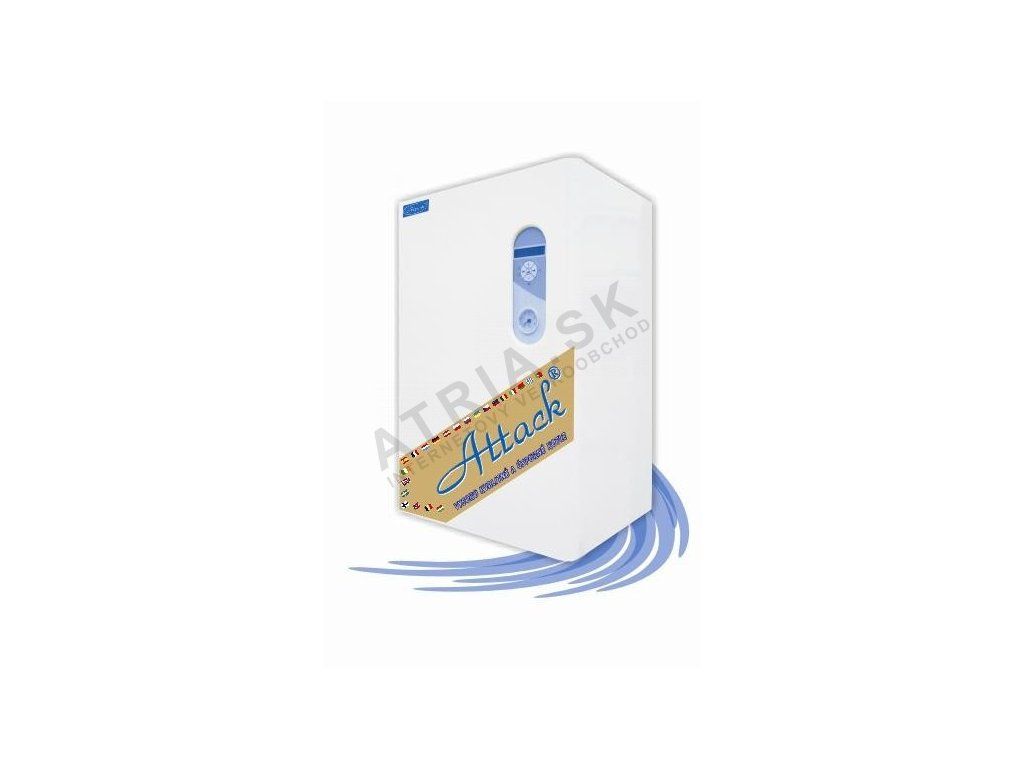
Attack Electric Excellent 8 (7.5 kW) – a compact 7.5 kW boiler with mobile app control and precise PID regulation. Suitable for cabins, smaller houses, or as a smart backup heat source. Price from €1,018.00. |
Frequently Asked Questions
Is an electric boiler worthwhile instead of a gas one?
Approximate heat loss values used in the boiler output calculation.
An electric boiler is worthwhile especially where gas is not available, where a gas connection would be expensive or slow to arrange, or as a supplementary or backup heat source. In a well-insulated house with lower heat consumption and the ability to use the HDO night rate, the difference in energy price compared with gas shrinks considerably. Where gas is readily available and heat consumption is high, a gas condensing boiler usually works out cheaper – you'll find a detailed comparison in the article Electric Boiler or Gas Condensing Boiler.What output electric boiler do I need for a family house?
As a rule of thumb, older uninsulated houses need around 100 W/m², normally insulated houses 50–70 W/m², and low-energy or passive houses only 30–40 W/m². For an exact calculation including a hot water reserve, we recommend the method in the article What Output Electric Boiler Do I Need.
Do I need HDO (dual-tariff metering) for an electric boiler?
It's not a requirement for the boiler to work, but if you have HDO or can set it up, it significantly helps reduce operating costs, especially combined with a heat storage tank. Without HDO the boiler works completely normally, just without the option of drawing on the discounted night rate. More in the article How HDO (Off-Peak Switching) Works with an Electric Boiler.
Will a standard household circuit breaker handle an electric boiler?
It depends on the boiler's output and the rating of your electrical wiring. Smaller boilers, roughly up to 8–9 kW, on a single-phase or three-phase connection are usually handled fine by a standard 3×25 A breaker; for higher outputs it's necessary to check the capacity with an electrician, or consider a model with breaker overload protection, such as the external regulator available for the Protherm Ray model.
Is installing an electric boiler complicated, and what do I need?
The boiler itself is easier to install than a gas one, since there's no chimney or flue gas discharge involved. However, the connection to the electrical grid may only be carried out by a person with professional electrotechnical qualification, and an inspection of the electrical equipment is required after installation. You should also check the capacity of the household circuit breaker in advance, and possibly the connection itself with the electricity distributor.
Can an electric boiler be combined with a heat pump or a solid-fuel boiler?
Yes, an electric boiler is commonly used as a supplementary or backup heat source alongside a heat pump or a solid-fuel boiler. It typically kicks in only during exceptional frosts, when the main source can't keep up with heat demand, or if the main source fails, so its higher operating cost only affects a small portion of annual consumption.
How long does an electric boiler last, and what does servicing involve?
With correct installation and normal maintenance, the lifespan of a quality electric boiler is usually around 15 years or more. Since there's no combustion, there's no need to clean soot from a burner or heat exchanger; servicing focuses mainly on checking the heating elements, seals, safety devices, and the electrical part, including a regular inspection.
Related Topics
- What Output Electric Boiler Do I Need
- Electric Boiler or Gas Condensing Boiler
- Comparison of Electric Boiler Brands
- How HDO (Off-Peak Switching) Works with an Electric Boiler
Have a Question About Choosing a Boiler?
Can't decide, or dealing with a specific situation in your household? Write to us – we're happy to help.