
What Output Do I Need for an Electric Boiler
What Output Do I Need for an Electric Boiler
Choosing the right output for an electric boiler is one of the most important decisions when buying one – more important than the brand or design. An undersized boiler can't keep the house at the desired temperature during frosts, runs continuously at maximum output, and the house will still be cold. An oversized boiler, on the other hand, unnecessarily burdens the electrical installation, may require a more expensive three-phase connection or stronger fuses, and in real operation it will often run at only a fraction of its output, which for some types of control means less efficient switching. The aim of this article is to show a clear, practically usable method for calculating the approximate output based on floor area and insulation, how the reasoning should change if the boiler is to serve only as a supplementary or backup heat source, and why it's essential to check the capacity of the electrical installation before buying.
Unlike a gas boiler, an electric boiler depends directly on how much electrical current it can safely draw from the household network. So choosing the output isn't just a question of comfort and savings, but also a technical and safety constraint. In the following sections we'll go step by step through an approximate calculation based on floor area, the difference between a main and a supplementary source, the question of the electrical installation, and finally two real-life calculations for specific houses of different sizes and insulation levels.
Approximate output based on floor area
Similar to gas boilers, a simple rule of thumb also applies to electric boilers: the required output can be estimated by multiplying the house's floor area by a coefficient expressing the specific heat loss per square meter. This coefficient depends mainly on the quality of insulation, but also on the age of the building, the quality of the windows, the shape of the house, the ceiling height, and the climate zone in which the house is located.
Approximate coefficient values you can generally work with:
- New build with quality insulation (low-energy or passive standard): approx. 0.04–0.05 kW/m². Minimal heat losses, quality triple-glazed windows, minimum thermal bridges.
- Averagely insulated family house (standard newer or additionally insulated building): approx. 0.06–0.08 kW/m². This is the most common category of Slovak family houses built or insulated in the last 15–20 years.
- Older, uninsulated or only partially insulated building: approx. 0.08–0.10 kW/m², in extreme cases (a brick house with no insulation at all, old wooden windows, high ceilings) even higher.
Important note: this is always only an approximate estimate meant to give you a quick first idea, not an exact calculation. The precise and binding basis for choosing a boiler's output is always a calculation of the building's heat loss (a thermal-technical assessment, or at least a simplified calculation according to the relevant standard), which takes into account the actual composition of the building envelope, the area and type of windows, the house's orientation to the cardinal points, room height, and the climate zone. However, the approximate coefficient is sufficient to know which output category your house falls into, so you don't end up buying a boiler that's half undersized or, conversely, needlessly oversized.
The following table shows an approximate estimate of the required output for three typical house sizes (60 m², 100 m² and 150 m²) at three levels of insulation:
| House area | Well-insulated new build (0.045 kW/m²) | Averagely insulated house (0.07 kW/m²) | Older uninsulated building (0.10 kW/m²) |
|---|---|---|---|
| 60 m² | approx. 2.7 kW | approx. 4.2 kW | approx. 6 kW |
| 100 m² | approx. 4.5 kW | approx. 6–8 kW | approx. 10 kW |
| 150 m² | approx. 6.75 kW | approx. 10.5–12 kW | approx. 15 kW |
| 200 m² | approx. 9 kW | approx. 14 kW | approx. 20 kW |
For a better visual idea of how the required output grows with increasing area for an averagely insulated house (coefficient 0.07 kW/m²), see the following simple bar chart:
Both the table and the chart show that for the same floor area, the required output can differ by tens of percent depending on insulation. So it's pointless to look only at the size of the house without considering which insulation category it actually falls into. If you're not sure which category your house belongs to, it's safer to lean toward the higher coefficient – most households underestimate their real heat losses, especially with older windows, an uninsulated roof, or an unheated but directly adjoining space (garage, staircase, cellar).
The simplified calculation procedure described in the previous section.
Main source vs. supplementary/backup source – a different approach to output
The calculation above applies in full when the electric boiler is meant to cover the entire heat loss of the house on its own, i.e. when it's the sole (main) heat source. The situation changes substantially, however, if the electric boiler isn't meant to be the sole heat source but only a supplementary or backup solution alongside another main source.
Typical cases where an electric boiler works as a supplementary or backup source:
- A bivalent setup with a heat pump – the heat pump covers the vast majority of the heating season, the electric boiler kicks in only during extreme frosts, when the heat pump's output and efficiency drop, or as a backup source in case of a fault or servicing of the pump.
- A fireplace or stove with a water-heating exchanger – the fireplace provides the main heating during transitional periods and under normal operation, the electric boiler tops up heating at times when no one is firing the fireplace (for example overnight or during absence).
- A cottage or recreational property with occasional use – there's no need to size it for permanent living during the coldest period, an output sufficient for a maintenance temperature and a quick warm-up before arrival is enough.
- Supplementary heating of one part of the house – for example an attic, an extension, or a room that's insufficiently heated on the main heating circuit.
In these cases it's not necessary (and often not economically sensible) to buy a boiler for the full calculated output based on area. As a rule of thumb, with good cooperation with the main source (for example a well-sized heat pump), an electric boiler at around 30–60% of the calculated total heat loss of the house is often sufficient, since the main source covers the rest. The exact ratio depends on how the main source is sized and at what bivalent point (outdoor temperature) the electric boiler is meant to switch in.
On the other hand, if the electric boiler is meant to serve as a full-fledged backup in case of a long-term outage or fault of the main source (not just to top up peaks), it's wiser to size it closer to the full calculated output, because in that case it must be able to take over heating the entire house on its own, though perhaps only for a limited time and with slightly reduced comfort (a lower set room temperature during emergency mode).
You also shouldn't forget about domestic hot water (DHW) preparation. If the electric boiler is meant to heat DHW in addition to space heating (either directly on-flow or via a storage tank), you need to add a reserve for water heating to the calculated heating output, especially if showering and filling a bathtub happen at the same time at lower outdoor temperatures in the household. For an average family, this reserve is generally in the range of a few extra kW, depending on the chosen method of DHW preparation and the size of the storage tank.
The same coefficients are used in the calculations in the text above.
Why check the electrical installation before choosing an output
An electric boiler is a designated electrical appliance and its connection must comply with applicable standards as well as the capacity of the household electrical installation. While with a gas boiler the question of fuel supply is primarily handled by the gas supplier and pipe sizing, with an electric boiler the limiting factor is directly the electrical connection, the main breaker, and the house's internal wiring.
Key points to check before buying a boiler of a specific output:
- Single-phase vs. three-phase connection. Lower outputs (typically up to roughly 6–9 kW depending on the specific model and its internal wiring of the heating elements) can be operated on a single-phase connection for some boilers, while higher outputs generally require a three-phase (3×400 V) connection, because on a single phase the current would rise to values that a standard household installation and its fuses can't handle. The exact threshold varies by manufacturer and model, so always check the specific boiler's technical datasheet.
- Size of the main breaker and the reserved capacity from the electricity distributor. Every house has a so-called reserved capacity (maximum drawable power) assigned by the distribution company, corresponding to the size of the main breaker before the electricity meter. If the current capacity is already almost fully used by existing appliances (electric cooker, water heater, heat pump, EV charger), adding a powerful electric boiler may require increasing the reserved capacity with the distributor, which is a chargeable and more time-consuming administrative process.
- Cross-section and condition of the existing cables and the fuses of individual circuits. Even if the main breaker has the capacity, the supply cable to the boiler itself and its fuse must match the output of the specific model – this assessment belongs exclusively in the hands of a qualified electrician, it's not something that can be estimated by a layperson.
- Inspection report. Connecting an electric boiler requires an inspection of the electrical installation and the appliance itself by an authorized person – without a valid inspection, the appliance may not be possible to legally and safely put into operation, and insurance coverage in the event of damage may be called into question.
Practical recommendation: before choosing a specific output and model, consult your plan with an electrician who knows the state of your electrical installation and can tell you what output can realistically be connected without major work, and whether a three-phase connection will be needed. It's pointless to pick an "ideal" output on paper based on floor area if the house's electrical installation simply can't handle that draw without costly renovation. In that case, it's worth considering either investing in strengthening the electrical installation, or an alternative solution – for example a combination with another heat source (a bivalent setup), which reduces the demand for instantaneous peak electrical power.
A related topic not to be underestimated is also the electricity tariff and rate structure – many households with electric heating use a dual tariff with night-time electricity (the so-called ripple control / off-peak tariff), which allows cheaper operation especially in combination with a storage tank. This topic is directly related to running costs, which we cover in detail in a separate article on the cost of running an electric boiler (link below in the related topics section).
Real-life example
Example 1 – an averagely insulated family house, main heating source. A family house with a floor area of 130 m², built in the 1990s, originally uninsulated, but over the years additionally insulated with an 8 cm external thermal insulation system and with replaced double-glazed plastic windows. This building can be classified as an "averagely insulated house" with a coefficient closer to the upper limit, i.e. approx. 0.08 kW/m², since the roof hasn't yet been additionally insulated and its renovation is planned only a few years from now. Calculation: 130 m² × 0.08 kW/m² = 10.4 kW. To this a small reserve for hot water preparation for a four-person household and a slight safety margin for periods of extreme frost need to be added, which brings the recommended output to approximately 12–14 kW. In this case, a suitable choice is the Protherm Ray 14KE (14 kW) model – slightly above the calculated value, which gives a reserve for the future (for example if roof insulation is delayed, or during greater-than-usual frosts) without the boiler being significantly oversized.
Example 2 – a larger, older-insulated house, main heating source. A family house with a floor area of 220 m², originally a brick building from the 1980s, additionally insulated with a 10 cm external thermal insulation system, with partially replaced windows. This combination corresponds more to the upper limit of the "averagely insulated house" category, i.e. a coefficient of approx. 0.08 kW/m². Calculation: 220 m² × 0.08 kW/m² = 17.6 kW; after rounding and a slight reserve for DHW and peak frosts, the recommended output comes out at approximately 18 kW. This value is covered almost exactly by the Protherm Ray 18KE (18 kW) model, which is sized almost ideally for a house like this – with no unnecessary reserve, but also no risk of being undersized. At this output, a three-phase connection is already fairly likely to be needed, which should be verified with an electrician before purchase.
Example 3 – a small cottage, supplementary/main source for a smaller space. A recreational cottage with a floor area of 55 m², built as a newer, well-insulated timber structure, used mainly on weekends and in the summer season, occasionally in winter. Given the quality insulation, a lower coefficient of approx. 0.05 kW/m² can be assumed, giving a calculation of 55 m² × 0.05 kW/m² = 2.75 kW. Since this is a smaller space with occasional use (there's no need to size it for continuous heating on the coldest winter days with all-day presence), and since it's useful to have a slight reserve for a faster warm-up of the space after arrival following a longer shutdown, a model with an output around 8 kW is sufficient. Here, the smaller Thermona THERM EL 8 model presents itself as a suitable choice, designed precisely for smaller spaces and providing a sufficient reserve for quick start-up heating of the cottage after arrival, while not being needlessly oversized for the size of the building.
All three examples show the same principle: the basis is an approximate calculation based on area and insulation, which is then adjusted according to the intended use (main or supplementary source), the method of DHW preparation, and the real operating conditions (permanent living vs. an occasional cottage). Only based on this adjusted figure does it make sense to choose a specific model, while also checking the possibilities of the electrical installation.
A different approach to sizing depending on the boiler's role in the system.
Recommended models by output
Below we list three specific electric boiler models from the atria.sk range, covering the various output categories described above – from smaller spaces and supplementary heating up to a main heat source for a larger family house.

|
Thermona THERM EL 8 – a compact, lower-output electric boiler, suitable for smaller apartments, cottages and recreational properties, or as a supplementary heat source for one part of a house. Thanks to its lower output, it's undemanding on the electrical installation and in many cases can even work with a single-phase connection (always check with an electrician for your specific installation). Price from €709.53. |

|
Protherm Ray 14KE – a mid output class, suitable as the main heating source for an averagely insulated family house with a floor area of roughly 130–180 m² (depending on the specific quality of insulation), or as a more powerful supplementary/backup source in a bivalent setup with another main heat source. Price from €961.00. |

|
Protherm Ray 18KE – a higher output, intended as the main heating source for larger family houses with a floor area of roughly 200–230 m², or for older, less well-insulated buildings with higher heat loss even at a smaller area. At this output, expect a higher likelihood of needing a three-phase electrical connection. Price from €1,001.73. |
|
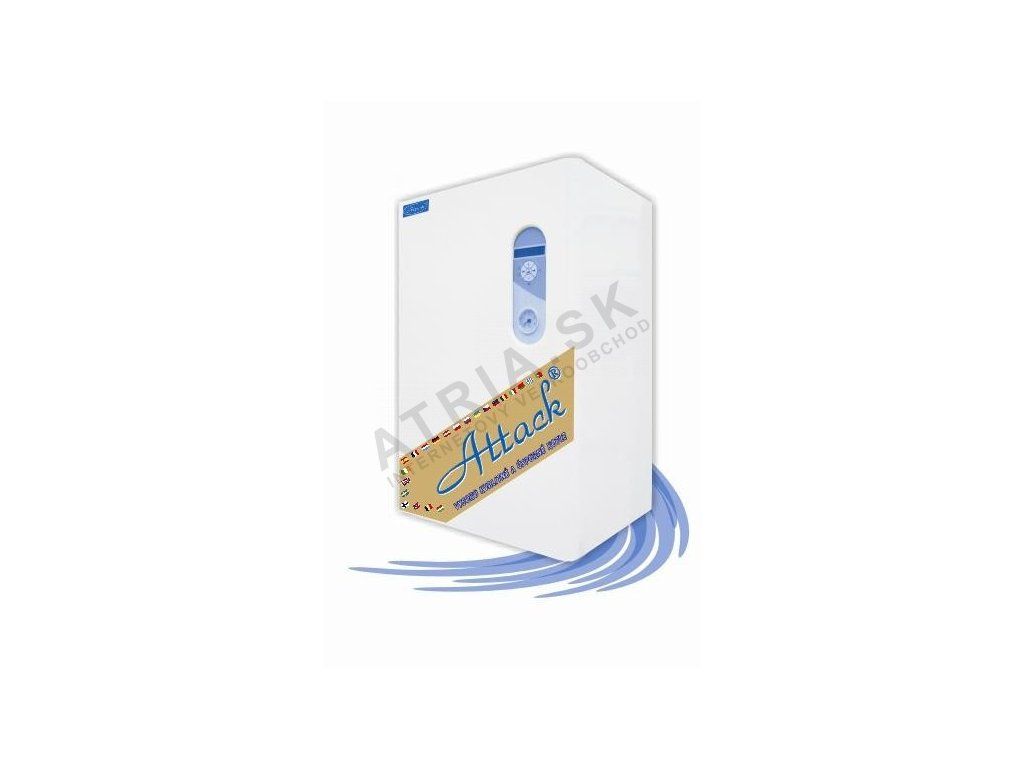
Attack Electric Excellent 8 (7.5 kW) – the opposite end of the output range from the two previous models, suitable for smaller and well-insulated spaces, cottages, or as a lower-output supplementary/backup source. Precise PID control can fine-tune the output to the current heat demand even at this lower range. Price from €1,018.00. |
If your house's calculated output falls somewhere between the output levels listed above, or if you need an output above 18 kW for a genuinely large or uninsulated building (electric boilers generally range from approximately 3–4 kW for the smallest models up to approximately 20–28 kW for the largest models intended as a main source for larger houses), we recommend consulting our sales team – we're happy to help choose a boiler tailored exactly to your house and its electrical installation, or to recommend a combination of several smaller boilers instead of one large one where that's more advantageous from an electrical-installation point of view.
Frequently Asked Questions
What output of electric boiler do I need for a 100 m² house?
For an averagely insulated house with a floor area of 100 m², the approximate output is around 6–8 kW (coefficient approx. 0.06–0.08 kW/m²). For a very well-insulated new build it can be as little as around 4.5 kW, while for an older, uninsulated building it can be as much as around 10 kW. The exact figure should always be confirmed by a heat-loss calculation for the specific building.
Can an electric boiler be undersized, and what happens if it is?
Yes, just as with other types of boilers. An undersized electric boiler runs continuously at 100% output even at normal winter temperatures and still can't maintain the desired room temperature, especially during hard frosts. This shows up as cold rooms, a slow heat-up after a shutdown, and ultimately also higher energy consumption per unit of heat produced, since the appliance runs continuously in an extreme mode.
Is it better to choose a higher output "just in case"?
Not automatically. A needlessly oversized electric boiler means a higher purchase price, greater demands on the fuses and electrical installation (in the extreme case, the need for a three-phase connection where a single-phase one would otherwise have sufficed), and in some operating modes also less smooth temperature maintenance due to frequent switching on and off at a low output stage. The right approach is to calculate the real need based on area, insulation, and intended use, and choose the closest suitable model with a reasonable, not excessive, reserve.
How does an electric boiler's output relate to the house's fuses and electrical installation?
A higher boiler output means a higher electrical current draw, which the supply cable, the fuse of that circuit, the main breaker before the electricity meter, and the reserved capacity assigned by the electricity distributor all need to handle. From a certain output threshold (varies by model, generally somewhere in the 6–9 kW range) the draw on a single-phase connection becomes too high and a three-phase (3×400 V) connection is needed. Checking with an electrician is therefore an essential step before buying a boiler of a specific output.
What output is enough if I want the electric boiler only as a backup or supplementary source?
If the electric boiler supplements another main heat source (for example a heat pump or a fireplace with a water-heating exchanger) and therefore doesn't need to cover the house's heat loss entirely on its own, an output on the order of 30–60% of the value calculated for heating the whole house independently is generally sufficient. The exact ratio depends on how the main heat source is sized and at what outdoor temperature the electric boiler is meant to start operating.
Does heating domestic hot water affect the required boiler output?
Yes. If the electric boiler is also meant to provide domestic hot water in addition to space heating, you need to add a reasonable reserve to the calculated heating output, especially if the household can be expected to draw heat for both heating and water heating simultaneously on cold days. This reserve varies depending on the chosen method of DHW preparation (on-flow or via a storage tank) and the size of the storage tank.
Three-phase or single-phase connection – when is which needed?
Lower outputs of electric boilers can, for many models, be operated on a single-phase connection, while higher outputs (generally from roughly 9–12 kW upward, the exact threshold varies by model) generally require a three-phase 3×400 V connection, because otherwise the current on a single phase would exceed safe and technically permissible values. This information can always be found in the technical datasheet of the specific model, and final confirmation should come from an electrician who knows the state of your household's electrical installation.
Can an electric boiler be replaced later with a more powerful one if the original output turns out to be insufficient?
Yes, replacing the boiler itself is technically possible, but if the new, more powerful model exceeds the capacity of the existing fuses or requires switching from a single-phase to a three-phase connection, work on the electrical installation will also be needed, and possibly an increase in the reserved capacity with the distributor. It therefore always pays off to make a thorough output calculation at the time of the first purchase, to avoid the need for such an additional investment later.
Related topics
- How to choose an electric boiler
- What breaker and electrical installation does an electric boiler need
- How much an electric boiler costs to run and how to save
- Comparison of electric boiler brands
Have a question about choosing a boiler?
Can't decide, or dealing with a specific situation in your household? Write to us – we're happy to advise.