
Comparison of stationary boiler brands
When deciding to replace an old boiler with a new stationary boiler, sooner or later you almost always end up asking: "Which brand should I buy?" That's natural – the manufacturer's name is the first thing you see in the catalogue, hear from a neighbour, or from an installer who "always fits one trusted brand." The reality of a technical choice, however, is different. The brand matters, but it should be the last criterion in the decision order – and that applies to stationary boilers exactly as we covered in detail in the article on the difference between a condensing and a classic stationary boiler.
Before you settle on a particular manufacturer, you should be clear on four things: what type of fuel and technology you need (a gas condensing boiler, or a solid-fuel boiler), what output your property actually requires, how the boiler will handle domestic hot water (DHW) preparation – a separate tank, or a compact solution with a built-in tank – and finally, what service support is available in your region. Only once you have answers to these questions does it make sense to compare specific models from specific manufacturers. A detailed guide to this whole decision process is available in the article How to choose a stationary boiler.
In this article we'll look at four brands that atria.sk offers for stationary boilers and tanks – three gas condensing brands (Protherm, Bosch, Vaillant) and one brand specialised in solid fuel (ATMOS). We'll show you where they really differ, where it makes sense to pay extra for a particular manufacturer, and when a completely different parameter than the logo on the boiler is decisive.
Protherm – a Slovak brand with the densest service network
Protherm is a brand with a specific standing on the Slovak market – it's an originally Slovak company, today part of a large international manufacturing group, which nevertheless kept its manufacturing and service base right in Slovakia. That's precisely why Protherm has long been the best-selling boiler brand on our market – it's not just a marketing status but a real consequence of the fact that almost every installer in every corner of Slovakia has experience fitting and servicing Protherm boilers, and the brand has the densest network of authorised service technicians among all the manufacturers available on atria.sk.
For stationary condensing boilers, Protherm offers the Medveď Condens range – a family of boilers that covers a wide spectrum of outputs, from smaller units suited to flats and smaller family houses up to more powerful versions for larger properties or combination with an external DHW tank. This breadth of range is one of the brand's main advantages – within one proven line you'll find almost any solution a typical household or smaller business needs, without having to combine components from different manufacturers.
In practice this means that if you choose Protherm, you can be sure you'll get spare parts and a service technician quickly and without unnecessary waiting almost anywhere in Slovakia – which, for a stationary boiler meant to serve for 15 years or more, is a very practical advantage you'll appreciate especially when the boiler breaks down in the middle of winter.

|
|
Protherm Medveď Condens 25 KKS Approximate price: €2,010.25 |
The Protherm Medveď Condens 25 KKS model is among the most popular choices for customers looking for a reliable mid-range stationary condensing boiler for a typical family house, with the option of connecting an external hot water tank sized to the household's current consumption.
Bosch – German technology and a strong technical background
Bosch is a name most customers associate primarily with power tools or the automotive industry – in reality, however, it's also one of the world's largest manufacturers of heating technology, with many years of developing and producing boilers, burners and control technology. This broad technical background of the whole group is also reflected in the boilers, which are part of a large international group also linked with the Junkers brand – historically one of the oldest European brands in heating technology.
For stationary condensing boilers, Bosch offers the Suprapur range, typical of a precise German engineering approach – an emphasis on build quality, control precision and long-term operating stability even under higher output load. The Suprapur range is particularly suited where higher output is needed – for example larger family houses, properties with greater heat loss, or combination with a more powerful DHW tank for households with higher hot water consumption.

|
|
Bosch Suprapur KBR 42 Approximate price: €2,187.00 |
An example is the Bosch Suprapur KBR 42 model – a boiler in a higher output class, intended for properties with greater heat loss or for operations that need a stable, powerful heat source backed by the strong technical background of the whole Bosch group.
Vaillant – compact solutions with a built-in tank
Vaillant is a German manufacturer with one of the longest histories in heating technology in Europe – the company has been dedicated to heating technology since the late 19th century and is among the founders of modern gas technology on the continent. This long history is also reflected in the breadth and sophistication of its current portfolio, which covers everything from small wall-hung boilers to large cascade solutions for commercial properties.
For stationary boilers, a specific and very popular choice is the ecoCOMPACT range – compact stationary boilers with a DHW tank built directly into the boiler body. While with Protherm and Bosch the usual solution is "boiler + separate external tank" as two components connected by pipework, ecoCOMPACT resolves both components in one compact unit. The main advantage is saving space in the boiler room – something you'll especially appreciate in smaller plant rooms, where every square metre counts – and also simpler installation, since there's no need to connect two separate devices.

|
|
Vaillant VSC 206/4-5 90 ecoCOMPACT Approximate price: €3,658.66 |
The Vaillant VSC 206/4-5 90 ecoCOMPACT model is a typical representative of this concept – a condensing boiler with a built-in 90-litre hot water tank in one compact body, complemented by the modern multiMatic control system. The higher purchase price compared to a classic boiler + separate tank combination is offset here by space savings and simpler installation – a typical example of how price alone says nothing without the context of exactly what the boiler contains and solves.
ATMOS – a specialist in solid fuel and gasification boilers
ATMOS is a completely different category compared to the previous three brands – it's not a gas condensing boiler, but a manufacturer specialised in solid-fuel boilers: wood, coal and above all so-called gasification (wood-gas) boilers. This technology works on a completely different principle than gas condensation – wood is first gasified in the combustion chamber at high temperature, and the resulting wood gas then burns in a separate combustion chamber with a secondary air supply. The result is significantly higher combustion efficiency and lower emissions compared to classic older-type solid-fuel boilers.
ATMOS boilers are the first choice where a gas connection isn't available – typically in cottage areas, in the countryside, or for properties with their own source of wood. An important feature of this technology is that solid-fuel gasification boilers work most efficiently in combination with an accumulation tank (heat store) – during a single firing, the boiler burns fuel at high output and the heat is stored in the accumulation tank, from where it's gradually drawn into the heating system even during hours when the boiler isn't firing. We cover this topic in detail in a separate article, Solid-fuel boiler and accumulation tank – how they work together, which we recommend reading before buying, since without a correctly sized accumulation tank the boiler won't achieve its declared efficiency or operating comfort.
|
|
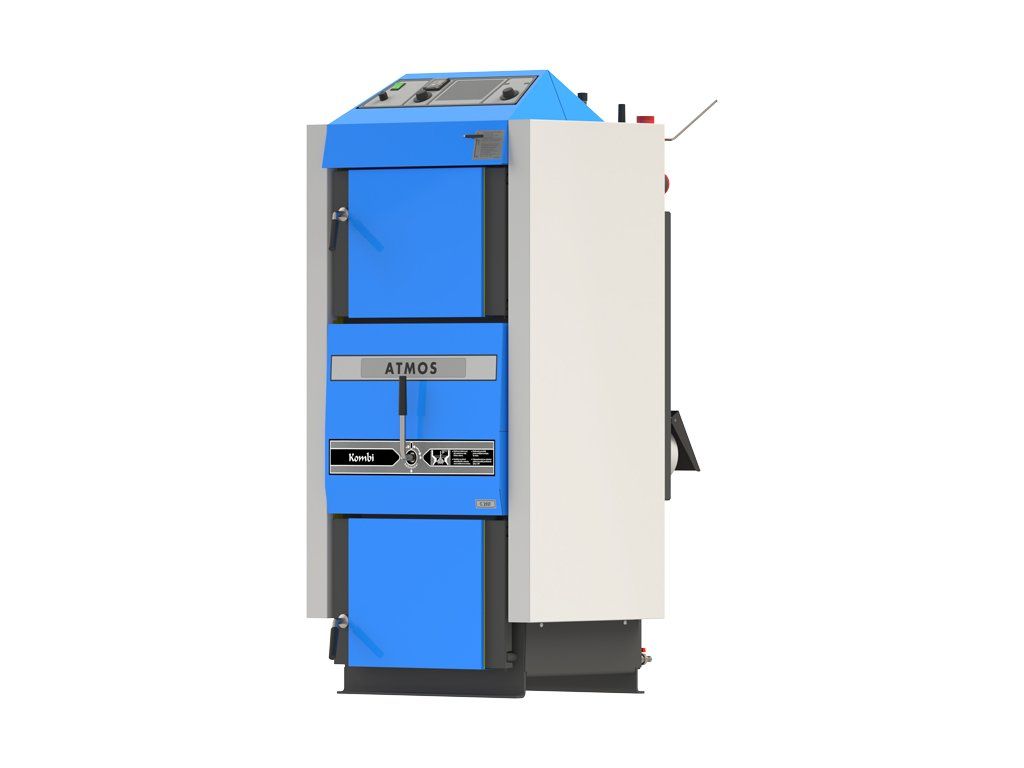
ATMOS C 25 ST Approximate price: €3,281.68 |
The ATMOS C 25 ST model is a mid-range wood gasification boiler, suitable for a typical family house or cottage with its own source of firewood – combined with a correctly sized accumulation tank it can provide heating comfort comparable to a gas boiler, at significantly lower fuel operating costs.
Brand comparison table
The following table summarises the main differences between all four brands in one place:
| Brand | Country of origin / group | Technology type | Approximate price | Main advantage |
|---|---|---|---|---|
| Protherm | Slovakia, part of an international group | Gas condensing, Medveď Condens range | from approx. €2,000 | Densest service network in Slovakia |
| Bosch | Germany, international group (linked with Junkers) | Gas condensing, Suprapur range | from approx. €2,100 | Strong technical background, suited to higher output |
| Vaillant | Germany | Gas condensing, ecoCOMPACT range (with built-in tank) | from approx. €3,600 | Compact all-in-one solution, space saving |
| ATMOS | Solid-fuel boiler manufacturer | Solid fuel – wood, coal, gasification boilers | from approx. €3,000 | Independence from a gas connection, low fuel costs |
The prices shown are approximate and relate to the specific models mentioned in this article – the actual price varies according to output, additional features and tank type. Note that price differences between brands (Protherm and Bosch in a similar output class, Vaillant priced higher due to the built-in tank) often stem more from the specific boiler configuration than from the brand itself.
How to decide – selection criteria in the right order
Summarising the previous sections, choosing a stationary boiler should follow this order:
1. Fuel type. Do you have a gas connection available? Then your choice narrows to Protherm, Bosch or Vaillant. If gas isn't available, or you have cheap access to firewood and want to lower operating costs, ATMOS and solid-fuel technology come into consideration. This decision practically instantly eliminates half the range and narrows your choice considerably – more detail in the article Condensing vs. classic stationary boiler.
2. Output for the property's needs. The boiler's output should be based on the building's heat loss (insulation, size, number of rooms) and on hot water demand (number of people in the household, number of bathrooms). An undersized boiler won't keep up on freezing days, while an oversized one will be needlessly expensive and will cycle more often, shortening its lifespan. You'll find the exact output calculation procedure in the article How to choose a stationary boiler.
3. DHW preparation solution. Do you want a separate external tank (more flexible, with the option of later replacement/enlargement), or do you prefer a compact all-in-one solution like Vaillant ecoCOMPACT (space saving, simpler installation)? This is purely a question of the boiler room's spatial options and personal preference, not of boiler quality.
4. Service network in your region. Before deciding, check with a local installer which brand they have the most experience with and how quickly a service technician for that brand is available in your district. For Protherm this question is almost always trouble-free thanks to the densest network in Slovakia; for other brands, service availability can vary regionally.
5. Price and budget. Only at the very end of ranking the criteria should you compare the prices of specific models that meet your requirements from points 1 to 4. The brand alone shouldn't be a reason to exceed your budget or compromise on output.
Real-world examples
Example situation 1 – a family house with a gas connection and higher hot water consumption. Imagine a four-member family in an older family house with a gas connection, where an end-of-life stationary boiler needs replacing. The house has two bathrooms, and the family is used to higher hot water consumption in the morning, when everyone is getting ready for work and school. The boiler room is a fairly small space in the basement, without much room for a separate large tank. In this case it makes sense to consider a compact solution such as Vaillant ecoCOMPACT with a built-in tank – this saves space in the boiler room, and installation is simpler since there's no need to connect two separate devices. If, on the other hand, the boiler room were more spacious and the family wanted a lower upfront investment with the option of later replacing just the tank without touching the boiler, a more rational choice would be a Protherm Medveď Condens or Bosch Suprapur combined with a separate external tank of the chosen size.
Example situation 2 – a cottage in a foothill area without a gas connection. Another example is the owner of a holiday cottage in a foothill area, where no gas pipeline runs and the nearest connection would require an expensive network extension. The owner also has access to their own firewood from the surrounding forest and uses the cottage regularly on weekends and for longer periods in winter. In this case a gas condensing boiler is ruled out by itself due to the missing connection, and the only realistic choice remains a solid-fuel boiler – specifically a gasification boiler such as the ATMOS C 25 ST. For the boiler to work efficiently and not require constant reloading of wood, it needs to be supplemented with an appropriately sized accumulation tank – the boiler then burns wood at optimal output during a single firing, and the heat is gradually released into the heating system even when the cottage owner isn't there to reload it. This principle is explained in detail in the article on combining a solid-fuel boiler and an accumulation tank.
Both examples show the same thing – the brand decision came up only at the very end, after the property's conditions were clear (gas availability, boiler room space, how it's used).
Frequently asked questions (FAQ)
Which stationary boiler brand is the most reliable?
All four brands covered in this article – Protherm, Bosch, Vaillant and ATMOS – are established manufacturers with a long history and proven reliability when correctly installed and regularly serviced. In practice, a specific boiler's reliability is influenced more by installation quality, correct output sizing and regular maintenance than by the brand itself. We always recommend entrusting installation and servicing to a qualified technician – more in the article Service, maintenance and lifespan of a stationary boiler.
Is Protherm really the best choice just because it's a Slovak brand?
Slovak origin and the densest service network are a real advantage, especially in terms of service speed and spare parts availability. However, this doesn't automatically mean Protherm is the technically best choice for every situation – for example, if you need a compact solution with a built-in tank, another brand may be more suitable. Service availability should be one of the criteria in your decision, not the only one.
Is it worth paying extra for a compact boiler with a built-in tank, like the Vaillant ecoCOMPACT?
It depends on the space you have available in the boiler room. If the boiler room is small, or you want simpler installation without connecting two separate devices, the extra cost for a compact solution is worth it. If you have enough space in the boiler room and want a lower upfront investment with the option of later replacing or resizing the tank independently of the boiler, the classic boiler-plus-separate-tank combination usually works out cheaper.
What's the difference between the Bosch Suprapur and an ordinary condensing boiler from another brand?
The Bosch Suprapur is a gas condensing boiler built on the same physical condensation principle as the Protherm Medveď Condens or Vaillant ecoCOMPACT – that is, using condensation heat from flue gases for higher efficiency. Differences between specific manufacturers' ranges lie primarily in build quality, control technology, available output ranges and price, not in the operating principle itself.
Can I use an ATMOS solid-fuel boiler in a new-build with low heat demand?
Yes, but you need to carefully match the boiler's output to the new-build's current low heat loss, and we almost always recommend combining it with an appropriately sized accumulation tank, which lets the boiler work in an efficient output range even with the house's low overall consumption. Without an accumulation tank, the boiler would have to cycle frequently at low output, which reduces both efficiency and lifespan.
How long does a stationary boiler last, and does lifespan differ by brand?
With correct installation, sizing and regular annual servicing, the typical lifespan of a stationary gas condensing boiler is 15 to 20 years; for solid-fuel boilers it's similar, or even longer with good water quality in the heating system and gentle operation. Lifespan differences between the brands in this article aren't significant – the more decisive factors are the water quality in the system, servicing regularity, and whether the boiler was correctly sized from the start. More in the article Service, maintenance and lifespan of a stationary boiler.
Does the choice of brand affect the ability to connect to an existing chimney or flue?
Not directly by brand, but by boiler type. Gas condensing boilers (Protherm, Bosch, Vaillant) generally require flue gas discharge via a special plastic or stainless-steel chimney system resistant to condensate, while solid-fuel boilers like ATMOS need a traditional masonry or stainless-steel chimney sized for higher flue gas temperatures. This question should always be resolved with a designer or chimney inspection technician before purchasing a specific model, regardless of manufacturer.
Related topics
- How to choose a stationary boiler – a complete guide to choosing output, type and configuration
- Condensing vs. classic stationary boiler – differences in technology and efficiency
- Solid-fuel boiler and accumulation tank – how they work together – important for anyone interested in ATMOS and similar boilers
- Service, maintenance and lifespan of a stationary boiler – how to extend a boiler's lifespan regardless of brand
- Frequently asked questions about stationary boilers and tanks – more practical customer questions
Have a question about a stationary boiler or tank?
Can't decide, or dealing with a specific situation in your household? Write to us – we're happy to help.