
Servicing, Maintenance and Lifespan of a Floor-Standing Boiler
While choosing a floor-standing boiler determines how well and economically your heating will run in its first season, whether that same boiler reliably lasts 15, 18 or even 20 years depends on something completely different – regular servicing and the owner's ongoing, routine care. A floor-standing boiler, whether it is a gas condensing unit, a classic gas unit, or a solid-fuel boiler, is a machine with a combustion process, a heat exchanger, a circulation pump, safety components and a series of seals that naturally wear out during operation. Neglected maintenance usually does not show up right away – the boiler runs seemingly without problems for several seasons, but in the background deposits, corrosion and mechanical wear accumulate, which eventually take their revenge with a breakdown at the most inconvenient time, usually in the middle of winter. In this article we look at exactly what an annual service inspection of a gas boiler and a solid-fuel boiler includes, what the owner can and should check on their own between visits, what the real lifespan of floor-standing boilers is and what shortens it the most, and finally when it still pays to invest in repairing an older boiler and when it is more sensible to consider replacement.
Why regular servicing is essential
An annual service inspection is not a formality invented by manufacturers to sell more spare parts. It has three quite concrete, interrelated reasons – warranty, safety and running economy.
Warranty. Practically all floor-standing boiler manufacturers tie the validity of the warranty to compliance with prescribed service intervals and to the servicing being carried out by an authorised person or a contracted service partner. If the boiler breaks down in its third or fifth year of operation and the owner cannot prove a service history (service booklet, invoices, a record of the inspection performed), the manufacturer may reject the claim even if the fault is not directly related to the missing service. In other words – a skipped service inspection can in practice mean that even an otherwise valid claim for a component worth hundreds of euros ends up being paid by the owner.
Safety. With gas boilers, this is a device that burns flammable gas and produces combustion products including carbon monoxide (CO). A corroded or leaking heat exchanger, a damaged seal on the flue gas path, or incorrectly set combustion can cause flue gases to leak into the boiler room – in an enclosed space this is a potentially life-threatening situation. That is exactly why flue gas measurement and a check of joint tightness are part of every annual inspection. With solid-fuel boilers, the risk factor tends to be a blocked chimney, excessive soot deposits (risk of a chimney fire), or a leaking firebox door.
Running economy. A fouled heat exchanger, a dirty burner or badly set combustion reduce the boiler's efficiency – the same amount of heat is produced at the cost of higher fuel consumption. With a gas condensing boiler, fouling of the exchanger also shows up as a drop in the condensing effect – precisely the feature people buy condensing technology for. A regularly serviced boiler therefore saves money in practice even without the owner noticing directly – it simply uses less gas or wood/coal than a neglected unit would.
What an annual service inspection of a gas boiler includes
The scope of the service inspection varies slightly between manufacturers, but the core of the tasks is practically the same for most gas floor-standing boilers (both condensing and classic). A typical annual inspection includes:
- Checking and cleaning the burner – removing deposits, checking flame uniformity and correct ignition.
- Checking the heat exchanger – a visual and functional check, for condensing boilers including the condensing part of the exchanger, where deposits from condensate can form.
- Checking seals and joints on both the gas and flue gas path – any leak of gas or flue gases is a safety risk.
- Checking the pressure in the expansion vessel and in the whole heating system – an undercharged or undersized expansion vessel is one of the most common causes of a drop in system water pressure between services.
- Functional check of safety components – the safety valve, pressure and flow switches, or other safety elements depending on the specific model.
- Flue gas measurement – CO, CO2 content and flue gas temperature, based on which the service technician may fine-tune the combustion process.
After completing the inspection, the service technician should issue a record (a service sheet, or an entry directly in the boiler's service booklet) with the date, a list of the tasks performed and the measured values. This document is exactly what the manufacturer or seller will require for any warranty claim – it is worth archiving together with the proof of purchase of the boiler for the whole of its operating life, ideally also scanned in electronic form as a backup.
An example of a boiler for which the scope of the annual inspection is exactly this "standard" type of service for gas condensing technology is the Protherm Medveď Condens 25 KKS – a floor-standing condensing boiler with an integrated tank, where besides the boiler body itself the service also checks the condition of the tank part and its anode.

Price: €2,010.25
View product →
A similar scope of regular inspection applies to classic (non-condensing) gas boilers and to larger output ranges intended for apartment buildings or commercial premises, such as the Bosch Suprapur KBR 42 – here the service often also includes checking the cascade arrangement, if the boiler is part of a multi-source set-up.
What servicing a solid-fuel boiler includes – different requirements
A solid-fuel boiler (wood, wood briquettes, coal, or a combined source) is more demanding to maintain than gas technology, for a simple reason – burning solid fuel produces a far greater amount of solid combustion products (soot, ash, and with lower-quality or damp fuel also tar), which continuously settle in the exchanger and along the flue gas paths. Servicing such a boiler therefore includes, besides the usual points (checking seals, functional check of safety components, checking system pressure), tasks that simply do not apply to gas technology:
- Cleaning the exchanger and flue gas paths of soot and ash – a fouled exchanger loses efficiency significantly, because the layer of soot acts as a thermal insulator between the flue gases and the heating water.
- Checking the seal of the firebox door and ash pan – a leaking door causes an uncontrolled supply of air into the combustion chamber, which worsens combustion control and increases fuel consumption.
- Checking the chimney draught – insufficient or, conversely, excessive chimney draught affects combustion quality and can cause the boiler room to fill with smoke when loading fuel.
- Checking the condition of the lining (on boilers that have one) – the firebrick lining of the combustion chamber can crack or wear over time and needs to be renewed during the boiler's lifespan.
For solid-fuel boilers it is also recommended to clean the exchanger not just once a year during the comprehensive service, but continuously through the season – the frequency depends on the intensity of heating and the quality of the fuel. An owner who burns mainly quality, well-dried wood will need to clean far less often than one who loads damp or poor-quality fuel.
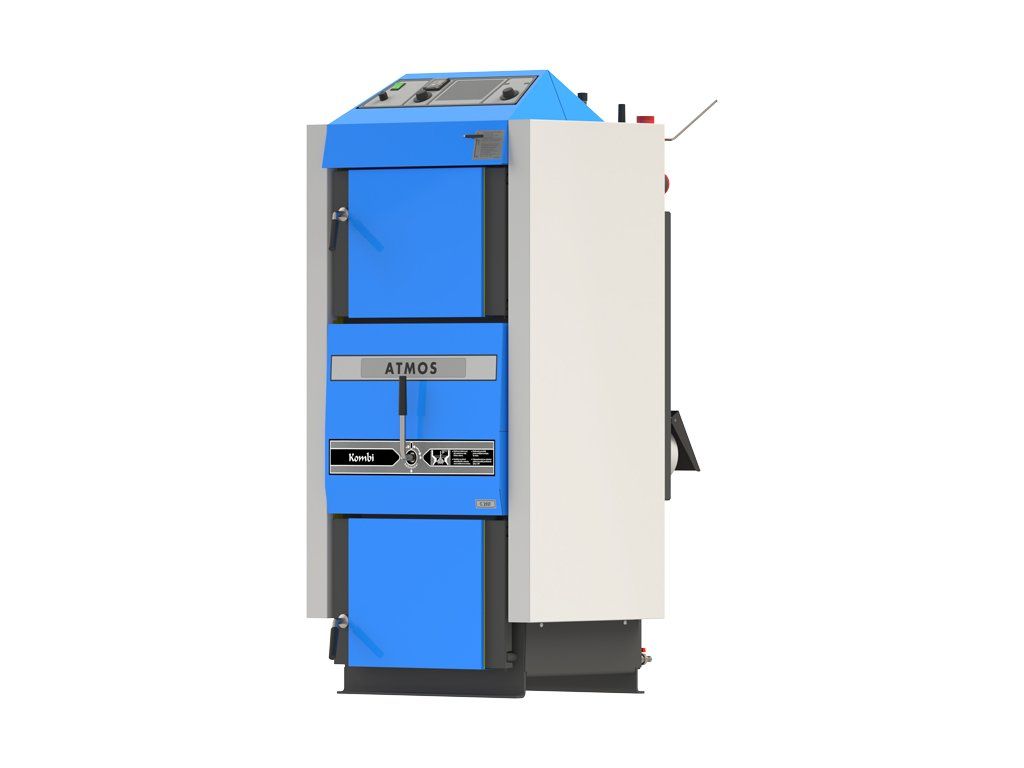
An example of modern solid-fuel floor-standing technology is the ATMOS C 25 ST – a boiler for which regular removal of soot from the exchanger and checking the door seal are key prerequisites for maintaining its declared output and lifespan throughout the whole heating season.
Price: €3,281.68
View product →
The difference in handling and servicing requirements between gas technology and solid fuel is one of the factors worth considering already when choosing – more on this in the article Condensing vs. classic floor-standing boiler and in the comparison Solid-fuel boiler and buffer tank – how they work together.
What you can do yourself between services
An annual service by a technician is irreplaceable, but between two inspections the owner can carry out a few simple tasks themselves that help catch a problem before it develops into a more serious fault. None of them require professional training or intervention inside the boiler.
- Ongoing check of the heating system pressure. On the boiler's display or pressure gauge, the pressure should stay within the range recommended by the manufacturer (generally around 1–2 bar, the exact value should be checked in the manual for the specific model). A slow, repeated drop in pressure between top-ups signals a leak in the system or a problem with the expansion vessel – both are worth addressing before air bubbles appear in the system and the pump becomes noisy.
- Visual check of the boiler's surroundings. Signs of moisture or rust under the boiler, on the piping, or under the safety valve can indicate an emerging leak. The sooner it is spotted, the cheaper the repair usually is.
- Listening to operating sounds. Bubbling, whistling or unusual knocking during operation (especially shortly after heating switches on) often signals air in the system, deposits in the exchanger, or a problem with the circulation pump. A healthy boiler runs quietly and smoothly.
- Checking the flame colour (where visually accessible through an inspection window) – on gas boilers the flame should be blue and even. A yellow, irregular or "lazy" flame is a sign of incomplete combustion and a reason for an earlier visit from a service technician, not just for the next annual inspection.
- On solid-fuel boilers, ongoing removal of ash from the ash pan and a visual check of the amount of soot in the exchanger (on models with an accessible cleaning opening) between individual service visits.
None of these checks replace professional servicing – their purpose is only to catch a signal in time that something is not right, rather than waiting to deal with it until the next scheduled inspection months later.
Typical lifespan and what shortens it the most
For gas boilers (both condensing and classic), with regular servicing and normal operation a lifespan of approximately 15 to 20 years is commonly quoted, and often more with quality manufacturers and consistent, regular servicing. This is an indicative range, not a fixed limit – a specific boiler may reach the end of its service life sooner or later, depending on the quality of the heating water, system sizing and intensity of operation.
Solid-fuel boilers, with quality manufacturing and regular maintenance (cleaning the exchanger of soot, ongoing checking of seals), also have the potential for a long lifespan, but they are more mechanically and thermally stressed – repeated fuel loading, high temperatures during intense combustion and larger temperature swings inside the combustion chamber place greater demands on the exchanger material than the steady operation of a gas burner.
Experience repeatedly confirms several factors that shorten a floor-standing boiler's lifespan the most:
- Neglected regular servicing. This is by far the most common cause of premature failure – without an annual inspection, small deviations (slight fouling, a slight drop in pressure, an emerging leak) build up and show up all at once, usually as a bigger and more expensive fault.
- Contaminated heating water without a filter or a dirt separator. Deposits (sludge, limescale, corrosion products) settle in the exchanger over the years and reduce heat transfer, which puts strain on the boiler and shortens the life of its most expensive component. A dirt filter or separator fitted on the return pipe is a relatively cheap investment that significantly prevents this.
- Incorrect boiler sizing. An oversized boiler often starts and stops (so-called cycling) instead of running smoothly at partial output – frequent starts and stops put far more strain on the burner, ignition and other components than long, smooth operation.
- Poor-quality or damp fuel in solid-fuel boilers – leads to higher tar and soot formation, faster fouling of the exchanger and more intense corrosion of the flue gas paths.
The common denominator of all these factors is that they are things the owner can mostly influence – by choosing a quality installation, adding a dirt filter, correct sizing when replacing, and disciplined adherence to service intervals. That is exactly why it can be said that a boiler's real lifespan is largely in the hands of the person operating it, not just a matter of chance or the quality of a particular unit.
When it pays to repair and when to replace an older boiler
The question of "repair or replace" typically comes up somewhere between the tenth and fifteenth year of operation, when faults start to multiply or when the service technician reports a more serious problem (for example on the exchanger). A few indicative guidelines that help with the decision:
- The boiler's age relative to its expected lifespan. Repairing a ten-year-old boiler that still has genuine years of operation ahead of it makes more sense than repairing a seventeen-year-old boiler at the edge of its typical lifespan.
- Repair cost relative to the price of a new boiler. A common rule of thumb is a threshold of roughly half the price of a comparable new boiler – if the repair (for example replacing the exchanger or the electronics) approaches or exceeds this threshold, it is worth considering whether it would be more sensible to invest the same money in a new unit with a full warranty.
- Availability of spare parts. For older models that the manufacturer no longer offers, it can happen that a specific part is unavailable or only after a long wait – this alone can tip the decision towards replacement.
- Efficiency trends. An older classic (non-condensing) boiler typically has significantly lower efficiency than current condensing technology. So with replacement, fixing the fault is combined with savings on running costs, which partly or fully offsets the investment in the new unit within a few seasons.
- Recurring faults. A boiler that suffers fault after fault within one or two seasons, even if each is individually cheap to repair, usually signals overall wear of the unit – the sum of repair costs and the loss of peace of mind from unpredictable operation often outweighs the benefit of "it still works".
When deciding on replacement, it is also worth considering whether the original boiler sizing even matched the building's actual needs (for example after subsequent thermal insulation) and what requirements the new generation of technology has for the boiler room – more on this topic in the article What requirements does a boiler room have for a floor-standing boiler.
Real-world examples
Example 1 – a neglected dirt filter. The owner of a family house with an almost thirteen-year-old classic gas boiler noticed for several seasons in a row that the boiler was "somehow banging more" in spring and that the heating season required a slightly higher set temperature than in previous years. During the annual service, the technician found significant fouling of the exchanger with deposits from the heating water – the system had never had a dirt filter or separator fitted, even though this is a fairly common, cheap add-on component of the installation. Chemically flushing the circuit and additionally fitting a filter solved the problem and the boiler's efficiency returned almost to its original level – but the neglected prevention cost the owner several extra seasons of needlessly higher gas consumption, which in total probably added up to many times the price of the filter itself.
Example 2 – deciding between repair and replacement. On a seventeen-year-old solid-fuel boiler, the service technician reported emerging corrosion on part of the exchanger during a routine annual inspection and recommended replacing it. The price of a replacement exchanger together with labour approached half the price of a comparable new solid-fuel boiler – and on top of that, the new generation of boilers in that output range offered noticeably higher combustion efficiency and simpler control. The owner ultimately decided on replacement rather than repair: they got a unit with a full new warranty, without the uncertainty of how much longer the rest of the original boiler would last, and with lower fuel consumption in future seasons. The boiler's age of seventeen years, the repair cost approaching half the price of a new unit, and the noticeable difference in efficiency were, in this case, three matching reasons for replacement rather than repair.
Both examples show the same principle – the decision between repair and replacement, and the length of a boiler's lifespan itself, almost always in practice depends on a combination of several factors (age, extent of the fault, water quality in the system, repair cost versus the price of a new boiler), not on a single isolated number.
Recommended products when replacing a floor-standing boiler
If a service inspection or recurring faults suggest that it is worth considering replacement rather than another repair, it is worth looking at the current range of floor-standing technology. Below are three models with a different focus – a compact gas condensing boiler with a tank, a more powerful gas boiler for larger buildings, and a modern solid-fuel boiler:
Gas condensing boiler with tank – €2,010.25
View product →

More powerful gas condensing boiler – €2,187.00
View product →
Solid-fuel boiler – €3,281.68
View product →
When choosing a specific model, it is also worth basing the decision on a more detailed comparison of output ranges and brands – you will find an overview in the article Comparison of floor-standing boiler brands, and if you are still choosing the type of unit, the introductory guide How to choose a floor-standing boiler will help.
Frequently Asked Questions (FAQ)
How often does a floor-standing boiler need servicing?
Standardly once a year, ideally before the start of the heating season. For solid-fuel boilers, ongoing cleaning of the exchanger and flue gas paths of soot and ash is also recommended during the season, depending on the intensity of heating and the quality of the fuel used.
What happens if I skip the annual service inspection?
Besides the risk of a gradual drop in efficiency and higher fuel consumption, above all there is a risk of losing the warranty – most manufacturers tie the validity of the warranty to a documented, regular service history. When claiming a fault without a service record, the manufacturer may then refuse to cover the repair, even if the fault is not directly related to the missed inspection.
What is the real lifespan of a gas condensing boiler?
With regular servicing and normal operation, 15 to 20 years is commonly quoted, and more with quality manufacturers and consistent care. This is an indicative range – the specific length depends on the quality of the heating water, system sizing and intensity of operation.
Is the lifespan of a solid-fuel boiler shorter than that of a gas boiler?
With quality manufacturing and regular maintenance, the lifespan can be comparable, but solid-fuel boilers are more mechanically and thermally stressed (repeated fuel loading, high temperatures during intense combustion), so they place greater demands on the thoroughness of maintenance – especially on regular cleaning of the exchanger of soot and checking the seals.
Why is it worth fitting a dirt filter or separator in the heating system?
Contaminated heating water without a filter or separator gradually deposits sludge and corrosion products in the boiler's exchanger, reducing its efficiency and shortening its lifespan. A filter or separator is a relatively cheap investment that significantly prevents this wear.
When does it pay to replace rather than repair an older boiler?
Roughly when the repair cost reaches about half the price of a comparable new boiler, when the boiler is already close to the upper limit of its typical lifespan (15–20 years), when faults recur, or when spare parts are hard to obtain. In such a case it is also worth taking into account the higher efficiency of current technology, which partly offsets the cost of replacement.
Do I have to use an authorised service centre for a specific brand?
To keep the warranty valid, the service generally needs to be carried out by an authorised person or the manufacturer's contracted service partner – the exact conditions vary by brand and specific model, so it is worth checking them in the boiler's warranty terms.
What should I do if I notice a drop in system pressure between services?
A one-off, slight top-up of water is normal, but a repeated, regular drop in pressure signals a leak in the system or a problem with the expansion vessel. In that case it is worth contacting a service technician before the problem shows up as a noisy pump or air in the system.
Related topics
- How to choose a floor-standing boiler
- Condensing vs. classic floor-standing boiler
- Solid-fuel boiler and buffer tank – how they work together
- What requirements does a boiler room have for a floor-standing boiler
- Comparison of floor-standing boiler brands
Do you have a question about a floor-standing boiler or tank?
Can't decide, or dealing with a specific situation in your home? Write to us – we're happy to help.