
How to Choose a Floor-Standing Boiler
A floor-standing boiler is the type of boiler that stands directly on the ground or on the boiler-room floor – unlike a wall-hung boiler, which hangs on the wall as a compact cabinet. This seemingly simple design distinction matters a great deal in practice: the base-mounted design makes it possible to build a far more robust heat exchanger, a larger combustion chamber and room for a built-in hot water cylinder, which is why floor-standing boilers are commonly produced in an output range from roughly 20 kW up to 90 kW and more. So if you are looking for a heat source for a larger family house, an apartment building, a business, a workshop or any property with higher demand for heat or hot water, a floor-standing boiler is usually the more natural choice than a wall-hung model. A floor-standing boiler is also worth considering when renovating a house that already has a separate boiler room – in such a space a base-mounted boiler can "settle in" naturally, without having to worry about wall load-bearing capacity or aesthetics in a living area.
This article serves as the main hub for choosing a floor-standing boiler. We summarise all the key decisions you will have to make before buying – condensing or conventional type, gas or solid fuel, what output to choose, whether you want a hot water cylinder built directly into the boiler or a separate one, and finally what demands the chosen boiler will place on your boiler room. For each topic you will find a brief summary and a link to a more detailed standalone article where we cover the question in depth. If you are also undecided between a floor-standing and a wall-hung design, we recommend starting with the article Floor-standing vs. wall-hung boiler – what's the difference, which compares the two types side by side.
Condensing or conventional floor-standing boiler?
The first major decision when choosing a floor-standing gas boiler is the combustion technology. Condensing boilers also make use of the heat contained in the water vapour of the flue gases, which a conventional boiler simply releases out through the chimney – thanks to this they reach efficiencies of up to around 98 %. In practice this means noticeably lower gas consumption at the same output, a faster payback on the higher purchase price, and today also a legislative preference (new installations are predominantly carried out as condensing systems). One example is the Protherm Medveď Condens 25 KKS model, a floor-standing condensing boiler with an output of 25 kW, which is among the most popular choices for an ordinary family house.
Conventional (non-condensing, low-temperature) boilers have a simpler design, a lower purchase price and have historically enjoyed great popularity especially at higher outputs, where until recently condensing technology was used less often. Their efficiency typically ranges between 84 – 90 %, which is noticeably less than a condensing solution, and in operation the higher fuel consumption means higher annual heating costs. Even so, conventional boilers have their place – for example where simplicity or a lower initial investment matters, or where technical conditions (such as a chimney with no option to drain condensate) complicate a condensing solution. Since this is one of the most important questions when choosing, we devote a separate detailed article to it, Condensing vs. conventional floor-standing boiler, where you will also find specific operating cost calculations and recommendations by property type.
Gas, or solid fuel?
The floor-standing design is not the exclusive domain of gas boilers. On the market you will also find floor-standing solid fuel boilers – wood, coal or wood gasification (so-called wood gas boilers). These are almost always recommended to be combined with a buffer tank (a store of heating water), which evens out the uneven course of solid fuel combustion – the boiler burns at full power, the heat is "pumped" into the buffer tank and the system then gradually releases it to the house according to current demand, instead of the boiler having to be continuously damped down to a low output (which shortens its service life and worsens combustion). A typical representative is the ATMOS C 25 ST, a floor-standing solid fuel boiler (coal/wood) with an output of 25 kW, which in practice is most often installed precisely in combination with an appropriately sized buffer tank.
The choice between gas and solid fuel usually depends on the availability of a gas connection, the price and availability of wood or coal in your region, but also on the level of convenience you expect from heating – a gas condensing boiler works fully automatically, whereas a solid fuel boiler requires regular refuelling and care (unless it is an automatic pellet boiler, which is a separate category). A complete guide to choosing the size of the buffer tank and how the whole system works in practice can be found in the article Solid fuel boiler and buffer tank – how they work together.
How to determine the correct boiler output
The output of a floor-standing boiler should be based primarily on the heat loss of the property (which depends on floor area, insulation, window size, climate zone and other factors) and on hot water demand, if the boiler is also going to supply it via a cylinder. Put simply: an oversized boiler switches on and off unnecessarily often (so-called cycling), which reduces its service life and efficiency, whereas an undersized boiler cannot keep up with heating on the coldest days and cannot heat a larger hot water cylinder quickly enough for a larger family. That is exactly why more powerful models are recommended for larger households, businesses or properties with higher hot water demand, such as the Bosch Suprapur KBR 42 – a floor-standing condensing boiler with an output of 42 kW, which will cover even more demanding properties with higher heat loss or a greater hot water flow rate.
The exact output calculation is individual to every property and involves more variables than can be summarised in a few sentences – that is why we have devoted a separate detailed guide to this topic, What output floor-standing boiler do I need, where you will find indicative tables by house floor area and insulation level as well as practical advice on avoiding the most common mistakes when estimating output. In general, however, it is better to consult a heating engineer or have a thermal calculation prepared than to "guess" the output by eye – incorrect sizing is one of the most common mistakes when replacing a heat source.
Built-in or external hot water cylinder?
Another important question is the preparation of domestic hot water (DHW). Floor-standing boilers offer greater flexibility in this respect than wall-hung models, because their dimensions allow for several solutions:
- Compact boilers with a built-in DHW cylinder – the cylinder is integrated directly into the body of the boiler, which saves a significant amount of space in the boiler room and simplifies installation (there is no need for separate connecting pipework and the mounting of another unit). One example is the Vaillant VSC 206/4-5 90 ecoCOMPACT + multiMATIC 700, a compact condensing boiler with a built-in 90-litre hot water cylinder – the ideal solution where boiler room space is limited yet solid hot water comfort is still needed for the household.
- Boiler with an external (free-standing) DHW cylinder – the cylinder is a separate vessel connected to the boiler by pipework. This solution is worthwhile especially for larger volumes (from 150 litres upwards), where a built-in cylinder would not have enough capacity, or if you plan to extend hot water preparation in the future with, for example, solar collectors or a heat pump – an external cylinder is better prepared from a system point of view for such an extension.
Which of the options is more advantageous for your house depends on the number of people in the household, the number of bathrooms and the planned way of using hot water (an ordinary shower vs. a large bathtub, several draw-off points at once and so on). A detailed comparison of both solutions, including recommended cylinder volumes according to household size, can be found in the article Boiler with a built-in or connected DHW cylinder.
What demands does a floor-standing boiler place on the boiler room
Since a floor-standing boiler is physically larger and more powerful than a wall-hung model, it also places greater demands on the space in which it will be located. Before deciding on a specific model, it is worth checking in advance whether your boiler room meets the basic requirements:
- Sufficient space – there must be room around the boiler for servicing and maintenance (replacing electrodes, cleaning the heat exchanger, chimney inspection and so on); with compact models featuring a built-in cylinder you also have to allow for the greater depth of the unit.
- Ventilation and combustion air supply – both gas and solid fuel boilers need a sufficient air supply for combustion; with sealed appliances (type C) the air is drawn in from outside through a coaxial flue, while with open appliances (type B) direct ventilation of the boiler room must be provided in accordance with applicable regulations.
- A functional chimney / flue system – with condensing boilers you also have to allow for draining condensate from the chimney (acidic condensate requires resistant, usually plastic chimney liners), while with conventional boilers with a higher flue gas temperature the chimney must match the parameters of the given technology.
- Fuel store – with solid fuel boilers it is necessary to set aside space for storing wood, coal or pellets sufficiently close to the boiler room, ideally with dry and ventilated storage.
- Electrical connection and condensate drain into the sewer – a common but often overlooked requirement, especially with condensing boilers.
The exact parameters (minimum room dimensions, ceiling height, distances from flammable materials, specific standards) differ according to the type of boiler, the fuel and the output, which is why we devote a separate detailed article to them, What demands does a floor-standing boiler place on the boiler room. If you are planning to renovate an older boiler room, it is worth checking these conditions before choosing a specific model – sometimes what actually fits into the existing space and can be operated safely there is the decisive factor.
Examples from practice
Scenario 1 – a family house with an existing boiler room being renovated. Imagine a brick family house with a floor area of approximately 160 m², built in the nineties, which has a separate brick boiler room in the basement left over from an original cast-iron solid fuel boiler. The owners decided to modernise their heating and, since the boiler room already exists in the house and is spacious enough, a floor-standing rather than a wall-hung solution naturally suggests itself – it saves having to demolish and alter the space and makes use of the existing chimney (after inspection and any modification for condensate drainage). The house has a gas connection, so the choice fell on a floor-standing condensing boiler with an output of around 25 kW, which will cover both the heat loss of the house and hot water preparation for a family of four – typically corresponding to a model such as the Protherm Medveď Condens 25 KKS. Given the sufficient space in the boiler room, the owners opted for an external 150-litre DHW cylinder instead of a compact built-in solution, since they do not plan to change anything in the future and wanted the certainty of sufficient hot water capacity even when two bathrooms are in use at the same time.
Scenario 2 – a cottage with a solid fuel boiler. The second typical case is a holiday cottage or mountain house without access to a gas connection, where wood from the surrounding forest is the fuel that is mainly available. In such a case a gas boiler is out of the question and the most natural choice remains a floor-standing solid fuel boiler, for example the ATMOS C 25 ST with an output of 25 kW. Since the owners use the cottage only at weekends and during holidays, that is, not continuously, they complemented the system with a buffer tank of around 500 – 750 litres – the boiler can then run at full output during a shorter refuelling interval, the heat is stored in the buffer tank and the cottage stays heated for several more hours after the fire in the boiler has burned out. This solution also makes it possible to leave the house unattended for longer without the risk of it cooling down sharply as the boiler burns out. The exact connection principle and recommended buffer tank volumes according to boiler output can be found in the article about combining a solid fuel boiler with a buffer tank, which we link to earlier in the text.
Recommended floor-standing boiler models
Below you will find four floor-standing boilers covering the most frequently required scenarios – an ordinary family house, a larger property with higher consumption, a compact solution with a built-in cylinder and a solid fuel variant. Clicking the name or the image will take you to the product detail with the current price, technical parameters and availability.

|
Protherm Medveď Condens 25 KKS – a floor-standing condensing boiler with an output of 25 kW, a universal choice for an ordinary family house as well as for renovating an existing boiler room. High efficiency, proven reliability and easy servicing thanks to an extensive network of authorised technicians. Price from €2,010.25. |

|
Bosch Suprapur KBR 42 – a floor-standing condensing boiler with a higher output of 42 kW, intended for larger households, businesses or properties with higher heat loss or increased hot water demand. Also suitable where a reserve of output is needed for a future extension of the property. Price from €2,187.00. |

|
Vaillant VSC 206/4-5 90 ecoCOMPACT + multiMATIC 700 – a compact condensing boiler with a built-in 90-litre hot water cylinder including the multiMATIC 700 digital control. The ideal solution for a smaller boiler room where a separate external cylinder cannot be accommodated. Price from €3,658.66. |
|
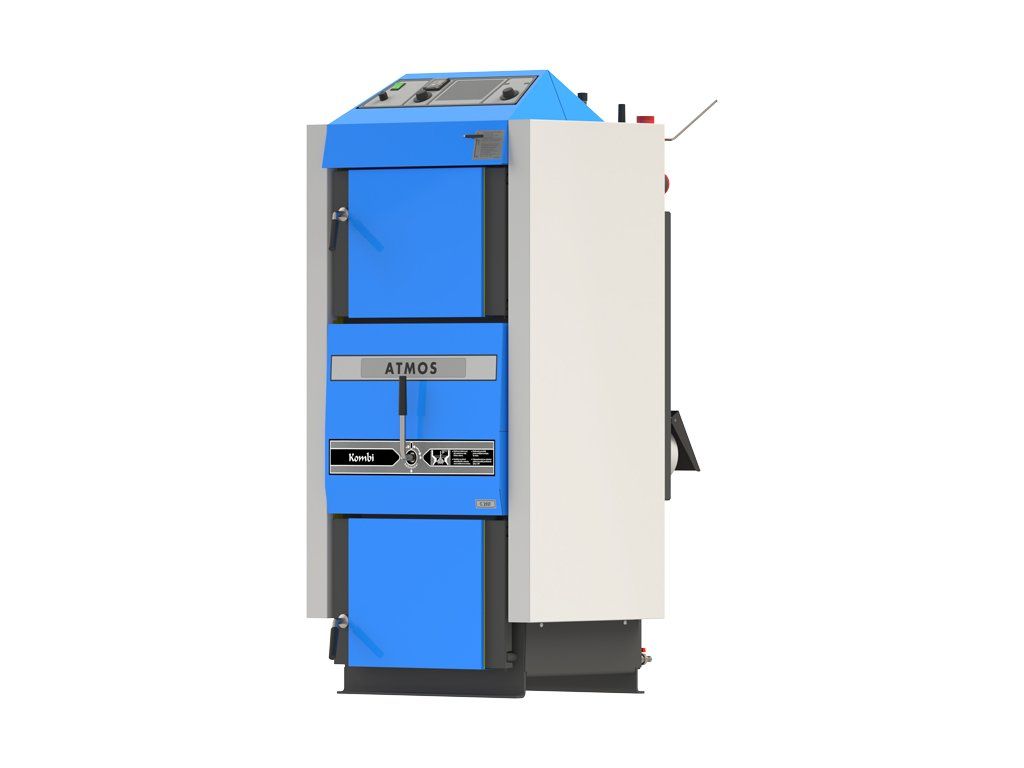
ATMOS C 25 ST – a floor-standing solid fuel boiler (coal/wood) with an output of 25 kW, suitable above all where no gas connection is available. We recommend combining it with an appropriately sized buffer tank for more efficient and more comfortable heating. Price from €3,281.68. |
When choosing a specific model we recommend comparing not only output and price, but also how the individual brands differ in spare parts availability, service network and long-term reliability – we cover this topic in a separate article, Comparison of floor-standing boiler brands.
Frequently asked questions (FAQ)
What is the main difference between a floor-standing and a wall-hung boiler?
A floor-standing boiler stands directly on the boiler room floor, a wall-hung boiler hangs on the wall. Thanks to its larger dimensions, a floor-standing boiler can handle a higher output (commonly from about 20 kW up to 90 kW and more) and a larger hot water cylinder volume, which is why it is suited above all to larger households, businesses or properties that already have a separate boiler room. A detailed comparison can be found in the article Floor-standing vs. wall-hung boiler – what's the difference.
Is a condensing boiler always worth it, or is a conventional one sufficient?
A condensing boiler has higher efficiency (up to around 98 %) and lower running costs, but a higher purchase price. A conventional (low-temperature) boiler has an efficiency of 84 – 90 %, a simpler design and a lower price. For an ordinary new installation the condensing type is today almost always recommended because of the fast return on investment, while a conventional boiler is justified mainly in the case of specific technical constraints. A detailed comparison including a calculation can be found in the article Condensing vs. conventional floor-standing boiler.
What boiler output do I need for a family house with a floor area of 150 m²?
The exact output depends on the heat loss of the particular house (insulation, window size, climate zone) and on hot water demand, so it is worth having a thermal calculation prepared or consulting an engineer. Indicative values and tables according to floor area and insulation can be found in the article What output floor-standing boiler do I need.
Is a built-in or a separate hot water cylinder better?
A built-in cylinder (for example in compact boilers of the ecoCOMPACT type) saves space and simplifies installation, but its volume is usually limited to about 90 – 120 litres. A separate external cylinder is worthwhile for larger volumes or if you plan to extend the system later with, for example, solar collectors. More in the article Boiler with a built-in or connected DHW cylinder.
Can a floor-standing solid fuel boiler be installed without a buffer tank?
Technically yes, but in practice it is almost never recommended. Without a buffer tank a solid fuel boiler often has to run at a low, damped-down output, which worsens combustion, increases tar formation and shortens the boiler's service life. A buffer tank allows the boiler always to burn at full output and stores the surplus heat for later use. The principle and recommended volumes can be found in the article Solid fuel boiler and buffer tank – how they work together.
What spatial and technical conditions must the boiler room meet?
The boiler room needs sufficient working space around the boiler, assured ventilation and combustion air supply, a functional chimney matching the type of appliance (including condensate drainage with condensing boilers) and, with solid fuel, also space for fuel storage. Exact parameters according to boiler type and output can be found in the article What demands does a floor-standing boiler place on the boiler room.
How often does a floor-standing boiler need servicing?
Regular annual servicing (checking the burner, heat exchanger, seals and combustion settings) is essential for safe operation, maintaining efficiency and keeping the manufacturer's warranty. With solid fuel boilers it is additionally necessary to clean the combustion chamber and the chimney of soot on an ongoing basis. A complete overview of service intervals and tips for extending service life can be found in the article Servicing, maintenance and service life of a floor-standing boiler.
Can a floor-standing boiler be added to an existing heating system without major work?
In most cases yes, especially if you are replacing an older floor-standing boiler in an existing boiler room – the heating pipework and the chimney generally remain as they are and only the heat source itself changes (possibly with the addition or modification of controls and condensate drainage when switching to condensing technology). The exact scope of the necessary work always depends on the condition of the original installation, however, so we recommend an on-site inspection by a heating engineer.
Related topics
- Floor-standing vs. wall-hung boiler – what's the difference
- What output floor-standing boiler do I need
- Condensing vs. conventional floor-standing boiler
- Solid fuel boiler and buffer tank – how they work together
- Boiler with a built-in or connected DHW cylinder
- What demands does a floor-standing boiler place on the boiler room
- Servicing, maintenance and service life of a floor-standing boiler
- Comparison of floor-standing boiler brands
- Frequently asked questions about floor-standing boilers and cylinders
Do you have a question about a floor-standing boiler or a cylinder?
Can't decide, or are you dealing with a specific situation in your home? Write to us – we will be happy to advise.