
What Output Floor-Standing Boiler Do I Need
What output floor-standing boiler do I need?
Choosing the right output for a floor-standing boiler is one of the most important decisions when heating a whole house, a business, or a larger building. Unlike smaller wall-hung boilers, which most often range up to 24–35 kW and typically serve flats and smaller family houses, floor-standing boilers cover a significantly wider spectrum – from about 20 kW for smaller family houses up to 90 kW and more for large buildings, businesses, multiple housing units, or combined heating systems. It is precisely this width of range that is the reason why, for floor-standing boilers, it is worth paying even more attention to the output calculation than for an ordinary wall-hung boiler in a flat.
In this article we show how you can roughly calculate the boiler output you need based on the heated area, the level of insulation, and the number of people in the household (for domestic hot water preparation), why it is important neither to oversize nor undersize the heating, and we run through the specific figures using two practical real-world examples. At the end you will find recommended floor-standing boiler models by output class and answers to the most frequently asked questions.
An important note to start with: all the coefficients and calculations given in this article are indicative and serve for a quick initial idea of the output needed. An exact calculation of a building's heat losses (a so-called thermal-technical calculation or heating design) should always be prepared by a heating specialist or designer, who will also take into account other factors – the building's orientation to the compass points, ceiling height, the number and quality of windows, thermal bridges, ventilation, and many other variables. This article will help you understand the principle and form an informed initial idea before consulting a specialist.
Why the correct boiler output matters so much
Many customers, when choosing a boiler, give in to the temptation of "better a bigger output, so the boiler has a reserve". For floor-standing boilers, which are bought for decades and often for larger buildings with higher investment costs, this is a mistake that can prove expensive – just like the opposite extreme, that is underestimating the output needed in order to save on the purchase price. Both extremes have real consequences that show up as early as the first heating season.
An oversized boiler – needlessly high output
When a boiler has a significantly higher output than the building actually needs, a phenomenon called cycling occurs – the boiler quickly heats up to the required temperature, switches off, the space quickly cools, and the boiler switches on again. This frequent switching on and off has several negative consequences:
- Lower overall running efficiency – the boiler does not operate in the optimal, steady-state regime where it achieves its best efficiency (especially with condensing boilers, where high efficiency is tied to longer operating cycles at low return temperatures).
- Increased wear on components – the burner, circulation pump, valves and electronics cope worse with frequent starts than with smooth, longer operation, which can shorten the boiler's lifespan and lead to more frequent service interventions.
- An unnecessarily high upfront investment – a bigger output generally also means a higher purchase price for the boiler, and sometimes greater demands on boiler-room space, the chimney, or the combustion air supply.
- Less stable room temperature – with some types of control, larger temperature fluctuations can occur, since the boiler "fires" output in short bursts instead of delivering heat smoothly.
An undersized boiler – insufficient output
The opposite problem is equally unpleasant, but shows up mainly on the coldest days of the year. An undersized boiler:
- Cannot keep up with the building's heat losses during hard frosts – the required indoor temperature is not reached, or is reached only with significant delay.
- Runs at maximum or near-maximum output for long periods, which increases wear and fuel consumption, since the boiler works outside its optimal range.
- When combined with hot water preparation, can experience a significant drop in heating output at the moment the DHW tank has priority for reheating – in practice this means that while someone is showering, the radiators or underfloor heating temporarily "cool down".
- Shortens the unit's lifespan, because permanently running at the limit of its output represents a greater load than a reasonable reserve.
The goal, therefore, is not to choose either the biggest or the cheapest boiler, but the output that matches the building's actual heat loss and hot water needs as closely as possible – with a reasonable, not exaggerated, reserve. For more on how to approach choosing a floor-standing boiler comprehensively (not just from an output perspective), see the article How to choose a floor-standing boiler.
Rough output calculation by area and insulation
The simplest and most widespread way of making an initial estimate of the boiler output needed is based on the building's heated area (in m²) and a heat-loss coefficient reflecting the level of insulation of the building. The formula is simple:
Required output (kW) = heated area (m²) × heat-loss coefficient (kW/m²)
The heat-loss coefficient differs depending on how well the building is insulated, and the condition of the windows, roof and building envelope. Indicative values, which we also use for further calculations in this article:
| Building type | Heat-loss coefficient | Description |
|---|---|---|
| Uninsulated / older house | ~0.10 kW/m² (100 W/m²) | Original masonry with no insulation, older windows, higher heat losses |
| Normally insulated house | 0.05–0.07 kW/m² (50–70 W/m²) | Insulated facade, plastic/quality windows – the most common category in Slovakia |
| Low-energy / passive house | 0.03–0.04 kW/m² (30–40 W/m²) | Quality insulation to current standards, controlled ventilation with heat recovery |
To illustrate how these coefficients translate into specific output for various building sizes, see the following table of indicative values:
| Heated area | Uninsulated house (0.10) | Normally insulated (0.06) | Passive/low-energy (0.035) |
|---|---|---|---|
| 150 m² | 15 kW | 9 kW | 5.3 kW |
| 200 m² | 20 kW | 12 kW | 7 kW |
| 250 m² | 25 kW | 15 kW | 8.75 kW |
| 350 m² | 35 kW | 21 kW | 12.25 kW |
| 500 m² | 50 kW | 30 kW | 17.5 kW |
| 800 m² | 80 kW | 48 kW | 28 kW |
The table shows why floor-standing boilers have such a wide output range – even a relatively common area of 500–800 m² (for example a larger family house combined with a business, a guesthouse, a small company, or a building with several housing units) reaches 50, 60 or even 80 kW with poorer insulation, a value that wall-hung boilers commonly do not reach, or only reach at the limit of their capability by cascading several units together.
It should also be stressed that "heated area" means the usable floor area that is actually heated – not always the whole built-up area of the house. Unheated spaces (for example a garage without a radiator, an unused cellar, an attic) are not included in the calculation, or are included with only part of their area if they are heated to a lower temperature.
Reserve for domestic hot water (DHW) preparation
The calculation by area and insulation gives you the basic heating output, that is, the output needed to cover the building's heat losses. For floor-standing boilers, however, a reserve for domestic hot water preparation also needs to be added – especially if the boiler has a built-in tank (a compact assembly) or a larger indirectly heated tank connected to it.
Why does this matter? Preparing hot water, especially in households with several people where simultaneous draw-off can occur (for example in the morning, when several household members shower in quick succession), places additional demands on the boiler. If the tank has a fast-heating function or a larger volume (for example 90, 120, 150 litres or more), the boiler must be able to deliver enough heat quickly to heat the water without significantly limiting the heating output for the rest of the house.
In practice, therefore, for buildings with higher DHW demand (more people, more bathrooms, businesses with higher hot water consumption), it is recommended to add a reserve of roughly 10–30% to the calculated heating output, depending on the size and type of tank and the number of people. The exact percentage should ideally be determined by a specialist based on the actual consumption profile, but as a rough rule:
- 1–3 people, normal DHW consumption: no need to significantly increase the calculated heating output; a smaller reserve of around 10% is enough.
- 4–6 people, a standard household with normal draw-off: a reserve of about 15–20% on top of the heating output, especially if the tank is smaller or shared between several bathrooms.
- A larger household, a business, or a building with high, simultaneous DHW draw-off (e.g. several bathrooms used at once, an accommodation facility): a reserve of 20–30% or more, or consider a separate, larger tank with its own reheating instead of relying solely on the boiler's reserve.
This is exactly why, when choosing a boiler with a built-in or connected tank, it is important to consider not just the heating output itself, but also how the tank is sized and what reheating output it has. We covered this topic in more detail in the article Boiler with a built-in or connected DHW tank, where you will also find a comparison of the pros and cons of both solutions.
Why floor-standing boilers have a wider output range than wall-hung ones
Floor-standing boilers differ from wall-hung ones mainly in construction (they stand on the floor and have a more robust exchanger and combustion chamber), and it is exactly this construction that lets them cover a significantly wider output range – from about 20 kW for smaller family houses up to 90 kW and more for large buildings, commercial premises, or houses with multiple housing units.
There are several reasons:
- A larger and more robust heat exchanger – floor-standing design allows for larger combustion chambers and exchangers, able to handle higher heat output without the extreme demands on compactness that wall-hung boilers, designed to hang on a wall, have.
- The option of both cascade and standalone deployment – large floor-standing boilers can be deployed standalone for buildings with high heat demand, where a whole cascade of wall-hung boilers would otherwise be needed.
- Greater weight and structural stability – allows long-term operation at higher output without excessive stress on the construction, which is advantageous especially for year-round or near-continuous operation (for example in businesses that heat even outside the normal heating season for DHW or process heat).
- Wider options for connecting accessories – large DHW tanks, several heating circuits, the option of connecting solar collectors or other heat sources, which is a common requirement for large buildings.
- Suitability for alternative fuels at higher outputs – with solid-fuel boilers (wood, coal, briquettes), a floor-standing design is practically the only realistic choice at higher outputs, since these boilers need a larger combustion space and fuel hopper.
Thanks to this, with floor-standing boilers you can choose a model tailored exactly to your building – you don't have to settle for the nearest "jump" in the output range, as sometimes happens with wall-hung boilers, where output steps (for example 24, 28, 35 kW) are more limited. We compared the differences between the two boiler types in detail, including output options, in the article Floor-standing vs. wall-hung boiler – what's the difference.
A practical example: two real-world calculation scenarios
For a better idea, let's look at two illustrative but realistic scenarios – one for an ordinary family house, the other for a larger building or business. Both examples are based on the coefficients given above and show how the reserve for DHW is added to the basic heating output.
Scenario 1: Family house, 250 m², normal insulation, 4-person household
Imagine a family house with a heated area of 250 m², with normal insulation (an insulated facade, quality plastic windows) – that is, a heat-loss coefficient of approximately 0.06 kW/m². The house is occupied by 4 people with standard hot water consumption and two bathrooms.
Step 1 – basic heating output:
250 m² × 0.06 kW/m² = 15 kW
Step 2 – DHW reserve:
For a 4-person household with standard draw-off (two bathrooms, possibility of simultaneous showering), a reserve of about 15–20% is appropriate.
15 kW × 1.18 (18% reserve) ≈ 17.7 kW
Result: The indicative boiler output needed falls in the range of 18–22 kW, with the upper end of this range providing a reasonable reserve for, for example, colder winters or a future modest increase in heated area (for example an extension, glazing a terrace). For a customer with this profile, that points to boilers in the roughly 20–25 kW class – for example the Protherm Medveď Condens 25 KKS model (25 kW, €2,010.25), whose output covers the calculated need with an adequate reserve for colder periods too.
Scenario 2: Larger building/business, 400 m², older/less insulation, higher DHW demand
The second scenario represents a larger building – for example a larger family house combined with a business, a guesthouse, or a company premises with an area of 400 m², of older construction and not fully insulated to current standards. In this case we will use a coefficient closer to the upper end of the "uninsulated/older insulation" category, that is 0.08 kW/m² (between normally insulated and uninsulated), and with higher, partly simultaneous, hot water draw-off (for example several bathrooms/showers used at different times).
Step 1 – basic heating output:
400 m² × 0.08 kW/m² = 32 kW
Step 2 – DHW reserve:
With higher, partly simultaneous hot water draw-off (more people, business character), a reserve of around 25–30% is appropriate.
32 kW × 1.28 (28% reserve) ≈ 41 kW
Result: The indicative boiler output needed in this case is around 40–45 kW. This category includes, for example, the Bosch Suprapur KBR 42 model (42 kW, €2,187.00), whose output exactly matches the calculated need of this larger building, including the DHW reserve.
Both scenarios show the same principle – first the basic heating output is calculated based on area and insulation, then a reasonable reserve for hot water preparation is added based on the number of people and the nature of the draw-off, and only this total forms the basis for choosing a specific boiler model. It is important not to stop at the "paper" calculation alone, but also to take into account the actual conditions of the specific building – orientation to the compass points, ceiling height, window quality and other factors that can shift the resulting required output by a few kW in either direction. That is why we recommend always discussing these indicative calculations with a specialist who will take into account all the specifics of your building.
Recommended floor-standing boiler models by output
Below you will find an overview of real floor-standing boiler models from various output classes, matching the typical scenarios described above – from medium output for ordinary family houses to higher output for larger buildings, and an alternative for solid-fuel burning.

|
Protherm Medveď Condens 25 KKS – 25 kW, medium output class A condensing floor-standing boiler suitable for typical family houses with a heated area corresponding to roughly 15–25 kW according to the calculation above (for example scenario 1 – a 250 m² house with normal insulation). Thanks to condensing technology it achieves high efficiency even at lower return temperatures, which is especially advantageous combined with underfloor heating or at lower heating water temperatures. Price: €2,010.25 |

|
Bosch Suprapur KBR 42 – 42 kW, higher output for larger buildings A boiler from a higher output class, suitable for larger family houses, businesses or buildings with higher heat and hot water demand – matching, for example, scenario 2 in this article (a 400 m² building with older insulation and higher DHW demand). A good choice if the calculated required output exceeds the typical range of wall-hung boilers. Price: €2,187.00 |

|
Vaillant VSC 206/4-5 90 ecoCOMPACT – compact assembly with a built-in 90 l tank An example of a boiler with a built-in hot water tank, where the DHW reserve described above in the article also needs to be considered when choosing output. Thanks to the integrated 90-litre tank, it is suitable for households with medium to higher demand for simultaneous hot water draw-off, without needing a separate large tank. Price: €3,658.66 |
|
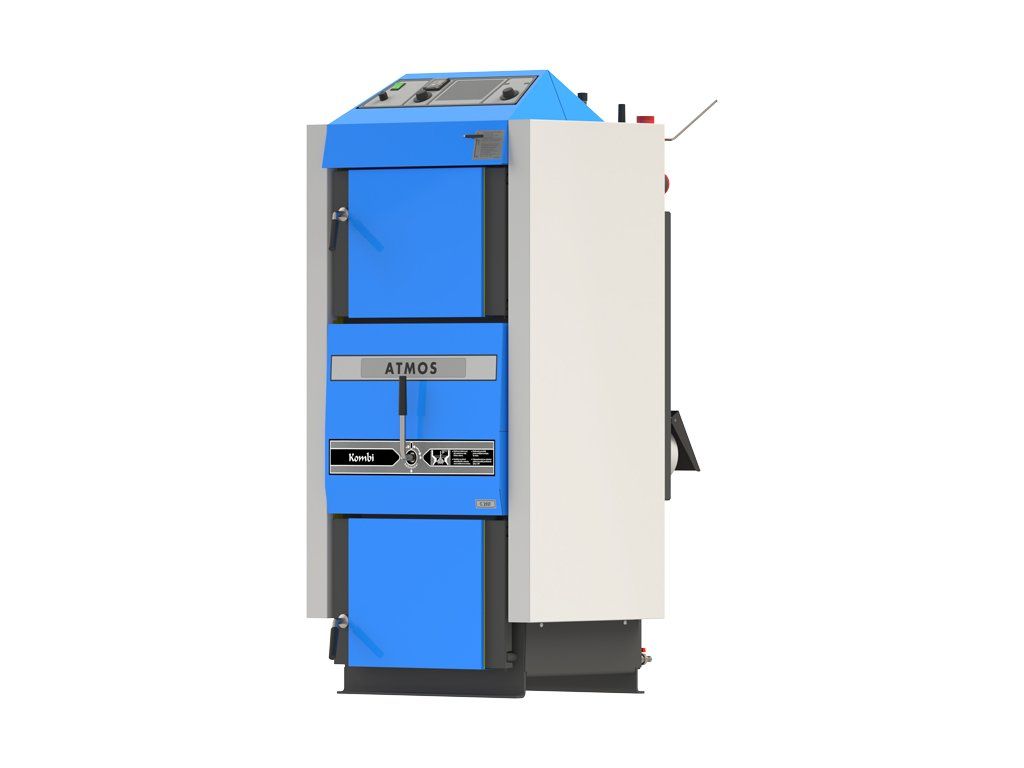
ATMOS C 25 ST – 25 kW, solid-fuel boiler An alternative for households that prefer burning solid fuel (wood) instead of gas. The same principle for calculating output by area and insulation applies here too – 25 kW roughly matches a family house with normal insulation and an area in the range described in scenario 1. For solid-fuel boilers, the loading interval also needs to be considered, and combining it with a buffer tank is recommended. Price: €3,281.68 |
When choosing between a condensing and classic (non-condensing) floor-standing boiler, we also recommend studying the differences in efficiency and running costs covered in the article Condensing vs. classic floor-standing boiler – the choice of technology can also affect what output is ultimately needed, since condensing boilers can make more efficient use of heat from the flue gases at the same nominal output.
Frequently Asked Questions (FAQ)
1. How do I find out my house's exact heat loss?
The most accurate way is to have a thermal-technical calculation prepared by a specialist or designer, who will take into account all the building's parameters (wall material, insulation thickness and type, window area and type, orientation to the compass points, ceiling height, ventilation method and other factors). The rough calculation by area and coefficient given in this article is only for a quick initial idea before consulting a specialist.
2. Is it better to choose a boiler with higher output "just in case"?
No, oversizing a boiler brings real disadvantages – frequent cycling (switching on and off), lower running efficiency, increased component wear, and an unnecessarily higher purchase price. The goal is to choose an output as close as possible to the building's actual need, with a reasonable, not exaggerated, reserve (generally in the single digits to low tens of a percent, not a multiple of the required output).
3. How does the output calculation for a floor-standing boiler differ from a wall-hung one?
The calculation principle (area × heat-loss coefficient + DHW reserve) is the same for both boiler types. The difference is that floor-standing boilers offer a significantly wider range of available outputs (from about 20 kW to 90+ kW), so for larger buildings, where a wall-hung boiler or a cascade of wall-hung boilers would hit its limits, a floor-standing design is a more natural, and often more economical, choice.
4. Do I need to include hot water preparation in the output calculation?
Yes, especially if the boiler has a built-in or connected DHW tank. In that case, a reserve for water heating is added to the basic heating output (by area and insulation), based on the number of people in the household, the number of bathrooms, and the likelihood of simultaneous hot water draw-off. As a rough guide, this is a reserve of about 10–30%.
5. What is the minimum and maximum output of the floor-standing boilers you offer?
The floor-standing boilers in the atria.sk range commonly cover from about 20 kW (smaller family houses) up to 90 kW and more (large buildings, businesses, multiple housing units). You will find the specific range and output-based filtering directly in the floor-standing boiler category.
6. Does the required output change if I insulate my house afterwards?
Yes, additional insulation (insulating the facade, replacing windows, insulating the roof) reduces the building's heat losses, and therefore also the boiler output needed – according to the table above, the heat-loss coefficient can drop, for example, from 0.10 to 0.06 kW/m², which for the same area means a significantly lower output requirement. If you are planning insulation work in the near future, it is worth taking this into account already when choosing the boiler, to avoid significant oversizing once the insulation work is finished.
7. Does the choice between a condensing and classic boiler affect the required output?
Not directly – the calculated heating output (kW) stays the same regardless of technology. Condensing boilers, however, can make more efficient use of the fuel's energy at the same nominal output by using heat from the flue gases, which shows up especially at lower heating water temperatures (for example with underfloor heating). We cover the differences between the two technologies in a separate article on this topic.
8. What demands does a higher-output floor-standing boiler place on the boiler room?
In general, as output increases, so do the demands on boiler-room space, combustion air supply, chimney sizing, and in some cases the electrical connection too. When choosing a boiler with higher output (for example above 40–50 kW), we recommend checking in advance that the boiler room meets all the technical requirements of the specific model – more detailed information can be found in the article on boiler-room requirements for a floor-standing boiler.
Related topics
- How to choose a floor-standing boiler
- Floor-standing vs. wall-hung boiler – what's the difference
- Condensing vs. classic floor-standing boiler
- Boiler with a built-in or connected DHW tank
- What requirements does a boiler room have for a floor-standing boiler
Do you have a question about a floor-standing boiler or tank?
Can't decide, or dealing with a specific situation in your home? Write to us – we're happy to help.