
Solid-Fuel Boiler and Buffer Tank - How They Work Together
A solid-fuel boiler works completely differently from a gas condensing boiler or an electric boiler. While a gas or electric source can regulate its output smoothly and almost instantly according to the house's current need – it switches on, delivers exactly as much heat as the system asks for, and then eases off or switches off again – a wood, coal or wood-gas (gasification) boiler cannot behave like this. A batch of fuel is loaded into the boiler, it is ignited, and from that moment it burns according to its own dynamics: first intensely, with high output and high flue gas temperature, then gradually weakening until it burns down to glowing ash. This process cannot be switched off at the push of a button, nor programmed to a precise schedule the way automatic heat sources can.
It is precisely in this difference that the reason lies why a buffer tank (often also called a heat storage tank or accumulation tank) is recommended in practice for practically every larger solid-fuel boiler. This is not a domestic hot water tank – that is handled by a separate DHW tank or instantaneous heating. A buffer tank is filled with heating water, and its sole job is to store the heat the boiler produces at a given moment and release it into the heating system according to what the house actually needs – including at times when the boiler has long since stopped burning. In this article we explain why this combination is essentially necessary, how buffering works from a technical point of view, how to estimate the correct tank volume, and what to watch out for in the connection so the boiler lasts as long as possible.
Why a solid-fuel boiler burns differently from a gas or electric source
Imagine a typical day during the heating season. A gas condensing boiler reacts to a drop in room temperature, or to a signal from weather-compensation control, practically instantly – it raises the burner's output to the required level, holds it there for as long as needed, and then lowers the output again or switches the burner off entirely. The whole process takes seconds and repeats several times an hour, exactly according to the house's current heat demand.
A solid-fuel boiler cannot work this way. When you load it with logs of wood or a shovel of coal and the fuel catches, the output rises sharply over the first tens of minutes – with wood gasification boilers even very steeply, because the gasification principle is based precisely on intense combustion at a high temperature in the combustion chamber. The output then stays at a high level for a while and eventually gradually falls, until only glowing ash remains of the fuel and combustion dies down. This cycle – ramp-up, peak, dying down – cannot be shortened or extended according to what the house needs at that moment. The boiler burns the way the physics and chemistry of combustion allow, not the way a room thermostat would like.
If such a boiler were connected directly to the heating circuit without any intermediate element, the house would receive far more heat than it needs in the first phase of burning – radiators or underfloor heating would overheat, rooms would become stuffy and unreasonably warm. In the second phase, as the fuel burns down, the output would conversely drop sharply below the house's need and the indoor temperature would start falling before it would be possible to reload. This cycle of overheating and undercooling is exactly what a buffer tank is meant to prevent.
Why the heating system does not work efficiently without a buffer tank
Most people first realise the point of buffering only when they try running a solid-fuel boiler without one. Without a heat storage tank, the owner is forced to regulate the boiler's output by throttling the air supply to the firebox – that is, to dampen combustion so the boiler does not produce more heat than the house is currently using. That sounds logical, but in practice this approach has several serious consequences:
First, damped combustion is incomplete combustion. When the air supply is restricted, fuel burns at a lower temperature and with a lack of oxygen, leading to incomplete combustion. Larger amounts of tar, soot and unburnt products form and settle in the combustion chamber, on the exchanger and in the chimney. The boiler needs cleaning more often, its efficiency falls, and the risk of blocked flues rises. This effect is especially pronounced with wood gasification boilers, since their design is built specifically for burning at high temperature and high output – as soon as the output is artificially throttled, the boiler loses the whole point of its design principle.
Second, frequent loading and dying down consumes fuel inefficiently. A boiler burning at its full, designed output burns fuel with significantly higher efficiency than a boiler forced to smoulder at low output. When the boiler has the option of transferring surplus heat into a buffer tank instead of having combustion throttled, it can work in exactly the output range for which the manufacturer built it, and in which it achieves the best ratio between fuel used and heat produced.
Third, repeated overheating and cooling of the system amounts to a thermal shock for the boiler itself. Rapid changes in water temperature inside the boiler body stress the welds, the seals and the exchanger material itself. With long-term operation without buffering, this shortens the boiler's lifespan – exactly the opposite of what most households want when they invest in a quality solid-fuel boiler.
Finally, there is also pure operating comfort: without buffering, the owner has to load fuel far more often and monitor the boiler practically continuously, because every batch of fuel has to be consumed at a rate matching the house's immediate need. With a sufficiently large buffer tank, on the other hand, a full batch of fuel can be burned at once at full output, and the heat is then gradually "drawn" from the tank over several hours, during which the boiler need not be burning at all.
How a buffer tank works – the principle in practice
A buffer tank is essentially a large, well-insulated steel tank filled with heating water, connected into the system between the boiler and the heating circuit (radiators, underfloor heating, or both). The boiler heats water that circulates primarily through the tank – heat is gradually "stored" in it as temperature stratification builds up inside the tank: the hottest water collects at the top, cooler water at the bottom. The house's heating circuit then draws hot water from the top of the tank according to how much heat the house currently needs, regardless of whether the boiler is burning at that moment or not.
Thanks to this arrangement, the boiler can burn a batch of fuel during a single loading at its optimal, full output – exactly as designed and tested by the manufacturer for the highest efficiency. All the heat the house does not use at that moment is not wasted, but is stored in the tank and waits there until the heating system "draws" it at the moment it is needed – which may be several hours later, by which time the boiler has long since cooled down and stopped burning.
In practice it looks something like this: in the evening a full batch of wood or coal is loaded, the boiler burns the fuel at high output over the course of one to two hours and transfers the heat into the buffer tank. The heating system then draws heat from the tank gradually throughout the night, without any need to reload or regulate the boiler in any way. In the morning the tank is partly "discharged" (cooled) and the cycle repeats with the next loading.
The size and quality of insulation of a buffer tank directly affect how long it can hold heat. Quality tanks, such as the HPWB2000 buffer tank with a 2,000-litre volume or the smaller HPWB500 buffer tank with a 500-litre volume, have thick thermal insulation precisely so that heat loss during storage is as small as possible, and so the investment in wood or coal is really used efficiently rather than escaping through the tank walls into the boiler room.
How to estimate buffer tank volume based on boiler output
The exact volume of a buffer tank should always be part of the heating system design and should take into account not only the boiler's output, but also the type of heating system (radiators or underfloor heating), the building's heat losses, the number of loadings the owner can realistically manage per day, and the specific boiler manufacturer's recommendations. Nevertheless, there is a rough rule commonly used in practice as a first estimate: about 50 to 100 litres of buffer tank volume is allowed for every kilowatt of boiler output.
The lower value in this range (around 50 l/kW) tends to be used for smaller, less intensively used boilers, or where space in the boiler room is limited and buffering is supplemented by, for example, more frequent loading. The higher value (closer to 100 l/kW) is recommended especially for wood gasification boilers, which burn very intensely and require a longer full-output burning cycle – here it is worth investing in a larger tank so that as much of the heat produced as possible can actually be used, rather than wasted by prematurely throttling the boiler's output.
An indicative overview of what estimating buffer tank volume by boiler output might look like is shown in the table below. This is a rough estimate – the exact figure should always be discussed with the boiler manufacturer or seller before purchase.
| Boiler output | Recommended tank volume (50–100 l/kW) |
| 10 kW | approx. 500 – 1,000 l |
| 15 kW | approx. 750 – 1,500 l |
| 20 kW | approx. 1,000 – 2,000 l |
| 25 kW | approx. 1,250 – 2,500 l |
| 30 kW | approx. 1,500 – 3,000 l |
In practical selection, it is also worth thinking about the boiler room's spatial constraints – buffer tanks with a volume of 1,000 litres and more are large, and it is necessary to check in advance whether they will fit into the space along with enough working room for connection and any servicing. This is exactly why smaller boiler rooms or lower outputs often use a combination of several smaller tanks instead of one large one, which gives more flexibility during installation.
Thermoregulation valve and protection against low-temperature corrosion
A buffer tank solves what to do with surplus heat during combustion. Equally important, though, is protecting the boiler itself from the opposite problem – preventing water that is too cold from returning to it from the heating circuit or from a cold, not-yet-heated buffer tank. A thermoregulation valve is fitted into the system for this purpose, often referred to in practice by the name of one of the best-known manufacturers, Laddomat.
The principle of a thermoregulation valve is fairly simple but functionally crucial: the valve ensures that water returning to the boiler is always at a sufficiently high temperature (generally at least around 60 °C), by mixing hot water directly from the boiler outlet into the return line until the system is sufficiently heated up. Only once the return water temperature is high does the valve gradually open the path to the buffer tank and the heating circuit.
Why does this matter? If cold water were to return to a solid-fuel boiler over the long term, acidic combustion products would condense on the inner walls of the exchanger – this is known as low-temperature corrosion. This condensation gradually eats away at the boiler's metal parts, shortens its lifespan and increases the risk of leaks. At the same time, combustion itself deteriorates at low combustion-chamber temperatures – larger tar deposits form, stick to the exchanger walls, reduce heat transfer and complicate cleaning and maintenance.
The thermoregulation valve therefore performs a dual role: it protects the boiler from corrosion caused by cold return water, and at the same time helps keep a stably high temperature in the combustion chamber, which is a prerequisite for clean and efficient combustion. Combined with a sufficiently large buffer tank, this creates a system able to extract the maximum heat from every batch of fuel with minimal wear on the boiler.
Real-world examples: two scenarios
Scenario 1: A family house with a wood gasification boiler
Imagine a typical family house heated by a wood gasification boiler with an output of around 25 kW – a type similar to, for example, the ATMOS C 25 ST. Gasification boilers are built to burn intensely and at high temperature, which is also the condition for their high efficiency and clean combustion with minimal tar. Without sufficient buffering, however, the owner would have to throttle the air supply as soon as the house reached the desired temperature – and would thereby force the boiler to burn precisely in the mode it is not optimised for.
In this case, compared with the rough 50–100 l/kW rule, it is worth going for the higher end of the range precisely because it is a gasification-type boiler. At 25 kW output, that means a tank with a volume closer to 2,000 litres, for example the HPWB2000 buffer tank. In practice this works as follows: the owner loads a full batch of wood once, or twice a day; the boiler burns the fuel over one to two hours at its full, most efficient output, and all the heat the house doesn't use immediately is stored in the 2,000-litre tank. The heating circuit then draws heat gradually throughout the day and night, so the house has a stable temperature without fluctuations, even though the boiler is not burning most of the time. At the same time, thanks to the thermoregulation valve, cold water does not return to the boiler, so the risk of tarring and corrosion remains minimal.
Scenario 2: A cottage with a smaller coal boiler
The second typical case is a holiday cottage or a smaller, occasionally heated building with a lower-output solid-fuel boiler, roughly around 10 kW – considerably smaller than the boiler in the previous example. The cottage's heat losses are lower, boiler room space is usually more limited, and the owner doesn't need as large a heat "reservoir" as in a year-round family house.
At an output of around 10 kW, the lower end of the rough rule (50 l/kW) corresponds to about 500 litres – matching exactly the smaller HPWB500 buffer tank. This tank fits into a more modest boiler room and, despite its smaller volume, still performs its main task: it allows the boiler to burn a larger batch of coal at once at an appropriate output, instead of constant throttling and long smouldering, which in a cottage with intermittent operation would lead to rapid fouling of the boiler with soot and tar, especially after weekends when the cottage is not heated at all for a long time. On arrival at the cottage, it is enough to load one larger batch of fuel, let the boiler burn it at an appropriate output, and heat from the 500-litre tank then covers heating demand for several more hours after the boiler has burned down – exactly what is needed for intermittent holiday-home use.
Recommended products
Below you will find the specific products mentioned in this article – a solid-fuel gasification boiler and two buffer tanks of different sizes, covering the typical range of boiler outputs in family houses and cottages.
| Image | Product | Price |
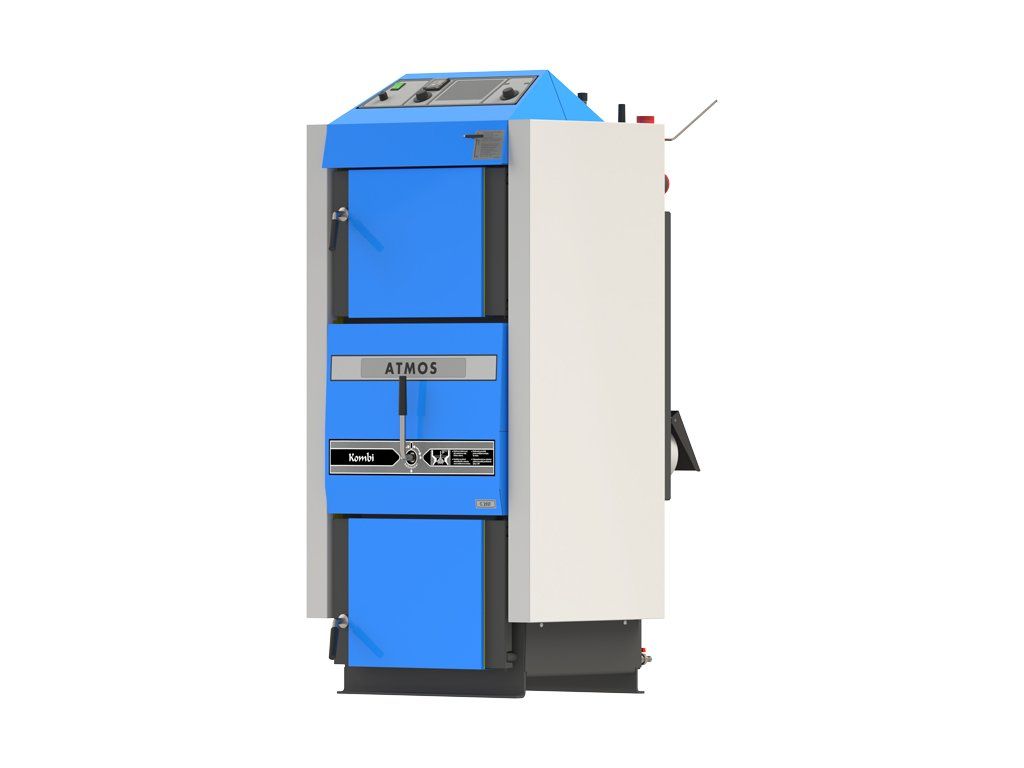 |
ATMOS C 25 ST Solid-fuel boiler (coal/wood), 25 kW output. Suitable for combining with a buffer tank in the range of approx. 1,250 – 2,500 l. |
€3,281.68 |
 |
HPWB2000 buffer tank 2,000-litre volume. Suitable for larger solid-fuel boilers, especially wood gasification boilers with an output of around 20–25 kW and more. |
€2,454.00 |
| – | HPWB500 buffer tank 500-litre volume. Suitable for smaller boilers, cottages and buildings with intermittent use, roughly for a boiler output around 8–10 kW. |
€828.53 |
When choosing a specific combination of boiler and buffer tank, we always recommend consulting directly with our team – the correct tank volume depends not only on the boiler's output, but also on the character of the building, the heating method, and how often loading is realistically planned.
Frequently Asked Questions (FAQ)
Do I need a buffer tank with a solid-fuel boiler, or is the boiler alone enough?
A solid-fuel boiler can technically work without a buffer tank, but in practice this brings significantly worse efficiency, frequent loading, faster tarring of the exchanger, and a shortened boiler lifespan due to constant throttling of combustion. For most wood gasification boilers, manufacturers directly recommend a buffer tank, because without one the boiler cannot make full use of its potential.
What is the difference between a buffer tank and a domestic hot water tank?
A buffer tank is filled with heating water and is used exclusively to store heat for the heating circuit (radiators, underfloor heating). A domestic hot water (DHW) tank heats potable water for taps, showers and similar, and works on a completely different principle. Some buffer tanks can have an additional built-in exchanger for preparing DHW, but their main function remains the same – storing heating water.
How many litres of buffer tank do I need for my boiler?
As a rough guide, allow 50 to 100 litres of tank volume for every kilowatt of boiler output. For wood gasification boilers, the higher end of this range is recommended. The exact volume should always also take into account the house's heat losses, the type of heating system, and the boiler manufacturer's recommendations – if in doubt, it is best to consult directly with the seller or manufacturer.
What happens if the buffer tank is too small?
If the tank is undersized, the boiler has nowhere to send surplus heat from intense combustion, so the air supply has to be throttled again to avoid overheating the system. This loses the main advantages of buffering – the boiler burns less efficiently, more tar and soot form, and the interval between loadings shortens, since the full potential of a single batch of fuel is not used.
Is a thermoregulation valve (Laddomat) mandatory, or just recommended?
Many solid-fuel boiler manufacturers recommend, or directly require, the use of a thermoregulation valve as a condition for keeping the warranty valid, since without one there is a risk of low-temperature corrosion of the exchanger caused by cold return water. It is a fairly cheap component compared to the price of the boiler, and it significantly extends its lifespan, so installing it is almost always worthwhile in practice.
Can a buffer tank be added later to an already installed boiler?
Yes, a buffer tank can be added to an existing system with an already installed solid-fuel boiler. It's just necessary to check whether the boiler room has enough space, and whether the existing pipework and circulation pumps can handle the new connection. In many cases this is work best entrusted to an experienced heating engineer, so the connection (including the thermoregulation valve) is done correctly.
How long can a buffer tank hold heat?
This depends on the tank's volume, the quality of its thermal insulation, the temperature it is charged to, and the house's current heat demand. A well-insulated tank with a volume of 1,000 to 2,000 litres can, given reasonable house demand, supply heat over many hours, often through a whole night, without needing to reload.
Is a buffer tank worthwhile even for a smaller boiler at a cottage that is only heated occasionally?
Yes – it is precisely with intermittent use, typical of a cottage, that buffering helps reduce the number of loadings on each arrival, while also protecting the boiler from repeated damped combustion, which would otherwise lead to faster fouling of the exchanger. At lower outputs, a smaller tank is enough, for example around 500 litres.
Related topics
- How to choose a floor-standing boiler
- What output floor-standing boiler do I need
- What requirements does a boiler room have for a floor-standing boiler
- Servicing, maintenance and lifespan of a floor-standing boiler
- Comparison of floor-standing boiler brands
Do you have a question about a floor-standing boiler or tank?
Can't decide, or dealing with a specific situation in your home? Write to us – we're happy to help.