
Frequently asked questions about stationary boilers and tanks
A stationary boiler is a natural choice for many family houses, larger properties, and smaller businesses, especially where higher output, a larger hot water tank, or the ability to combine multiple heat sources including solid fuel is needed. When choosing one and during everyday operation, however, the same questions keep coming up again and again – what's the difference compared to a wall-mounted boiler, what output to choose, is condensing technology worth it, how large a hot water tank do I need, what does the boiler room need to meet, and how long does a boiler last with regular servicing.
In this article we've gathered the most common questions our customers ask, both when choosing and during the operation of a stationary boiler and tank, in one place, and divided them into clear topic areas: choice and purchase, technology, hot water tank, installation and boiler room, service and lifespan, and finally brand comparison. If you're interested in a specific topic in more depth, at the end of the article you'll find links to separate detailed texts covering it.
Choice and purchase
The first group of questions concerns how to decide between a stationary and a wall-mounted boiler in the first place, and what to think about before you start comparing specific models.
What's the difference between a stationary and a wall-mounted boiler?
A stationary boiler stands independently on the floor, usually in a separate boiler room or utility room, and its design allows it to reach higher output – commonly from roughly 20 kW up to 90 kW and more. A wall-mounted boiler, by contrast, is mounted on the wall, is more compact, and its output range is lower, which is enough for smaller flats and houses. A stationary boiler also generally works with a larger domestic hot water tank than a comparable wall-mounted model, so it handles simultaneous draw-off at multiple points better. A detailed comparison of both types can be found in the separate article Stationary vs. wall-mounted boiler – what's the difference.
Who is a stationary boiler more suitable for than a wall-mounted one?
A stationary boiler makes sense especially in larger family houses, multi-generation houses, holiday cottages with higher occupancy, but also in smaller businesses such as guesthouses, workshops, or facilities with higher and more peaked hot water and heat consumption. It's also worth considering if you're planning to combine multiple heat sources in the future – for example a gas condensing boiler with a solid fuel boiler or a buffer tank. For an ordinary flat or smaller house, on the other hand, a smaller, cheaper wall-mounted boiler is generally fully sufficient.
What output stationary boiler do I need for a family house?
The exact output is always calculated from the specific building's heat loss, which is influenced mainly by floor area, insulation quality, ceiling height, the number and size of windows, location and climate zone, as well as whether the boiler also handles heating water in a tank alongside space heating. That's precisely why stationary boiler outputs on offer span a wide range, from roughly 20 kW for smaller houses up to 90 kW and more for large or multi-unit buildings and businesses. A detailed procedure for calculating or at least roughly estimating the output can be found in the article What output stationary boiler do I need.
Is a stationary boiler worth it even for a smaller flat or house, or is it an unnecessarily large solution?
For a small flat or a low-energy house, a stationary boiler is, in most cases, genuinely oversized and needlessly expensive – a smaller wall-mounted boiler fulfils the same function at a lower purchase and operating cost, and also saves space. A stationary boiler starts to pay off roughly from the point where you already need higher output, a larger hot water tank, or where you want the option of later adding another heat source, for example solid fuel or a heat pump in a bivalent setup. If you're not sure where exactly your situation falls, it's worth having the house's heat loss calculated before choosing the type of boiler.
What should I watch out for when buying a stationary boiler besides output itself?
Besides output, it's important to think through the available space in the boiler room (a stationary boiler, with any tank, takes up substantially more space than a wall-mounted model), the type of available fuel or energy, the option of connecting an external hot water tank, possible future expansion with another heat source, and, not least, the density of the given brand's service network in your region. For higher outputs, typical of larger houses or smaller businesses, it's worth reaching for a proven brand with a sufficient output range – an example is the Bosch Suprapur KBR 42 condensing stationary boiler with an output of up to 42 kW, which is suitable precisely for properties with higher heat demand.

Technology – condensing, classic, solid fuel
The second big group of questions concerns the combustion technology itself – how a condensing boiler differs from a classic one, and how a solid fuel boiler fits into this picture.
What's the difference between a condensing and a classic stationary boiler?
A classic, non-condensing boiler releases flue gases into the chimney at a high temperature, and part of the energy is irretrievably lost as a result, resulting in an efficiency of roughly 84 to 90%. A condensing boiler, by contrast, also makes use of the latent heat contained in the water vapour in the flue gases – it cools the flue gases enough that condensation occurs, and returns the recovered heat back into the heating circuit. This allows it to achieve an efficiency of up to 98%, which in practice translates into lower fuel consumption for the same heating output. A detailed comparison of both technologies can be found in the article Condensing vs. classic stationary boiler.

Is it worth paying extra for condensing technology in a stationary boiler?
With stationary boilers, which commonly run at higher output and therefore also higher total fuel consumption, the difference between 84–90% efficiency for a classic boiler and up to 98% for a condensing one shows up more noticeably in annual costs than with small boilers for a flat. The higher purchase price of a condensing boiler therefore generally pays for itself faster in larger houses and businesses, thanks to lower gas consumption throughout the entire heating season. Moreover, condensing technology is today gradually replacing classic solutions among manufacturers even for stationary boilers, so choosing a condensing model also secures you longer-term availability of spare parts and servicing.
How does a stationary solid fuel boiler work, and why does it need a buffer tank?
A solid fuel boiler – wood, wood briquettes, or coal – burns fuel in batches and can't regulate output as smoothly and quickly as a gas or electric source. The heat generated therefore needs to be stored somewhere so it isn't wasted when unused, and so the boiler can burn efficiently even outside the moment the house actually needs heat. This is what a buffer tank filled with heating water is for; its indicative volume is calculated at roughly 50 to 100 litres for every 1 kW of boiler output. Thanks to the buffer tank, the boiler burns fuel more efficiently, and the household can draw heat gradually for several hours even after the boiler has burned out. Exactly how this pair works together is described in the article Solid fuel boiler and buffer tank – how they work together.
Can a stationary solid fuel boiler be combined with another heat source too?
Yes, and in practice this is a very common solution. In that case, the buffer tank becomes a shared hub, into which, alongside the solid fuel boiler, a gas boiler, an electric heating element, or, for example, a heat pump can also deliver heat. This gives the household the assurance that even at times when there's no time to add wood, a second source will automatically take over heating. This bivalent setup is popular especially at cottages and in houses where the owners want to use cheaper solid fuel but don't want to rely on it 100%.
What's the difference between a classic gas stationary boiler and a solid fuel boiler in terms of everyday operation?
A gas boiler, whether classic or condensing, works fully automatically – it ignites and regulates its output by itself according to the set temperature, with no need for operator intervention. A solid fuel boiler, by contrast, requires regularly adding fuel, monitoring combustion, and cleaning out ash, although modern models with a fuel hopper or automatic feeding significantly ease this operation. The choice between them is therefore often not just a question of technology, but also of how much time and willingness the household has to devote to operating the heat source.
Hot water tank
A stationary boiler is generally paired with a substantially larger domestic hot water tank than a wall-mounted model. Here are the most common questions customers ask on this topic.
What's the difference between a built-in and an external hot water tank?
A built-in tank is part of the boiler itself – a typical example is a capacity of around 90 litres – and its main advantage is space saving, since the boiler and tank form one compact unit. An external, freestanding tank is connected to the stationary boiler via piping, and its advantage is a more flexible capacity, commonly from roughly 100 to 500 litres and more, so it can be precisely matched to the needs of a specific household or business. Which solution is more advantageous for your house is discussed in detail in the article Boiler with a built-in or connected domestic hot water tank.

How big a hot water tank do I actually need?
The exact capacity always depends on the number of people in the household, how hot water is used (for example the number of bathrooms, a bathtub vs. a shower, or possibly a jacuzzi), and whether it's a permanently occupied home or a holiday property with peak occupancy. A built-in tank typically offers a capacity of around 90 litres, which is enough for an ordinary household's smooth draw-off throughout the day. If hot water demand is higher, for example due to multiple bathrooms or a larger number of people, an external tank with a capacity of roughly 100 to 500 litres and more is available, which can be chosen precisely to match the household's real consumption.
Can I add a tank to a stationary boiler later, or do I have to choose it right at the start?
For boilers prepared for connecting an external tank, adding a tank later is possible if the boiler has a suitable output and the controller can manage the tank. Nevertheless, it's worth deciding on the tank already when buying the boiler – this makes it easier to choose a suitable model and plan the space and piping in the boiler room, avoiding possible additional installation modifications later. For boilers with a built-in tank, such as the compact Vaillant ecoCOMPACT, changing the capacity afterward is of course not possible, since the tank is a fixed part of the boiler.
How often does a hot water tank need cleaning or descaling?
The frequency depends mainly on water hardness at the given location – with harder water, deposits form in the tank faster and more frequent checks are needed. In practice, checking and possibly descaling the tank is generally scheduled at the same interval as the boiler's regular annual servicing, since the service technician has access to the tank at the same time. Regular care extends the tank's service life, keeps its heat losses low, and reduces the risk of deposits forming that restrict hot water flow.
Real-world examples
Example 1: Replacing an old classic boiler in a family house
In an older family house with a floor area of around 150 m², the original classic gas stationary boiler with low efficiency was nearing the end of its life. Given sufficient space in the boiler room and the requirement for comfortable hot water for a four-person household, the choice fell on a condensing stationary boiler with a compact built-in tank, which replaced both the original large tank and the boiler itself with one space-saving unit. The advantage of this solution was that the piping didn't need to be changed, nor the boiler room space enlarged, while thanks to condensing technology with efficiency up to 98%, gas consumption dropped noticeably compared to the original classic boiler already from the first heating season.
Example 2: Combining solid fuel and a buffer tank off the gas network
In a family house without access to the gas network and with its own available supply of firewood, the owners decided on a stationary solid fuel boiler connected together with a buffer tank. The boiler with an output of around 25 kW was supplemented with a buffer tank sized according to the indicative rule of 50 to 100 litres per 1 kW of output, so it could burn fuel efficiently in batches and the heat from a single firing would last longer in the house. The buffer tank is also prepared for connecting a supplementary electric source, so the household has the assurance of heating even during periods when it's not possible to keep adding fuel continuously.
Installation and boiler room
A stationary boiler places higher demands on the space it's installed in than a wall-mounted model. Here are the most common questions concerning the boiler room and the installation itself.
What space requirements does a boiler room have for a stationary boiler?
The boiler room must provide sufficient ventilation and combustion air supply needed for burning, a functional and compliant chimney or flue for discharging flue gases, and, in the case of a solid fuel boiler, also space for storing fuel right next to the boiler. Besides that, you need to allow for sufficient working space around the boiler for servicing, and suitable floor load capacity, especially if a larger external tank or buffer tank is added to the stationary boiler. The exact list of boiler room requirements can be found in the article What requirements does a boiler room have for a stationary boiler.
Do I need my own chimney for a stationary boiler?
For classic, non-condensing boilers and for solid fuel boilers, a functional chimney is an essential part of the installation, and its condition must be assessed and approved by a chimney sweep before the boiler is commissioned. Condensing boilers have a lower flue gas temperature, and in many cases flue discharge can also be handled via a turbo or coaxial system routed directly through the wall, without needing a classic masonry chimney – the specific solution, however, always depends on the type of boiler, output, and local conditions, so it's worth discussing with the installation company before buying.
Can a stationary boiler be installed outside a classic boiler room, for example in a garage or utility room?
Yes, provided the given space meets the same basic conditions as a classic boiler room – sufficient ventilation, combustion air supply, and the ability to connect to a chimney or other suitable flue discharge. For spaces that aren't heated year-round, such as a garage, the risk of frost also needs to be considered, and either a frost-resistant solution chosen, or a minimum tempered temperature ensured, to avoid damaging the boiler, tank, or piping during winter.
Who can connect and commission a stationary boiler?
Connecting and commissioning a stationary boiler should always be carried out by a professional installation company with the appropriate licence, in many cases directly an authorised service technician for the given brand – especially since, for most manufacturers, initial commissioning by an authorised technician is a condition for warranty validity. Part of the process is also an inspection of the chimney or other flue discharge method carried out by a chimney sweep, confirming that the given discharge method is suitable and safe for the specific boiler type and output.
Service and lifespan
The last big group of operational questions concerns how long a stationary boiler lasts and what regular care means for it.
What's the typical service life of a stationary boiler?
With regular servicing and following the manufacturer's recommendations, the typical service life of a stationary boiler is around 15 to 20 years. The actual service life in practice also depends on water quality in the system, the mode of operation (for example frequent on/off cycling versus continuous operation), and whether the boiler was correctly sized for the house's needs from the start – a significantly oversized or undersized boiler tends to wear out faster.
How often does a stationary boiler need servicing?
The recommended interval is once a year, ideally just before the start of the heating season, so any deficiencies can be fixed before the boiler faces its heaviest load. Regular annual servicing is also, for most manufacturers, a condition for maintaining warranty validity, so skipping it can affect not only operating safety and efficiency, but also your claims against the manufacturer in the event of a fault. More on the recommended scope of service tasks can be found in the article Service, maintenance, and lifespan of a stationary boiler.
What happens if I neglect regular boiler servicing?
Without regular servicing, boiler efficiency gradually declines, which shows up as higher fuel consumption for the same output, while the device's real service life shortens. Neglected servicing also increases the risk of an unexpected fault precisely during the heating season, when a repair is most inconvenient and service companies generally have the most work. Last but not least, missing regular servicing can also mean losing the warranty, since most manufacturers make it conditional on maintaining the prescribed service intervals.
Can only some parts of a stationary boiler be replaced after years of operation, instead of replacing the whole boiler?
Yes, with stationary boilers from reputable brands it's common for worn or faulty components – for example the burner, circulation pump, electronic controller, or seals – to be replaced individually, without needing to replace the entire boiler. Spare parts availability, however, varies by brand, age, and the specific boiler model, so it's sensible when buying to also consider how long the given manufacturer typically supports older models with spare parts and servicing.
Brands
Finally, a few questions about which stationary boiler brands we offer and how they differ from each other.
What stationary boiler brands do you offer, and how do they differ?
Our range includes condensing stationary boilers from Protherm, Bosch, and Vaillant, long-established and well-available solutions on the Slovak market with a dense service network. For customers who prefer solid fuel, the ATMOS brand is available, with a broad output range of boilers for wood and other solid fuels. A detailed comparison of the individual brands and their ranges can be found in the article Comparison of stationary boiler brands.
Is Protherm a good choice for a stationary condensing boiler?
Protherm is among the longest-established brands on the Slovak market, and its stationary Medveď Condens range is one of the most popular choices for family houses with typical heat and hot water needs. The advantage is a widely available service network throughout Slovakia and good spare parts availability even for older models, an important factor for a stationary boiler with a planned service life of 15 to 20 years.
How do Bosch and Vaillant differ from Protherm in stationary boilers?
Both Bosch and Vaillant are German brands with an emphasis on compactness and technological sophistication – examples are the Bosch Suprapur range with higher outputs suitable for larger properties, or the compact Vaillant ecoCOMPACT range, which combines a condensing boiler with a built-in hot water tank into one space-saving unit. The differences from Protherm are mostly in the specific design, available output ranges, and additional features, rather than in the principle of condensing technology itself, which is comparable across all three brands.
Is ATMOS a reliable brand for solid fuel boilers?
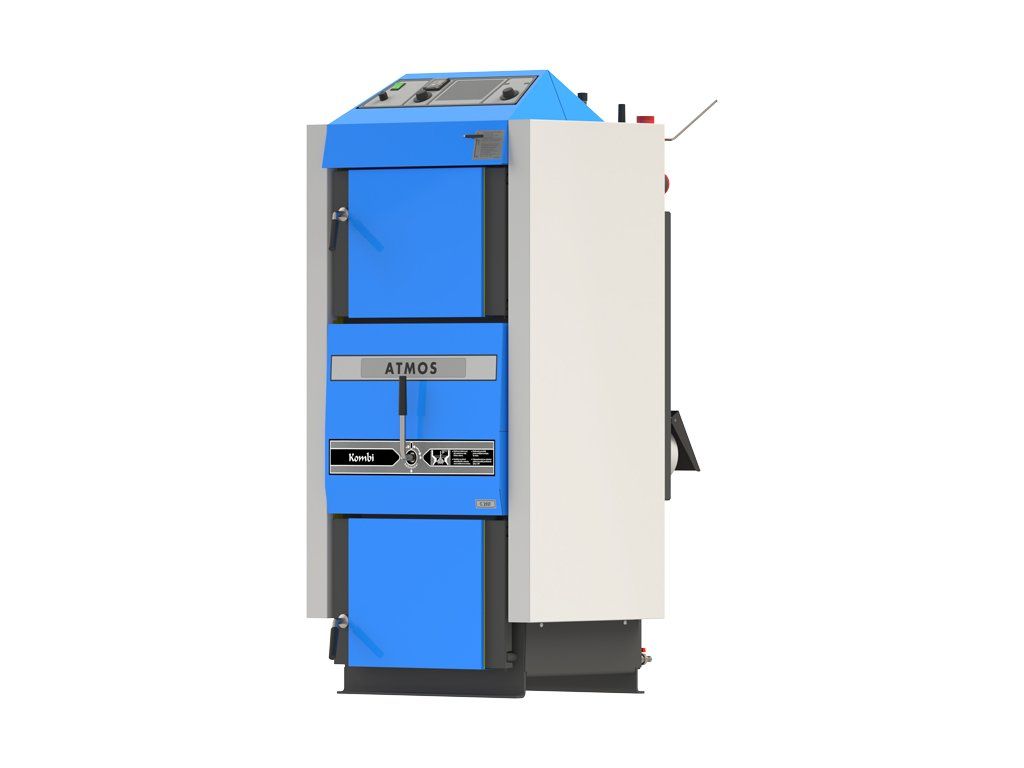
ATMOS is a brand with a long tradition of manufacturing solid fuel boilers in Central Europe, offering a wide output range covering everything from smaller family houses to larger properties. It's a popular choice precisely in combination with a buffer tank, since this setup allows efficient burning of wood and other solid fuels without needing to add fuel constantly. The ATMOS C 25 ST model presented above in the article is a typical example of such a solution for a family house with medium heat demand.
Can you choose between the individual brands by price too, or do they differ significantly?
Price differences between brands do exist and depend mainly on output, the type of technology (condensing vs. classic), and whether the boiler also includes a built-in hot water tank. A compact solution with a built-in tank, such as the Vaillant ecoCOMPACT, is generally more expensive than a standalone boiler without a tank, but saves space and the cost of a separate external tank and the associated piping. When comparing prices, it's therefore always worth considering not just the boiler itself, but also what's included in the given price and what you'd otherwise have to buy separately.
Related topics
If any of the topics in this FAQ interested you in more depth, also see our detailed separate articles devoted to individual questions about stationary boilers and tanks:
- How to choose a stationary boiler
- Stationary vs. wall-mounted boiler – what's the difference
- What output stationary boiler do I need
- Condensing vs. classic stationary boiler
- Solid fuel boiler and buffer tank – how they work together
- Boiler with a built-in or connected domestic hot water tank
- What requirements does a boiler room have for a stationary boiler
- Service, maintenance, and lifespan of a stationary boiler
- Comparison of stationary boiler brands
Have a question about a stationary boiler or tank?
Can't decide, or dealing with a specific situation in your household? Write to us – we're happy to help.