
Frequently Asked Questions About Home Water Pump Systems and Filtration
A home water pump system is one of those pieces of equipment most house owners only think about the moment they need to solve a specific problem - the well is running low, the mains pressure is fluctuating, or they're moving to a plot without a public water supply. That's exactly why a large number of questions have accumulated around home water pump systems and water filtration, questions that reach us both in our advice service and in discussions under our products. In this article we've collected the most common ones and answer them practically, with real numbers and without unnecessary sales padding - where it's appropriate to recommend a specific product, we do so; elsewhere we'd rather explain the principle so you can decide for yourself.
What is a home water pump system and when do you actually need one
A home water pump system is essentially a combination of three elements - a pump that delivers water from the source (well, borehole, tank), a pressure tank that keeps the system at a constant pressure and limits how often the pump switches on, and automatics (a pressure switch or electronic control) that switches the pump on and off as needed. Filtration is sometimes added too, if the water from the source is contaminated with mechanical impurities, sand, or has a higher iron or manganese content.
You need a water pump system in these typical situations: a house or cottage without a connection to the public mains (the source is a well or borehole), a house with its own well as an additional source for watering the garden (even if it's connected to the public mains), or a situation where the pressure from the public mains is insufficient and you need to boost it for the upper floors of the house. Each of these cases requires a somewhat different approach to choosing the pump and tank, which we cover in more detail in a separate article on choosing a home water pump system.
What power and pressure do I actually need from a water pump system
This is probably the most common question we get from customers - and the answer always depends on the number of people in the household, the number of draw-off points (taps, showers, washing machine, dishwasher) and whether you plan to water the garden. In general, a typical household needs a flow rate that can handle simultaneous draw-off from 2-3 points at once, and pressure that ensures comfortable showering even on an upper floor.
For guidance, here are three typical scenarios we encounter most often in practice:
- 1-2 people, flat or cottage: a flow rate of approximately 30-40 litres per minute and pressure of around 2.5-3 bar is sufficient. This typically calls for a smaller pressure tank (for example 24 litres) and a simpler pump.
- 3-4 people, typical family house: we recommend planning for a flow rate of 40-60 litres per minute and pressure of 3-3.5 bar (cut-in pressure approximately 1.5-2 bar, cut-out 3.5-4 bar). Here a pressure tank of around 80-100 litres is worthwhile.
- 5 or more people, house with garden and irrigation: you need to plan for a flow rate of 60-80 litres per minute, pressure of 3.5-4.5 bar and a larger pressure tank (150-200 litres), so the pump doesn't switch on too often even with simultaneous water use in the house and garden.
Below is a simple graphical overview of these three scenarios - the bars show the required flow rate in litres per minute according to household size.
If you're not sure which category your household falls into, it's better to choose a slightly oversized solution - a pump that runs most of the time at 70-80% of its capacity has a longer service life than one permanently at the edge of its limits. You'll find the detailed calculation procedure, including the formula for simultaneous draw-off, in the article on what power and pressure you need from a water pump system.
What types of pumps are used, and when
For home water pump systems, we most often encounter two types of pumps - a self-priming surface pump and a submersible pump. The choice mainly depends on the water level depth in the source.
A self-priming pump is installed outside the source (in a utility room or shaft) and draws water in through a suction hose. It's suitable if the water level in the well or borehole is within about 7-8 metres of the pump - beyond that, self-priming loses effectiveness. An example of a practical solution for this kind of use is the BZP-10 petrol pump, which is engine-driven and portable - it's especially handy where electricity isn't available (a cottage, a plot without a connection) or as a backup solution during a power outage, when you need, for example, to pump water out of a flooded well or basement.
A submersible pump, by contrast, is lowered directly into the borehole or well below the water level and pushes the water upward. It's used for deeper sources, typically boreholes with a water level depth of 10, 20 or more metres. An example is the SKM 100 submersible pump intended directly for wells and boreholes - at a price of €190.40, it's a solution that can also handle a narrower borehole diameter, where a surface pump simply can't be used.
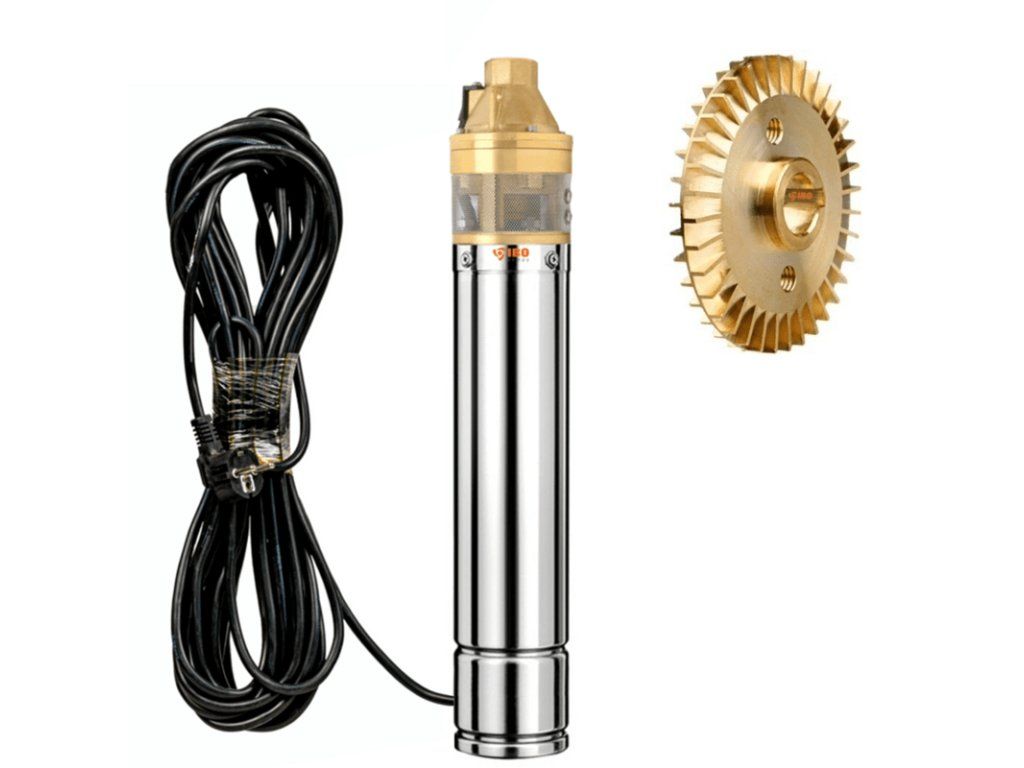 |
SKM 100 submersible pump for wells and boreholes - a suitable choice if the water level in your source is deeper than 7-8 metres and a surface self-priming pump would no longer have sufficient suction power. Price from €190.40. |
 |
BZP-10 petrol water pump, engine-driven, self-priming, portable, for garden use - a practical solution for a cottage without electricity, or as a backup source during a power outage, when you need to quickly pump out or deliver a larger quantity of water. Price from €161.10. |
What size pressure tank is right
A pressure tank (hydrophore tank) performs an important function - it creates a supply of pressurised water in the system, thanks to which the pump doesn't switch on every time a tap is opened, only when the pressure in the tank drops below the set threshold. The larger the tank, the fewer times the pump switches on per day, which extends its service life and reduces wear on the automatics and seals.
We offer three size categories that cover practically all common situations:
- A smaller tank up to 24-30 litres - suitable for a cottage, flat, or as an additional solution alongside an existing system. An example is the AQUA OLA 24 l pressure tank, horizontal, priced at €64.30.
- A medium tank of around 90 litres - the most common choice for a typical family house with 3-4 people. We offer it, for example, as the stainless steel CH 90 L pressure tank, vertical, priced at €466.80. The stainless steel design is more resistant to corrosion, which is especially valued with water that has a higher mineral content.
- A large tank of around 200 litres - for larger households or houses with garden irrigation, where simultaneous draw-off is higher. We offer the galvanised HVP 200 L pressure tank with water gauge, vertical, priced at €535.10.
The following chart compares these three tank sizes together with their approximate price, so you can see how the volume/price ratio changes.
 |
AQUA OLA 24l pressure tank, horizontal, for home water pump systems - a compact solution for a cottage, flat, or as an additional tank alongside an existing system, where there's no room for a larger tank. Price from €64.30. |
 |
Stainless steel CH 90 L vertical water pressure tank for home water pump systems - a proven medium size for a typical family house, the stainless steel design resists corrosion even with harder water. Price from €466.80. |
 |
Galvanised HVP 200L pressure tank with water gauge, 6 bar, for home water pump systems, vertical, without bladder - suitable for larger households or houses with garden irrigation, where a larger supply of pressurised water is needed. Price from €535.10. |
How a home water pump system works in practice - wiring diagram
To make it clear how the individual components work together, let's look at a simplified diagram of a typical system, from the water source to the tap in the house. This sequence applies to most installations; the only difference may be whether filtration is placed before or after the pressure tank (we recommend placing it after the tank, right before the piping into the house, so the filter doesn't clog unnecessarily often).
When installing, it also matters where you physically place the system. For wells with a larger diameter, the pump and accessories are often installed in a water meter shaft, which protects the equipment from frost and the weather while also allowing convenient access for servicing. An example is the round PP water meter shaft 1300x1000, plastic, self-supporting, priced at €261.40 - its advantage is that it doesn't need to be lined or additionally reinforced with walls, which simplifies and shortens installation.
 |
Round PP water meter shaft 1300x1000, self-supporting plastic - a practical solution for placing the water meter, valves or part of the water pump system outside the house, protecting against frost and making service access easier. Price from €261.40. |
A more detailed installation procedure, including recommended pipe diameters and typical connection mistakes, can be found in a separate article on installing and wiring a home water pump system.
When do I need water filtration, and what type
Filtration is handled separately from the water pump system's output, because it solves a different problem - not the quantity or pressure of the water, but its quality. For your own source (well, borehole), we always recommend having at least a basic water analysis done, which will show whether mechanical filtration is needed (sand, sediment), removal of iron and manganese, water softening (high hardness), or, for example, pH adjustment.
In practice, we most often encounter these situations:
- Mechanical filtration - handles sand, rust from piping, and fine impurities. This is the basic level that practically every system connected to its own source should have, since it also protects the pump itself and the fittings from wear.
- Iron and manganese removal - typical for borehole water, where iron shows up as rust-coloured water, stains on sanitary fixtures and laundry.
- Water softening - deals with limescale, which gradually damages water heaters, washing machines and dishwashers. It also shows up as soap lathering less well.
The order of the filters in the system matters - the mechanical filter should always come first (protecting the other components), followed by any iron removal, and softening only at the end, right before the hot water distribution. You'll find a complete overview of filter types, their maintenance and approximate prices in a separate article on water filtration.
How much does a complete home water pump system with basic filtration cost
Customers often ask us about the total budget, not just the price of individual components. As a rough guide, a complete system for a typical family house (3-4 people) consists of the following items: a pump, a pressure tank, basic mechanical filtration, accessories (piping, fittings, pressure switch), and the installation itself.
If we were to put this together from specific products in our range as an example for a medium-sized household - the SKM 100 submersible pump (€190.40) plus the stainless steel CH 90 L pressure tank (€466.80) - we arrive at approximately €657 for just these two key components, to which you need to add mechanical filtration (usually in the range of €40-120 depending on the type and cartridge capacity) and accessories with installation (approximately €150-300 depending on the complexity of the installation and whether you do it yourself or through a professional company).
The following chart shows the approximate cost breakdown of the individual parts of the system for this medium configuration.
So altogether we arrive at an approximate budget of around €960 for a complete, functional medium-sized system - of course, this is an illustrative example; the specific sum will vary depending on the source's depth, the length of the piping, and the quality of components chosen. For a larger household with an HVP 200 L pressure tank instead of the 90-litre one, the budget rises by approximately the price difference between these tanks, i.e. by just under €70, which is not a major difference in the overall investment compared to the benefit of significantly fewer pump switch-ons.
Maintenance - what and how often to check
Regular maintenance extends the lifespan of the whole system and also prevents unpleasant surprises, such as a sudden water outage over a weekend. The recommended schedule looks like this in practice:
- Mechanical filter - check the cartridge and replace as needed approximately every 2-3 months, more often if the source has heavier contamination.
- Pressure tank - check the air bladder's pre-charge pressure once a year (it should usually be 0.2-0.3 bar lower than the pump's cut-in pressure), and top it up through a valve similar to a tyre valve if it has dropped.
- Pump - a visual check of tightness and noise on an ongoing basis, we recommend more thorough servicing once every 2 years, more often with intensive use (for example, irrigating a large garden).
- Iron removal filter/softener - depending on the type of media, usually regeneration or replacement of the media once every 6-12 months.
You'll find the complete maintenance schedule, including specific procedures (for example, how to correctly top up a pressure tank), in the article on maintaining a water pump system and filters.
The most common faults and how to prevent them
Among the problems we encounter most often in our advice service are: a pump that switches on too often even at low water draw-off (usually signalling a loss of pre-charge pressure in the tank or a microscopic leak in the system), a gradual drop in mains pressure over the course of days to weeks (often caused by a clogging mechanical filter or a worn pump membrane), and noisy pump operation, which can signal air in the suction pipe or bearings nearing the end of their service life.
Most of these problems can be prevented by exactly the regular maintenance described above - the most common cause of an unnecessary service call is a neglected check of the pre-charge pressure in the pressure tank, which can be checked in a few minutes without needing a professional. You'll find a detailed overview of faults, their symptoms, and what you can fix yourself versus when to call a service technician in a separate article on the most common faults in a home water pump system.
Frequently asked questions
Do I always need filtration with a well?
Not automatically, but we recommend it in most cases. At the very least, mechanical filtration protects the pump and fittings from wear caused by sand and fine impurities, which is always worthwhile in practice, even if you wouldn't need it for drinking water quality reasons. The extent of further filtration (iron removal, softening) should be based on a water analysis.
How big a difference is there between a 90-litre and a 200-litre pressure tank in practice?
The main difference isn't in the maximum pressure, but in how often the pump switches on. A larger tank means fewer switch-ons per day, which saves wear on both the pump and the automatics. For a typical household without irrigation, the difference is more about comfort and component lifespan; for houses with garden irrigation, the difference is already noticeable in the system's practical performance during simultaneous draw-off in the house and garden.
Can the BZP-10 petrol pump be used as a permanent part of a home water pump system?
No, this type of pump is intended more as a mobile or backup solution - for example for a cottage without electricity, pumping water out after a flood, or as an emergency source during a power outage. For a permanent, automatically controlled home water pump system, you need an electric pump connected to a pressure switch and automatics that switch it on and off on their own as needed.
How often should I check the tank pressure, and can it be done myself?
Yes, checking the pre-charge pressure is simple, and we recommend doing it once a year. It's done similarly to checking tyre pressure - you connect a pressure gauge via the small valve on top of the tank (first you need to depressurise the system and drain the water from the tank). The correct pre-charge pressure is usually 0.2-0.3 bar lower than the pump's set cut-in pressure.
Is a stainless steel pressure tank worth it over a galvanised one, given it's more expensive?
For harder water or water with a higher mineral content, yes - stainless steel is more resistant to corrosion and usually has a longer service life. For typical, less aggressive water, the difference in practical lifespan is smaller, and the decision can be based more on budget and the available volume within a given product line.
Do I need a water meter shaft even if my pump is in a utility room in the house?
Not necessarily - a shaft is mainly used when a water meter, shut-off valves or part of the system needs to be placed outside the house, for example at a well on the plot or at a connection point to the public mains located further from the house. If the whole system is in the utility room, you don't need a shaft.
Related topics
- How to choose a home water pump system
- What power and pressure do I need from a water pump system
- Pressure tanks for a home water pump system
- Water filtration - types of filters and when you need them
- Installation and wiring of a home water pump system
- Maintenance of water pump systems and filters
- The most common faults in a home water pump system
You'll find the complete range of pumps, pressure tanks, filtration and accessories in the main category Home water pump systems and filtration.
Do you have a question about this topic?
Not sure what to do, or dealing with a specific situation in your household? Write to us - we're happy to help.