
What Pump Power and Pressure Do I Need
The question "what pump power and pressure do I need" sounds simple at first glance, but in practice it's the most common reason people bring home an incorrectly sized pump. Either they buy a model that's too weak, which runs out of breath when the shower and washing machine are used at the same time and the pipe pressure drops to a minimum, or conversely they invest in a needlessly oversized pump system that's constantly switching on and off, is noisy, and wears out faster. In this article we'll go step by step through what the terms output, flow rate, and pressure actually mean, how to calculate your household's real needs yourself, what role the well depth and suction lift play, and finally three concrete real-world examples with recommended products.
Why pump output and pressure is a key question
A home water pump system isn't just a pump bolted to a pipe - it's an entire system that also has to handle the moments when water demand is highest. Picture a typical morning in a family home: someone's in the shower, water's running into the kettle in the kitchen, the washing machine is filling, and outside the irrigation system might still be finishing its cycle. If the pump system doesn't have enough output, it shows immediately - pressure throughout the house drops, the shower "coughs" out cold water, the washing machine signals a low-pressure error, and the taps bubble air. Conversely, if the pressure is set too high or the tank is too small, the pump switches on practically every time a tap is opened, which shortens its lifespan and increases electricity consumption.
Correct sizing therefore isn't just a technical formality - it genuinely affects living comfort, pump lifespan, and operating costs for years to come. The good news is that the calculation isn't complicated - you just need to know a few basic numbers and put them together correctly.
Basic terms you need to know
Flow rate (output) in litres per minute
Flow rate, commonly given in litres per minute (l/min) or cubic metres per hour (m³/h), tells you how much water the pump can deliver per unit of time at a given pressure. This figure is the most important parameter when choosing a pump, because it directly determines how many draw-off points you can use at the same time without a noticeable pressure drop. As a guide - a typical showerhead uses roughly 8 to 12 litres per minute, a kitchen sink around 6 to 8 litres per minute, a washing machine filling 8 to 10 litres per minute, and a garden hose or sprinkler easily 15 to 20 litres per minute.
Pressure in bar and the operating range
Pressure is given in bar and determines how forcefully water comes out of a tap or shower. For a typical household, a comfortable operating pressure is in the range of 2.5 to 4 bar. Pump systems work within a so-called switching range - when the pressure in the system drops below the lower threshold (typically around 1.5 to 2 bar), the pump switches on automatically and restores pressure until it reaches the upper threshold (usually 3 to 4 bar), at which point it switches off again. It's precisely this hysteresis (the difference between the switch-on and switch-off pressure), combined with the pressure tank's volume, that determines how often the pump will cycle.
Suction lift and the effect of well depth
If the pump draws water from a well or borehole, an important parameter is suction lift - the distance between the water level and the pump. Standard surface home water pump systems can physically draw water up to a theoretical maximum height of roughly 8 to 9 metres (in practice, due to losses in the pipework and altitude, realistically 6 to 7 metres), because suction works on the principle of atmospheric pressure, which has its own physical ceiling. For deeper wells or boreholes, a submersible pump therefore has to be used, which is placed directly in the water and pushes the water upward rather than drawing it - this principle has practically no depth limit and can handle boreholes tens of metres deep.
How many litres per minute do you actually need
The simplest way to picture the required output is to divide households into a few categories based on how water is actually used. These values come from everyday practice in selling and advising on home water pump systems, and they include a reasonable margin for simultaneous draws.
Worked out in practice: a cottage, a family home, a house with a garden
For a cottage or weekend home, where usually only one tap or shower is used at a time, an output of around 20 to 30 litres per minute is enough. A typical family home with one bathroom, kitchen, and toilet, where at most two draw-off points run at the same time (for example a shower and a kitchen sink), needs about 40 to 50 litres per minute. If the house has a garden with an irrigation system or a larger area to water, you need to add a margin and plan for 60 to 80 litres per minute, because garden irrigation alone can "eat up" 15 to 20 litres per minute. And finally, households with several bathrooms, or smaller commercial premises or farms with a higher number of simultaneous draws, should reach for pump systems with an output of 90 to 120 litres per minute.
What matters is not to add up all the theoretically possible draws in the house, but to consider simultaneity - i.e. how many taps are actually running at the same moment. It's precisely this consideration that most often decides whether a household chooses an output of 45 or 70 litres per minute.
What pressure to set and what affects suction lift
A simple rule applies when setting the pressure - the lower threshold (switch-on pressure) should be set so that a comfortable pressure of at least 1.5 bar remains even at the highest floor or the tap furthest from the pump system. If you have a floor at a height of 3 metres, you need to plan for a loss of roughly 0.3 bar just to overcome this height (every 10 metres of water column height corresponds to a loss of roughly 1 bar), plus friction losses in the pipework, which increase with the length of the pipe runs and the number of elbows and fittings.
That's why for wells where the water level is deeper than roughly 6 metres below the pump, or for boreholes, a submersible pump is used instead of a surface pump system - it's lowered directly into the water and pushes the water upward, bypassing the physical limit of suction. An example is the SKM 100 submersible pump, designed exactly for this type of application.
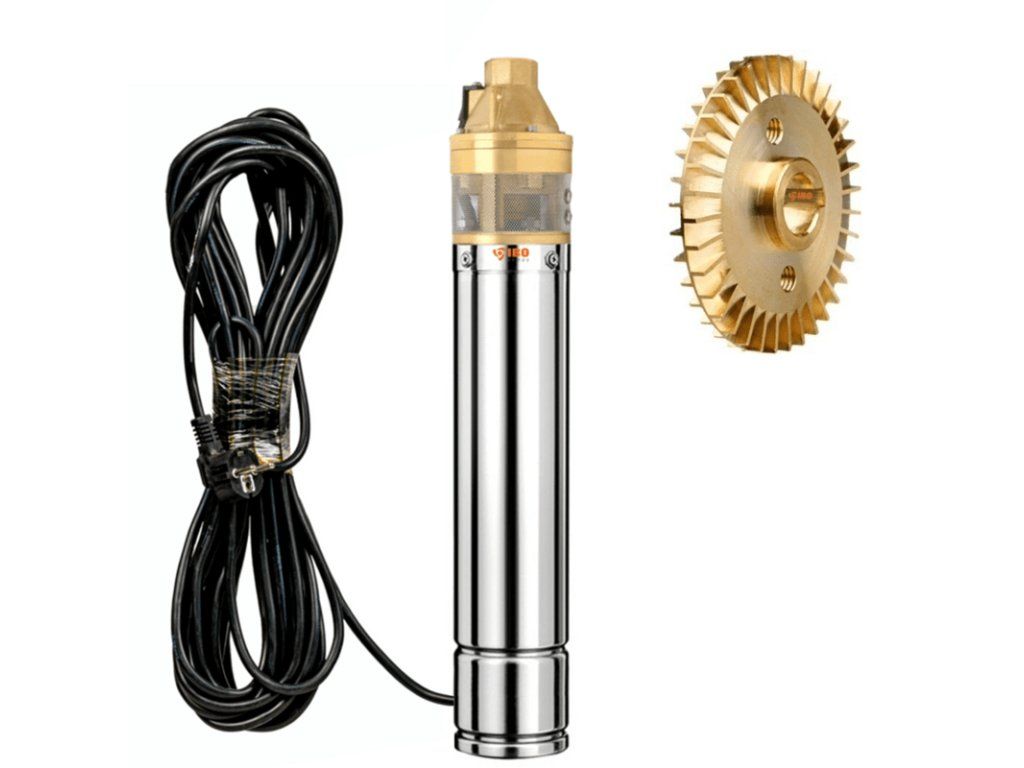 |
SKM 100 submersible pump for wells and boreholes - suitable exactly when the water level is deeper than the aforementioned 6-7 metres and a surface pump system could no longer physically draw the water up. It's placed directly in the well or borehole and pushes the water upward with no suction-lift limitation. Price from 190.40 EUR. |
The role of the pressure tank and its size
The pressure (diaphragm) tank is often underestimated but a key element of the whole pump system. Its job is to keep a supply of water under pressure in the system so the pump doesn't have to switch on for every tiny draw - for example when someone just washes their hands. The larger the tank, the less frequent the pump's switching cycle, which extends its lifespan and reduces wear on the contacts and diaphragm.
For a small household, cottage, or flat with a single bathroom core, a smaller tank of around 24 litres is fully sufficient, and it also fits into a cramped utility room. An example is the AQUA OLA 24l horizontal pressure tank, a popular choice precisely for smaller households and cottages. For a typical family home with a reasonable number of draw-off points, a tank with a volume of around 90 litres is more suitable, where it's worth reaching for a higher-quality stainless steel design for a longer lifespan - here the CH 90 L stainless steel pressure tank is a suitable choice. And finally, for households with a garden, an irrigation system, or several simultaneously used draw-off points, a significantly larger tank of around 200 litres is recommended, which can cover even a sudden high demand without the pump cycling frequently - here the HVP 200L galvanised pressure tank with sight glass is suitable.
 |
AQUA OLA 24l pressure tank, horizontal, for home water pump systems - a compact solution for a cottage, flat, or small household with a single bathroom core, where a smaller volume is enough and a lower switching frequency isn't an issue. Price from 64.30 EUR. |
 |
CH 90 L stainless steel pressure tank, vertical, for home water pump systems - a well-balanced solution for a typical family home, where the stainless steel design ensures a significantly longer lifespan than galvanised tanks, especially with harder water. Price from 466.80 EUR. |
 |
HVP 200L galvanised pressure tank with sight glass, 6 bar, for home water pump systems - a large-volume solution for households with a garden, an irrigation system, or several simultaneously used draw-off points, where it's important to limit frequent pump cycling. Price from 535.10 EUR. |
Procedure: how to calculate the required output yourself
The following procedure will help you arrive at a real figure without having to call a technician - although for larger or more complicated installations (a deep borehole, several buildings, a combination of irrigation and utility water in the house), consulting a specialist is always advisable.
Step 1 - count the draw-off points. List all the taps, showers, toilets, the washing machine, the dishwasher, and any garden hose or irrigation the house has.
Step 2 - determine the simultaneity of draws. Be realistic about how many of these points can genuinely be in use at the same time. For a typical family that's usually no more than two or three points at once, even if the house has ten draw-off points.
Step 3 - add up the flow rate. Assign each simultaneously running draw-off point its typical flow rate (shower 8-12 l/min, sink 6-8 l/min, washing machine 8-10 l/min, garden 15-20 l/min) and add them up. Add a margin of roughly 15-20% to the resulting figure so the pump system isn't constantly working at its maximum.
Step 4 - check the depth and suction lift. Measure or find out the depth of the water level in the well or borehole. If it exceeds roughly 6-7 metres, plan for a submersible pump instead of a surface pump system.
Step 5 - choose the pump and pressure tank. With the calculated flow rate and knowledge of the suction lift, you can now choose a specific model and a suitably sized pressure tank to go with it, according to the table above.
Three real-world examples
Example 1: A cottage with one draw-off point
A smaller cottage with one bathroom and a kitchen tap, where at most one draw is used at a time. Water is pumped from a nearby well with a water-level depth of around 4 metres. Here an output of 20-30 litres per minute and a smaller pressure tank of up to 24-50 litres is fully sufficient. Since the depth is below the limit for normal suction, a surface pump system handles the job without any problem.
Example 2: A family home for four people
A typical family home with one bathroom, kitchen, toilet, and washing machine, where in the morning a shower and a kitchen tap run at the same time. The sum of the flow rates (10 + 7 l/min) plus a margin gives a need of around 45 litres per minute, which corresponds exactly to the "family home 1-4 people" category from the table above. A pressure tank of around 90 litres is suitable, for example the stainless steel CH 90 L, which also handles harder water well without corroding.
Example 3: A house with a garden and a deeper borehole
A house with a garden where, during summer, the bathroom in the house and the garden irrigation are used at the same time, with water pumped from a borehole with a level at a depth of around 12 metres. Here a surface pump system is already physically insufficient because of the depth, so a submersible pump (for example the SKM 100) is needed, supplemented with a large-volume pressure tank of around 200 litres, so that frequent summer irrigation doesn't cause the pump to keep cycling constantly.
The most common mistakes when choosing output and pressure
The first typical mistake is adding up all the draw-off points in the house instead of the real simultaneity of use - the result is a needlessly oversized and more expensive pump system. The second common mistake is underestimating the suction lift - when the owner buys a standard surface pump system without checking the actual depth of the water level, and the pump then simply doesn't draw water at all, or only with a significantly reduced output. The third mistake is too small a pressure tank in a house with a garden - the pump then cycles almost continuously during watering, which dramatically shortens its lifespan. The fourth mistake is forgetting the margin - calculating "right at the edge" without any margin usually doesn't pay off, because a household's needs tend to increase over the years (an extension, a pool, irrigation) rather than decrease.
Finally, it's worth mentioning an alternative for smaller or temporary use outside the house's main water supply - for example in the garden, at a cottage without an electrical connection, or as an emergency solution. A petrol-engine pump is suitable for this purpose, as it works independently of the electrical grid.
 |
BZP-10 petrol water pump, engine-driven, self-priming, portable, for the garden - a practical choice for watering the garden, transferring water at a cottage without electricity, or as an emergency solution independent of the electrical grid. Price from 161.10 EUR. |
Effect on electricity consumption and pump lifespan
Correctly chosen output and pressure show up not only in comfort but also in your wallet and in how long the pump lasts. The electrical power draw of pumps for a typical household is typically between roughly 550 W for smaller models and 1100-1500 W for more powerful pump systems for a house with a garden. Electricity consumption itself isn't at all dramatic for typical household use - with a realistic daily draw of a few dozen minutes of operation per day, we're talking about a few euros a month. Incorrect sizing shows up far more significantly in the number of switching cycles. If the pressure tank is too small or the hysteresis too narrow, the pump can cycle several hundred times a day instead of a few dozen, which puts significant strain on the starting capacitor, the pressure switch contacts, and the tank diaphragm itself. In practice this means that an undersized or poorly equipped pump system, which at first glance saves money on the purchase, often breaks down prematurely, and the repair or replacement of key parts ultimately costs more than if a slightly larger pressure tank or a more suitable pump model had been chosen from the start.
It's also worth thinking about seasonal fluctuations. While in winter a household usually only uses normal indoor draws, in summer these are joined by garden irrigation, a pool, washing the car, or watering a greenhouse, so peak demand can be two to three times the winter average. When sizing output, therefore always plan for the summer peak, not the winter average - a pump system sized only for winter needs will be permanently at the limit of its capability during summer.
When it's worth calling in a specialist
The procedure described above covers the vast majority of typical family homes and cottages. There are, however, situations where a simple calculation is no longer enough without an expert assessment - for example when a house combines several water sources (both the public mains and a well), when several separate buildings on one plot need to be supplied at the same time, when it's a deeper borehole with an unknown yield (i.e. how much water the well or borehole can actually supply per unit of time, which is a different parameter from pump output), or when a larger irrigation system with automatic control is planned. In such cases we recommend contacting a professional installation company, which can also take into account local specifics such as water hardness, level fluctuations during the year, or regulations on groundwater abstraction.
Frequently asked questions
What's the difference between pump output and pump system pressure?
Output (flow rate) tells you how many litres of water per minute the pump can deliver, while pressure tells you the force with which water comes out of a tap. Both parameters are related - a pump's actual flow rate drops as the required pressure increases, which is why they're always given together in the form of a so-called pump performance curve.
Can I use a smaller pump system and simply buy a larger pressure tank?
A larger pressure tank helps reduce the switching frequency, but it won't make up for insufficient pump output. If the pump can't deliver enough flow when several points are drawing at the same time, the pressure in the system will drop regardless of the tank's size - the drop will just show up later.
How do I find out how deep the water level is in my well?
The simplest way is to lower a long rope or tape measure with a weight into the well until you feel the water level, and measure the distance from the edge of the well. For a borehole, this information is usually provided by the company that drilled it, or it's stated in the well's project documentation.
What happens if I buy a pump system that's too powerful?
An oversized pump system isn't a functional problem, just an unnecessarily higher investment. There's some risk that with very high output and a small pressure tank, the pump may switch on and off faster than optimal, which is why more powerful pumps are recommended to be combined with an appropriately sized pressure tank.
Does the length and diameter of the pipework affect the required output?
Yes, longer pipework with a smaller diameter or more elbows and fittings causes greater pressure losses from friction. For larger houses or longer runs (for example to a more distant garden), it's therefore advisable to plan for a slightly higher pump output than would correspond just to the sum of the draw-off points.
Can one pump system be used for both drinking and utility water from a well at the same time?
Technically yes, the pump and pressure tank don't distinguish the purpose of the water they're pumping. However, for well or borehole water intended for drinking, its quality must always first be checked at an accredited laboratory, and suitable filtration added if needed based on the result.
Related topics
How to Choose a Home Water Pump System
Pressure Tanks for Home Water Pump Systems
Well vs. Mains Water - When a Pump System Pays Off
Installing and Connecting a Home Water Pump System
Back to the main category: Home Water Pump Systems and Filtration
Do you have a question on this topic?
Not sure, or dealing with a specific situation in your household? Write to us - we're happy to advise.