
How to Choose a Home Water Pump System
A home water pump system is one of those devices that most people buy exactly once every fifteen years or more - and that's precisely why so many mistakes happen when choosing one. An undersized pump, an undersized pressure tank, or the wrong type for a given water source can cause fluctuating water pressure, frequent pump cycling, noisy operation, and an unnecessarily shortened lifespan for the whole system. In this article we'll go step by step through how to navigate the range of home water pump systems on offer, what to actually look at, and where it pays to invest a bit more so you're not dealing with the same problem again in three years.
We're working from the everyday situations we encounter most often at atria.sk - supplying a family home with water from a well or borehole, boosting pressure from the public water mains, and garden/cottage solutions. For each topic we'll also show specific products from our range so you can see how the theory plays out in real prices and parameters.
What is a home water pump system and what is it for
A home water pump system is a compact system that delivers water from a source (well, borehole, tank, or the public water mains) to the plumbing in the house while also keeping the pipework at a stable pressure. It essentially consists of three parts: the pump, the pressure tank (hydrophore), and the control/switching unit with a pressure switch and pressure gauge. Some models have all three parts built into a single housing, while others consist of a separate pump and tank connected by piping.
The principle is simple - when you open a tap, the pressure in the system drops below a set threshold (typically around 1.5-2 bar), the switch turns the pump on, and it refills water into the tank and the plumbing at the same time. When the pressure reaches the upper threshold (usually 3-4 bar), the pump switches off. The pressure tank does a very important job here - it evens out short draws (washing hands, flushing) so the pump doesn't switch on for every small amount of water drawn. That's exactly why its volume is one of the most important selection parameters, which we'll cover in a separate chapter.
So a water pump system isn't just "an extra pump" - it's a system whose individual components have to match each other in both power and volume. An oversized tank paired with a weak pump means slow pressure recovery; an undersized tank paired with a strong pump means frequent cycling and rapid wear of both the motor and the diaphragm.
When a home water pump system is worth it and when it isn't
The first question you need to answer is: do you have your own water source (a well or borehole), or are you connected to the public water mains? If you have your own source, a pump system is practically essential - without it, water simply won't get from the well into the house. If you're connected to the public mains and the pressure is sufficient, you don't need a pump system at all.
There is, however, a third and increasingly common situation - you're on the public mains, but the pressure is at or below the threshold, typically on upper floors, at the ends of water main branches, or in towns with older infrastructure. In that case a so-called booster water system is used, which doesn't add water from a source but simply increases and stabilizes the pressure of the existing supply. Here a smaller pump output is usually enough, because the water is already in the pipe - it just lacks pressure.
A more detailed breakdown of the decision between a well and the mains, including approximate operating costs for both variants, can be found in a separate article, Well vs. Mains Water - When a Pump System Pays Off.
The water source determines the pump type
This is probably the most important decision in the whole selection process, because choosing the wrong pump type for the source simply won't work, or will work poorly and not for long. There are essentially two basic types:
Submersible pumps
A submersible pump is lowered directly into the water - into a well or borehole. It's used wherever the water level is deeper than roughly 7-8 metres, i.e. for most drilled boreholes and deeper dug wells. The advantage is that the pump works "on discharge pressure" (it pushes water up), not on suction lift, so it can handle even tens of metres of depth without losing output due to suction limits. The downside is a more complex installation (lowering it on a rope/hose into the borehole) and more demanding servicing in case of a fault.
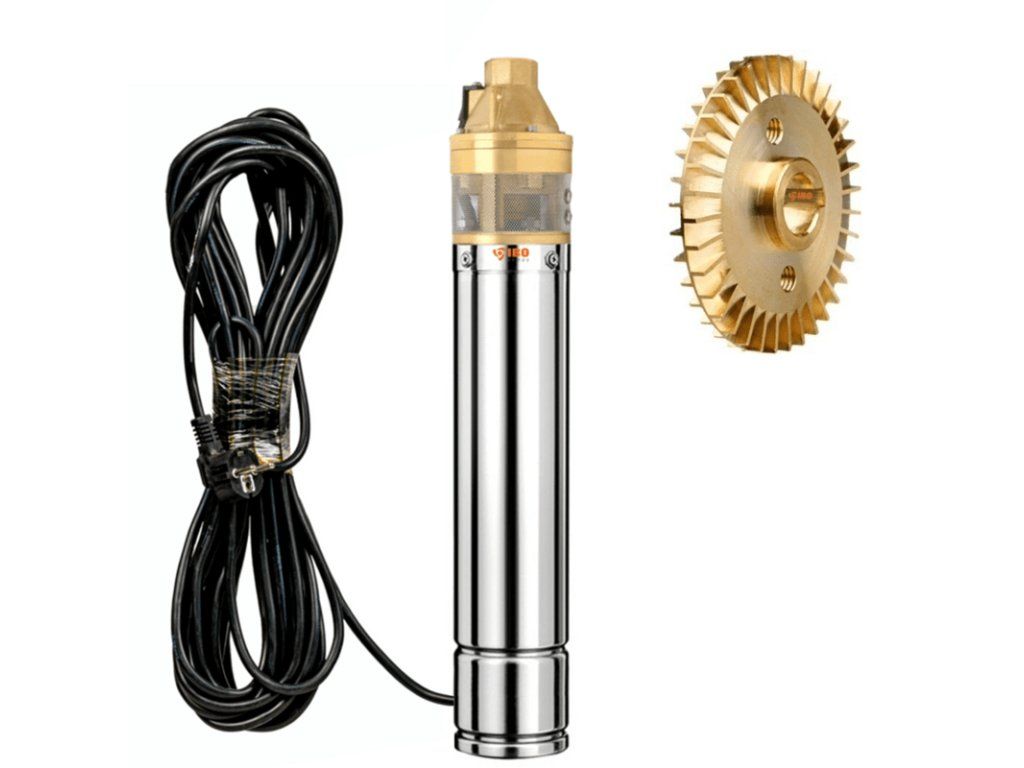 |
SKM 100 submersible pump for wells and boreholes - a typical example of this category, suitable directly for a drilled borehole or a deeper dug well, where a surface pump can no longer draw water up. Price from 190.40 EUR. |
Surface (self-priming) pumps
A surface pump stands outside the water, usually in a utility room or a shaft, and draws water in through a suction hose fitted with a foot/check valve. Their limit is suction lift - the physical maximum is roughly 8-9 metres (in practice you should plan for around 7 metres including losses in the pipework), so they're suitable for shallower wells, rainwater tanks, or as booster systems from the mains. The advantage is easier access for servicing and a lower purchase and service price.
A special category is portable engine-driven (petrol) pumps, which aren't used as a permanent part of a home water pump system but rather for garden irrigation, pumping from a greater distance, or as an emergency solution during a power outage - they work independently of the electrical grid.
 |
BZP-10 petrol water pump, engine-driven, self-priming, portable, for the garden - a self-priming, portable solution independent of electricity, practical as a backup source during a power outage or for garden irrigation from a tank or stream. Price from 161.10 EUR. |
Below is a simplified diagram summarising the difference between the two main types - note in particular the different depth ranges each one can work effectively within.
What output and pressure your water pump system actually needs
After the pump type, the second key parameter is output - specifically flow rate (how many litres of water per hour the pump delivers) and pressure (what pressure it can build and hold in the system). Both parameters need to be assessed together, because pump output drops as discharge height increases - meaning a pump that delivers, say, 4000 l/h at zero height may deliver noticeably less when pumping up to the second floor.
As a rough guide, a typical four-person household with one bathroom, a kitchen, and a washing machine needs a flow rate of about 2500-3500 litres per hour and a pressure of around 3 bar at the draw-off point. If the house has several draw-off points at the same time (for example an upstairs bathroom as well as a ground-floor one, garden irrigation, several taps running at once), you need to plan for a higher flow rate, because the individual draws add up. We cover the exact calculation based on the number of people, appliances, and height differences in the house in detail in the article What Pump Power and Pressure Do I Need - we recommend reading it before choosing a specific model, since underestimating output is one of the most common selection mistakes.
The following chart illustrates how the approximate flow-rate requirement changes according to household size and the number of simultaneous draw-off points - the values correspond to the common recommendations we also use when advising customers.
Pressure tank - size and material determine both comfort and lifespan
The pressure tank (hydrophore) is often underestimated, even though it has a direct effect on how often the pump switches on, and therefore on its lifespan. The larger the tank's volume, the less often the pump kicks in during normal draws, which means quieter operation, less wear, and more stable water pressure while showering or filling the washing machine.
As a rule of thumb: smaller tanks up to around 24-50 litres are suitable for cottages, flats, or households with minimal simultaneous draw. Medium tanks of around 80-100 litres will cover a typical family home. Larger tanks from 150 litres upward are worthwhile for houses with several bathrooms, garden irrigation, or wherever you want a longer interval between pump cycles even at the cost of a higher initial investment.
The second decisive factor is material and construction - galvanised tanks with a sight glass (a transparent level tube) are a proven, more affordable solution, while stainless steel tanks last longer especially with more aggressive water (for example water high in iron) from a well, because they don't corrode. When choosing between a vertical and a horizontal (lying) design, the main deciding factor is the space available in your utility room - horizontal tanks fit under the ceiling in low spaces, while vertical tanks save floor space.
 |
AQUA OLA 24l pressure tank, horizontal, for home water pump systems - a compact horizontal solution for cottages, smaller households, or as an additional tank for lower draw. Price from 64.30 EUR. |
 |
CH 90 L stainless steel pressure tank, vertical, for home water pump systems - a medium size suitable for a typical family home; you'll appreciate the stainless steel design especially with well water that has a higher iron content. Price from 466.80 EUR. |
 |
HVP 200L galvanised pressure tank with sight glass, 6 bar, for home water pump systems, vertical, bladderless - a large-volume solution for a bigger house, several draw-off points, or in combination with a larger pump, where you want the longest possible intervals between pump cycles. Price from 535.10 EUR. |
To get a better idea of the price and volume differences between the individual tank classes, see the overview below - the height of the bar corresponds to the volume in litres, with the price shown under each bar.
You can find more on the differences between tank types (including bladder vs. bladderless, permissible pressure, and recommended air pre-charge pressure) in a separate article, Pressure Tanks for Home Water Pump Systems.
Accessories that are often forgotten: the meter shaft and filtration
For an outdoor well or borehole, you also need to deal with the placement of the water meter, shut-off valves, and possibly the pump system itself outside the house - water meter shafts are designed for exactly this. A self-supporting plastic shaft is set directly into the ground above the connection, protects the fittings from frost, and also allows convenient access for meter reading or servicing.
 |
PP 1300x1000 round water meter shaft, plastic, self-supporting - a practical solution for locating the water meter and shut-off valves outside the house; the self-supporting construction can withstand backfilling with soil without additional concreting. Price from 261.40 EUR. |
A second topic closely tied to a pump system, especially with your own water source, is filtration. Water from a well or borehole can contain mechanical impurities (sand, sediment), an elevated iron and manganese content, or hardness above recommended values. Improperly filtered water shortens the lifespan not only of the pump system itself but also of the washing machine, boiler, or heating boiler. We therefore recommend considering at least a mechanical pre-filter for every new pump system on your own water source, or a complete filtration set based on a water analysis. You can find a detailed overview of filter types and when each one is needed in the article Water Filtration - Types of Filters and When You Need Them.
Step-by-step process for choosing a water pump system
If you want to simplify your decision-making, it's worth proceeding in this order - the order isn't arbitrary, since each following step depends on the previous one:
This process deliberately leaves the choice of specific brand and model until last - the parameters (type, output, volume) should be clear before you start comparing specific products, otherwise it's easy to end up choosing based on price or looks rather than what the house actually needs.
Installation - what to watch out for
Installing a home water pump system isn't complicated from a craftsmanship point of view, but there are a few points that are often underestimated in practice. For a surface pump, the length and diameter of the suction hose are key - too long or too thin a hose increases losses and the pump won't reach its rated output. The suction pipework must be airtight, because even a small leak will cause the pump to lose its prime and "run dry".
For a submersible pump in a borehole, it's important to correctly size the discharge pipe and protect the pump against dry running (most often with a float or electronic level sensor) - otherwise, if the water level drops (for example during a dry period), the pump can be destroyed within a few minutes of running.
The pump system - or rather its control unit and pressure tank - needs to be placed in a frost-protected space. Frozen water in the tank or in a seal can cause it to crack and effectively take the equipment out of operation in the middle of winter, when a repair is least convenient. In the utility room, it's also worth planning for drainage of any water leak (a floor drain or at least a catch tray) and enough space around the equipment for future servicing - replacing the tank's diaphragm, cleaning the filter, or checking the seals needs to be done repeatedly throughout the system's lifespan.
You'll find the complete connection procedure, including a pipework diagram, check-valve placement, and the recommended order of components, in the article Installing and Connecting a Home Water Pump System.
Budget - how much a water pump system with all its accessories costs
The total investment in a functional home water pump system consists of several items that can be combined according to the actual situation. If we sum up the prices of the products mentioned above, it's clear the range is genuinely wide - from a simple solution for a cottage to a complex system for a larger family home with a borehole.
- Portable petrol pump (BZP-10): from 161.10 EUR - suitable as a supplement or backup solution, not as the main pump system for the house.
- Submersible pump for a borehole (SKM 100): from 190.40 EUR.
- Small pressure tank (AQUA OLA 24l): from 64.30 EUR.
- Medium stainless steel tank (CH 90 L): from 466.80 EUR.
- Large galvanised tank (HVP 200L): from 535.10 EUR.
- Water meter shaft (PP 1300x1000): from 261.40 EUR.
A simple solution for a cottage (pump + small tank) thus comes out at roughly around 250-260 EUR excluding installation, while a complete system for a family home with a borehole, a larger tank, and a shaft ranges roughly from 900 to 1300 EUR excluding installation, depending on the chosen tank size and any filtration. On top of that you need to add the cost of pipework, electrical wiring, and the installation itself, which varies depending on the location and the complexity of the borehole.
It's important to view the pressure tank and pump as an investment with a long payback period - a better-quality (larger or stainless steel) tank means fewer pump cycles per day, which directly shows up in motor lifespan and how noisy the system is. Saving a few dozen euros on the tank therefore usually doesn't pay off in practice.
The most common mistakes when choosing a home water pump system
Over years of experience selling pumping equipment, a few typical mistakes keep recurring, and they're easy to avoid:
Underestimated pump output
The customer chooses a pump based on the lowest price, regardless of the number of draw-off points in the house. The result is weak pressure when several appliances are used at the same time (for example a shower and a washing machine running together).
Pressure tank that's too small
A small tank in a larger house means the pump kicks in practically every time a tap is opened - that's audible, uncomfortable, and unnecessarily wears out both the motor and the diaphragm.
Wrong pump type for the water-level depth
A surface pump installed on a well with a level deeper than 7-8 metres simply won't work reliably - it will lose its prime and its output will be significantly lower than the manufacturer states.
Forgotten dry-run protection
Especially with submersible pumps in boreholes with a fluctuating water level (for example in drier summers), a pump can be irreversibly damaged within minutes without dry-run protection.
Underestimated filtration
Water with an elevated sand or iron content, without a pre-filter, gradually damages not only the pump system but also every appliance connected to the supply - the washing machine, the boiler, the heating boiler.
Placement in an unheated space
A pump system placed in a space without frost protection is at risk of a cracked tank or pipework during the first hard winter.
Frequently asked questions
How big a pressure tank (hydrophore) do I need for a family home?
For a typical family home with four occupants and one or two bathrooms, a tank with a volume of around 80-100 litres is suitable, for example the CH 90 L stainless steel tank. For a larger house with several simultaneous draws or garden irrigation, it's worth reaching for a tank of 150 litres or more, for example the HVP 200L.
Can I use a surface pump for a borehole deeper than 10 metres?
No, or at least not reliably. Surface (self-priming) pumps have a physical suction-lift limit of around 7-8 metres in practice. For a deeper water level, you need a submersible pump, such as the SKM 100, which works directly in the water and handles tens of metres of depth without losing output.
How often should the diaphragm in a pressure tank be replaced?
The diaphragm's lifespan is typically between 5 and 10 years, depending on water quality, the number of pump cycles, and the quality of the diaphragm itself. You can tell a cracked or worn diaphragm because the tank stops acting as a buffer and the pump starts switching on noticeably more often.
Is a stainless steel tank really necessary, or is a galvanised one enough?
With water from the public mains without an elevated iron content, a galvanised tank with a sight glass, such as the HVP 200L, is perfectly adequate and more affordable. A stainless steel tank, such as the CH 90 L, is recommended especially for well water with a higher iron content or other more aggressive components, where a galvanised surface corrodes faster over time.
Can a home water pump system be operated without electricity, for example during a power outage?
A standard electric pump system doesn't work without electricity. As an emergency or supplementary solution in that case, a portable engine-driven (petrol) pump is used, for example the BZP-10, which works independently of the electrical grid and can temporarily provide at least a basic water supply.
Do I always need a water meter shaft with a pump system?
A shaft is needed above all when the water meter and shut-off valves are located outside the house, for example with a connection from a well or the public mains routed across the property. If the entire system (including the water meter) is located directly in the house's utility room, a separate external shaft isn't necessary.
Related topics
- What Pump Power and Pressure Do I Need
- Pressure Tanks for Home Water Pump Systems
- Water Filtration - Types of Filters and When You Need Them
- Installing and Connecting a Home Water Pump System
- Well vs. Mains Water - When a Pump System Pays Off
You'll find the full range of pumps, pressure tanks, and accessories in the main category Home Water Pump Systems and Filtration.
Do you have a question on this topic?
Not sure which pump system, pump, or pressure tank to choose for your specific house and water source? Write to us - we're happy to advise.