
Well vs. Water Mains - When a Home Water Pump System Pays Off
Well vs. water mains – when a home water pump pays off
The question "should I connect to the public water mains, or build my own water source" troubles a large share of house owners in Slovakia – especially those building outside larger towns, where the mains either don't reach at all, or the connection is expensive and complicated. Just as often the question comes up the other way round: the house is already connected to the mains, but the owner is considering a well as an additional source for watering the garden, washing the car or filling a pool, in order to save on water and sewage charges. In this article we'll look at the real numbers, at how your own water source works technically, what components you need, and when investing in a home water pump system genuinely pays off – and when it's cheaper and simpler to just stay on the mains.
How much water a household actually uses
Before we start counting costs, it's important to have a realistic idea of consumption. Average water consumption per person in a household in Slovakia is roughly 35 to 40 m³ a year (i.e. around 95 to 110 litres per person per day, matching typical water utility statistics and practical experience). For a four-person household that means approximately 140 to 160 m³ of water a year. On top of that comes seasonal garden consumption – for an average garden with a lawn and vegetable patch, summer watering can add another 20 to 40 m³ per season, with larger plots or a pool adding significantly more.
This figure – say 150 m³ a year as an average for a typical four-person household without a large garden – will be used as the basis for all further calculations in the article, so you can see exactly how we arrive at the conclusions. Your actual consumption may differ, so at the end we recommend checking your own water bills and adjusting the calculation accordingly.
What water from the mains really costs
The price of water from the public mains consists of two items – the water charge (for delivered drinking water) and the sewage charge (for wastewater removal and treatment). The sum of both items varies between individual water utility companies in Slovakia, but on average it's around €4.50 to €5.20/m³ including VAT. For our model calculation we'll use €4.80/m³ as a representative average.
At a consumption of 150 m³ a year, that means annual water costs of approximately €720. If the household also has a larger garden with watering needs, this figure can easily rise to €900–1,100 a year. This is the amount we'll compare against the cost of your own water source.
The costs of your own water source – a well or borehole together with a home water pump – consist mainly of electricity to power the pump and ongoing maintenance (filter replacement, occasional pump servicing, checking the pressure tank). A typical submersible pump for a family house has a power input of approximately 0.55 to 1.1 kW, and with typical use (not continuous operation, but switching on as needed) a household consumes roughly 150 to 300 kWh a year for pumping water. At an electricity price of around €0.20/kWh, that's €30 to €60 a year. On top of that comes maintenance – filters, occasionally checking the bladder in the pressure tank, possible servicing – which we can estimate at a further approximately €40 to €60 a year. In total, your own water source costs roughly €90 to €110 a year, which is a saving of about €610 to €630 a year compared to the mains, at our model consumption of 150 m³.
The following chart compares these two figures visually – it shows why, at higher water consumption, a private water source is clearly cheaper to operate.
Dug well or drilled well (borehole)?
If you decide on your own water source, the first question is how you'll actually get to the water. In Slovakia, two main types are used in practice:
Dug well – the traditional solution, usually 4 to 12 metres deep, with a ring diameter of 80 to 120 cm. The advantage is simpler and cheaper construction where the groundwater level is shallow, and the option of using a simpler, cheaper pump. The disadvantage is greater dependence on seasonal fluctuations in the groundwater level (in dry summers a well can "dry up" or drop significantly) and a higher risk of contamination from the surface, since the water comes from shallower layers. The approximate cost of building a dug well ranges from €2,500 to €6,000 depending on depth, ring type and terrain difficulty.
Drilled well (borehole) – built with a drilling rig to a depth usually of 15 to 40 metres (exceptionally more), with a much smaller diameter (most commonly 100–160 mm) and lined with a plastic or steel casing. The advantage is access to more stable, deeper and generally cleaner water, less dependence on drought and a smaller footprint on the plot. The disadvantage is a higher price per metre (approximately €80–150 per running metre of borehole including casing) and the need for a more powerful submersible pump suited to the smaller borehole diameter. The total investment in a borehole at a typical depth of 20–25 metres therefore ranges from approximately €2,000 to €4,500.
To either option you need to add the home water pump system itself – i.e. a submersible or surface pump, pressure tank, pressure switch and piping. A complete home water pump system (pump + pressure tank + accessories) costs approximately €400 to €1,200 depending on the power and tank volume you choose.
It's also worth including a water meter shaft in the overview, which serves as an access and service point for the piping and possibly for metering – especially if part of the plot remains connected to the mains alongside the well. A quality plastic self-supporting shaft withstands soil pressure even without additional concrete encasement, which saves both time and cost during installation.
 |
Round PP water meter shaft 1300x1000, self-supporting plastic - a self-supporting plastic shaft is a practical solution for accessing the piping at a well, including combined connections with the mains, and does not need to be encased in concrete. Price from €261.40. |
The following chart compares the approximate investment costs of the individual options for your own water source – a dug well, a drilled well (borehole) and the typical cost of a mains connection where one is available at all (the connection price varies depending on distance from the main line; we're using an average of around €1,500–3,000 for the connection itself, excluding utility fees).
The chart reveals something important – if the mains reach your plot and the connection is cheaper than a private water source, the investment in a well only pays off thanks to lower operating costs in later years. If the mains don't reach the plot at all (a common situation for isolated homes, cottages or houses outside a village), the comparison isn't about "whether", only about which type of source to choose.
How a home water pump system works – wiring diagram
Whichever you choose – a dug or a drilled well – the principle of a home water pump system is in most cases the same. Water is drawn from the well or borehole by a submersible pump placed directly in the water (in wider dug wells a surface pump with a suction hose can also be used, but for boreholes a submersible pump is practically the only option). The pump pushes water into a pressure tank, which acts as a pressure reservoir – thanks to it, the pump doesn't switch on every time a tap is opened, only when the pressure in the system drops below the set threshold. The pressure switch automatically controls the pump's switching on and off according to the pressure in the tank.
When choosing a submersible pump for a well or borehole, it's worth reaching for a proven model with sufficient delivery head even for a greater water level depth – this is a typical problem with cheap pumps, which look sufficiently powerful on paper but the pressure noticeably drops once installed in a real, deeper well.
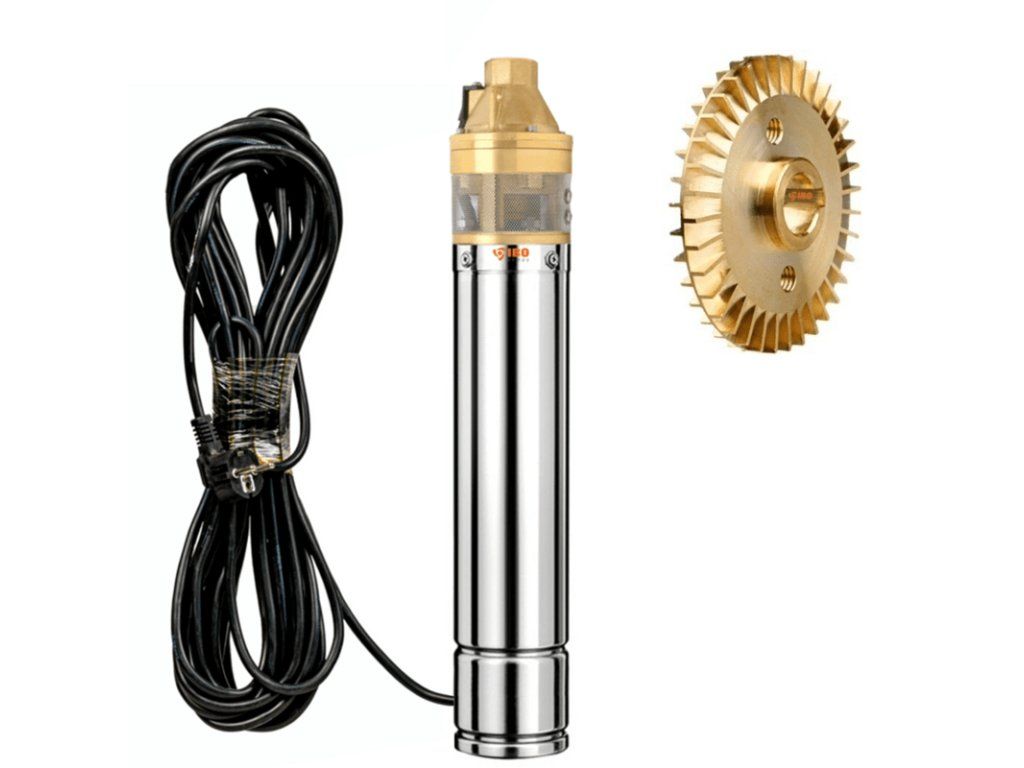 |
SKM 100 submersible pump for wells and boreholes - a typical solution for a drilled or a deeper dug well, suitable as the heart of the whole home water pump system described in the diagram above. Price from €190.40. |
You then connect a pressure tank to the pump. Here it's important to choose the volume according to the household's actual consumption and the number of draw-off points – for a typical family house, tanks in the range of 80 to 200 litres are used most often, while for smaller premises or cottages a smaller volume of around 24 litres is sufficient.
 |
Galvanised HVP 200L pressure tank with water gauge, 6 bar - a vertical tank with enough volume for an entire family house, reducing the number of pump switch-ons described in the wiring diagram above. Price from €535.10. |
 |
Stainless steel CH 90 L vertical pressure tank - a medium volume suitable for a smaller household or as an addition to a larger system, the stainless steel construction extends its service life when in contact with cold well water. Price from €466.80. |
Combination – mains and well at the same time
It doesn't have to be an "either – or" choice. A very common and practically sensible solution is to keep the house connected to the mains (for the guaranteed drinking water quality and reassurance in case your own source fails) and at the same time build a well or rainwater harvesting purely for watering the garden, washing the car, filling a pool or flushing toilets. It's precisely this seasonal consumption that pushes up the mains bill the most, since it doesn't involve drinking water requiring mains quality.
For such seasonal or occasional use (garden, cottage, work on the plot without an electrical connection), it's often worth reaching for a portable petrol pump instead of an electric submersible pump, since it works independently of the electrical grid and can easily be moved between a well, a rainwater barrel or a stream.
 |
BZP-10 petrol water pump - a self-priming portable pump independent of electricity, ideal for seasonal pumping from a well or barrel for watering the garden without having to build a fixed water pump system. Price from €161.10. |
This combination makes sense especially where a full home water pump system with a pressure tank would be too expensive an investment relative to how many litres of non-potable water are actually used – you can get a petrol pump for a significantly lower sum than a complete water pump system, and it only needs to be used during the summer season.
When a home water pump system pays off and when it doesn't
From the figures above and from practical experience, several clear situations emerge where a private water source makes sense:
A water pump system pays off if: the mains are simply not available at the building site or the connection would be disproportionately expensive due to the distance from the main line; the household has high water consumption due to a large garden, pool or livestock; there is a proven and stable groundwater source on the plot (an existing neighbouring well, a hydrogeological survey confirming sufficient yield); you plan to live in the house long-term (the investment pays off gradually over the years, not immediately).
A water pump system doesn't pay off, or is riskier, if: the mains are already available on the plot at a reasonable connection price and the household's consumption is ordinary without a large garden; a hydrogeological survey or the experience of the surrounding area shows unstable or insufficient groundwater yield (especially for dug wells in drier areas); the local groundwater quality has long-standing problems (high iron, manganese, or nitrates from agriculture) that would require costly, ongoing treatment; it's short-term housing or there's uncertainty about staying in the house longer – over a shorter horizon the investment may not have time to pay for itself.
Return on investment – a realistic calculation
Let's return to the figures from the introduction of the article. With a model saving of approximately €620 a year (€720 for the mains minus €100 for operating your own source) and an investment in a drilled well with a water pump system of approximately €4,000 (the mid-point of the range given above), the simple payback period comes to approximately 6.5 years. For a more expensive dug well with a higher investment of around €6,000, it's approximately 9.7 years. For households with higher consumption (for example 250 m³ a year due to a garden and pool, where the annual saving compared to the mains rises to approximately €1,000–1,100), the payback period shortens to 4 to 6 years even for the more expensive solution.
These figures are approximate and always depend on the specific location, the depth to water, and the local water and sewage price in your municipality – but the principle holds generally: the higher a household's water consumption, and the more expensive the local water and sewage charges, the faster your own water source pays for itself.
Water quality from a well – don't underestimate it
Deciding on your own water source doesn't just mean building a well and a pump – water quality is just as important a question. Groundwater can contain elevated amounts of iron and manganese (a typical sign is rust-coloured staining of sanitary fixtures and laundry), hardness causing scale build-up in taps and appliances, or, in agricultural areas, elevated nitrates. Before building a well, or at least right after, it's therefore worth having a laboratory water analysis done – without it, you won't know whether the water meets the parameters for drinking use, and what type of treatment you may need (mechanical filter, iron removal, water softener, UV disinfection lamp).
This aspect is extensive enough that we've dedicated a separate, detailed article to it – if you're planning a well, we recommend reading it before construction, so you know in advance what kind of water treatment to budget for.
Practical experience from installations
In real installations, three types of situations recur most often. The first is a new house outside a village without mains available, where a drilled well is the only sensible solution and the investment is calculated as part of the construction budget from the start – here the question of payback doesn't even arise, since the alternative would be an expensive extension of the mains line at the builder's expense. The second is an older dug well left by previous owners, which the new owners want to "revive" with a new pump and water pump system instead of connecting to the mains – here it's crucial to first check the yield and water quality, since an old well may have a silted bottom or cracked rings. The third, increasingly common situation is precisely the combination mentioned above – the house stays on the mains, but a separate, cheaper source of non-potable water is built for watering a larger garden or filling a pool, which can reduce summer water bills by tens of percent without having to deal with drinking water quality at all.
In all three cases, the same recommendation applies: don't buy components "by eye", but first calculate your actual consumption and depth to water, and only then choose the pump's power and the pressure tank's volume. An undersized water pump system shows up as fluctuating pressure when several draw-off points are used at the same time, while an oversized one shows up as an unnecessarily higher investment and energy consumption.
Frequently asked questions
How long does a well stay dry before it refills?
For dug wells, the recovery of the water level depends on the type of subsoil and the current groundwater yield – in drier periods, the level may recover more slowly than it's drawn down, so during droughts it's recommended to limit intensive pumping (for example, filling a pool all at once) and give the well time to refill. Drilled wells reaching deeper, more stable layers tend to be more resistant to drought fluctuations.
Do I need a permit for a well?
Yes, in most cases a permit from the relevant state water authority (usually the municipality or district office, environmental department) is needed both to build and to operate a well, even a well intended only for non-potable water. It's worth checking the specific procedure and required documents directly at the local office before starting excavation or drilling work.
Can well water be used as drinking water without any treatment at all?
Sometimes yes, but this can never be assumed automatically – a laboratory analysis confirming whether the water meets hygienic limits for drinking water is always necessary. Even water that looks clean and odour-free can contain, for example, elevated nitrates or microbiological contamination that isn't detectable without an analysis.
What happens if the power goes out – will I be left completely without water?
With an electric submersible pump, yes, the water pump system doesn't work during a power outage (the same applies to mains water with a home pressure booster system, if the house uses one). A solution can be a small backup power source (a UPS or generator) for critical appliances, or, for seasonal non-potable water only, the petrol pump mentioned above, which is independent of the electrical grid.
Does a well pay off even in a town where mains water is commonly available?
For the typical consumption of a family house in a town with mains water available, a separate water pump system usually doesn't pay off as a replacement for the mains – the investment pays back more slowly and there's no guarantee of drinking quality. However, a smaller non-potable water source just for watering the garden can make sense, if the plot is large enough and garden watering significantly raises summer bills.
How often does a home water pump system need servicing?
It's recommended to check the air pressure in the pressure tank's bladder, the condition of the filters (replaced according to contamination, typically several times a year if there's a high iron content), and the functioning of the pressure switch once a year. The pump itself, if used correctly and sufficiently submerged, typically lasts many years without intervention under normal operation in a family house.
Related topics
How to choose a home water pump system
What power and pressure do I need from a water pump system
Pressure tanks for a home water pump system
Water filtration - types of filters and when you need them
Installation and wiring of a home water pump system
Home water pump systems and filtration
Do you have a question about this topic?
Not sure whether your own water source will pay off, or dealing with a specific situation with your well or water pump system? Write to us - we're happy to help.