
Shafts and Tanks for Wells - How to Choose
Shafts and tanks for wells - how to choose
Anyone with their own well or borehole sooner or later faces the same question: where to place the pumping equipment, how to protect it from frost and dirt, and which tank or shaft to actually buy so it fits the specific well. At first glance this looks like a simple, almost purely construction-related detail - in reality it's a decision that will affect the lifespan of the entire water pump system for 20 or even 30 years ahead. A poorly chosen or poorly installed shaft is one of the most common reasons a pump or pressure tank fails prematurely - freezing, water ingress, condensation and mechanical damage to the piping are all completely common scenarios in practice.
In this article we'll go through the types of shafts and tanks actually used for wells and boreholes, what dimensions and installation depth make sense, how a plastic shaft differs from concrete rings, when it's worth investing in a self-supporting construction, and how to choose the related components too - the pump, pressure tank and accessories. The goal is for you to be able to make the decision yourself, without having to rely solely on a salesperson's recommendation.
What a shaft at a well is actually for
A shaft at a well or borehole essentially has three roles. The first is protection - it protects the pump, piping, fittings, and possibly the pressure tank, from frost, rainwater, runoff from the surrounding terrain, and mechanical damage (for example from garden machinery driving over it or from mowing). The second is accessibility - it allows convenient service access to the valves, check valves, measuring equipment, or the pump itself, without having to dig up the lawn. The third, often underestimated role is maintaining the right temperature and humidity in the space where the equipment operates - condensation in a damp, unventilated space can damage electronics just as reliably as frost. For boreholes, the shaft also often becomes the only place where the borehole head, water level measuring equipment and the pump's control elements are physically accessible - so it's important to plan for sufficient interior space already at the selection stage, not only at installation.
Plastic vs. concrete vs. composite shaft
In practice, three basic types of shaft construction are used for wells and water meter/pumping purposes: plastic (most often polypropylene or polyethylene), concrete rings, and composite (fibreglass) tanks. Each type has its place and none is universally the best - it depends on the installation depth, the groundwater level, the availability of equipment on site, and the budget.
Plastic shafts
Plastic shafts, for example round self-supporting constructions with dimensions of around 1300x1000 mm, are the most common choice for family houses today. The main advantage is weight - such a shaft weighs roughly 15 to 25 kg, which in practice means two people can install it without a crane or heavy machinery. A self-supporting construction also means the shaft can bear the load of the surrounding terrain and doesn't require additional formwork or concrete encasement of the wall (this varies from product to product - always check the load rating of the cover if machinery or cars will drive over the shaft).
An example of this kind of solution is the round PP water meter shaft 1300x1000, self-supporting plastic - a typical representative of the category we encounter most often at family houses:
 |
Round PP water meter shaft 1300x1000, self-supporting plastic - suitable as a space for installing the pump, supply piping and fittings at a well or borehole, self-supporting construction without the need for concrete encasement, low weight allows installation without a crane. Price from €261.40. |
The disadvantage of plastic shafts is lower resistance to groundwater buoyancy if the surrounding plot has a high groundwater level - an empty plastic shaft can literally be "pushed" out of the ground if it isn't properly weighted or anchored. That's why, on plots with a high groundwater level, it's recommended to either encase the bottom in concrete or choose a heavier construction.
Concrete rings
Classic concrete rings are still common, especially in older installations or where high weight and resistance to buoyancy are needed. A single ring with an internal diameter of around 1000 mm typically weighs 150 to 300 kg depending on the height and wall thickness, which means installation requires a crane or at least a tractor loader - it can't realistically be done by hand. The advantage is the high weight (the ring won't push itself out of the ground) and good resistance to mechanical load. The disadvantage is the labour-intensive installation, the risk of cracks as the terrain settles, and poorer tightness of the joints between individual rings - leaking joints are in practice the most common source of surface water getting into the shaft.
Composite (fibreglass) tanks
Composite shafts and tanks combine the advantages of both previous solutions - they're lighter than concrete, but at the same time more resistant to buoyancy and mechanical stress than thin-walled plastic. The price is usually higher, so they most often appear for deeper installations (over 2 m) or for boreholes with a higher groundwater level, where a plastic construction is no longer sufficient.
The following overview summarises an approximate comparison of all three types - the weight is always approximate, for the typical size used at family houses (diameter approx. 1000-1300 mm):
What size and depth of shaft to choose
The size of the shaft should be based on three things: the installation depth of the piping (i.e. the depth below the frost line), the size and type of pumping equipment to be installed in the shaft, and whether the pressure tank will also be in the shaft, or placed separately in the house/utility room.
In Slovakia, the frost-free depth (the depth below which the soil no longer freezes even in a hard winter) is commonly between 80 and 100 cm, and can be up to 120 cm in mountain and foothill areas. This means the water pipe running from the well or borehole to the house should be laid at this depth, and the shaft must be deep enough for the pipe's connection point to be below this line, not just under the surface.
Common shaft dimensions for family houses are:
- 800 mm diameter - just for installing the borehole head itself and basic fittings, minimal service space, suitable only where the pump is submersible directly in the borehole and the shaft serves only as an access point.
- 1000-1300 mm diameter - the most common choice, enough room for the head, valves, check valve, and possibly a smaller pressure tank, with comfortable service access even for an adult.
- 1500 mm diameter and more - if a larger pressure tank (for example 200 litres) is placed in the shaft together with the pump and filtration, or if future expansion of the equipment is anticipated.
The depth of the shaft (the height of the construction) is usually chosen in the range of 1000 to 2000 mm; for deeper boreholes or a higher groundwater level, a deeper construction with an extra bottom section may be needed. A rule from practice: it's always better to choose a somewhat larger diameter than seems necessary - later installing filtration, a second pump, or replacing fittings is very awkward in a cramped shaft, and a service technician will charge extra for working in a confined space.
What correct shaft installation in the ground looks like
The following diagram shows a typical cross-section of a plastic shaft installed at a well, including the frost-free depth and the recommended bedding:
The key point is to ensure drainage at the bottom of the excavation - a layer of compacted gravel under the shaft carries away any condensation or seepage from the construction and prevents the shaft from standing in stagnant water. It's equally important to make the shaft's cover load-bearing enough if machinery is expected to drive over it, and to seal the pipe pass-throughs in the shaft wall against surface water getting in.
Pump for a well or borehole - what to think about when choosing it together with the shaft
The choice of shaft is closely linked to the type of pump connected to it or into it. Essentially, there are two approaches: a surface (self-priming) pump placed in the shaft, or a submersible pump directly in the borehole/well, with the shaft serving only as an access and distribution point.
For shallower wells (up to approx. 7-8 m water level depth), surface pumps placed in the shaft are commonly used - the advantage is easier servicing, since the pump is physically accessible without pulling it out of the borehole. An example is the BZP-10 petrol pump, which, while not a typical stationary shaft solution (it's more of a mobile/garden pump), illustrates well the principle of a self-priming surface pump that draws water in from above, rather than being submerged:
 |
BZP-10 petrol water pump, engine-driven, self-priming, portable, for garden use - suitable as a mobile/backup solution for pumping water from a well, for example during a power outage or for watering from a shaft without a permanent connection. Price from €161.10. |
For deeper boreholes (over 8-10 m water level depth), a submersible pump lowered directly into the borehole on a steel cable, together with the delivery pipe and cable, is used almost exclusively. In this case, the shaft mainly serves as the place where the delivery pipe connects to the pipeline leading to the house, where the check valve, shut-off valves and possibly the pressure switch are fitted. A typical example is the SKM 100 submersible pump:
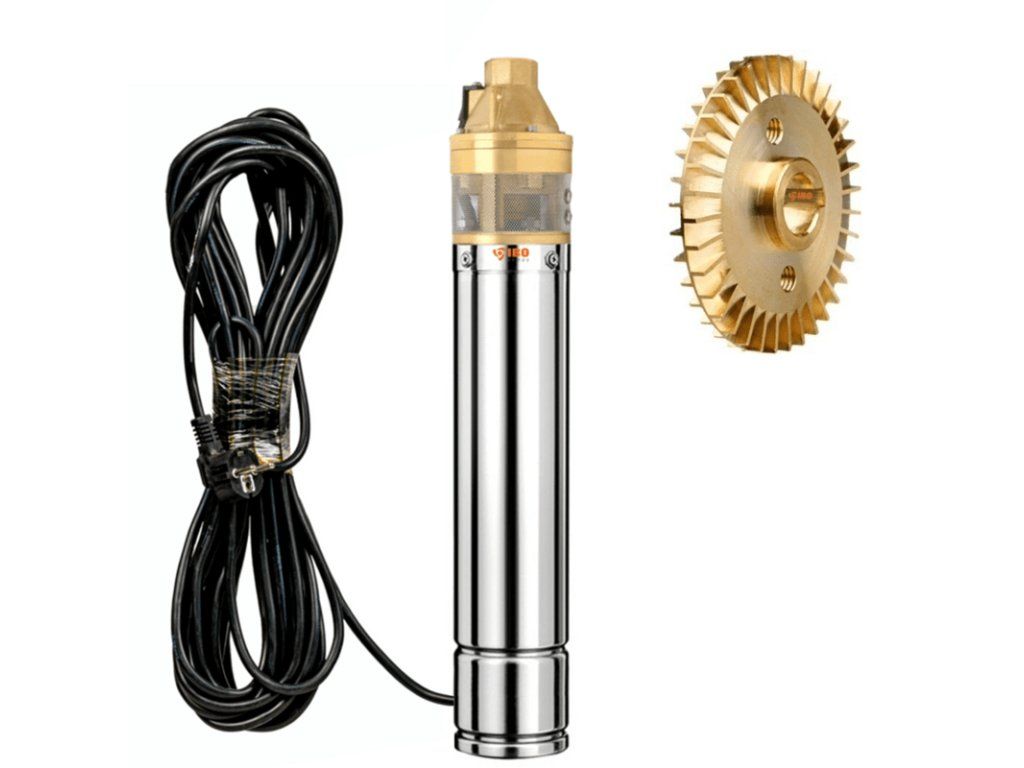 |
SKM 100 submersible pump for wells and boreholes - intended for permanent installation directly in the borehole, with this solution the shaft serves mainly as a distribution and service point, not as the space for the pump itself. Price from €190.40. |
A practical note: with a submersible pump, it's important that the shaft's cover has a large enough diameter to allow the pump to be pulled straight out in the future for servicing or replacement - this is often overlooked, and it ends up requiring the surrounding paving or terrain to be dug up during servicing.
Pressure tank - in the shaft, or in the house?
A pressure tank (an expansion tank with a membrane or bladder) is part of almost every home water pump system, and its job is to maintain pressure in the pipework and reduce how often the pump switches on. Whether to place it directly in the shaft at the well, or in a utility room in the house, depends on the tank's size, the available space in the shaft, and whether the shaft freezes.
Smaller tanks, for example the AQUA OLA 24 l pressure tank, fit into a shaft without any problem even with a smaller construction diameter:
 |
AQUA OLA 24l pressure tank, horizontal, for home water pump systems - a compact solution suitable even for smaller shafts with a diameter of around 1000 mm, the horizontal construction saves on height. Price from €64.30. |
Larger tanks (100 l and up), on the other hand, generally won't fit into a typical well shaft together with the rest of the equipment, and it's better to place them in a utility room or garage, where there's no risk of freezing and service access is simpler. Examples are the galvanised HVP 200 l pressure tank and the stainless steel CH 90 l pressure tank:
 |
Galvanised HVP 200L pressure tank with water gauge, 6 bar, for home water pump systems, vertical, without bladder - a solution for larger households or houses with higher water consumption, given its size it's placed in a utility room, not in a well shaft. Price from €535.10. |
 |
Stainless steel CH 90 L vertical water pressure tank for home water pump systems - a medium size suitable for small and medium households, the stainless steel construction handles a somewhat damper environment better than galvanised, but even so, placement outside the well shaft is recommended. Price from €466.80. |
The following chart compares the approximate volumes and prices of the pressure tanks mentioned, so it's clear at a glance how the price rises with volume:
The most common mistakes when choosing and installing shafts
Over the years, the same few mistakes keep recurring in practice, and they're easy to avoid:
1. Too small a shaft diameter
The buyer chooses the cheapest, smallest shaft and after a year finds that filtration or a second pump won't fit. Solution: choose one size larger diameter instead - the price difference between a 1000 mm and a 1300 mm shaft is usually only a few tens of euros, but the extra space pays off with every future service visit.
2. Laying the pipe above the frost-free depth
If the supply pipe is laid shallower than 80 cm "because it was easier to dig that way", there's a risk of the pipe freezing and cracking in a hard winter. The repair requires digging up the terrain again, which is far more expensive than sticking to the recommended depth from the start.
3. Missing drainage at the bottom of the shaft
Without a gravel bedding, condensation and seepage water accumulate in the shaft, which shortens the lifespan of both the pump and the electrical components. The solution is simple and cheap - a layer of compacted gravel under the construction.
4. Underestimating buoyancy at a high groundwater level
An empty plastic shaft can be "pushed" out of the ground at a high groundwater level, even before backfilling or after prolonged rain. On plots where a high groundwater level is common, it's advisable to choose a heavier (concrete or composite) construction, or to encase the bottom of the plastic shaft in concrete.
5. Insufficient space for future servicing
As already mentioned for submersible pumps - if the shaft's cover is too small or incorrectly positioned, pulling the pump out for future servicing complicates the work and makes the intervention more expensive. Check in advance the diameter of the cover and whether the pump can actually be pulled straight out from that position, without catching on the shaft wall.
How to proceed when choosing - a brief guide
A summary of the procedure that has proven reliable in practice:
- Find out the water level depth in the well/borehole and decide whether it will be a surface or submersible pump.
- Check the groundwater level on the plot - at a high level, choose a heavier construction or concrete encasement.
- Find out the local frost-free depth (commonly 80-100 cm, more in mountain areas) and plan the pipe's installation depth accordingly.
- Choose the shaft diameter with a margin - better one size larger than exactly matched to the current equipment.
- Decide whether the pressure tank will fit in the shaft (smaller volumes up to approx. 50 l), or belongs in a utility room (larger volumes).
- Ensure drainage at the bottom of the excavation and a cover load rating suited to the expected load on the terrain above the shaft.
- Plan service access so the equipment can be removed in the future without digging up the surroundings.
The following diagram also illustrates the procedure in simplified form - the individual steps build on one another, and skipping any of them (especially checking the groundwater level and the frost-free depth) is the most common source of additional costs:
Frequently asked questions
What diameter shaft do I need for a typical family house?
For most family houses, a diameter of 1000 to 1300 mm is sufficient - it provides enough space for fittings, a check valve and possibly a smaller pressure tank, while remaining comfortable to service. If you plan to add filtration or a larger tank in the future, choose the upper end of this range.
Does the shaft have to be deeper than the frost-free line?
The shaft itself doesn't have to be entirely below the frost-free line, but the pipe's connection point (where the water pipe leaves towards the house) does. In Slovakia this line is commonly between 80 and 100 cm, and higher in mountain areas - it's always better to check the local recommendations, since they vary slightly by region.
Is a plastic or concrete shaft worth it?
At a typical groundwater level and installation by hand or with light equipment, a self-supporting plastic shaft is the more practical choice - it's lighter, installs faster, and the joints are usually tighter than with concrete rings. A concrete construction makes sense where high weight is needed due to water buoyancy, or where equipment for installing heavy sections is available.
Can a pressure tank be placed directly in the shaft at a well?
Yes, for smaller volumes (typically up to 30-50 litres) the tank fits into a typical shaft without any problem. For larger volumes (90 l and up), the space usually isn't enough in combination with the rest of the equipment, so such tanks tend to be placed in a utility room or garage, where there's also no risk of freezing.
How do I know if I'm at risk of groundwater buoyancy on an empty shaft?
The most reliable way is to do a test probe or ask your neighbours/local installation company about their experience with the groundwater level in the area - the risk is significantly higher in waterlogged or lowland areas. If in doubt, it's cheaper to preventively choose a heavier construction or encase the bottom in concrete than to deal with a pushed-up shaft after installation.
How often does a shaft need checking, and what should be part of the maintenance?
It's recommended to check at least once a year (ideally in spring after the winter period) whether water is accumulating in the shaft, whether the cover seals properly, and whether there are visible cracks in the construction or at the pipe connection. For a submersible pump, it's also recommended to check the pressure tank's pressure and the condition of the check valve, since these are the most common source of faults in the whole system.
Related topics
How to choose a home water pump system
What power and pressure do I need from a water pump system
Pressure tanks for a home water pump system
Installation and wiring of a home water pump system
The most common faults in a home water pump system
Back to the main category: Home water pump systems and filtration
Do you have a question about this topic?
Not sure what to do, or dealing with a specific situation in your household? Write to us - we're happy to help.