
Maintenance of Home Water Pump Systems and Filters
Why it pays to give your water pump system regular attention
A home water pump system is one of those pieces of equipment most households only think about the moment it stops working - typically in the morning when there's no water, or on a Saturday when the nearest service centre is closed. Yet most faults we encounter in practice don't arise suddenly. They develop gradually, over months or years, and can be prevented with regular, simple and cheap checks. The difference between a water pump system that lasts 12-15 years without major intervention, and the same system that needs a new pump and membrane after 4 years, usually comes down to whether someone occasionally checked the air pressure in the tank, replaced the filter cartridge and checked the seals.
This article is a practical guide to what, how often and why to check on a home water pump system and water filtration setup - regardless of whether your system is connected to a well, a borehole or the public mains with additional treatment. It's based on common situations we encounter with customers and in service reports, and on the recommendations of the manufacturers of the pumps, tanks and filters we sell.
Annual maintenance schedule - what to check and when
The most common mistake in maintaining a water pump system isn't a wrong procedure, but simply forgetting to check at all. That's why it helps to tie the schedule to something regular - for example, the changing of the seasons. Below is a simplified overview of how to spread the tasks across the year, so nothing gets left out:
This schedule isn't a universal recipe - a water pump system drawing water from a well with a higher sand content will need the sediment filter replaced more often, possibly even once a month. Conversely, a system connected to a good-quality borehole with clean water can safely extend some of these intervals. What matters is having at least an approximate calendar and not relying on things "somehow holding up".
The pressure tank - the most commonly underestimated part of a water pump system
The pressure (hydrophore) tank is a component most people don't notice until it starts causing problems - the pump switching on and off frequently (so-called "short cycling"), fluctuating water pressure at the taps, or, in a worse case, the sound of water leaking directly from the tank's valve. In most cases, one single thing is behind this: incorrect air pressure in the tank's pre-charge chamber.
The principle is simple. Inside, the tank is divided by a membrane (or bladder) into two parts - one with water, the other with air. The air side must be set to a pressure approximately 0.2 to 0.3 bar lower than the pump's cut-in (switch-on) pressure. For example, if your pump's cut-in pressure is set to 2.5 bar, the air in the tank should be at approximately 2.2 to 2.3 bar. If the air pressure is too low, the tank loses its capacity and the pump switches on practically every time a tap is opened - this shortens the motor's and switch's service life by years. Conversely, if the pressure is too high, the tank can't accumulate water effectively and the system loses pressure stability.
Step-by-step procedure for checking tank pressure
For an experienced water pump system owner, the whole procedure takes less than 10 minutes and requires no special tools other than an ordinary tyre pump with a pressure gauge (the same kind most households have in the garage for a bicycle or car). The valve on the pressure tank is structurally identical to a tyre valve (a so-called Schrader valve), so the same tool can be used both to measure and to inflate.
If, when checking, you find that the tank doesn't hold pressure at all and "leaks out" immediately, or that water rather than air was escaping from the outlet valve, the membrane or bladder in the tank is probably ruptured and the tank needs replacing - repairing the membrane itself is in most cases neither economical nor commonly technically feasible for standard home tanks.
Choosing a replacement pressure tank by capacity
If a replacement is needed, it's good to know that the tank's capacity is chosen according to the pump's power and the household's consumption, not at random. Smaller horizontal tanks around 24 litres are suited more as an addition to smaller pumps or as a backup solution, medium tanks around 90 litres cover a typical family house, and larger 200-litre tanks are used where the simultaneous consumption is higher (several outlets used at once, a larger household, garden irrigation on the same circuit).
When choosing the tank material (galvanised versus stainless steel), what matters most is the environment where the tank will stand, and the budget. Stainless steel tanks have a longer expected lifespan especially in damp or poorly ventilated spaces (for example in a shaft or an unheated extension); galvanised tanks are the standard, more affordable choice for a dry boiler room or utility room.
 |
AQUA OLA 24l pressure tank, horizontal, for home water pump systems - a suitable replacement for a smaller pump or as an additional tank for fluctuating pressure, the compact horizontal design also fits in a tight utility room. Price from €64.30. |
 |
Stainless steel CH 90 L vertical water pressure tank for home water pump systems - a good choice when replacing after a ruptured membrane, if the tank is placed in a damper space where the investment in a stainless steel design pays off. Price from €466.80. |
 |
Galvanised HVP 200L pressure tank with water gauge, 6 bar, for home water pump systems - suitable for households with higher simultaneous water consumption, the water gauge additionally allows you to visually check the water level in the tank on an ongoing basis. Price from €535.10. |
The pump - what to watch for when checking it, and when to consider replacement
The pump itself is the heart of the water pump system, and its maintenance differs by type - a submersible pump for a well or borehole has completely different inspection requirements from a surface self-priming pump installed in a utility room.
For surface pumps (a typical home water pump system in a boiler room or utility room), it's worth checking once a year:
- the tightness of the shaft seal (a small drip under the pump while running is the first sign that the seal is wearing out),
- noise and vibration - a new, unusual sound (whining, knocking) often means a worn bearing,
- the condition of the suction strainer and check valve on the suction side - a clogged or leaking strainer is the most common reason a pump "loses its prime" and has to re-prime every time it starts,
- the electrical connection and the condition of the capacitor on single-phase motors.
For submersible pumps in a well or borehole, physical inspection is more difficult, since the pump is lowered deep below the water level. Here, in practice, we rely more on indirect signals: a drop in the amount of water delivered, frequent switching by the flow or pressure switch, cloudiness or sand in the water (a sign of a worn impeller or a problem directly in the well), or increasing power consumption for the same output. If any of these symptoms appear, we recommend not waiting for a complete failure - pulling out and servicing a submersible pump is physically more demanding work (especially for deeper boreholes), and it's better to plan it in advance than to deal with an acute water outage.
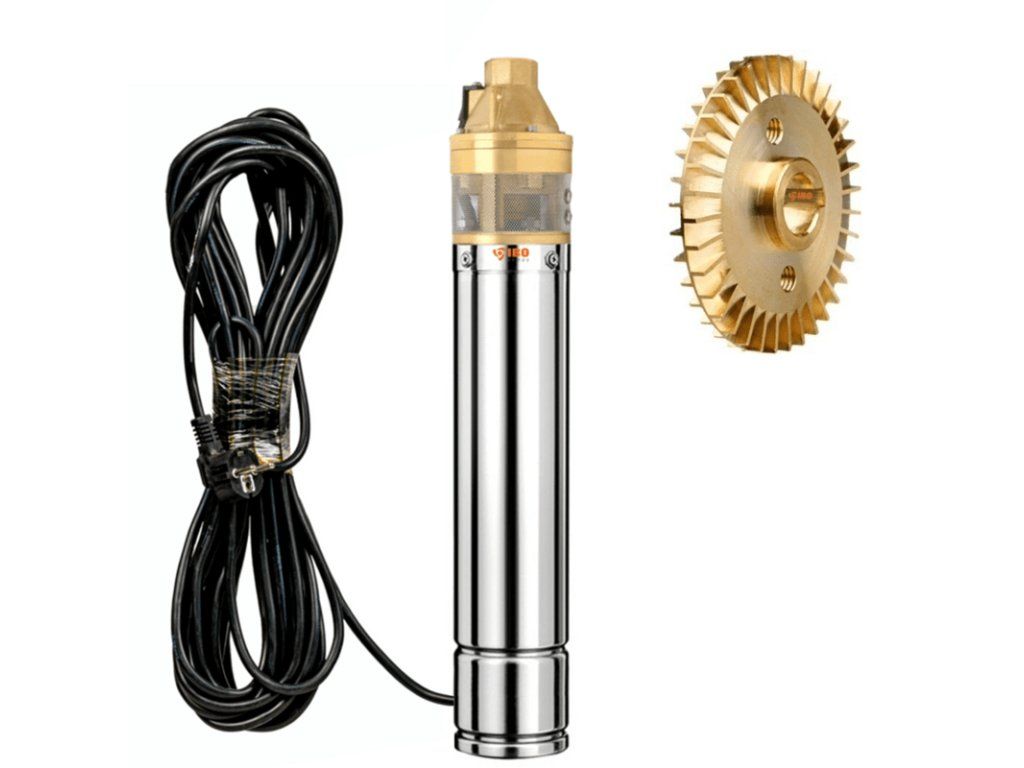 |
SKM 100 submersible pump for wells and boreholes - a typical replacement for a worn original submersible pump, if a drop in output, sand in the water, or increasing power consumption as described above appears. Price from €190.40. |
Practical experience from the field: the typical service life of a quality home pump with reasonable maintenance is approximately 8 to 12 years. If a pump is approaching this age and even one of the symptoms above appears at the same time, a planned replacement is usually more economical than repeated repairs - especially for submersible pumps, where the labour itself (pulling out and lowering back in) makes up a significant part of the service cost regardless of whether the whole pump is ultimately replaced, or just part of it.
For moments when you need to temporarily bridge a failure of the main pump - for example during servicing, or when pumping water out of a well, pit or flooded garden - it's worth having an independent backup solution on hand:
 |
BZP-10 petrol water pump, engine-driven, self-priming, portable, for garden use - independent of the electrical grid, practical as a temporary backup during servicing of the main water pump system or when pumping water out independently of the house's plumbing. Price from €161.10. |
Water filtration - why replacing cartridges matters more than it seems
Filtration and the water pump system itself work as a single system - a clogged or overloaded filter affects the whole system, not just the water quality. A clogged cartridge puts increased resistance on the pump; the pump has to work harder to achieve the same flow rate, and over time this shows up both in its wear and in electricity consumption.
In a typical home water pump system, we most often encounter these types of filtration and their recommended replacement intervals:
The sediment (mechanical) filter catches sand, rust and coarser impurities and is the first line of defence against particles that would otherwise damage the pump and the taps in the house. For well water with a higher sand content, we recommend checking the cartridge after just a month and replacing it more often than the stated 2-3 month interval if needed - a clogged cartridge visibly darkens and the flow through it noticeably drops.
The activated carbon filter removes taste, odour and partly also chlorine (for water from the public mains) or organic substances (for well water). The roughly 6-month interval is an approximate average - with more intensive use (for example, if water from the same circuit also goes to the kitchen for direct consumption), it's worth shortening the interval.
The reverse osmosis (RO) membrane, if part of the system, has a longer interval of around 12 months, but its condition can also be checked on an ongoing basis by measuring the total water mineralisation (with a TDS meter) before and after the membrane - a significant drop in efficiency is a clear sign the interval needs shortening.
The water softener resin isn't replaced directly as often as filter cartridges, but requires regular topping up of regeneration salt (monthly) and periodic regeneration, the frequency of which depends on the hardness of the incoming water and household consumption - with harder water, regeneration may be needed several times a week, with softer water once every few days.
A practical sign that it's time to deal with a filter or softener, even without tracking a calendar: a noticeable drop in water pressure at several outlets at once, the return of an odour or cloudiness that had previously disappeared, or a white coating on taps and in the kettle (a sign that the softener has stopped working effectively).
Water meter shaft - checking even outside the heating season
If the water pump system, or at least the main shut-off valve and water meter, is located in an outdoor shaft, this part of the system is the one most often neglected during routine maintenance - it's "out of sight, out of mind" until frost or a downpour arrives. We recommend checking at least twice a year (in spring and autumn):
- the tightness of the cover, and whether surface water is getting into the shaft,
- the condition of the seals on the connections inside the shaft,
- the functioning of the main shut-off valve (it should be possible to close and open it without excessive force),
- before winter - insulating and protecting the water meter and piping against freezing, or possibly installing a heating element for shallow shafts in extremely cold areas.
A separate topic is the quality and condition of the shaft itself - older brick or concrete shafts leak water over time and lose their tightness, which can cause the surrounding soil to become waterlogged or the pipes to be damaged by frost. When rebuilding or building a new connection, it's therefore worth reaching for a modern, self-supporting plastic shaft, which is watertight and resistant to the pressure of the surrounding soil.
 |
Round PP water meter shaft 1300x1000, self-supporting plastic - a suitable replacement for an older, leaking brick or concrete shaft; the self-supporting construction handles the pressure of the surrounding soil without additional concrete encasement. Price from €261.40. |
Winterizing a water pump system - the most common cause of spring repairs
A large share of the faults we deal with in spring didn't arise in winter itself, but were caused by incorrect or entirely skipped winterizing in autumn. Frozen water in a pipe, pump or pressure tank expands in volume and can crack even a metal housing, not just plastic piping.
For a water pump system located in an unheated space (a cottage, summer kitchen, a stand-alone utility building not heated in winter), before the first frosts we recommend:
- completely draining the water from the pump via the drain plug (usually at the bottom of the pump housing),
- also draining the pressure tank and leaving the drain valve open,
- disconnecting and draining the filter cartridges too, if they freeze in the same space - a frozen filter housing can crack just like the pump body,
- for larger or permanently occupied buildings where the water pump system can't simply be shut down, consider insulating the utility room or heating it slightly (for example, with a small electric heater and a thermostat set just above freezing).
For a water pump system in a heated utility room of a family house, the risk of freezing is lower, but it's still worth checking before winter that the heating in that room hasn't failed (for example, a radiator disconnected during a renovation) and that any outdoor piping to the shaft or well is properly insulated.
The most common symptoms of problems and what they indicate
From experience with service reports, a fairly reliable "diagnostic table" can be put together - a combination of symptoms usually clearly shows where in the system to look for the cause:
- Frequent switching of the pump on and off at low draw-off - almost always low or zero air pressure in the pressure tank, or a ruptured membrane.
- The pump runs, but water doesn't flow or flows weakly - a clogged suction strainer, a clogged sediment filter, or a drop in the water level in the well/borehole.
- Fluctuating pressure at the taps (sometimes strong, sometimes weak flow) - most often incorrect pressure in the tank or a partially clogged filter.
- Cloudy water or sand in the water - a worn submersible pump impeller, a damaged suction strainer, or a problem directly in the well (for example, an incorrectly fitted well casing).
- Odour or a change in the water's taste that wasn't there before - a depleted activated carbon filter.
- White coating on taps and in the kettle - the water softener isn't working or doesn't have enough salt.
- Dripping directly from the pump body while running - a worn shaft seal, servicing or replacing the pump will soon be needed.
If a combination of several symptoms appears at once (for example, the pump short-cycling together with weak flow), we recommend starting with a check of the pressure tank - it's the fastest and cheapest check, and it often solves the problem on its own, or clearly shows that the cause lies elsewhere.
When to handle it yourself and when to call a service technician
Checking and adjusting the tank's air pressure, replacing filter cartridges, topping up salt in the softener, a visual check for leaks and basic winterizing can be handled without problems by most handy homeowners - they don't require specialized tools or professional training, just some regularity.
On the other hand, we recommend calling in a service technician for:
- replacing or repairing the pump itself, especially a submersible one in a borehole or well,
- any work on the water pump system's electrical wiring,
- suspicion of a problem directly in the well or borehole (a significant drop in yield, cloudiness that a filter doesn't fix),
- a recurring fault that wasn't resolved after checking the pressure and filters yourself.
Regular home maintenance doesn't replace servicing, but significantly reduces how often it's needed, and, importantly, keeps it planned rather than an emergency - which usually also translates into lower costs compared to dealing with an acute breakdown.
Frequently asked questions
How often should I check the air pressure in the pressure tank?
We recommend checking at least twice a year, ideally in spring and autumn. If you notice the pump switching on and off frequently at low water draw-off, check the pressure immediately regardless of when the last check was - it's the most common cause of this symptom.
What air pressure should be in the pressure tank?
The general rule is to set the air pressure approximately 0.2 to 0.3 bar lower than the pump's cut-in (switch-on) pressure. So at a cut-in pressure of 2.5 bar, set the air in the tank to approximately 2.2 to 2.3 bar. You can find the exact value for a specific model in the manual for the water pump system or tank.
How often do filter cartridges need replacing?
Approximately: the sediment (mechanical) filter every 2-3 months, the activated carbon filter around every 6 months, the reverse osmosis membrane around every 12 months. For water with a higher sand or impurity content, the intervals may be shorter - the most reliable signal is visible darkening of the cartridge or a drop in flow.
What does it mean when the pump often short-cycles (switches on and off)?
In the vast majority of cases, this is incorrect (most often too low) air pressure in the pressure tank, or a ruptured membrane inside the tank. Check the pressure according to the procedure in this article - if the tank doesn't hold pressure at all, it will need replacing.
How should I prepare a water pump system for winter if it's in an unheated space?
Before the first frosts, drain the water from the pump, from the pressure tank, and from any filter cartridges located in the same unheated space. Frozen water can crack even a metal pump or tank housing, not just plastic piping.
How long does a home water pump system's pump last with proper maintenance?
With reasonable, regular maintenance (checking seals, a clean suction filter, correct tank pressure), the typical expected service life of a quality pump is approximately 8 to 12 years. Neglected maintenance, especially long-term incorrect pressure tank pressure, can significantly shorten this lifespan.
Related topics
If you're dealing with your home water pump system more broadly, these articles of ours may also be useful:
- How to choose a home water pump system
- What power and pressure do I need from a water pump system
- Pressure tanks for a home water pump system
- Water filtration - types of filters and when you need them
- The most common faults in a home water pump system
You can find the full overview of topics on home water pump systems and filtration in the main category Home water pump systems and filtration.
Do you have a question about this topic?
Not sure what to do, or dealing with a specific situation in your household? Write to us - we're happy to help.