
Most Common Home Water Pump System Faults
A home water pump system is one of those pieces of equipment that owners of family homes and cottages get used to so quickly that they stop noticing it's there - until one day no water comes out of the tap, the pump keeps running non-stop, or an unpleasant knocking sound comes from the utility room. Over decades of selling pumping equipment and pressure tanks, we know that the vast majority of home water pump system faults fall into just a few recurring categories - and almost all of them can either be fully prevented with regular maintenance, or fixed by a more experienced user in a few dozen minutes. In this article we go through the most common home water pump system faults systematically - from loss of prime through frequent pump cycling to pressure tank problems - explaining why they happen, how to recognise them, and when it's worth reaching for a replacement part or a whole new unit instead of repeated repairs.
How a home water pump system works - why it's important to understand the principle
Before getting into specific faults, it's useful to recall the basic operating scheme. A home water pump system consists of four main parts that together form a closed system: the water source (well, borehole, or other source), the pump itself (most often self-priming or submersible), the pressure tank with a diaphragm or bladder, and finally the pressure switch, which automatically switches the pump on and off according to the current pressure in the system. If even one link in this chain fails, it shows up across the whole system - which is why diagnosing a fault is often detective work, where you need to proceed from the simplest explanation to the more complex one.
Precisely because it's a chain of interlinked components, we recommend always working from the water source toward the output when looking for the cause of a fault - first check the water level in the well and the suction line, then the pump's condition, then the pressure tank, and finally the electrical and control components. This logic recurs throughout the following sections of the article.
The most common home water pump system faults and their causes
Over recent years, communicating with customers and service partners has repeatedly confirmed the same order of fault causes. The following overview is based on the real-world frequency with which individual problems occur in home water pump systems in normal use in a family home:
1. Loss of prime and air in the system (the most common fault, roughly 28% of cases)
This is by far the most common reason a home water pump system stops delivering water entirely even though the pump keeps turning and "runs dry". Air most often gets into the suction pipework through leaking joints, a damaged foot valve on the suction line, or the water level in the well dropping below the level of the suction strainer. Self-priming pumps can expel air from a short section of pipe on their own, but only to a certain extent - if the leak is persistent, the pump will repeatedly lose its prime even after being refilled. In practice we encounter this problem most often with seasonal use, for example at cottages where the pump was disconnected over winter and the joints loosened slightly by the time it was reconnected in spring.
Solution: check all the suction joints both visually and by touch (a wet spot or bubbles while the pump is running will reveal a leak), replace the foot valve if it's worn, and make sure the suction strainer is always at least 30-50 cm below the water level. For deeper wells or boreholes where the level drops significantly in dry months, switching to a submersible pump is a practical solution that eliminates the loss-of-prime problem entirely - it's permanently submerged in the water and doesn't need suction as such.
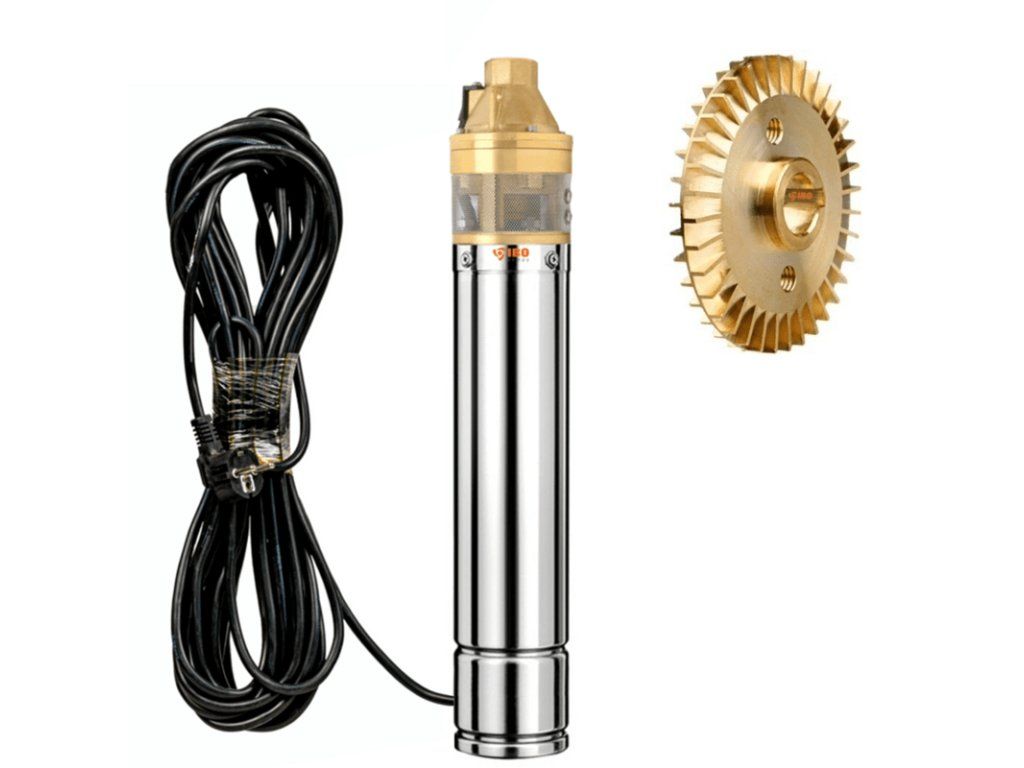 |
SKM 100 submersible pump for wells and boreholes - since it works submerged directly in the water, it completely eliminates the most common cause of home water pump system faults - loss of prime. A suitable solution for deeper wells or a fluctuating water level. Price from 190.40 EUR. |
2. The pump switching on and off too often - cycling (roughly 24% of cases)
If the pump switches on even at a minimal water draw, for example just a slowly dripping, leaking toilet cistern, or switches on and off in quick succession during normal use, the cause is almost always the pressure tank. Inside the tank is a rubber diaphragm or bladder that separates the water from the air cushion - it's precisely this air cushion that allows a certain reserve of water under pressure to be kept in the tank so the pump doesn't have to run every time a tap is opened. If the diaphragm bursts, or the air cushion gradually leaks out through the valve, the tank loses its ability to store pressure and the system behaves as if there were no pressure tank at all - so the pump switches on at practically every draw, even a minimal one.
Diagnosis is fairly simple: on the top of the tank there's a valve similar to a car tyre valve, through which you can check and top up the air (the pressure should be roughly 0.2 bar lower than the pump's set switch-on pressure). If water appears through this valve when pressed, instead of air, the diaphragm is burst and the tank needs replacing. This is one of the most common reasons customers order a new pressure tank from us instead of repairing the original one - diaphragms on older or cheaper tanks can only be replaced to a limited extent, and it's only cost-effective on larger, better-quality tanks.
3. Contaminated or clogged filtration (roughly 18% of cases)
The third most common cause of faults doesn't relate directly to the pump, but to the quality of the water being pumped. Water from a well or borehole practically always contains a certain amount of mechanical impurities - sand, particles of rust from the pipework, or organic sediment. If the system doesn't have adequate pre-filtration, these impurities gradually build up on the pump's impeller, clog the suction side, or reduce flow through the pressure tank. This shows up as a gradual drop in output, noisier pump operation, and in worse cases overheating and damaged bearings.
In practice we recommend checking and cleaning the mechanical filter at least twice a year, or more often with visibly contaminated water. If there's no filter at all, adding one is often the simplest and cheapest prevention you can carry out on a home water pump system - replacing a filter cartridge costs a fraction of repairing or replacing a damaged pump.
4. Low water pressure in the system
Low pressure shows up as a weak stream of water from a tap or shower, even though the pump is running. There are usually several causes at once: an incorrectly set pressure switch (switch-on and switch-off pressure both too low), a worn pump that no longer reaches its original parameters, insufficient pump output relative to the number of draw-off points in the household, or a partly clogged filter as mentioned above. In older households where a washing machine, dishwasher, or a second bathroom has been added since the original design, it's common for a pump that was originally sufficient to simply no longer keep up with current demand.
The solution is either correctly re-setting the pressure switch (we recommend this adjustment only for more experienced users or a service technician, since an incorrect setting can damage the tank or pump), or replacing the pump with a more powerful one matching the household's current consumption.
5. Leaks and water loss from the system (roughly 15% of cases)
Leaks most often appear at threaded joints, at the pump shaft seal (the mechanical seal gradually wears and starts leaking), or on the pump body itself where the casting was damaged by frost - this is a typical problem with pump systems left over winter in an unheated room without the water being drained. Frozen water inside the pump body expands and can cause fine, at first invisible cracks that only show up when the system is started again in spring.
Prevention is simple and cheap: drain the water from the pump and from any pipework in outdoor or unheated spaces before winter, or place the whole pump system in a heated or at least insulated room, for example a water meter shaft with sufficient depth below the frost line.
 |
PP 1300x1000 round water meter shaft, plastic, self-supporting - suitable for placing the pump system, water meter, or connection below the frost line, which significantly reduces the risk of frost damage over winter. The self-supporting construction also withstands soil loading. Price from 261.40 EUR. |
6. Unusual pump noise
Noise that differs from the normal operating sound - knocking, squeaking, "rattling", or regular thuds - almost always signals a mechanical problem. Most often it's worn motor bearings, a damaged impeller (for example after drawing in sand or a small stone), or cavitation caused by an insufficient water supply on the suction side. Cavitation occurs when the pump "hungers" for water faster than the suction line can supply it - air bubbles form in the liquid and then implode, causing the characteristic knocking sound while also gradually damaging the impeller.
If cavitation is suspected, check the diameter and length of the suction pipework (too narrow or too long a suction line increases resistance), the condition of the suction strainer, and the immersion depth. With persistent mechanical noise, usually nothing helps except replacing the pump - repairing bearings on typical home pumps is almost never financially worthwhile compared with the price of a new unit.
7. Pressure switch fault (roughly 10% of cases)
The pressure switch is a mechanical or electronic component that measures the pressure in the system and switches the pump motor on and off accordingly. Mechanical switches lose setting accuracy as they age, the contacts get burnt, and the switch either stops responding altogether (the pump won't start even when pressure drops to zero), or conversely stays permanently closed (the pump runs continuously even once the required pressure has been reached, leading to overheating and motor damage). Newer-generation electronic switches are more reliable, and many also include dry-run protection.
8. Electrical fault or motor damage (roughly 5% of cases)
The least common but most serious category - burnt-out motor windings, a damaged capacitor in single-phase motors, or a broken supply cable. It shows up either as a completely non-functional pump (the motor "hums" but doesn't turn, which usually signals a faulty capacitor), or the circuit breaker tripping when trying to start it. These faults clearly belong in the hands of an electrician or service technician - any intervention in the electrical part without the proper qualification is a safety risk.
The pressure tank - the most commonly overlooked source of problems
Since the pressure tank is responsible for a good third of all faults (a combination of frequent cycling and related leaks), it's worth giving it separate attention. The tank's size and quality directly affect how often the pump switches on - a larger tank can hold a greater reserve of water under pressure, so the pump works in longer, less frequent cycles, which extends its lifespan. The following overview compares three common tank size categories from our range:
The small 24-litre horizontal AQUA OLA-type tank suits a cottage or a smaller household with one or two draw-off points - it's cheap and compact, but with a larger draw the pump will cycle fairly often. The medium 90-litre stainless steel tank represents a sensible compromise for a typical family home - the stainless steel design also eliminates the risk of corrosion that shows up over time on cheaper galvanised tanks. The large 200-litre galvanised tank with a sight glass is recommended for larger houses with several bathrooms, or where a water reserve is needed, for example because of fluctuating borehole output.
 |
CH 90 L stainless steel pressure tank, vertical, for home water pump systems - a suitable replacement for a tank with a burst diaphragm; the stainless steel design also resists corrosion long-term, which shortens the lifespan of cheaper tanks. Price from 466.80 EUR. |
 |
HVP 200L galvanised pressure tank with sight glass, 6 bar, for home water pump systems, vertical, bladderless - a large-volume tank with a sight glass for continuous level checking, suitable for larger households or fluctuating borehole output. Price from 535.10 EUR. |
 |
AQUA OLA 24l pressure tank, horizontal, for home water pump systems - a compact solution for a cottage or smaller household, fits easily even in a cramped utility room. Price from 64.30 EUR. |
How to approach diagnosis - a simple decision procedure
When a pump system stops working properly, it's worth proceeding systematically rather than trying things at random. The following diagram summarises the procedure we recommend as a first step for most common faults:
Prevention - how to avoid recurring faults
Most of the faults described above can be prevented with fairly simple but regular maintenance. We recommend the following yearly cycle, which takes just a few hours in total but can extend the pump's lifespan by several years:
In spring, before the first period of heavier use after winter, check all the joints on the suction line, clean or replace the filter cartridge, and check the air pressure in the pressure tank using a tyre pressure gauge. In summer, during the period of highest demand, watch whether the pump starts cycling noticeably more often than at the start of the season - this is the earliest warning sign of an approaching diaphragm problem. In autumn, before the first frosts, thoroughly check that the pump will be protected from freezing over winter, or drain the water from it if it remains in an unheated space. And finally, we recommend a complete visual check of the whole system, including electrical connections, once a year, even if nothing seems to indicate a problem - a preventive hour-long check is always cheaper than an emergency repair in the middle of summer, when demand for service is highest and waiting times are longest.
For standalone properties, cottages, or gardens without a connection to the public mains, it's also worth having a backup solution on hand in case the main pump system fails and you need to pump water immediately - for example for watering the garden or as a temporary supply during a repair.
 |
BZP-10 petrol water pump, engine-driven, self-priming, portable, for the garden - a practical backup solution independent of the electrical grid, suitable as a temporary substitute when the main pump system fails or for watering the garden. Price from 161.10 EUR. |
When to fix a fault yourself and when to call a service technician
Most reasonably handy homeowners can, without any problem, check the suction joints, top up air in the pressure tank, replace a filter cartridge, or clean the suction strainer themselves, without needing special tools. On the other hand, we always recommend leaving any work on the pump's electrical parts, replacing the pressure switch, or repairing internal mechanical parts of the motor to a service technician - the risk of damaging expensive equipment or an electric shock simply isn't worth the potential savings. It's also true that if the pump or pressure tank has already been in operation for ten years or more, it's worth considering a straight replacement with new equipment rather than repeated partial repairs when a major fault occurs - older parts also often can't even be sourced anymore for newer pump models.
Frequently asked questions
Why does my pump switch on even when nobody is using water?
The most likely cause is a water leak somewhere in the system - it could be a dripping tap, a leaking toilet cistern, or a leak in the pipework. If a thorough check finds no leak, check the air pressure in the pressure tank - a discharged or burst bladder causes exactly this symptom.
How often should the pressure in the pressure tank be checked?
We recommend checking at least once a year, ideally in spring before the season of higher demand. If you notice the pump starting to cycle more and more often during the season, that's a signal for an immediate check, not something to wait until next year for.
Can a burst diaphragm in a pressure tank be replaced on its own?
With some larger, better-quality tanks, yes - the diaphragm or bladder can be ordered as a separate replacement part. With cheaper and smaller tanks it's usually not worth it - the cost of the part plus labour often comes close to the price of a whole new tank, so in these cases we recommend replacing the whole unit outright.
Why does water with sand or cloudy water come out of my tap?
This is a typical sign of inadequate or worn filtration, or a damaged suction strainer letting mechanical impurities straight into the system. The solution is to install or replace the mechanical filter ahead of the pump, or to check the condition of the suction strainer and its immersion depth in the well.
How long does a typical home water pump system last without a major fault?
With regular maintenance and good-quality water, pumps typically last 8 to 15 years, and pressure tanks with a good diaphragm last about as long. Lifespan is significantly shortened by an unaddressed suction leak, operation without filtration, and the system freezing over winter - these three factors together account for most of the premature faults we see among customers.
Is it worth investing in repairs on an older, fault-prone pump system, or buying a new one outright?
If the equipment has more than ten years of operation behind it and this is already the second or third fault within a year, in most cases it's financially and practically worthwhile to replace it with new equipment - you'll save yourself repeated service visits and the risk of the pump system breaking down at exactly the wrong moment, for example during a holiday at the cottage.
Related topics
If you're dealing with a home water pump system more comprehensively, you might also be interested in our other articles on this topic:
- How to Choose a Home Water Pump System
- What Pump Power and Pressure Do I Need
- Pressure Tanks for Home Water Pump Systems
- Maintaining Your Pump System and Filters
You'll find the complete range of pumps, pressure tanks, filters, and accessories in the main category Home Water Pump Systems and Filtration.
Do you have a question on this topic?
Not sure, or dealing with a specific situation in your household? Write to us - we're happy to advise.