
How to Choose a Condensing Boiler
Why a Condensing Boiler Instead of a Conventional One
A condensing boiler can extract substantially more heat from the fuel than a conventional (atmospheric) boiler – it also uses the hidden heat contained in the water vapour produced when natural gas is burned. A conventional boiler simply releases this vapour through the flue, while a condensing boiler cools it in a special heat exchanger below the so-called dew point, the vapour condenses back into water, and the released heat is used to further heat the heating water. Thanks to this, a condensing boiler commonly reaches an efficiency of around 108% (relative to the calorific value of the gas), while a conventional boiler operates at around 88–92%.
Simplified diagram of the condensing principle – heat from the water vapour in the flue gases isn't lost through the chimney but instead further heats the heating water.
Three Key Selection Criteria
When choosing a condensing boiler, three things matter most: output, the method of hot water preparation, and the installation location including flue gas discharge. The brand (Bosch, Buderus, Protherm, Vaillant, Viessmann or Attack) is the last step – they all offer comparable quality and lifespan, differing mainly in price, design and service availability (a detailed brand comparison is available in a separate article, Comparison of Condensing Boiler Brands).
1. Boiler Output
Output depends on the heated area, the insulation of the house, ceiling height, climate zone and the number of radiators – as a rough guide, approximately 1 kW per 10 m² for a normally insulated house. An older, uninsulated building may need 30–50% more, while a new build with good insulation (e.g. passive house standard) can manage with substantially lower output. Ideally, the exact output should be confirmed by a heat loss calculation – an incorrectly sized boiler (either oversized or undersized) is one of the most common causes of higher consumption and lower comfort. A detailed procedure and an interactive calculator can be found in the article What Output Condensing Boiler Do I Need.
2. Hot Water Preparation – 4 Types
Depending on the number of draw-off points and the number of people in the household, choose between four types of solution:
|
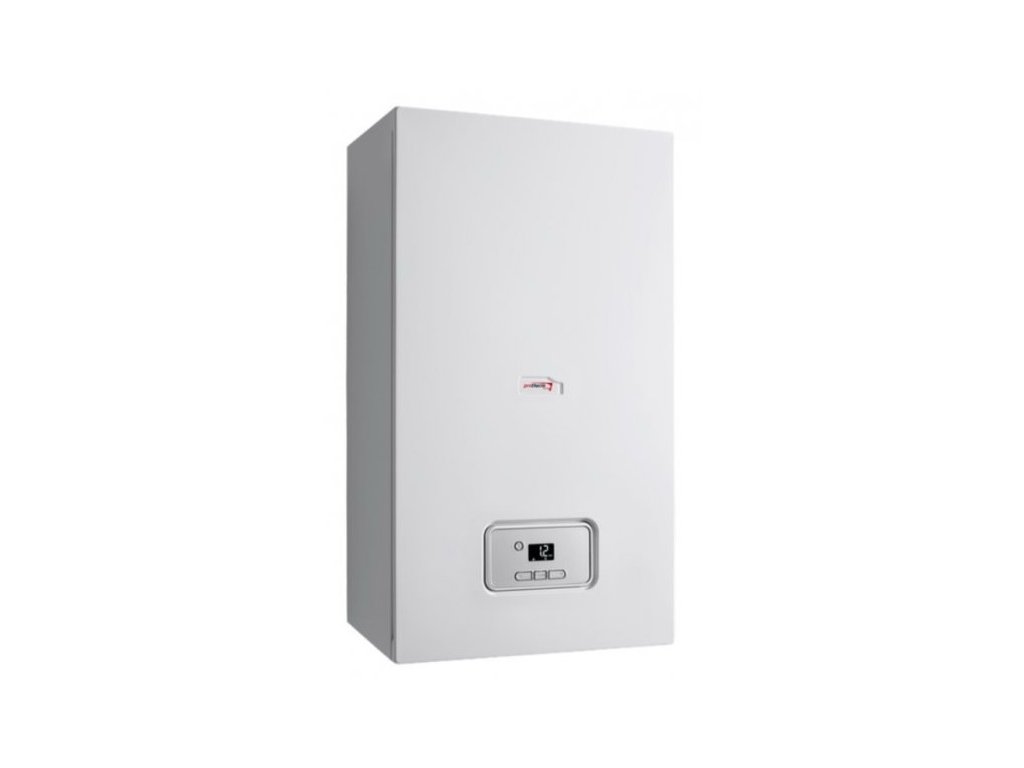
Boilers with flow-through DHW heating – no storage tank, water is heated directly on draw-off. Suitable for smaller households with a single draw-off point (e.g. a flat with one bathroom). Example: Protherm Gepard Condens 18/25 MKV, from €1,322. |

|
Boilers with a built-in storage tank – a compact solution, the tank is part of the boiler's body. Saves space, suits smaller boiler rooms. Example: Protherm Tiger Condens 30/35 KKZ 42, from €2,680. |

|
Boiler and storage tank sets – a separate, larger-volume storage tank, for higher hot water consumption (multiple bathrooms, a larger family). Example: Vaillant VU 246/5-3 ecoTEC pro + VIH Q75 B, from €2,557. |

|
Boilers with the option to connect a storage tank – a boiler without a tank that you can add at any time later. A flexible solution if you're not sure about your future consumption. Example: Protherm Gepard Condens 12 MKO, from €1,268. |
3. Installation Location and Flue Gas Discharge
A wall-mounted boiler is usually placed in a boiler room, bathroom or kitchen. There are two basic types based on the combustion method:
- Turbo (room-sealed) boiler – has a closed combustion chamber, draws combustion air from outside and discharges flue gases via forced draught (a fan) through a wall or flue duct. Today, mostly turbo versions are sold, as they are safer and independent of room ventilation.
- Atmospheric boiler – needs a chimney and a supply of combustion air directly from the room; a less common type nowadays.
Flue gas discharge can be concentric (flue gases and intake air routed through one pipe within a pipe, out through the wall) or separated (two independent pipes, advantageous for a greater distance from the perimeter wall or when several boilers are connected to a shared chimney). Suitable accessories:

|
Protherm Splitting Element Ø 2 x 80 mm R2KP – used with a separated flue discharge system, when the air intake and exhaust need to be split into two independent routes. Price from €24. |
|
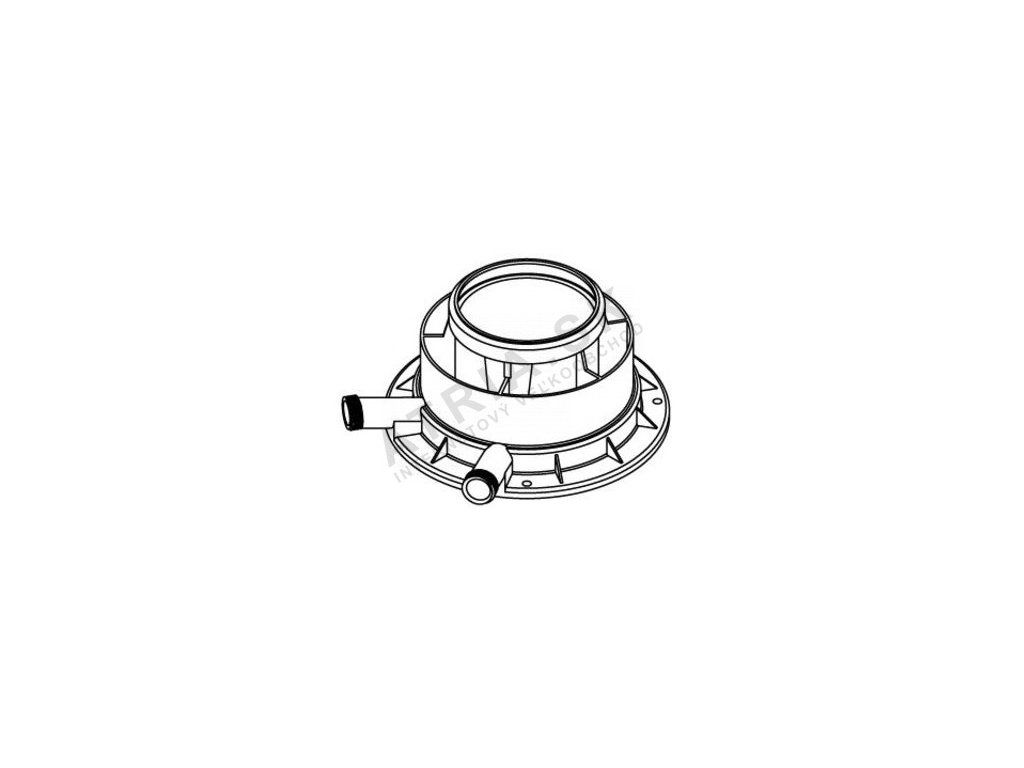
Protherm Flue Duct Adapter 60/100 mm A1KP – a reducing/transition piece between different flue duct diameters, a common part of the installation kit. Price from €18. |
You'll find the full range in the flue gas discharges, flue ducts section. The exact type and length of the discharge is determined by the project/installation company according to the boiler's distance from the perimeter wall and local regulations.
Fuel and Energy Source
The vast majority of condensing boilers on the Slovak market are designed for mains natural gas. Versions convertible to propane-butane (LPG) also exist for locations without a gas connection – this requires a special nozzle/setting, which is usually handled by an authorised service technician during commissioning.
Controls and Savings
Most boilers can be supplemented with a room thermostat or weather-compensated (equithermal) control (adjusts output according to the outdoor temperature), which significantly increases both comfort and fuel savings. A detailed setup guide can be found in the articles Thermostat and Weather-Compensated Boiler Control and What Temperature to Set on a Condensing Boiler.

|
Vaillant VRT 50 – a room thermostat compatible with common condensing boilers, enabling precise temperature control in the reference room. Price from €71. You'll find the full range in the boiler controls section. |
Price and Budget
Approximate price ranges (boiler only, excluding installation):
- Basic boiler with flow-through heating or the option to connect a storage tank: from approx. €1,200–1,400
- Boiler with a built-in storage tank: from approx. €2,200–2,700 (depending on tank volume and output)
- Boiler + separate storage tank set: from approx. €2,400–2,600 (depending on tank volume)
On top of the boiler's price, you need to add installation, possibly adjustment of the flue gas discharge, controls, and commissioning by an authorised service provider (a condition for the warranty to be valid).
Installation – DIY or a Professional
Connecting a condensing boiler to the gas supply, flue gas discharge and electrical network must be carried out by a professional installation company with the appropriate authorisation – this involves work with gas equipment, where DIY installation is neither legally nor safely possible. The company will also register the boiler with the manufacturer, which activates the full warranty period. Atria.sk is an online retailer; installation is arranged by the customer through their own heating engineer, but we're happy to recommend verified installation partners in your region.
The three areas covered in detail in this article.
The four solutions covered in the chapter above.
Summary of the steps from selection to boiler start-up.
Frequently Asked Questions
- Is investing in a condensing boiler worth it? Yes – thanks to using the heat from flue gases, it commonly saves 15–20% of fuel compared to a conventional boiler, with a payback period usually within a few years.
- Do I need to have a design ready before buying? It isn't required, but an exact heat loss calculation from a professional company guarantees a correctly sized output and helps you avoid both oversizing and undersizing the boiler.
- What's the difference between a turbo and an atmospheric boiler? A turbo boiler has a closed combustion chamber with forced discharge through a wall or flue duct, while an atmospheric boiler needs a chimney and air supply from the room – today mostly turbo versions are sold.
- Can a condensing boiler be connected to an old chimney? Yes, for the chimney version the flue needs to be lined with a plastic or stainless-steel liner resistant to condensate.
- Where does the condensate from the boiler drain to? A condensing boiler produces mildly acidic condensate, which is usually drained directly into the waste/sewer system via a siphon; in some cases a neutralisation box is recommended.
- Can a condensing boiler also be used with underfloor heating? Yes, condensing boilers are an ideal match for low-temperature systems such as underfloor heating – details in the article Underfloor Heating and a Condensing Boiler.
Video: How a Condensing Boiler Works
Source: Vaillant Slovensko, YouTube
Recommended Boilers
Based on the criteria from this article, we recommend starting by looking at these three models – covering a flat/smaller house, a typical family home, and a more demanding household with a wide modulation range:
|
|
Protherm Gepard Condens 18/25 MKV – a good starting point for a flat or smaller family home, the densest service network in Slovakia. Price from €1,322.00. |
|
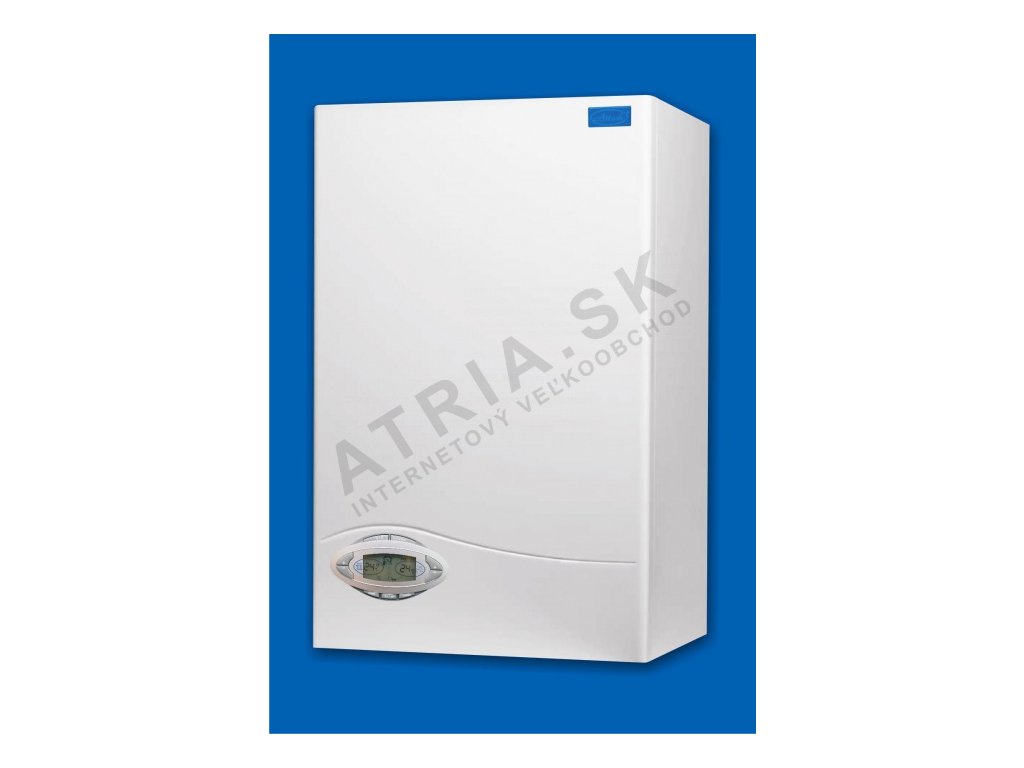
ATTACK CONDENSING 20 Premium – a Slovak manufacturer, a functional boiler without extra premium add-ons. Price from €1,731.00. |

|
Viessmann Vitodens 100-W, 3.2 – 25 kW, DHW – for a more demanding household, a wide modulation range starting from 3.2 kW. Price from €2,398.90. |
You can browse and filter the full range of condensing boilers by output, brand and price here.
Related Topics
- What Output Condensing Boiler Do I Need
- Most Common Selection and Installation Mistakes
- Comparison of Condensing Boiler Brands
- Is It Worth Replacing an Old Gas Boiler with a Condensing One?
Have a Question About Choosing a Boiler?
Can't decide, or dealing with a specific situation in your household? Write to us – we're happy to advise.