
What Temperature to Set on a Condensing Boiler
The question "what temperature to set on a condensing boiler" sounds simple, but in reality it hides three completely different temperatures that the boiler remembers independently of one another: the heating water temperature (the one flowing to the radiators or underfloor heating), the domestic hot water – DHW temperature (the one that comes out of the tap when you turn on a hot shower), and finally the room temperature, which you set on the thermostat or directly on the boiler if you don't have a thermostat. Each of these follows different logic and a different recommendation – and mixing them up is the most common reason why owners of condensing boilers either heat unnecessarily expensively, or (less often, but it happens) risk a health problem related to hot water. In this article we'll go through all three temperatures step by step, explain why, and show you concrete tools that make setting them easier.
Three Temperatures, One Boiler
A condensing boiler is essentially a small power station for heat that simultaneously serves two completely different circuits:
- Heating circuit – the water that circulates between the boiler and the radiators or underfloor heating. Its temperature is called the "flow temperature" or "heating water temperature", and on the boiler's display you'll often find it under a radiator symbol.
- DHW circuit – domestic hot water in the storage tank (water heater), or directly at the point of use in the case of instantaneous heating. On the display it's marked with a tap or droplet symbol.
- Room temperature – the air temperature in your living room, which the boiler doesn't know directly unless a room thermostat reports it.
While for room temperature the simple rule "I set whatever feels comfortable to me" applies, for the first two temperatures there are expert recommendations worth following – one for the sake of savings and boiler efficiency, the other for health reasons. Let's go through them one by one.
Heating Water Temperature – As Low As Still Sufficient
This is, paradoxically, the point where most people do exactly the opposite of what's correct for a condensing boiler. With an old conventional boiler, the rule was "the higher the water temperature in the radiators, the warmer the apartment, so I'd rather set it higher." With a condensing boiler it's the other way around – and it's directly related to the principle that makes condensing technology so economical.
A condensing boiler gains extra heat by cooling the flue gases enough that the water vapor in them condenses back into water, and during this phase change additional heat is released that would otherwise escape through the flue. For this condensation to happen at all, the temperature of the return water (the water returning from the radiators back to the boiler) must be low enough – roughly below 55 °C, ideally even lower. The lower you set the heating water temperature on the boiler, the more flue gas condenses and the higher the efficiency you get from the fuel. Conversely, if you set the temperature unnecessarily high "just to be safe," the boiler can end up working practically like a conventional non-condensing one – you burn more gas for the same comfort.
That's why the basic rule for a condensing boiler is: set the lowest heating water temperature that still reliably heats the space to the desired room temperature even during the coldest frosts. The specific value differs mainly according to the type of heating system:
Underfloor Heating
Large-area underfloor heating has a huge radiating surface (the entire floor of the room), so a much lower water temperature is enough to deliver the same amount of heat compared to radiators. The typical range is approximately 30 – 40 °C, and in well-insulated new buildings often even less is enough. It's precisely this low operating temperature that's the reason why the combination of a condensing boiler and underfloor heating is considered one of the most economical on the market – with it, the boiler condenses practically continuously. A detailed guide to sizing and setup can be found in the separate topic Underfloor Heating and a Condensing Boiler.
Radiators
Radiators have a smaller surface area, so they need hotter water to deliver the required output – typically 45 – 65 °C, and in extreme frosts with older, undersized radiators exceptionally even more. The exact value depends on how large your radiators are relative to the room's heat loss (the so-called heating curve), and on what temperature spread the radiators were originally designed for (typically 55/45 °C or the older 70/55 °C). If your radiators are properly oversized, you can try going below 50 °C without losing comfort. You can find more on choosing the right temperature, and on when it pays to replace radiators with larger ones, in the topic Radiators and a Condensing Boiler.
Why It's Better Not to Set a Fixed Temperature Manually
Most people set the heating water temperature once in the autumn "by eye" and leave it like that for the whole winter. The problem is that the required water temperature changes day by day depending on the outdoor temperature – during a mild January warm spell, much less is needed for heating than during a freezing night at -15 °C. If you leave the boiler running at one fixed, high temperature "just to be safe," you're overheating unnecessarily and losing efficiency even on days when much less would be enough.
The solution is weather compensation control – using an outdoor sensor, the boiler continuously recalculates on its own what heating water temperature it currently needs, based on the current outdoor temperature and a pre-set heating curve. This way you don't need to manually adjust anything – the boiler adapts by itself, and in the process it typically maintains a lower average water temperature than if you set it to a fixed value – which means higher efficiency and lower gas bills.

|
Protherm – Outdoor temperature sensor (wired) for boilers with an eBus bus – an outdoor sensor that constantly reports the current outside temperature to the boiler. Thanks to it, the boiler calculates the required heating water temperature on its own and you don't need to manually adjust anything – instead of a single fixed value, you get a full weather compensation control system. Price from €33.54. |
The other side of the same coin is the room thermostat, which in turn tells the boiler whether the room is already warm enough or needs more. The combination of an outdoor sensor and a room thermostat is the most comfortable and most economical solution you can have with a standard condensing boiler.

|
Vaillant VRT 50 – a room thermostat for setting the desired room temperature and a weekly time program (for example, a lower temperature at night, higher in the morning and evening). Thanks to it, the boiler heats exactly as much as needed, rather than "blindly" following a fixed curve. Price from €71.64. |
You'll find a complete overview of control types, how the heating curve is set, and what to watch out for during installation in the topic Thermostat and Weather Compensation Control for a Boiler.
Domestic Hot Water (DHW) Temperature
For hot water at the tap, a completely different logic applies than for heating water – here it doesn't pay to go "as low as possible." The expert recommendation is to keep the temperature in the DHW storage tank at approximately 55 – 60 °C, for one specific health reason: the legionella bacterium.
Legionella is a bacterium that naturally occurs even in drinking water and, at temperatures roughly between 20 °C and 45 °C, can multiply in standing water (for example, precisely in a hot water storage tank). If inhaled as a water aerosol (for example in the shower), it can cause a serious respiratory illness. At temperatures above 55 – 60 °C, the bacterium's growth stops, and at higher temperatures (around 70 °C) it is directly destroyed – which is why in practice it's recommended to either keep the tank permanently above 55 °C, or at least regularly (for example once a week) run a so-called thermal disinfection cycle, during which the boiler briefly heats the water to a higher temperature.
At the same time, this doesn't mean "the higher, the better." Too high a DHW temperature has two disadvantages:
- More limescale – the hotter the water, the faster calcium and magnesium precipitate out of it and settle in the tank, on the heat exchanger, and in the pipework. This shortens the tank's service life and reduces heating efficiency (the tank needs to be cleaned and descaled more often).
- Higher energy consumption – heating water to a higher temperature costs more energy, and since it's mixed with cold water down to a comfortable roughly 38 – 40 °C at the point of use anyway, the extra "reserve" is essentially wasted.
That's why in practice it's recommended to stay within the 55 – 60 °C range – it's a compromise that safely eliminates the risk of legionella while not unnecessarily driving up limescale formation or energy consumption. When drawn at the tap, this hot water is mixed with cold water via a mixing tap, so in reality you get a comfortable 38 – 40 °C from the shower or sink, regardless of the fact that the water in the tank is at 55 – 60 °C.
|
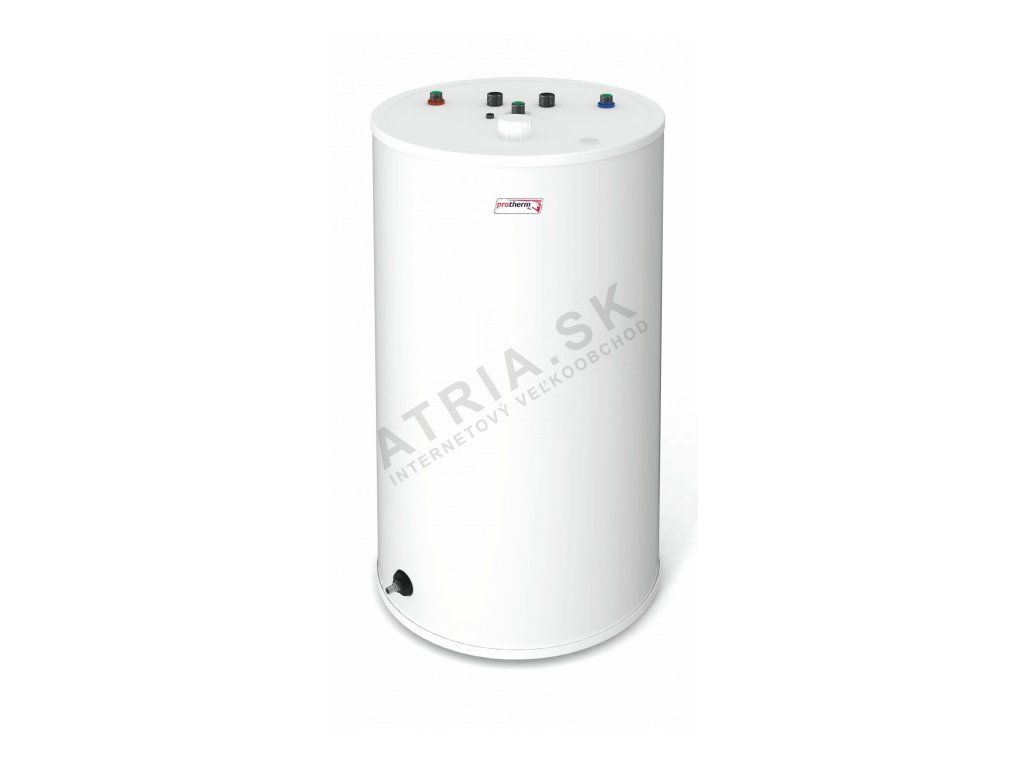
Protherm FE 200 BM – stationary storage tank – this is exactly the type of tank in which the DHW temperature is set and maintained. Larger volumes (200 liters here) have the advantage of a more stable temperature during several simultaneous draw-offs, for example in a household with several bathrooms. Price from €822.66. |
Recommended Room Temperature
The third temperature you deal with is the one you feel directly – the air temperature in the room. Here it's more about comfort than a technical parameter, but even here there are commonly recommended values:
- Living areas during the day: generally 20 – 22 °C is the value most people perceive as comfortable.
- Bedroom: many people prefer a lower temperature, around 17 – 19 °C – cooler air is associated with better-quality sleep and also saves energy.
- Night or when away from the apartment/house: it pays to use a so-called setback mode – temporarily lowering the temperature by 2 – 4 °C instead of switching the heating off completely. Turning it off completely and then reheating a cooled-down house often consumes more energy than a mild, ongoing setback.
Every extra degree of room temperature counts toward consumption – it's generally stated that lowering it by 1 °C can save on the order of a few percent on heating costs. You can find more detailed calculations and tips for real savings in the topic Gas Consumption and Heating Savings.
Since the recommended room temperature differs from room to room (bedroom cooler, living room warmer), it pays to set the temperature separately for individual rooms rather than using one value for the whole house:

|
Elektrobock EMF-1 – a programmable thermostatic radiator head that lets you set a different temperature and time program in the bedroom than in the living room, without needing to modify the heating system. Price from €20.06. |
Overview Table of Recommended Temperatures
| Parameter | Recommended range | Note |
|---|---|---|
| Heating water – underfloor heating | 30 – 40 °C | Lower temperature = higher condensation efficiency |
| Heating water – radiators | 45 – 65 °C | Exact value depends on frost level and radiator sizing |
| Domestic hot water (DHW) in the tank | 55 – 60 °C | Prevents legionella growth, compromise with limescale |
| Room temperature – living areas (day) | 20 – 22 °C | Typical comfort recommendation |
| Room temperature – bedroom / night | 17 – 19 °C | Setback instead of switching heating off completely |
Approximate temperatures covered in the individual chapters above.
Three different temperatures that the boiler handles at the same time.
The reason weather compensation control pays off compared to a fixed value.
Frequently Asked Questions
- Does a higher heating water temperature affect how fast a room heats up? Yes, a higher water temperature delivers more heat into the space in a shorter time, but for everyday operation it's much more advantageous to set a lower temperature and let the boiler heat longer and more smoothly – this saves on gas consumption and extends the time during which the boiler condenses.
- Can I keep the DHW temperature permanently set to 70 °C to be "safe" against legionella? It's not necessary, and in the long run it unnecessarily increases both limescale formation and energy consumption. The recommended 55 – 60 °C already reliably eliminates the risk of legionella; it only makes sense to use a higher temperature (for example 65 – 70 °C) briefly, during occasional thermal disinfection of the tank.
- Why can't my boiler keep the house warm during severe frosts even though the heating water temperature is set low? This means the set temperature (or the heating curve in the case of weather compensation control) is too low for that frost level relative to the size of your radiators or the house's heat loss. The solution is to slightly increase the curve for low outdoor temperatures, or to reconsider the radiator sizing – more in the topic Radiators and a Condensing Boiler.
- Can the heating water temperature and the DHW temperature be set independently? Yes, they are two completely separate circuits with their own settings on the boiler's display or app; changing one value doesn't affect the other in any way.
- Is it worth investing in an outdoor sensor and a room thermostat when the boiler works even without them? Yes – without them you have to set the heating water temperature manually "by eye," and in practice most people keep it unnecessarily high for the entire heating season. Weather compensation control with inputs from both sensors can deliver noticeable savings without any loss of comfort.
- Why does the hot water from my tap have a different temperature than the one I set on the boiler? The temperature in the tank (e.g. 58 °C) is mixed with cold water in the mixing tap when drawn, so at the tap you actually feel a lower, comfortable temperature of around 38 – 40 °C. The temperature in the tank itself is intentionally higher, to prevent legionella.
- Do I have to change the heating water temperature manually every time the weather changes? No, that's exactly what weather compensation control with an outdoor sensor is for – the boiler calculates the required temperature on its own based on the current outdoor temperature, and you don't need to adjust anything.
- Does the recommended DHW temperature change between summer and winter? The recommended range of 55 – 60 °C in the tank itself applies the same all year round, since it's related to legionella prevention, not the weather. Only the heating water temperature changes (in summer it's practically not needed at all, since the boiler switches to summer mode and only prepares DHW), while most households leave the DHW tank setting unchanged throughout the year.