
Underfloor Heating and a Condensing Boiler
Why Underfloor Heating Is an Ideal Combination with a Condensing Boiler
If you're thinking about renovating your heating system or building a new house, you've probably already come across the advice: "For underfloor heating, get a condensing boiler – it's the best possible combination." This advice isn't a marketing phrase – it's backed by simple physics, which we'll now explain in plain terms so you know exactly why it works and how to get the maximum saving out of it.
A condensing boiler differs from a classic (atmospheric) boiler in that it can also use the so-called latent heat contained in the water vapour produced by burning gas. For this phenomenon – condensation – to happen at all, the flue gases must be cooled in the boiler below the dew point (around 55 °C). And that's the key to the whole principle: the lower the temperature of the water returning from the heating system back to the boiler (the so-called return water), the more the flue gases cool down inside the boiler, and the more extra heat gets "squeezed" out of them. At a low return water temperature (around 30 – 40 °C), a condensing boiler can achieve a real efficiency of around 108 – 109% relative to the calorific value of the gas (the so-called net calorific value) – in other words, significantly more heat from the same amount of fuel than a standard boiler delivers.
The condensation principle, explained in detail in the article below.
How Condensation Works in Practice
Picture it like this: hot water from the boiler goes into the heating system, releases heat into the room, and returns cooler. The "cooler" the system is (meaning the lower the heating water temperature it needs), the cooler the water that returns to the boiler – and the longer and more intensely the boiler condenses. Condensation isn't really a yes/no question, but a matter of degree – the boiler can condense partially, most of the time, or practically continuously. And this is exactly where underfloor heating stands out.
Underfloor Heating vs. Radiators – A Fundamental Difference in Temperature
Ordinary radiators need a relatively high heating water temperature to heat a room – typically 55 to 70 °C at the inlet (even more for older, undersized radiators). The return water therefore typically comes back at a temperature often above 45–50 °C, which is right at or above the dew point – a condensing boiler still works better than a classic boiler in this case, but it only condenses partially.
Underfloor heating works on a completely different principle – large-area heat radiation from the entire floor surface. Thanks to the large heat-exchange surface (dozens of square metres instead of a few small radiator panels), a much lower water temperature is enough to heat the same room – typically 30 to 45 °C at the inlet to the floor loops, and often even less in well-insulated new builds. The return water therefore comes back to the boiler at a temperature well below the dew point, so the boiler can condense practically continuously, throughout the entire heating season. The result is the highest achievable efficiency of condensing technology in practice and the lowest gas consumption per unit of heat you can realistically achieve in an ordinary household.
In simple terms: radiators + condensing boiler = a good combination that still saves compared to an old boiler. Underfloor heating + condensing boiler = the best possible combination, in which the boiler operates as close as possible to its theoretical maximum.
How This Combination Is Actually Connected
In practice there are two typical scenarios, depending on whether the house has only underfloor heating, or a combination of underfloor heating and radiators.
A House with Only Underfloor Heating
If every room has only underfloor heating, the situation is simplest. The boiler supplies water to the underfloor heating manifold (the so-called distribution manifold), from which individual loops run to each room. The manifold usually also contains its own mixing (control) unit, which ensures that the water temperature in the floor loops never exceeds a safe limit (typically around 45–50 °C, to prevent the floor covering from overheating). Many modern condensing boilers can also work in a low-temperature mode straight from the factory, so in some cases they can even be connected directly without an additional external mixing station – however, the exact connection is always designed and approved by a designer or an experienced installer based on the specific type of floor loops and the length of the circuits.
Combining Underfloor Heating and Radiators in One House
A very common situation is that underfloor heating is used in only part of the house (for example bathrooms, living room, kitchen), while the rest is heated by classic radiators. In that case you effectively need two circuits with different water temperatures in the system – a high-temperature one for the radiators and a low-temperature one for the underfloor heating. This is solved using a mixing unit (mixing station) with a three-way or four-way valve, which blends cooler return water into the hot water coming from the boiler before it enters the floor loops, lowering the temperature exactly to the value the underfloor heating needs. The radiator circuit stays connected directly to the boiler at the higher temperature.
For this type of installation in particular, it's worth checking out our separate Knowledge Center article Radiators and a Condensing Boiler – it explains how to set up the boiler so that it works as efficiently as possible even in a combined system with higher temperatures.
Installing underfloor heating using the wet process (i.e. embedding the pipes in a concrete screed) also requires a quality system insulation board under the piping – it ensures that heat is directed upward into the room rather than downward into the neighbour's ceiling or into the ground. Here's an example of a suitable product from our own range:

|
System Insulation Board UHP55 for Underfloor Heating (STIROTERMAL BASIC) – a system board with moulded studs for holding the pipes in place, designed for wet-process installation of hot-water underfloor heating. It provides thermal and partial acoustic insulation under the screed, so that low-temperature heating water releases its heat where it's meant to go – into the room, not into the structure. Price from €11.72/m². |
Choosing a Condensing Boiler for Underfloor Heating
Not every condensing boiler is equally suited to combination with underfloor heating – what matters most is whether the boiler can reliably and stably operate at low outlet temperatures (downward power modulation) and whether it has a wide enough modulation range to adapt to the current heat demand without needless switching on and off (so-called cycling). A quality condensing boiler designed for low-temperature systems can smoothly regulate its output according to exactly how much heat the house currently needs – during transitional periods (spring, autumn) it can run at very low output precisely because underfloor heating doesn't need a high flow of hot water.
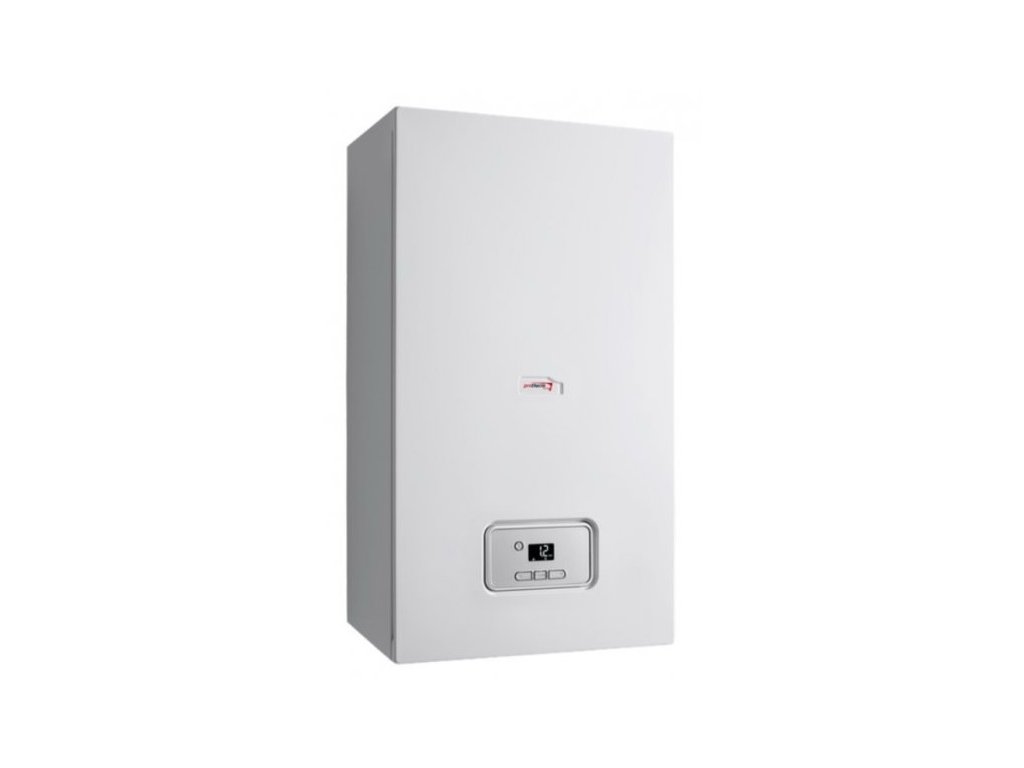
|
Protherm Gepard Condens 18/25 MKV – a condensing boiler well suited to combination with underfloor heating thanks to reliable low-temperature operation and smooth power modulation. Thanks to its wide output range (18/25 kW), it can suit both a smaller flat and a family house with a larger underfloor heating area. Price from €1,322.00. |
What to Watch Out for When Designing the System
Combining underfloor heating with a condensing boiler is ideal in terms of efficiency, but for it to work truly smoothly, the design needs to take into account several specifics that don't come up so significantly with radiators.
Correct Output Sizing
The boiler's output must be calculated based on the house's actual heat losses (through the walls, windows, roof and floor), not a rough "by eye" estimate. An undersized boiler won't be able to keep up with heating the house to the required temperature on frosty days, while an oversized boiler will cycle too often (switching on and off quickly), which reduces both its lifespan and efficiency. With underfloor heating, it's also important to account for heat losses downward through the floor if it isn't sufficiently insulated – which is exactly why it's worth not skimping on this and using a quality system insulation board (see above). You'll find a detailed procedure for calculating the required output in the separate Knowledge Center article What Boiler Output Do I Need.
The Thermal Inertia of Underfloor Heating
Compared to radiators, underfloor heating has significantly greater thermal inertia – while a radiator responds to a thermostat setting change within tens of minutes, a concrete screed with floor loops can take several hours to respond to the same change. In normal operation this is an advantage (the system holds a stable, even temperature without swings), but it also means a simple on/off thermostat isn't an ideal solution – the house would "overshoot" between too warm and too cold with a long delay.
Why Weather Compensation Is Worth Having
Precisely because of the thermal inertia of underfloor heating, weather-compensated control is strongly recommended for this combination – a system that automatically adjusts the heating water temperature according to the current outdoor temperature (using an outdoor sensor), instead of waiting for the room temperature to change and only reacting afterwards. Thanks to this, the boiler "knows" in advance that it has turned colder outside and slightly raises the water temperature before this shows up in the room – the system then works more smoothly, without unnecessary swings, while also keeping the return water as low as possible (and condensation as high as possible) exactly according to what the house actually needs at that moment.

|
Vaillant VRT 50 – a room thermostat with weather compensation support, suitable for controlling a combined boiler + underfloor heating system. By working together with the outdoor sensor, it helps keep the heating water temperature as close as possible to what the house actually needs, and therefore the return water temperature as low as possible – exactly what a condensing boiler needs for maximum efficiency. Price from €71.64. |
You can find more about how to set up weather compensation exactly, and what types of thermostats exist, in the Knowledge Center article Thermostat and Weather-Compensated Boiler Control.
More About Underfloor Heating
This topic focused mainly on combining underfloor heating with a condensing boiler. If you're interested in underfloor heating itself – types of systems (wet vs. dry process), floor build-up, suitable floor coverings, pipe spacing, or choosing a suitable manifold – we recommend checking out the separate Underfloor Heating section directly in the atria.sk catalogue, where you'll find the full product range as well as more detailed information on each type of system.
The key difference between the two types of heat emitters.
The two common setups discussed in the article above.
Three key areas covered in the article.
Frequently Asked Questions
- Can a condensing boiler be connected to old underfloor heating? Yes, as long as the underfloor heating is functional and designed for low temperatures (which is practically always the case with underfloor heating), a condensing boiler can be connected without any problems – in fact, old underfloor heating usually operates at even lower temperatures than modern systems, so condensation will be even more pronounced.
- Is it worth combining underfloor heating in just the bathroom with radiators elsewhere? Yes, it's a common and workable solution. It requires a mixing unit for the underfloor circuit, as described above, but in terms of both comfort (a warm bathroom floor) and efficiency, it's a good compromise between investment and benefit.
- Do I necessarily need weather compensation with underfloor heating? It's not a strict requirement, but given the thermal inertia of underfloor heating it's strongly recommended – the system can be run without it, but with bigger temperature swings and somewhat worse control of consumption.
- Why is an insulation board needed under underfloor heating, and isn't an ordinary screed enough? Without quality thermal insulation under the pipes, a significant part of the heat escapes downward (into the ceiling of the floor below or into the ground) instead of heating the room above. A system insulation board also makes installation easier thanks to moulded studs that hold the pipes at a precise spacing.
- Is underfloor heating with a condensing boiler more expensive to install than radiators? The initial investment in underfloor heating (piping, insulation, manifold, labour) is usually higher than for radiators, but thanks to significantly higher condensing efficiency, this investment pays itself back over time through lower gas bills.
Related Topics
- Radiators and a Condensing Boiler
- What Boiler Output Do I Need
- Thermostat and Weather-Compensated Boiler Control
- How to Choose a Condensing Boiler
Have a Question About Choosing a Boiler?
Can't decide, or dealing with a specific situation in your household? Write to us – we're happy to help.