
What Output Do I Need for a Condensing Boiler
Below you will find practical tables to help you get oriented when choosing a condensing boiler – approximate output by house floor area, heating circuit type, flue gas exhaust method, and hot water storage tank size. The tables serve as a preliminary estimate; we will be happy to confirm the exact output and connection before you buy, or we recommend consulting a professional installation company.
Calculate Boiler Output in 30 Seconds
Two operating modes mentioned in the article below.
1. What boiler output will I need for my house based on living area or heated space volume?
|
Living space area, volume |
Recommended output |
|
|
112 m 2 |
300 m 3 |
9 kW |
|
187 m 2 |
500 m 3 |
15 kW |
|
250 m 2 |
666 m 3 |
20 kW |
|
300 m 2 |
800 m 3 |
24 kW |
|
375 m 2 |
1000 m 3 |
30 kW |
|
537 m 2 |
1433 m 3 |
43 kW |
|
750 m 2 |
2000 m 3 |
60 kW |
2. What type of boiler will I need based on the heating circuit type?
|
No. of circuits |
Heating circuit type |
Recommended temperature gradient |
Heating mode |
Recommended boiler type |
|
1 |
radiator |
75/55 °C |
HT |
circulation |
|
1 |
radiator + DHW |
75/55 °C |
HT |
circulation |
|
2 |
radiator + DHW + underfloor |
70/50 °C 40/30 °C |
LT |
condensing |
|
3 |
radiator + DHW + underfloor + pool |
70/50 °C 40/30 °C |
LT HT |
stationary (or condensing) |
|
4 |
radiator + DHW + underfloor + pool + ventilation |
70/50 °C 40/30 °C |
HT |
stationary (or condensing) |
|
5 |
radiator + DHW + underfloor + pool + ventilation + solar |
70/50 °C 40/30 °C |
HT |
stationary (or condensing) |
HT - high-temperature mode
LT - low-temperature mode
3. What type of boiler will I need based on the available installation space?
|
Installation space |
Combustion air supply |
Recommended boiler type |
|
separate enclosed room |
opening as required by standard |
dependent on room air (open-flue) |
|
(boiler room, bathroom, WC) |
via a chimney/flue kit |
independent of room air (room-sealed) |
|
open |
free air supply |
dependent on room air (open-flue) |
|
(hallway, staircase) |
via a chimney/flue kit |
independent of room air (room-sealed) |
4. How to choose a suitable boiler based on the flue gas exhaust method?
|
Flue gas exhaust method |
Recommended boiler type |
|
existing masonry chimney |
stationary boiler, or wall-mounted atmospheric boiler |
|
flue kit for room-air dependent (open-flue) operation |
wall-mounted turbo boiler |
|
flue kit for room-sealed (independent of room air) operation |
wall-mounted turbo boiler |
5. What size storage tank will I need based on the number of people in the household?
|
Number of people |
Instant/flow heating |
Boiler output [kW] |
Storage tank volume [ l ] |
|
2 |
x |
11-24 |
- |
|
3 |
- |
11 |
65 |
|
4 |
- |
20 |
105 |
|
5 |
- |
24 |
120 |
|
more people |
- |
up to 60 |
up to 300 |
How to choose the right boiler
Several parameters are important when choosing the right boiler. It is of course an investment for many years to come, so the choice of boiler should be considered carefully. You should be able to answer basic questions such as: What kind of fuel will I use? What boiler output will I need? Where will I place the boiler? What flue gas exhaust method will I choose? How will hot water be prepared?
Choosing the fuel:
There are several options. The range offered by boiler manufacturers includes, for example, boilers for natural gas, electricity, propane... Energy is becoming more and more expensive, so it's worth choosing the most economical solution possible. If you've decided on a gas boiler, you naturally need to have a gas supply already in place – if you don't, this issue needs to be resolved or you should choose a different option.
Choosing the boiler output:
The correct output should always be chosen based on a project calculation that determines the building's heat losses. A correctly designed boiler will provide enough heat both in cold and transitional periods of the year and allows the output to be reduced to an optimal value. If you don't have such a calculation, our table can help as a rough guide for a preliminary boiler choice. In any case, always consult a professional company that will carry out the installation before purchasing the equipment. A proper design is a very important technical solution at this stage.
Boiler installation space:
The boiler can be placed on the floor as a stationary unit, or you can choose a wall-mounted one. Wall-mounted boilers are placed either in a boiler room, or, if safety requirements are met, in other unoccupied rooms. Given current trends, it is also possible to place the boiler in a bathroom. In the case of hot water, it is recommended to place the boiler or storage tank close to the draw-off point in order to reduce heat losses in the piping. The boiler needs to be serviced, so it shouldn't be placed in poorly accessible locations.
Boiler design:
Old boilers, which were bulky, unattractive, and heavy, are a thing of the past. Modern boilers have come onto the market that every customer can nicely match with the other details in their home. Unsightly pipework is also long gone – today's units in white finish look modern and clean. On these new wall-mounted boilers, the connecting fittings are recessed under the boiler casing, so once installed they don't disrupt the boiler's modern design. Most customers, however, worry about boiler noise – but manufacturers have solved that too, as none of the modern boilers exceed 55 dB(A). This value is within the standard for residential spaces. The boilers are also equipped with a pump with a speed switch, which allows you to set a suitable flow speed through the heating system and thus reduce the noise level in the system.
Flue gas exhaust method:
An essential criterion when choosing the right boiler and its future installation location is the availability of the air supply needed for combustion and for exhausting the flue gases. The supply of combustion air and the exhaust of flue gases must be reliable and safe. The following flue gas exhaust methods are most commonly used:
1. Chimney
For the chimney version, the chimney needs to be fitted with a stainless steel liner and sufficient air must be ensured for the boiler. The room must have adequate ventilation.
2. Turbo
A boiler with a sealed combustion chamber, which means a flue system from the manufacturer is required. These are usually coaxial pipes with a diameter of 60/100 or 80/125. With this solution there are no special requirements for the air supply to the room where the boiler is located. This means they can also be placed in smaller spaces without ventilation openings.
Method of hot water preparation:
1. Boilers with instant/flow heating
These are very efficient because only the amount of water that will actually be used gets heated. This means there are no heat losses during storage. They switch on when you turn on the tap, at which point the water starts heating up. However, boilers with instant/flow heating are better suited to smaller households where water isn't drawn at two or more points at once. The disadvantage is a drop in flow rate or temperature when hot water is drawn at several points at the same time (bathtub, sink, shower, etc.).
2. Boiler with a storage tank
In this case, the hot water is prepared in the storage tank. A boiler and storage tank set is suitable for larger households, since it allows hot water to be supplied to a greater number of draw-off points. If part of the hot water is drawn from the storage tank, or if its temperature drops, the water is reheated again with low energy consumption. The water temperature in the storage tank should be in the range of 55 to 60 degrees Celsius. A higher temperature causes limescale to build up, while a lower temperature can allow unwanted bacteria to form.
Important information in numbers
Boilers with instant/flow heating provide 12–16 litres of water, heated by 25°C per minute, so the water coming out of the tap will be about 38°C, which is the optimal temperature for showering. A standard tap has a flow rate of about 5 litres per minute, a shower about 8 litres, and a bathtub 12 litres or more. These figures show that a flow-heating boiler can, for example, supply a sink and a shower at the same time, or fill a bathtub without any problem. With boilers that have a storage tank, there's no problem supplying a sink, shower, and bathtub at the same time. In this case, the limiting factor is the volume of the storage tank.
Operating costs:
Worried you'll be paying a lot of money for heating in the future? Experts in this field say that it's not only important to choose the right boiler, but also to focus on other related issues such as insulating the house, installing thermostatic valves on radiators, lowering the temperature of the heated building at night or when residents are away, etc.
Condensing boilers are the most economical, able to save up to 17% of fuel compared to standard boilers and up to 33% compared to outdated gas boilers. Significant savings are achieved because a condensing boiler doesn't just use the calorific value of the fuel like a standard boiler does, but is also able to make use of part of the condensation heat of the vapour contained in the flue gases, which in standard boilers is irretrievably lost up the chimney. It can therefore be said that investing in a condensing boiler is the best decision you can make.
Programmable room thermostat:
Choosing the right controls saves you money and takes care of your comfort. By installing one, you get an overview of the temperature in the living space and thus prevent the room from overheating. The thermostat lets you set the temperature as needed for different time zones.
If you can't decide on the kind and type of product that would best suit you, or you haven't found the product you need in our range, you can contact us and we'll help you choose.
Heat control - raising the temperature by 1°C means a 6% increase in costs.
Weather compensation control
Its role is to ensure comfort in the heated space depending on the outside temperature. The heating water temperature therefore changes depending on the outdoor temperature. When it's colder outside, the heating water temperature automatically increases. Conversely, when it's warmer outside, the water temperature decreases.
Nominal diameter
|
DN (mm) |
inches |
|
6 |
1/8 |
|
8 |
1/4 |
|
10 |
3/8 |
|
15 |
1/2 |
|
20 |
3/4 |
|
25 |
1 |
|
32 |
1 1/4 |
|
40 |
1 1/2 |
|
50 |
2 |
|
65 |
2 1/2 |
|
80 |
3 |
|
100 |
4 |
|
125 |
5 |
|
150 |
6 |
|
200 |
8 |
|
250 |
10 |
|
300 |
12 |
|
350 |
14 |
|
400 |
16 |
|
450 |
18 |
|
500 |
20 |
Examples of Boilers by Output Class
For a better idea of what condensing boilers in different output categories actually look like:

|
Protherm Gepard Condens 12 MKO – lower output (4.0 – 12.0 kW), suitable for a smaller flat or a well-insulated smaller area. Price from €1,268. |
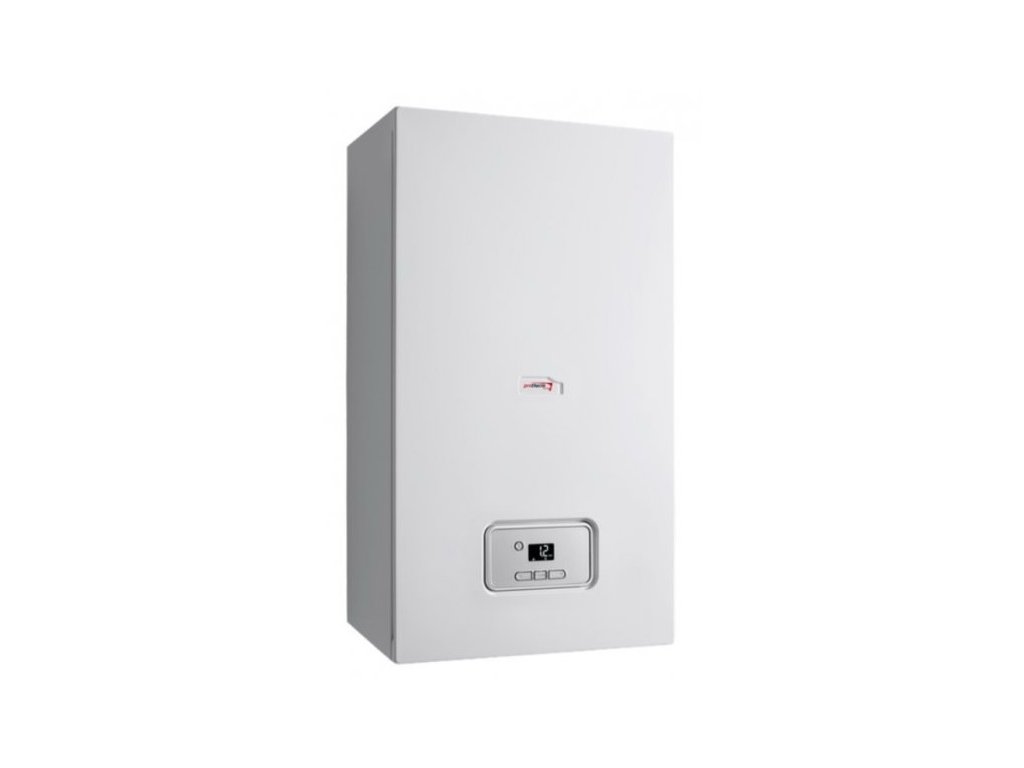
|
Protherm Gepard Condens 18/25 MKV – mid-range (18/25 kW), the most common choice for a typical family house up to approx. 200–250 m². Price from €1,322. |

|
Protherm Tiger Condens 30/35 KKZ 42 – higher output (3.5 – 30.0 kW) with a built-in 42 l storage tank, suitable for a larger house or higher hot water consumption. Price from €2,680.62. |
Values from the table above, approximately 1 kW per 10 m² with standard insulation.
Three examples of specific models from the table above.
Approximate process, the exact output should always be confirmed by a professional.
Frequently Asked Questions
- How do I find out exactly what boiler output I need? The table above can help as a rough guide (approx. 1 kW per 10 m² with standard insulation), but the exact output should always be confirmed by a project design or our expert advice before buying.
- What is the difference between high-temperature and low-temperature mode? High-temperature mode (HT) is used by classic radiators, while low-temperature mode (LT) is typical for underfloor heating – a condensing boiler can handle both.
- Why is the flue gas exhaust method important? It determines whether you can connect the boiler to an existing chimney or need a plastic concentric flue through the wall – it also affects where the boiler can be installed.
- Is investing in a condensing boiler worth it? Yes, by using the heat from flue gases it typically saves 15–20% of fuel compared to a classic boiler.
Have a Question About Choosing a Boiler?
Can't decide, or dealing with a specific situation in your household? Write to us – we'll be happy to help.