
Bleeding a Radiator - When and How
Why does air appear in a radiator at all
Air in a radiator isn't a fault that means something serious is broken - it's a normal side effect of running any sealed heating system. Water in a heating circuit contains dissolved air, similar to how sparkling water contains dissolved CO2 bubbles. When heated, the solubility of gases in water decreases, so air gradually escapes and travels through the system as microscopic bubbles. Since air is lighter than water, it collects at the highest points of the system - and those are usually the top parts of radiators, especially ones on the highest floors of the house.
Topping up water in the system also contributes to air release. Every time water is topped up (for example after a repair, after replacing a radiator, after work on the pipework, or simply when pressure drops), fresh mains water enters the circuit, and it always has a higher dissolved-air content than water that has already been circulating in the sealed system for a long time. So after every water top-up, expect to have to bleed the system again within a few days to weeks - this is completely normal and doesn't indicate a leak.
A second common source of air is micro-bubble corrosion - in older steel radiators and in systems with unsuitable water treatment, slow corrosion can occur, releasing hydrogen. This behaves the same way as air in the system - it rises and collects in radiators. If the same radiator needs bleeding repeatedly at short intervals (weekly, even after you've ruled out a leak), it's one of the signs that the state of the internal water treatment - and possibly the radiator body itself - should be checked.
How to tell a radiator needs bleeding
The most reliable and simplest test is to put your hand on the radiator with the valve fully open and the heating running at full output. If the top of the body is noticeably cooler than the bottom, or completely cold, it's almost always an air bubble trapped in the upper part of the radiator. Air blocks the flow of hot water exactly where the water should be radiating the most heat, so the body only works partially - even though the boiler is running at full output and the room is cold.
Another typical symptom is bubbling or a quiet "fizzing" sound coming from the radiator or the pipework right after the circulation pump starts, or as the water in the system gradually warms up. This sound is produced exactly the way it is when pouring water with bubbles through a narrow point - the air bubble moves inside the radiator body and knocks against the walls or the valve seat.
A third sign, which many homeowners don't directly associate with bleeding, is a slower rise in room temperature and higher fuel consumption at the same thermostat setting. An air bubble taking up part of the body's volume reduces the radiator's actual heat-exchange surface - in practice this looks like the boiler running longer to reach the same room temperature it previously reached in less time. The chart below shows how significantly an air bubble can limit a radiator's actual heat output, depending on how much of the body's volume it occupies.
As you can see, even a relatively small air bubble taking up around a third of the body's internal volume can reduce a radiator's actual heat output by roughly 20 to 30%. With a larger bubble taking up half the volume, output drops by roughly half - in that case you can usually clearly feel that half of the body is lukewarm or completely cold, while the bottom half is hot. That's exactly why it's worth dealing with bleeding as soon as the first symptom appears, rather than waiting until the air bubble grows large enough that heating output drops noticeably and consumption rises.
What you'll need
For bleeding a typical panel or sectional radiator, a few simple tools that most households already have - or that can be bought for a few euros - are enough:
- a bleed key (square-section or flat-profile, depending on the type of valve on your radiator),
- a small container or cup to catch the escaping water,
- a cloth or rag to wipe up drips right away,
- a flat screwdriver if needed, if the radiator's bleed valve has a slot instead of a square socket.
The bleed valve is usually located in the top corner of the radiator, on the opposite side from the connection to the thermostatic valve. On some newer radiators it's built directly into a bleed cap on top of the body. If you're not sure which of the screw-type elements on the radiator is the bleed valve and which serves another purpose, the simplest thing is to look - the bleed valve is small, usually with no visible control mechanism, while the thermostatic valve has a head with a numbered scale or a display.
Step-by-step procedure
Bleeding itself is a simple task that, with a bit of care, even someone who doesn't otherwise deal with heating at home can manage without trouble. The diagram below sums up the order the steps should follow, so the process goes smoothly without unnecessary water loss or a drop in system pressure.
In step three, it's important to turn the valve gradually and slowly, not open it fully in one go - the bleed valve isn't meant to be opened fully like a tap; a quarter to half a turn is enough. If it's opened too far, there's a risk it won't tighten properly again, or that water will start gushing out in a stream that's harder to control. Throughout the process, keep the container held right under the valve, because the moment the air escapes, a drop or a short jet of water can spurt out without warning.
A practical tip from service experience: switch off the circulation pump before bleeding (either by turning off the boiler, or at least switching it to standby), because a running pump can scatter the air bubble around the radiator body and make the process take longer. When the water in the system is still, air reliably collects at the highest point of the body and bleeding is faster and cleaner.
What to do when only air, and no water, comes out of the valve
If only air (a hissing sound) escapes from the bleed valve and water still doesn't start flowing even after a good while, it means the overall system pressure is too low to push water up to the bleed point, or that the system doesn't have enough water in it. In that case, first top up water in the system via the filling valve at the boiler until the gauge shows the recommended value (for most houses with a standard boiler this is roughly 1.0 to 1.5 bar cold, the exact value is typically stated by the boiler manufacturer on the panel or in the manual), and then repeat the bleeding.
The opposite case - water flowing out immediately, with no initial air escaping at all - means there was no air in that particular radiator at the time of checking. This isn't a fault or a waste of time, just a sign that this particular radiator was fine and the problem needs to be looked for elsewhere, for example on a higher floor or on the radiator furthest from the boiler, where air typically collects the most.
Temperature control and why it's linked to bleeding
Bleeding on its own only solves the physical problem of the air bubble, but good temperature control on the radiator significantly reduces how often the problem recurs, while also improving overall comfort and savings. A good-quality thermostatic valve with precise regulation maintains a smoother, more stable flow of water through the radiator, reducing the risk that sharp changes in flow will release and accumulate more air in the system than usual.
 |
Thermostatic dual-regulation valve - 1/2"xEK; angled - a dual-regulation valve allows fine flow adjustment directly at installation, which helps balance the whole circuit and reduces the risk of air repeatedly collecting in this particular radiator. Especially suitable when replacing an old, leaking or faulty valve. Price from €14.27. |
The thermostatic head on the control valve doesn't affect the air bubble itself in any way, but it helps indirectly - stable control means fewer sharp swings in the water temperature inside the body, and therefore fewer opportunities for dissolved air to be released during rapid heating. If your radiators have old, mechanically worn heads that can't hold the set temperature precisely and cause frequent sharp on/off flow changes, it's worth considering replacing them.
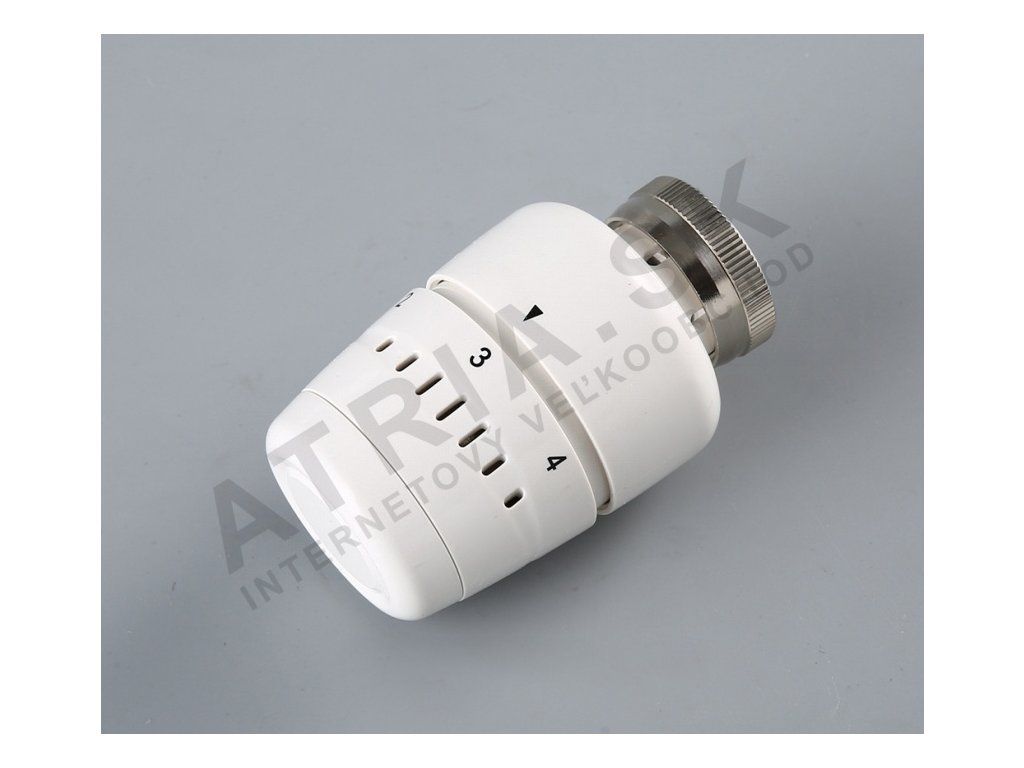 |
Large thermostatic head - lacquered - a quality replacement for a worn-out or faulty original head, with more precise control and smoother flow, which reduces the risk of air repeatedly building up during sharp water-temperature changes. Price from €8.49. |
The difference between a manual and an automatic bleed valve
Besides the classic manual bleed valve, there are also automatic bleed valves, which are fitted mainly at the highest points of the system (underfloor heating manifolds, the top points of risers, some types of radiators) and release air on their own, without any intervention. On standard panel radiators in houses, however, a manual valve is still most commonly used - it's cheaper, more reliable in terms of long-term sealing, and gives precise control over when and how much air is released.
An automatic valve has its place especially where physical access for manual bleeding is impractical, or where air collects regularly and in larger amounts, for example at the top of a riser pipe in a multi-storey house. Its downside is that it's a mechanical part with a moving float, which can jam over time or start to leak slightly, so automatic valves also need occasional checking. For a typical house with standard panel radiators, manual bleeding at regular intervals is therefore still the most commonly recommended solution in practice, as the more reliable and cheaper option.
How often to bleed and when during the year
There's no universal rule that applies to every household, because how often air accumulates depends on the age of the system, water quality, how well the valves seal, and how often water is topped up in the system. In practice, though, the following annual schedule has proven itself and covers most typical houses and flats with their own heating.
The first bleed at the start of the season (typically in October, when the heating is switched on fully after summer) is the most important - during summer the heating system stood with little circulation, and that's exactly when the most air has time to release and accumulate. The second check mid-season (December to January) serves more as a safety check - just place your hand on the top of the radiators every so often, and check and bleed if you suspect a cooler top. The third check before the end of the season helps you record the current pressure, giving you a reference value to compare against in autumn before the next start-up.
What to top up and how to add water
After every bleed the pressure in the system also drops slightly, because a small amount of water escapes along with the air. If the boiler gauge shows a value below the recommended minimum (typically less than 1.0 bar cold for a typical house, exact values vary by building height and boiler type), water needs to be topped up via the filling valve. For a normal top-up with cold tap water, a small amount is enough - open the filling valve slowly and watch the gauge until it settles at the required value, then close the valve again.
For systems that also feed underfloor heating pipework, or where a control fitting needs to be added or replaced directly at the manifold, it's worth having a complete set of components on hand, which makes both installation and any future adjustments to the circuit easier.
 |
HPW Set1 control set - a practical set of control components handy when adjusting or extending a heating circuit, for example when balancing flow between individual branches is being addressed alongside dealing with air in the system. Price from €27.94. |
When plain bleeding isn't enough
If a radiator still doesn't heat evenly after being properly bled, or air keeps appearing repeatedly within just a few days, other causes besides normal air accumulation should be considered:
A leak in the system. If the system's pressure regularly drops faster than normal (a noticeable drop over a few days, not weeks), water may be leaking somewhere in the circuit - either visibly (dripping at a joint, valve or pump), or hidden (a damp patch on a wall where pipework runs in the floor). In this case, bleeding only masks the problem, it doesn't solve it - the source of the leak needs to be found and repaired.
A clogged or damaged valve. If a radiator still doesn't heat evenly after bleeding and ruling out air, the cause may be a clogged or damaged thermostatic valve that's restricting sufficient flow. Clogging is often an issue in older systems with sediment or corrosion products in the pipework.
An improperly balanced system. In larger houses with several radiators, it can happen that one or two radiators (typically the ones furthest from the boiler or on the highest floor) don't get enough flow, because closer radiators "steal" the flow. This shows up outwardly in a similar way to an air bubble (a cooler radiator), but bleeding won't help here - it's solved by hydraulically balancing the whole system, or by replacing radiators with ones that have more precise flow control built into the body.
 |
Radiator 21K 300 x 400, output 298W - if the original radiator is already worn out, or suffers from repeated internal corrosion releasing gas, replacing it with a new body solves the problem permanently and also delivers a more accurate, stated output. Price from €58.79. |
 |
Radiator 21K 300 x 500, output 373W - a slightly more powerful variant in the same line, suitable when replacing a radiator in a room with higher heat loss, where you want a reliable margin of output without the risk of recurring problems with the old body. Price from €65.56. |
Safety notes
Only bleed when the water in the system is at most lukewarm, never hot straight from operation at full output - hot water from an open valve can cause burns. It's best to bleed either before the heating switches on in the morning, or at least an hour after it switches off, when the water in the body has cooled to a tolerable temperature but the system isn't completely cold yet (in a completely cold system, air collects less reliably at the bleed valve).
Never open the bleed valve fully, and never leave it unattended - even a brief absence with the valve open can cause a large amount of water to escape and a significant pressure drop throughout the system. If you have children or pets at home, make sure during bleeding that they don't come into contact with the escaping water or the container it's flowing into.
Frequently Asked Questions
How often do radiators need bleeding?
For a typical household, once at the start of the heating season (typically in October) and roughly once mid-season is usually enough. If you've recently topped up water in the system (for example after a repair or replacing a radiator), expect to have to bleed again within one to two weeks, until the air from the fresh water has released and settled.
Why doesn't anything flow from the radiator even though air is hissing out?
If only air escapes from the valve but water doesn't start flowing for a long time, the overall system pressure is probably too low to push water up to the bleed point. First top up water via the filling valve at the boiler to the recommended pressure value, then repeat the bleeding.
Is it normal for pressure to drop after bleeding?
Yes, a small amount of water always escapes along with the air, so a slight pressure drop (for example from 1.8 to 1.5 bar) is normal and expected. If the gauge drops below the recommended minimum, simply top up water via the filling valve until the pressure settles at the required value.
Can a radiator bleed itself, without any intervention?
A standard manual valve won't release air on its own - that requires manual action. Only an automatic bleed valve with a float mechanism can do it by itself, but that's only fitted to standard panel radiators in exceptional cases - it's more commonly used on manifolds and at the top points of risers.
How do I tell which valve on a radiator is the bleed valve and which is the control valve?
The bleed valve is a small screw-type element with no visible scale, usually located in the top corner of the radiator opposite the water inlet. The control (thermostatic) valve, by contrast, always has a head with a numbered scale or a display, used to set the desired temperature.
Can repeatedly bleeding the same radiator mean there's a fault?
If the same radiator needs bleeding repeatedly at short intervals (weekly) even without you having recently topped up water, it could be either a hidden leak in the system or internal corrosion of the body releasing gas. In that case it's worth having the system checked and also considering checking the condition of the radiator itself.
Related topics
- How to choose a radiator - type and size
- Radiator not heating or heating unevenly
- Thermostatic heads and smart control
- Radiator installation and replacement
You'll find the full range of radiators, valves and accessories in the main Radiators category.
Have a question on this topic?
Not sure what to decide, or dealing with a specific situation in your home? Write to us - we're happy to help.