
Oil-filled Radiators as Supplementary Heating
Oil-filled radiators as supplementary heating
An oil-filled radiator is one of the best-selling portable electric appliances for topping up heat, and most households have had at least one brush with one - whether at a cottage, in a child's room, or during a period when the boiler broke down and a few cold days needed bridging quickly. That's exactly why it's worth taking a sober look at this technology, without the marketing phrases about "economical heating of the whole flat", because an oil-filled radiator simply isn't built for that and shouldn't be sold that way either. It's a local, slow-reacting heat source that works great as a supplement to the main heating, but it should never replace a properly sized heating system for the whole house.
In this article we'll look at how an oil-filled radiator works, what output you actually need, how much it costs to run, when it makes sense and when it's better to invest in a permanent solution instead - such as a classic panel radiator with thermostatic control. We're drawing on real customer experience as well as the typical technical parameters found on most oil-filled radiators sold on the Slovak market.
How an oil-filled radiator works
The principle behind an oil-filled radiator is simple, and that's exactly why the technology has remained practically unchanged for decades. Inside a sealed metal body (finned, similar to a small central-heating radiator) there is mineral oil. An electric heating element - similar to the one you know from a kettle - heats the oil. Oil has a high thermal capacity, so it not only doesn't overheat quickly, but more importantly it can hold heat for a long time and release it gradually into the room even after the heating element switches off.
Heat spreads from the radiator's surface into the room in two ways - by convection and by radiation. Cooler air near the floor warms up on contact with the hot fins, rises, and creates a natural circulation of air in the room. At the same time, the radiator's surface also radiates heat directly, similar to a classic central-heating radiator in a flat. The ratio between convection and radiation depends on the design - more fins and a larger surface means more convection, while more compact bodies radiate relatively more.
It's precisely the thermal inertia of the oil that is the main difference compared to direct resistive convectors or infrared panels. While a convector with a resistive wire starts heating - and cooling - almost instantly, an oil-filled radiator heats up more slowly (typically 10 to 20 minutes before you feel noticeable warmth), but after switching off it keeps "coasting" on the heat stored in the oil for a long time. In supplementary heating this is both an advantage and a disadvantage at once - an advantage in that the room temperature is more stable and fluctuates less, a disadvantage in that an oil-filled radiator isn't suited to a quick, one-off top-up of a room just before you use it.
What output does an oil-filled radiator actually need
Oil-filled radiators are commonly sold with an output of 1000 W, 1500 W, 2000 W and 2500 W, usually with two or three power stages (for example 700/1300/2000 W), so you can dose the heat as needed instead of switching straight to full output. As a rough guide, for a well-insulated room of typical height (ceiling up to 2.7 m), about 100 W per m² is enough as a supplementary heat source alongside a working main heating system. That means a 1000 W radiator will comfortably top up a room of around 10-12 m², a 1500 W unit suits a room of around 15-18 m², and a 2000 W unit can handle a larger living room up to 20-24 m² - provided, of course, that it's genuinely topping up the heat, not acting as the sole heat source in freezing weather.
This rough figure of 100 W/m² applies when the room is otherwise tempered (for example by central heating set to a lower temperature, or by heat coming in from neighbouring heated rooms) and the oil-filled radiator only needs to make up a difference of a few degrees. If you wanted to heat a room from cold using an oil-filled radiator as the sole heat source, the actual output required is significantly higher, typically 60-80 W/m² just to cover heat losses under typical insulation, plus a margin for the difference between outdoor and indoor temperature on freezing days. This is exactly where customers are most often disappointed - they buy a 2000 W radiator for a 20 m² room in a block of flats with non-functioning heating, and wonder why the room is never warmer than 16-17 °C. Physically, it simply can't come out any other way, because the heat losses of a larger, more poorly insulated room in frosty weather easily exceed what a single 2 kW appliance can deliver.
Running costs - what an oil-filled radiator really costs you
An oil-filled radiator is a direct electric heating appliance, meaning every watt of power it draws from the mains converts to heat at close to 100% efficiency. That's the physical maximum achievable from electricity (unlike, for example, a heat pump, which can turn 1 kWh of electricity into 3-4 kWh of heat by drawing extra heat from the surroundings). That's exactly why direct electric heating - which includes an oil-filled radiator - is, in terms of running cost per kWh of heat produced, the most expensive commonly available form of heating.
At a rough electricity price of around €0.20/kWh (a typical figure for households in Slovakia on a single-rate tariff - check the exact figure on your own bill), an hour of operation works out as follows: a radiator on the 1000 W setting costs about €0.20/hour, on 1500 W about €0.30/hour, on 2000 W about €0.40/hour, and on 2500 W about €0.50/hour. If you left such a radiator running continuously at full 2000 W output for an entire day (24 hours), that would come to roughly €9.60 for just one day - and that's exactly why an oil-filled radiator should never replace proper heating for a whole heating season, but should only serve for short-term, targeted top-up heating of a specific room at a specific time (for example the bathroom in the morning, or a child's room in the evening).
In practice, the thermostat on an oil-filled radiator doesn't run continuously at full output - once the room reaches the set temperature, the thermostat switches the heating off, and switches it on again only when the temperature drops below the set threshold. Actual consumption is therefore always lower than the theoretical "output times time" calculation, often by 30-50% depending on the room's heat losses and the difference between indoor and outdoor temperature. Even so, a simple rule applies - the more hours a day the radiator runs and the higher the output you use, the faster the savings from a "proper" heating solution via central heating with well-set controls pay off in comparison.
When an oil-filled radiator really earns its place in a household
Despite everything above, an oil-filled radiator isn't a bad solution - it's just a solution for a specific, limited range of situations. It's most worthwhile in these cases:
The shoulder season, outside the heating season
In spring and autumn, when it's still too warm outside to fire up the boiler for the whole house, but one or two rooms are cold in the evening or morning, switching on a small oil-filled radiator for an hour or two is significantly cheaper and more practical than starting up the whole heating system for the sake of a few degrees in one room.
Rooms outside the main heating circuit
Bedsits above a garage, finished attics, rooms in cottages used only occasionally, or spaces that for various reasons never got a central-heating radiator - here a portable oil-filled radiator is clearly the simplest and cheapest solution in terms of purchase price.
A temporary failure of the main heating
A boiler fault, a gas outage, a service intervention - in such situations it's good to have at least one working oil-filled radiator at home as a backup, until the main system is fixed.
The individual heat needs of one household member
Someone in the household feels the cold more than the others (typically in the bedroom at night, or in a study during sedentary work) and doesn't want to overheat the whole flat by an extra 2-3 °C just for that. A small oil-filled radiator by the desk or bed solves local comfort without unnecessary blanket overheating.
On the other hand, an oil-filled radiator makes no sense as a replacement for a whole season's heating in a larger room, as a fix for poor thermal insulation (the radiator won't hold heat in if it's escaping through windows and walls), or as a "temporary" solution that actually drags on for years - in that case, running costs will long since have exceeded the cost of investing in a proper radiator connected to central heating.
Comparison with other forms of supplementary heating
An oil-filled radiator isn't the only option for topping up heat. It's worth knowing the alternatives too, and when each one is more suitable.
 |
Radiator 21K 300 x 400, output 298W - if you've been topping up one room with an oil-filled radiator for a second heating season running, it's worth considering a permanent solution: a small panel radiator connected to central heating can handle even a small space with no ongoing electricity cost, and combined with a thermostatic head it holds a precise temperature with no attention needed. Price from €58.79. |
If the problem is a whole smaller room with persistently inadequate heating (for example an extension, or a room over a garage), it's worth working out how many heating seasons it would take for the investment in a permanent radiator to pay off compared to repeatedly running an oil-filled radiator - with typical use of a few hours a day all winter, this often comes out at one to two seasons.
How to combine an oil-filled radiator sensibly with central heating
The most common practical situation is this: central heating works in the flat, but in one particular room (bedroom, child's room, bathroom) you occasionally need a temperature a few degrees higher than the rest of the flat. Instead of overheating the whole flat through the boiler for that reason, it's more energy- and cost-efficient to set the central-heating radiator in that room to a lower base temperature and make up the difference with an oil-filled radiator only at the times you actually need it (for example in the morning while getting children dressed, or in the evening before bed).
The key to making this combination work without unnecessary waste is functioning thermostatic control on the central-heating radiator - otherwise the boiler and the oil-filled radiator can end up "competing" for the same room, resulting in higher consumption from both systems at once.
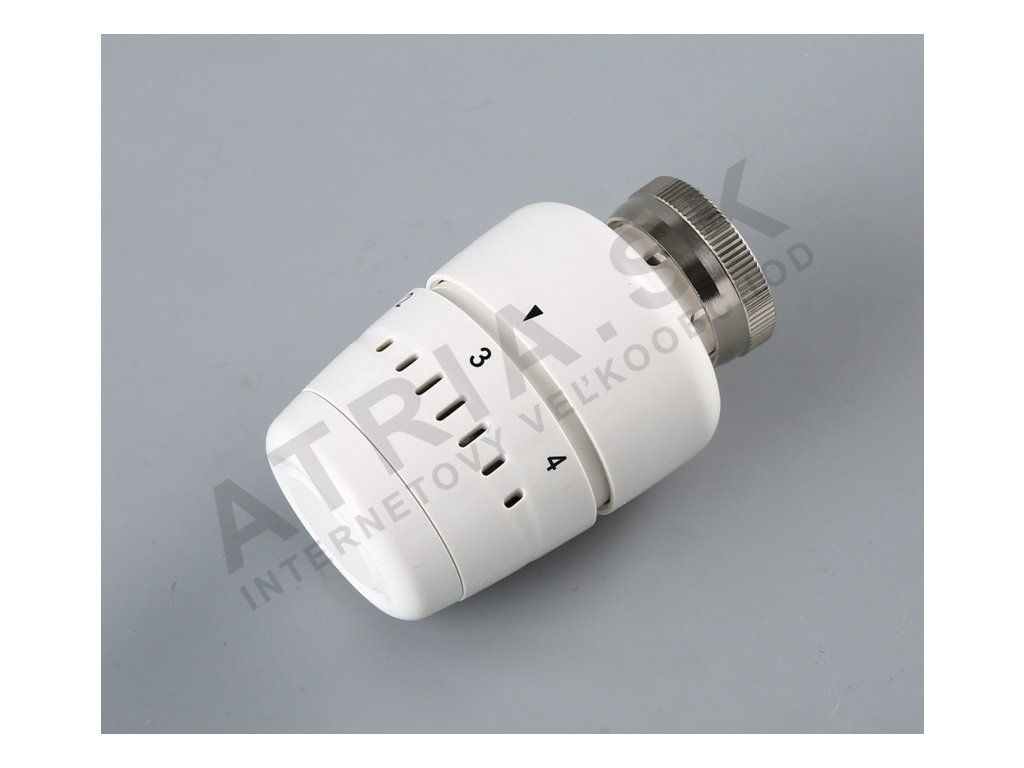 |
Large thermostatic head - lacquered - precisely holding a lower base temperature on the central-heating radiator is the foundation for sensibly combining it with temporary top-up heating from an oil-filled radiator. Without a working head, it's easy for the heating system to bring the room up to full temperature at exactly the time you're already topping it up with electricity. Price from €8.49. |
 |
Thermostatic dual-regulation valve - 1/2"xEK; angled - if the radiator in the room doesn't have thermostatic control at all yet (an older type with a simple shut-off valve), a dual-regulation angled valve is a prerequisite for being able to fit a thermostatic head on it at all, and for achieving a sensible coexistence with supplementary electric top-up heating. Price from €14.27. |
Safety and practical tips for use
An oil-filled radiator is one of the safer portable electric heating appliances precisely because its surface heats up much less than, say, a direct resistive convector or an infrared panel - the typical surface temperature of the fins is around 60-90 °C, which is still enough to cause a burn on prolonged direct contact, but far less risky than appliances with a glowing element. Even so, a few basic rules are worth following.
Always place the radiator on a flat, stable, non-flammable or at least heat-resistant floor, at least 50 cm from curtains, furniture and other flammable materials. Never hang wet laundry on it to dry, and never cover it - restricting airflow around the fins can cause overheating and, in extreme cases, even damage the appliance. In rooms with small children or pets, consider a model with an additional protective grille, or at least make sure it's placed away from the usual paths through the room.
Better-quality models have a built-in tip-over cut-off (the radiator switches off automatically if tilted past a certain angle) and a thermal cut-off against overheating - when buying an older or second-hand radiator, be sure to check for these features, since they tend to be the first thing to fail on cheaper, older units. Never plug the radiator into an extension cable with a lower cross-section than its power draw requires (for 2000 W and above, a cable with a cross-section of at least 1.5 mm² is appropriate - ideally plug it directly into a socket with no extension cable).
After a long period out of use (for example over summer), it's a good idea to inspect the radiator visually before using it again - look for cracks on the surface, stains from leaking oil, and damage to the power cable. An oil leak is a safety risk and grounds for taking the appliance out of service immediately; repeated servicing (topping up/replacing the oil) is not recommended for an ordinary consumer to attempt at home.
How to choose a specific model
When choosing a specific oil-filled radiator, it's worth looking at a few parameters beyond the output alone. The number of fins and the body's total surface area affect how evenly heat spreads in the room - more fins for the same output means a lower surface temperature per unit of area, which is more comfortable and safer. A mechanical or electronic thermostat - an electronic one generally holds the temperature more precisely (less fluctuation around the set value), and some models also have a weekly timer, letting the radiator switch on before you even get home.
Casters on the underside of the body are handy if you plan to move the radiator between rooms - a filled oil-filled radiator typically weighs between 8 and 15 kg depending on output and oil volume, so handling it without casters is fairly awkward. If you're buying a radiator for a child's room or a household with small children, look for a model with a cooler-to-the-touch fin cover or an additional protective grille.
Finally, consider noise level too - a good-quality oil-filled radiator should be practically silent (no fan, just the quiet click of the thermostat), unlike fan convectors, which can be disruptive, especially in a bedroom at night.
Frequently Asked Questions
Can an oil-filled radiator heat a whole heating season instead of central heating?
Technically yes, but in practice it's almost never worth it. Direct electric heating is the most expensive commonly available form of heating in terms of cost per kWh of heat, so the cost for a whole season would be significantly higher than with gas, a heat pump, or even an electric boiler with storage. An oil-filled radiator is designed for short-term, local top-up heating, not for seasonal operation as the sole heat source.
Why does an oil-filled radiator still fail to bring a small room up to the desired temperature?
This is most often down to the output being wrongly sized for the room's heat losses (for example old, draughty windows, missing insulation, a high ceiling), or to using the radiator as the sole heat source instead of a supplement to existing heating. Also check whether the radiator is partly blocked by furniture or a curtain, which significantly restricts warm air flow into the room.
Is it safe to leave an oil-filled radiator switched on overnight?
With a model that has a working thermostat, a thermal cut-off and a tip-over cut-off, overnight operation is common and considered safe, provided basic rules are followed (sufficient distance from flammable materials, direct connection to a socket, no covering). Even so, for older or cheaper models without these safety features, we recommend a more cautious approach and not leaving the appliance unattended for long periods.
Is it worth buying a 2500 W oil-filled radiator "just to be safe", even if the room is only 15 m²?
It's not worth significantly oversizing the output - higher power draw means higher consumption at the same thermostat setting, and in a small room the full output won't get used anyway, since the thermostat will switch the radiator off more often. It's better to choose a model with the right output for the floor area (see the table above), and perhaps favour a model with several power stages so you can dose the heat according to actual need.
How often does an oil-filled radiator need checking or servicing?
Normal domestic use doesn't require regular servicing - the oil is sealed in the system for the appliance's entire lifespan. Only a visual check is recommended before each new heating season (cracks, stains from oil leaks, condition of the power cable and plug), and immediate withdrawal from use at any suspicion of a leak.
Can an oil-filled radiator be combined with a thermostatic head on the central-heating radiator in the same room?
Yes, and it's the recommended way to achieve higher comfort in one room without unnecessary waste - the central-heating radiator with a working thermostatic head holds a lower base temperature, and the oil-filled radiator makes up the difference only when you need it. The key is that the control on the central-heating radiator actually works, otherwise both heat sources can end up inefficiently "competing" for the same space.
Summary
An oil-filled radiator is a reliable, safe and inexpensive appliance for short-term, local top-up heating - ideal for the shoulder season, for rooms outside the main heating circuit, or as a backup solution if the boiler fails. However, it's not a substitute for properly sized heating for a whole season, since direct electric heating is among the most expensive forms of heating per kWh of heat. If you find yourself topping up the same room season after season, it's worth working out whether it would pay off in the long run to invest in a permanent radiator with quality thermostatic control connected to central heating.
Related topics
How to choose a radiator - type and size
What radiator output do I need
Thermostatic heads and smart control
Frequently Asked Questions About Radiators
Radiators
Have a question on this topic?
Not sure what to decide, or dealing with a specific situation in your home? Write to us - we're happy to help.