
Thermostatic Heads and Smart Control
The thermostatic head - a small part that decides your heating bill
A thermostatic head is one of those things most people only notice once it stops working - when a radiator heats at full blast even with the window open, or conversely stays cold even in a frost. Yet it's exactly this small plastic part on top of the radiator valve that ultimately decides how much you pay for gas or electricity during the heating season. At atria.sk we've been selling thermostatic heads and complete valves for years, and in this article we'll look at how it all actually works, what the numbers on the dial mean, when it's worth switching to smart control, and where people most often go wrong with installation and use.
No need to worry about technical terms - the principle is simple, and once you understand it, you'll be able to work out for yourself why a particular room never quite warms up the way you'd like, and what to actually do about it.
How a thermostatic head works - the wax capsule principle
A thermostatic head isn't an electronic device (unless we're talking about the smart version, which we'll get to later) - it's a purely mechanical regulator that works with no batteries and no electricity. Inside the head there's a capsule filled with a wax compound or a liquid sensitive to temperature. When the air temperature in the room rises, this fill expands and pushes on a pin, which mechanically presses the valve inside the valve body toward closing. When the temperature drops, the fill contracts, a spring in the valve pushes the pin back, and the flow of heating water through the radiator opens up again.
This whole cycle repeats continuously and automatically - so the head doesn't work like a switch (on/off), but as a proportional regulator that tries to hold the set temperature within a narrow band around the target value, usually with a deviation of about 1 to 2 °C. This is important to understand - a thermostatic head never holds a room at exactly one temperature to a tenth of a degree, there's always a slight fluctuation around the set value. That's exactly why, in more sensitive rooms (bedroom, child's room), many customers switch to electronic solutions with more precise control.
The diagram below shows the whole mechanism step by step, in simplified form:
Precisely because it's a relatively slow, mechanical process based on thermal expansion, a thermostatic head has a certain amount of lag - it reacts with a delay of a few minutes, not instantly. This is normal and shouldn't be treated as a fault.
The numbered scale on the head - what the numbers 1 to 5 actually mean
Most common mechanical heads have a scale on the rotating part with a snowflake (or star) symbol and numbers 1 to 5, sometimes with intermediate steps. Many customers ask us exactly how many degrees Celsius each number corresponds to - the answer is that these are approximate values that vary slightly by manufacturer, valve type and conditions in the room (air flow, proximity to a window, mounting height). Even so, there's a generally recognised rough table used by most manufacturers, including Heimeier, Danfoss, Honeywell and cheaper Asian brands:
- Snowflake symbol (*) - frost protection, keeps the room at about 7 °C to stop the pipework freezing
- Position 1 - about 12 °C, suitable for unused hallways, storage rooms, garages connected to heating
- Position 2 - about 16 °C, bedrooms, hallways, rooms where you want it cool for sleeping
- Position 3 - about 20 °C, typical living temperature, the most commonly used setting in living rooms
- Position 4 - about 24 °C, bathrooms, rooms where you want a noticeably higher temperature
- Position 5 - about 28 °C, maximum output, not usually used permanently, only for a top-up boost
We've also shown these values graphically, so you can see at a glance how each head position translates into the actual room temperature:
It's important to know these values only apply roughly under "standard" conditions - if the head is covered by a curtain, furniture, or exposed to a direct draught of cold air from a window, it will measure the temperature incorrectly, and the set position won't match the actual temperature in the middle of the room. This, by the way, is the most common cause of complaints like "the radiator is hot but the room is cold" - the problem isn't the radiator's output, but the head being placed wrongly or covered up.
If you're replacing the whole angled valve along with the head (for example during a bathroom renovation, or switching from an old valve with no thermostatic control), we recommend a dual-regulation type, which also allows precise flow adjustment when balancing the whole system:
 |
Thermostatic dual-regulation valve - 1/2"xEK; angled - the angled version is the most common solution for most flat installations, where the pipework comes up out of the floor. The dual-regulation function also allows precise flow adjustment (pre-setting), which is important especially for larger systems with several radiators, where you want to balance the system so every room heats evenly. Price from €14.27. |
Mechanical vs. smart (electronic) thermostatic head
Over the past few years, electronic, so-called smart thermostatic heads have become much more widespread - they work on the same valve-closing principle, but instead of a wax capsule they have a small electric motor controlled by electronics that reads a precise digital thermometer. The difference in precision and comfort is noticeable, but it's worth talking about the downsides too, so you can decide based on real need, not marketing.
Advantages of smart heads
- Control precision typically around 0.2 to 0.5 °C instead of 1-2 °C for mechanical ones
- Ability to set a weekly schedule (e.g. lower temperature overnight and during the working day, higher in the morning and evening)
- Remote control via a mobile app - you can switch the heating on while you're still on your way home
- Linking with a room thermostat or hub, shared zone control across several rooms
- Open-window detection (a rapid temperature drop) - automatically pauses heating
Downsides and what to watch out for
- They need batteries (usually 2× AA), which need replacing roughly once every 1 to 2 years
- Higher purchase price - for several radiators in a flat this can add up to a noticeable investment
- More complicated pairing and setup, not something every senior or less tech-savvy user will appreciate
- If WiFi or the app goes down, the head generally still works at least in basic manual mode, but you lose the remote-control advantage
A practical recommendation from our experience: smart heads make the most sense in rooms where the temperature genuinely changes over the course of the day (living room - different mode by day and evening; bedroom - cool for sleeping, warm in the morning), or in cottages you don't visit regularly and want to be able to pre-heat remotely before arriving. In permanently occupied rooms with a steady routine (for example a child's room with the same schedule all the time), the investment in a smart solution pays back more slowly, and a good-quality mechanical head may be the more sensible choice.
The diagram below compares both types across the key parameters mentioned above:
Installation - orientation, space around the head, common mistakes
Even though a thermostatic head is a simple part, its installation follows a few rules that are commonly broken and end up stopping the whole system working as it should.
1. Head orientation
The head should be fitted so the sensing part (the body of the head) is exposed to free airflow from the room, ideally in a horizontal or slightly angled position. If the valve is positioned so the head would point straight down, or be right against a wall or furniture, heat from the pipework affects it directly and the head then "sees" a higher temperature than actually exists in the room - the result is an underheated room. In such cases, heads with a remote sensor (capillary) exist, or it's recommended to relocate the valve.
2. Being covered by a curtain, furniture, or a radiator cover
This is probably the most common mistake we see among customers. If the radiator, head included, is hidden behind a decorative cover, a long curtain or furniture, the head measures the temperature in its own "pocket" of warm air, not the room's actual temperature. Result: you set it to position 3, but the room is cold, because the head closes before the room has actually warmed up.
3. Air in the system
If a radiator only heats partially (for example cold at the top, warm at the bottom), the problem usually isn't the head but air trapped in the radiator body - in that case bleeding will help, not replacing the head. See the separate article on bleeding radiators for the detailed procedure.
4. The wrong assumption that "a higher number = faster heating"
Many people think that setting the head to maximum (5) will heat the room faster. That's not true - a head at the maximum setting just lets the valve stay open longer and the room will be heated to a higher target temperature, but the speed at which it warms up depends on the radiator's output and the heating water temperature, not the head's position. If you want to pre-heat a room quickly, the head's position won't change anything - in that case, only a smart head with a time program, which starts heating early before you arrive, makes sense.
For a complete replacement or when installing a new heating branch, it's worth dealing with the valve, head and possibly a control set all at once - especially with underfloor pipework or when connecting several circuits:
 |
HPW Set1 control set - a complete set for connecting a radiator, including a valve ready for a thermostatic head, especially suitable for a complete connection replacement or installing a new radiator. It makes installation easier, since all the components are from a single manufacturer and fit together. Price from €27.94. |
Smart control across a whole flat or house - zoned heating
Individual smart heads handle control at a single-room level. If you want to go further, though, you can build so-called zoned heating - a combination of smart heads on each radiator with a central room thermostat or hub that also communicates with the boiler. The advantage of this approach is that the system can:
- Work out which rooms currently need heat and adjust the boiler's own output accordingly (not just the flow through individual radiators) - you save on gas consumption too, not just by redistributing heat
- Set a different schedule for each room separately - a home office can have a different mode than the bedroom or a child's room
- Respond to room occupancy (on pricier systems with a motion sensor) and reduce heating in unused spaces
- Show consumption history by room, which helps identify which room is "eating" the most energy (typically rooms with poor insulation or large windows)
You need to be realistic - building a full zoned system in a flat with 4-5 rooms means an investment in the order of hundreds of euros (smart heads on every radiator, plus possibly a central unit), so it's worth calculating the payback for your specific consumption first, not just buying it "because others have it too".
How much you can actually save - a practical example
A well-known rule of thumb is commonly used for heating control: lowering the average room temperature by 1 °C brings a heating cost saving of roughly 6%. This rule applies roughly to a typical house or flat with standard insulation, and it's the basis for estimating how much more precise control will bring you.
Let's take a specific, simplified example of a household with annual heating costs of €900 (a typical figure for a smaller flat with average Slovak gas consumption):
- Switching from old, uncontrolled valves (with no head at all) to mechanical thermostatic heads - a typical saving of 10 to 20%, thanks to avoiding unnecessary overheating of rooms from sunlight, cooking, or more people being in a room. At €900 a year, that's a saving of roughly €90 to €180 a year.
- Switching from mechanical heads to smart heads with a schedule (lower temperature when away and at night) - an additional saving of roughly 5 to 15% on top of the already-controlled mechanical state, so a further €35 to €100 a year.
- Combining this with zoned control linked to the boiler - according to independent measurements, a further saving on the order of 5 to 10% of the boiler's total consumption, since the boiler doesn't supply heat to zones that don't need it.
The chart below shows these three levels of control in the context of the €900-a-year example mentioned above:
These figures are approximate, and the actual saving depends on the building's insulation, window size, the number of rooms used, and how disciplined you've been about controlling things manually so far. Households that already manage their heads conscientiously by hand (for example lowering the temperature in unused rooms) will save less by switching to automation, since they're already achieving part of the saving manually.
Common problems with thermostatic heads and how to fix them
The head is "frozen" and won't turn
After summer, when the valve has sat in one position (usually closed) for a long time, the pin inside the valve can seize up with deposits or corrosion. Solution: unscrew the head (usually just loosening the retaining ring or screw is enough), and with pliers or a small screwdriver carefully press and release the pin on the valve body itself a few times until it moves freely again. Only then screw the head back on. That's why it's recommended to set all heads to maximum for a few days at the start and middle of the summer season - this prevents them seizing up by next winter.
The radiator still heats even with the head closed to zero/the snowflake
If a radiator heats even though the head is in the frost-protection position, either the valve itself is damaged (the pin isn't pressing all the way closed), or it's an older valve type that's not compatible with that head (different manufacturers have slightly different pin travel). In this case, only replacing the whole valve will help, not just the head.
The head clicks or makes noise
A slight click when opening/closing is normal on some types (especially cheaper mechanical heads). If the noise is loud, or there's a regular "hissing" sound, it's usually air in the system or water pressure that's too high - this needs to be addressed at the level of the whole heating system, not by replacing the head.
A smart head won't connect to the app/hub
The most common cause is a weak WiFi or Zigbee/Z-Wave signal at the installation point (radiators tend to be in room corners, often further from the router) or dead/incorrectly inserted batteries. Before making a claim, try pairing the head right next to the router - if it pairs there, the problem is signal range, not the head's functionality.
A practical example from a customer installation
A common scenario we see from customers: renovating a bathroom core, where the bathroom radiator is also being replaced. On this occasion it makes sense to replace the radiator, valve and head all at once, since the installer already has the system drained and the work doesn't need doing twice. When choosing the output for a radiator in a smaller bathroom (for example 300 x 400 mm), it's worth planning for higher comfort (head position 4, i.e. around 24 °C), so it's worth choosing a radiator with a margin in output, not one right at the edge of the room's needs:
 |
Radiator 21K 300 x 400, output 298W - a compact panel radiator suitable for smaller bathrooms in particular, or as a supplementary heating body, where a higher set temperature - and so a higher actual output load - is expected. Combined with a good-quality thermostatic valve, it holds the desired temperature precisely without unnecessary overheating. Price from €58.79. |
If you're only replacing the head itself (for example the old head is cracked, leaking, or has simply reached the end of its life after 15-20 years - yes, even mechanical heads have a lifespan determined by wear on the bellows and spring), there's no need to replace the whole valve. Most heads have the standardised M30x1.5 connection, which fits the vast majority of common valves on the market:
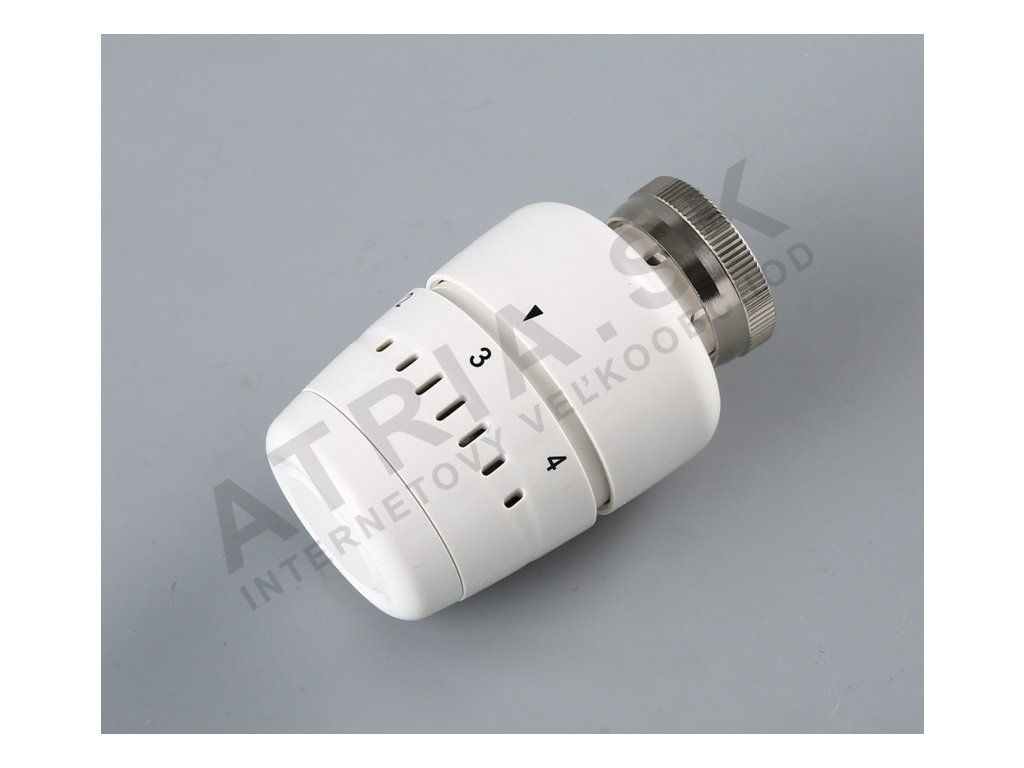 |
Large thermostatic head - lacquered - a quality mechanical unit with a lacquered surface, suitable as a direct replacement for a worn-out or damaged head with no need to touch the valve itself. Its larger diameter makes it easier to operate for older people with limited fine motor skills too. Price from €8.49. |
How to choose between a mechanical and a smart head - a quick summary
If you're weighing up which type suits you, follow a simple rule: in rooms with a steady, unchanging routine (for example a hallway, storage room, utility room), a good-quality mechanical head is enough - an investment in a smart solution practically never pays back there, since there's nothing to optimise. In a living room, bedroom and home office, on the other hand, where temperature needs genuinely change during the day, a smart head can bring a noticeable saving as well as comfort. If you're considering a complete upgrade for the whole flat, we recommend starting with the rooms where the difference between the daytime and night-time/away temperature is greatest - that's where the investment pays back fastest.
Frequently Asked Questions
Do I have to replace the whole body when replacing an old valve with no thermostat, or is adding a head enough?
If you genuinely have an old valve with no thermostatic element at all (typically just a hand wheel with no scale), you can't fit a thermostatic head onto it - you need a valve with a so-called thermostatic connector (M30x1.5), which the head attaches to. For a complete replacement, we recommend going straight for a dual-regulation valve, which also lets you balance the flow across the whole system.
Can a thermostatic head be fitted to an old cast-iron radiator too?
Yes, as long as the radiator or its connection has a suitable valve with a thermostatic connector. On very old cast-iron radiators, it's sometimes necessary to first replace the shut-off valve itself, since old types tend to either have no control at all or an incompatible thread.
Why doesn't my head close fully after being set to a lower number, with the radiator still heating slightly?
Slight warmth even at a low head setting is normal, especially if the heating water in the system is very hot (for example with older boilers with no weather-compensated control). If a radiator heats significantly even at setting 1 or the frost-protection position, we recommend checking the pin inside the valve is working properly - it may be clogged or mechanically damaged.
Is it worth buying smart heads for every radiator in the flat at once?
Not necessarily. We recommend starting in 2-3 rooms where the difference between the desired daytime and night-time temperature is greatest (typically the bedroom and living room), trying out how it actually works, and only then deciding whether investing in the rest of the flat is worthwhile for you personally, based on your routine.
How often do the batteries in a smart head need replacing?
Typical battery life is 1 to 2 years with standard 2× AA alkaline batteries, depending on how often it switches and how intensively it communicates with the hub/app. We recommend having spare batteries ready at home, especially at the start of the heating season, when the heads are most active.
Can I use a thermostatic head on underfloor heating too?
Thermostatic heads in their classic form are fitted directly to radiator valves, not to an underfloor heating manifold - that uses a separate set of actuators controlled by a room thermostat. The automatic control principle is conceptually similar, though. See the article on underfloor heating for details.
Related topics
If you're looking at control and radiator selection more broadly, these topics might interest you too:
- How to choose a radiator - type and size
- What radiator output do I need
- Radiator not heating or heating unevenly
- Bleeding a radiator - when and how
- Frequently Asked Questions About Radiators
You'll find the full range of radiators, valves and accessories in the main Radiators category.
Have a question on this topic?
Not sure what to decide, or dealing with a specific situation in your home? Write to us - we're happy to help.