
What Radiator Output Do I Need
What radiator output do I need
The question "how powerful a radiator should I buy" sounds simple at first, but it's exactly here that one of the most common mistakes happens when replacing heating bodies. Customers often confuse the size of the original radiator with its output, buy "by eye", or rely on a guess from a salesperson who's never even seen the room. The result is either a cold room that can't be properly heated even with the valve fully open, or, conversely, an oversized radiator that needlessly pushes too much water through the heating and forces you to constantly fiddle with the thermostatic head. In this article we'll explain in practical terms how a radiator's output is calculated, what values are realistic in Slovak homes, and how to choose a specific product that fits both your room and your wallet.
Why the right radiator output matters
A radiator isn't just a design feature under the window - it's a heat exchanger that has to be able to release exactly as much energy into the room as escapes through the walls, windows, roof and ventilation. If this balance is off, it shows up in one of two ways.
The first case is an undersized radiator. Even with the boiler set to a high heating-water temperature and the thermostatic valve fully open, the room temperature simply doesn't reach the desired level, especially on freezing days. A typical example from practice: a living room with a large north-facing glazed area, where the original cast-iron radiator was replaced with a smaller panel one without recalculating - the result was a room that never reached more than 18 °C in January, even with the boiler running continuously.
The second case is an oversized radiator. The room heats up quickly, but often unevenly - the air near the radiator is hot, the rest of the room cooler, and the thermostatic head has to constantly add and reduce flow, which shortens its lifespan and causes the characteristic "clicking" as it regulates. Oversizing also means an unnecessarily higher purchase price for the radiator and higher demands on the volume of water in the system.
Correct sizing, then, isn't just a matter of comfort, but also of the system's lifespan and, ultimately, heating costs - the radiator itself doesn't determine consumption, but badly working control does.
How a room's heat loss is calculated
An exact heat-loss calculation is a job for a designer and is based on the STN EN 12831 standard - it takes into account the building envelope's construction, the heat-transfer coefficient of each element, window area and orientation, air exchange, and many other variables. For a typical household replacing an old radiator with a new one (not designing a completely new house), though, a simplified, practice-proven approach is commonly used, based on so-called specific heat loss expressed in watts per square metre of floor area (W/m²).
This value depends mainly on how insulated the building is and what windows it has. In practice, we most often come across four categories:
- Uninsulated building built before 1990 (solid brick masonry with no insulation, old wooden windows) - roughly 100 to 130 W/m².
- Partially insulated or older building with replaced windows - roughly 70 to 90 W/m².
- New build to common standards, 10-15 cm insulation, plastic windows with insulating triple glazing - roughly 40 to 60 W/m².
- Low-energy to passive standard - roughly 20 to 40 W/m².
These ranges are approximate, but they're enough for choosing a radiator for a typical room in a house or flat - precision down to individual watts isn't necessary here, since radiator manufacturers state output at a standard temperature drop anyway, which differs slightly from the actual conditions in your heating system.
The chart below compares these four categories - the older and more poorly insulated the building, the higher the specific heat loss needed, and so the higher the required radiator output for the same room area.
The basic practical formula is then: required radiator output (W) = room floor area (m²) × specific heat loss (W/m²). For corner rooms, rooms with large north-facing windows, or rooms with higher ceilings (over 2.7 m), it's recommended to add a safety margin of roughly 10 to 15% to the result.
Step by step - the radiator output calculation procedure
To avoid getting lost when choosing, it's worth working through this systematically. Below is the procedure we recommend to customers choosing a radiator themselves without a designer.
1. Measure the room's floor area
Multiply the room's length and width in metres. For irregular floor plans, split the room into rectangles and add up the areas.
2. Place the building in an insulation category
Use the table above. If you're not sure which category your building falls into, it's better to lean toward the higher value - it's better to have slightly higher output with the option to turn it down with a thermostatic head, than insufficient output that can't be made up for by anything.
3. Calculate the base heat demand
Area × specific heat loss = the approximate required output in watts.
4. Factor in the room's specifics
A corner room, large glazing, a high ceiling, or a room above an unheated space (for example a garage) - add a 10-20% margin. Conversely, a room between two heated rooms may need slightly less.
5. Choose a specific model based on the catalogue output
Manufacturers state radiator output at a standard temperature drop (most often 75/65/20 °C, or 55/45/20 °C for low-temperature systems with a heat pump). Always compare radiators stated at the same drop, otherwise you're comparing apples with oranges.
6. Add the right control
Even a precisely calculated radiator needs a good-quality thermostatic valve and head, so the output can be fine-tuned to the room's current needs, the weather, and solar gain.
The diagram below sums up this procedure clearly too:
Once you've calculated the radiator, it's worth thinking about the control straight away too, so you don't have to deal with this step as an afterthought the first time the heating comes on. A proven choice, for example, is a complete control set that includes the components needed to connect and fine-tune the heating circuit:
 |
HPW Set1 control set - a practical set for connecting and fine-tuning the heating circuit, helping you achieve exactly the output you calculated for the room and keep it stable even as the heating water temperature changes. Price from €27.94. |
A real calculation example
Let's walk through the whole procedure with a specific, real example, the kind we regularly deal with for customers - a small bedroom in an older, partially insulated house (the windows have been replaced, the facade hasn't been insulated).
Given: a room 3.2 × 3.5 m, so an area of 11.2 m². The house has replaced windows but an uninsulated facade, which corresponds to the "partially insulated building" category with a specific loss of roughly 80 W/m². The room is a corner room (two walls facing outside), so we add a 15% margin.
Calculation: 11.2 m² × 80 W/m² = 896 W. After adding a 15% margin for the corner position: 896 × 1.15 ≈ 1030 W.
For this output, you could theoretically fit one larger panel radiator, or (which is more common in practice given the limited wall width under a window) combine two smaller radiators so their combined output matches the need. As an example, let's take two similarly sized radiators from our catalogue that differ only in width:
 |
Radiator 21K 300 x 400, output 298W - a compact panel radiator with a 298 W output, suitable for example as a supplementary body in a smaller room, or combined with another radiator to reach a higher output need. Price from €58.79. |
 |
Radiator 21K 300 x 500, output 373W - a model 100 mm wider in the same height range, 373 W output. The difference compared to the previous model is 75 W (roughly +25%) for an extra €6.77, which is often more cost-effective when making up a shortfall in output than paying extra for a completely different height or depth range. Price from €65.56. |
Our example needed roughly 1030 W. Combining two such bodies (for example 373 W + 373 W = 746 W, or with a bit more available wall width 373 W + 298 W = 671 W) would still fall short, so we'd need to look at a higher height range or radiator type (for example 22K instead of 21K), because the 300 mm height models alone wouldn't be enough for the available wall space - this is a common situation, where the space under a window limits the width and you need to reach for a taller type or a double/triple panel (type 22 or 33) instead of a single one (type 11/21). The chart below compares both models mentioned and the required output for our example:
The chart shows that a single radiator in this height range falls well short of the room's needs - so either two bodies need combining, or a taller/deeper radiator type needs choosing. That's exactly why it's important to know the actual required output before buying, not at the first heating of the season, when it's far harder and more expensive to change the solution.
What if the output is insufficient or oversized
If it turns out your current radiator doesn't have enough output, you basically have three solutions. The first is replacing it with a larger or more powerful model in the same height range (as in the example above). The second is switching to a different construction range - for example from a simple type 10/11 to a double type 21/22, which has a substantially higher output at the same outer dimensions thanks to the extra panel and fins. The third, less common solution is reducing the room's own heat loss - for example replacing old windows, additional sealing, or insulating the wall behind the radiator with reflective foil, which reduces heat loss outward and increases the effective use of existing output.
With an oversized radiator, the situation usually doesn't require a replacement - good-quality thermostatic control is enough, able to throttle the hot-water flow so the output genuinely matches the room's needs without unnecessary temperature swings. Here it's worth investing in a good-quality head and valve instead of cheap, less precise variants, which have a wider control band and so hold the set temperature less precisely.
The role of thermostatic heads and control in achieving correct output
Even a perfectly calculated radiator won't be used to its full potential without good-quality control. A thermostatic head and valve handle what a static calculation doesn't capture - variable heat from sunlight, heat from household appliances, the number of people in the room, or the changing outdoor temperature during the day. A good-quality dual-regulation fitting also lets you fine-tune the flow during installation so it matches the precisely calculated output, not just the maximum flow the radiator is built to allow.
In practice, correctly set thermostatic control has been shown to save on the order of 10 to 15% of heating costs, for comparable comfort, compared to radiators with no control or with badly set, undersized valves - simply because no more heating happens than is actually needed, and heat isn't cranked up "by force" at every swing in the weather.
When choosing control, we recommend a combination of a proven dual-regulation angled valve and a good-quality head with a precise temperature sensor:
 |
Thermostatic dual-regulation valve - 1/2"xEK; angled - an angled unit allowing precise flow setting at installation (pre-setting), so the radiator works precisely at the calculated output instead of full, uncontrolled flow. Price from €14.27. |
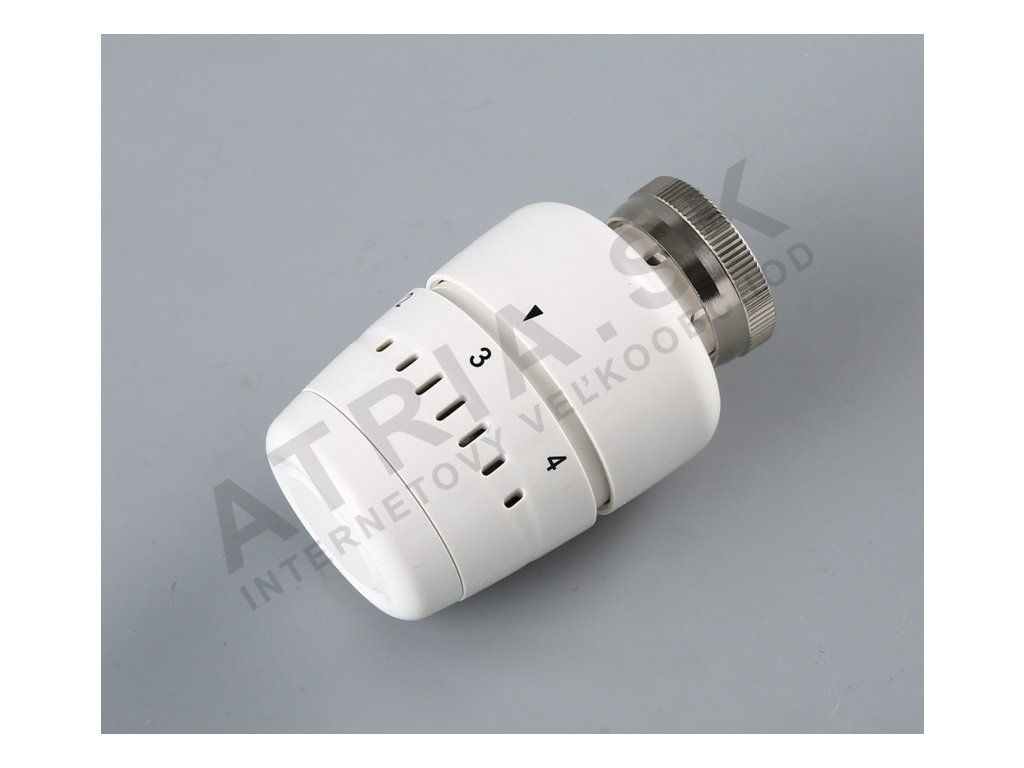 |
Large thermostatic head - lacquered - a good-quality head with a larger sensor body, which responds more precisely to the actual room temperature than cheap plastic variants, helping keep the radiator's calculated output true in practice, not just on paper. Price from €8.49. |
Common mistakes when choosing radiator output
Over years of selling heating equipment, we repeatedly come across the same mistakes, all of which are easy to avoid:
Estimating based on the original radiator without recalculating. If the house has since been insulated, or conversely the original radiator was already undersized from the start, copying the old size just carries the mistake forward.
Ignoring the heating system's temperature drop. A radiator rated at a 75/65/20 °C drop will have a lower actual output on a low-temperature system with a 55/45/20 °C drop (common with heat pumps), typically 30 to 40% lower. When combining with a heat pump, you therefore need to plan for significantly larger radiators, or switch to underfloor heating.
Forgetting about corner and attic rooms. These spaces have higher heat loss than interior rooms of the same area, and without an added margin they'll always be colder than the rest of the house.
Underestimating control. Even a perfectly calculated radiator doesn't do its job without a working valve and head - it's a bit like buying a powerful car with no accelerator pedal for fine control.
Mixing several height ranges in one room without recalculating. Combining two radiators of different heights can work visually, but in terms of output you always need to add up the actual watts, not just "eyeball" that it looks big enough.
When it's worth bringing in a professional
The simplified specific-heat-loss calculation is reliable for a typical radiator replacement in an existing house where you know roughly how well it's insulated. We recommend bringing in a heating designer or at least an experienced installer in these cases: a complete renovation of a whole house's heating system, switching to a heat pump or another low-temperature source (where an exact loss calculation is necessary to correctly size the whole system, not just one radiator), unusual layouts (very high ceilings, glazed walls, conservatories), or if you're not sure which insulation category your house falls into. The cost of a professional calculation is negligible compared to the cost of replacing an undersized radiator after the season.
Frequently Asked Questions
How do I calculate radiator output without a professional?
Multiply the room's area in m² by the specific heat loss for the building's insulation (roughly 40-130 W/m² depending on the category above) and add a 10-20% margin for corner or otherwise exposed rooms. The result is the approximate required output in watts, which you use to choose a specific model.
Is it better to buy a radiator with higher output "just to be safe"?
A moderate margin (10-15%) is fine and can be turned down well with a good-quality thermostatic head. Significant oversizing (for example 50% or more), though, causes uneven heating, an unnecessarily higher price, and less precise control.
Does the required radiator output change when switching to a heat pump?
Yes, significantly. Heat pumps commonly work at a lower temperature drop (for example 55/45 °C or even less), at which the same radiator has a lower actual output than with a classic gas boiler at a 75/65 °C drop. When switching to a heat pump, radiators therefore need recalculating from scratch, and it's often necessary to replace them with larger bodies or combine them with underfloor heating.
How do I know if I have an undersized radiator?
Typical symptoms are: on freezing days the room can't reach the desired temperature even with the valve fully open, the radiator is hot to the touch across its whole surface (meaning it's working at maximum output), and the room temperature noticeably lags behind neighbouring rooms of similar area.
Can a radiator's output be increased without replacing it?
Partly, yes - reflective foil behind the radiator reduces heat loss into the wall and increases the effective use of the existing output; bleeding and a higher heating-water temperature (if the heat source allows it) help too. These measures, though, usually only solve a smaller output shortfall; for a bigger deficit, replacing it with a more powerful model is the more reliable solution.
Do I need to calculate output for every room separately?
Yes, heat loss is always calculated per room, since each room has a different area, a different number and size of windows, a different orientation, and different neighbouring heated or unheated spaces. An average output for the whole house would lead to uneven heating between rooms.
Related topics
More articles to help you choose and run your radiators:
- How to choose a radiator - type and size
- Side vs. bottom radiator connection
- Thermostatic heads and smart control
- Radiator installation and replacement
- Radiator not heating or heating unevenly
You'll find the full range of radiators in the main category: Radiators.
Have a question on this topic?
Not sure what to decide, or dealing with a specific situation in your home? Write to us - we're happy to help.