
Frequently Asked Questions About Radiators
A radiator looks like a simple device at first glance - a metal panel or a set of fins that hot water flows through, releasing heat into the room. In practice, though, it's the source of most of the questions our customers write to us about: what output to choose, whether the connection should be side or bottom, why a radiator only heats up halfway, or how much a decent thermostatic head costs. In this article we've gathered the most common questions about radiators in one place and answered them practically, without unnecessary theory - the way we'd explain it to a neighbour renovating a bathroom or replacing an old cast-iron radiator with a new steel one.
What radiator output do I need?
This is by far the most common question we get. The answer depends on the room's heat loss, which is calculated from the floor area, ceiling height, insulation of the building envelope, the number and quality of windows, and which direction the room faces. As a rough guide, a typical new build or an insulated flat works out at around 60-80 W of heat loss per square metre, while an older, uninsulated house can be as high as 100-130 W/m².
A specific example from our catalogue: the 21K 300 x 400 radiator has an output of 298 W and is better suited to small spaces - bathrooms, storage rooms, hallways, or as a supplementary radiator under a small window. By comparison, the 21K 300 x 500 radiator already delivers 373 W, which is still a fairly low output given the small 300 mm height, which is why these low heights tend to be combined into a row of several units, or a higher type (such as type 22 or 33) is chosen where wall space is limited but heat loss is high.
For a typical 20 m² living room with standard insulation, we're generally looking at around 1200-2000 W of total output needed for the room - this is usually solved with a single type 22 radiator, 1000-1400 mm wide and 500-600 mm high, or with two smaller radiators under two windows. It is always best to have the exact calculation done based on the specific room's heat loss, but a rough estimate from the floor area is a good starting point when choosing.
Which radiator type to choose - panels, fins and the 10/11/21/22/33 designation
Designations such as 10, 11, 21, 22 or 33 on steel panel radiators describe the construction - how many panels and how many rows of convector fins the radiator has. The first digit is the number of panels, the second the number of rows of fins behind them. Type 10 is a single smooth panel with no fins - the lowest output, but also the slimmest profile (about 5 cm), suited to places with little room in front of the radiator (such as a narrow hallway). Type 11 has one panel and one row of fins, type 21 has two panels with one row of fins between them, type 22 has two panels with two rows of fins, and type 33 has three panels with two rows of fins - the highest output for a given size, but also the deepest profile (over 15 cm).
In practice this means that for the same width x height, a type 33 can have two to two-and-a-half times the output of a type 10. So if you're renovating a room with high heat loss and want a radiator under a small window, it's worth reaching for a higher type instead of buying an extremely long, low-type radiator that won't even fit under the window.
These are approximate, commonly used ratios - you'll always find the exact output of a specific unit directly in the product parameters (manufacturers state it for a standardised temperature drop, usually 75/65/20 °C or 70/55/20 °C, which is why values differ slightly between manufacturers).
Side or bottom radiator connection?
Older radiators and cheaper models usually have a side connection - the pipework comes from the side, inlet at the top, outlet at the bottom (or vice versa depending on the side). Newer radiators, especially designer and bathroom models, increasingly have a bottom connection - both pipes run up from under the floor directly beneath the radiator, which looks cleaner and suits underfloor pipework in particular. The difference in output between the two connection types is minimal in practice for the same radiator (usually under 5%), so the main deciding factor is where your pipework comes out and which look you prefer.
Both connection types require a quality thermostatic valve, which regulates water flow according to the temperature set on the head. Both angled and straight pipe runs commonly use a dual-regulation valve, which allows fine-tuning of flow and back-balancing of the system (so-called pre-setting), which is especially important in larger houses with several radiators on one circuit, where without balancing the radiators closest to the circulation pump overheat while the furthest ones don't heat up enough.
 |
Thermostatic dual-regulation valve - 1/2"xEK; angled - a classic angled valve with dual regulation, ideal for a side-connected radiator, allowing precise flow balancing between several radiators on a circuit. Price from EUR 14.27. |
Why doesn't a radiator heat up, or why does it heat unevenly?
This is the second most common complaint and advice topic. It's usually one of a few typical problems: air trapped in the radiator (heats at the bottom, cold at the top), a clogged or badly set valve (doesn't heat at all or only minimally), a poorly balanced system (one radiator hot, another cold), or a clogged filter/debris in the system after many years of operation (especially with older steel pipework).
The practical way to diagnose the problem at home is always the same - first check that both the shut-off and thermostatic valves are open, then try bleeding the radiator, and only if that doesn't help move on to balancing the system or calling a service technician to flush the circuit.
In practice, bleeding the radiator or replacing the valve resolves the vast majority of cases customers report to us - a service intervention on the whole heating circuit is only needed for older systems that haven't been cleaned for years, or where the circulation pump is objectively undersized.
Thermostatic heads and temperature control on a radiator
A thermostatic head is a simple mechanical (or electronic) regulator that opens or closes the water flow into the radiator based on the air temperature around it. A typical mechanical head has a scale usually from 1 to 5 (or with a snowflake and sun symbol at the ends), with each step corresponding roughly to a difference of about 2-4 °C. A good-quality head can hold the set room temperature to within about ±1 °C, which over a heating season translates into a noticeable saving compared to a radiator with no control, or with an old, faulty head that's stuck in one position.
When replacing an old radiator or just the valve, it's worth replacing the head too, especially if it's more than 10-15 years old - the wax or liquid fill in the sensor loses accuracy over time, and the head then either overheats the room unnecessarily or fails to bring it up to a comfortable temperature.
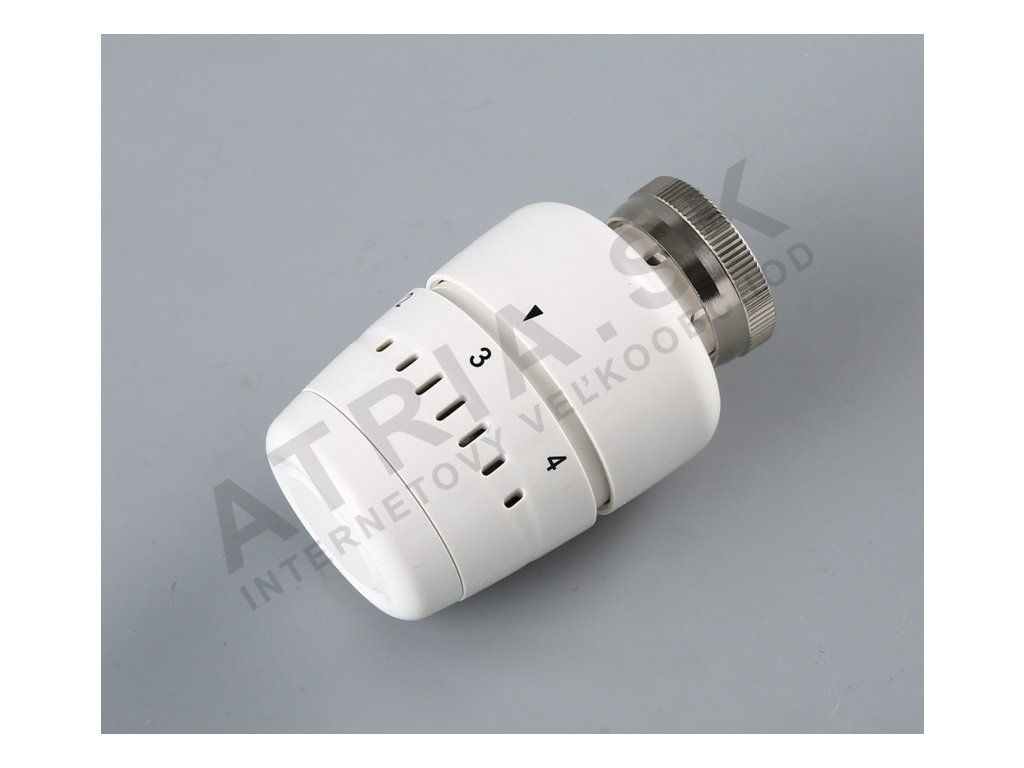 |
Large thermostatic head - lacquered - a quality replacement for an old, worn-out head, more precise room temperature control, easy to fit on most common valves. Price from EUR 8.49. |
If you're addressing the whole control setup at once - for example with a boiler feeding both underfloor and radiator circuits - it's also worth looking at complete control sets, which include all the fittings you need in one place instead of buying parts individually.
 |
HPW Set1 control set - a complete set of fittings for connecting and controlling the heating circuit, a practical choice when combining radiators with another heat source or underfloor heating. Price from EUR 27.94. |
Bleeding a radiator - when and how often
Air builds up in a radiator naturally - every time water is topped up in the system, from slight leaks at the valves, and from a chemical reaction inside the steel bodies. The classic symptom is a radiator that's warm at the bottom and cold at the top, or gurgling/bubbling sounds as the water flows. Bleeding is done simply with a bleed key (or a flat screwdriver on some models) on the small valve at the top on the side of the radiator - open it slowly until only water, no air, escapes, then close it immediately.
The recommended frequency is at least once at the start of the heating season (in September or October) for the whole house, and otherwise whenever you notice a radiator not heating evenly across its whole surface. If a radiator needs bleeding often (several times a month), it usually means there's a leak somewhere in the system or a problem with the boiler's expansion vessel, which is a job for a service technician.
Installing and replacing a radiator - what to keep in mind
When replacing an old cast-iron or panel radiator with a new one, the first thing to check is the spacing of the connection points (the centre distance) - for a side connection this is the distance between inlet and outlet, for a bottom connection it's the exact position of both pipes coming out of the floor or wall. If the spacing doesn't match the original, this is solved either with an adapter or by adjusting the pipework, which is a job for a heating engineer.
Another point is the material - steel panel radiators are now the most common and most affordable choice with a good output-to-price ratio, aluminium radiators respond faster (they heat up and cool down more quickly) and are lighter, while cast-iron radiators, by contrast, hold their heat for a long time even after the boiler switches off thanks to their high thermal mass, but they're heavy and respond more slowly to setting changes. In a typical flat or house renovation today, the steel panel radiator is the most common choice - it combines a reasonable price, sufficient output and a wide choice of sizes.
The installation itself isn't complicated - the old brackets are either kept, if the spacing matches, or replaced with new ones, the radiator is hung, connected to the valve and the lockshield (union fitting) on the other side, and the system is filled and bled. Despite its simplicity, we recommend leaving this work to a heating engineer - incorrectly tightened fittings or a forgotten bleed during the first fill can cause an unnecessary leak or an airlock right after installation.
Before installation it's also worth thinking through the exact position on the wall. Traditionally a radiator is mounted under a window, so that cold air flowing down from the glass rises through the radiator body and mixes with warm air before it reaches the floor - this reduces the feeling of a "draught" from the window. The recommended minimum distance from the floor is usually 10-12 cm (for air flow underneath and for cleaning), and a similar gap is left above to the windowsill so warm air can rise freely without being blocked by the sill. On walls with a weaker substrate (such as plasterboard or a thin partition), suitable fixings with adequate load capacity must be used - a radiator filled with water weighs noticeably more than an empty one, which is often underestimated when choosing wall plugs.
Colour is another detail that customers designing a modern interior often ask about - most steel radiators are supplied as standard in white (RAL 9016), but more and more manufacturers now also offer coloured finishes (anthracite, black, or a RAL shade on request) for a modest price premium. When choosing a coloured radiator, expect a longer delivery time, since it isn't stocked to the same extent as the white version.
How much do radiators and accessories cost
Prices depend on the size, type (10-33) and material. Small, low-type radiators for a bathroom or hallway (for example, the 300 x 400 mm size with a 298 W output) start at roughly EUR 59, while the slightly larger 300 x 500 mm size with a 373 W output starts at around EUR 66. For larger sizes for living rooms (1000-1400 mm wide, 1000-2000 W output), the price typically runs from several dozen up to over a hundred euros more than the small models, depending on type and output. Accessories - valves, heads and control sets - typically make up a tenth to a quarter of the radiator's own price, but have a significant effect on comfort and consumption, so it's not worth skimping on them.
 |
Radiator 21K 300 x 400, output 298W - a compact type 21 radiator suited to a bathroom, hallway or smaller room with lower heat loss. Price from EUR 58.79. |
 |
Radiator 21K 300 x 500, output 373W - a slightly higher output at a still-compact size, a good choice where you need a bit more heat but wall space is limited. Price from EUR 65.56. |
Frequently Asked Questions
Does the new radiator have to be the same type as the original?
No, when replacing a radiator you don't have to keep the original type (10, 11, 21, 22, 33) - what matters is only that the connections match (spacing, side/bottom) and that the output is sufficient for the room. If the original radiator was undersized or oversized, replacement is exactly the right opportunity to recalculate the actual need and choose a more suitable type.
Can a radiator be installed without a heating engineer, as a DIY job?
A handy homeowner can manage hanging the body itself on existing brackets, but connecting it to the water supply (disconnecting and reconnecting the existing pipework, tightening the union fitting, filling and bleeding the system) already requires experience and the right tools. A mistake when tightening a joint can cause a water leak straight into the flat, so most customers leave this part to a heating engineer, even though they often source and transport the radiator body themselves.
Why is the new radiator smaller but has the same or higher output than the old cast-iron one?
For a given size, old cast-iron radiators (sectional) generally had lower thermal efficiency than modern steel panel radiators with convector fins, which transfer heat more effectively through air convection, not just radiation from the surface. That's why it's now common for a more compact type 21 or 22 panel radiator to reach the same or a higher output than a much bulkier old cast-iron unit.
How often do radiators need bleeding?
Usually once at the start of the heating season is enough for all the radiators in the house. If a particular radiator needs bleeding repeatedly during a single season, it's usually a sign of a leak in the system or a problem with the expansion vessel, which needs a heating engineer to check.
Is it worth investing in thermostatic heads on every radiator?
Yes, a thermostatic head on every radiator lets you set the temperature in each room individually based on its actual use (for example, a lower temperature in the bedroom, higher in the living room), which for a typical household brings a noticeable saving on heating compared to radiators with no control or with a single setting for the whole house.
What's the difference between side and bottom connection in terms of output?
The difference in output is minimal for a comparable radiator type and size, usually just a few percent. The choice between side and bottom connection depends mainly on where the pipework comes out in your house and which look you prefer - a bottom connection looks visually cleaner, since the pipework isn't visible by the wall.
Can several radiators of different outputs be connected on one circuit?
Yes, this is common practice - what matters is correctly balancing the circuit (setting the flow at each valve) so that radiators closer to the circulation pump aren't overheated at the expense of ones further away. For several radiators on one circuit we therefore recommend dual-regulation valves, which allow balancing directly at the valve body.
Is there a difference between a radiator for a low-temperature system (heat pump) and a classic boiler?
Yes, with a heat pump the heating system generally runs with lower water temperatures (for example 45/35 °C instead of the classic 75/65 °C with a gas boiler), so for the same radiator the actual output comes out lower than the rated value stated for the standardised temperature drop. If you're planning to switch to a heat pump in the future, it's worth choosing radiators with a margin in output now (a higher type or larger size), or planning for a combination of radiators and underfloor heating, which suits low-temperature sources more naturally.
Related topics
If you have a more specific question about radiators, take a look at these more detailed topics too:
- How to choose a radiator - type and size
- What radiator output do I need
- Side vs. bottom radiator connection
- Radiator not heating or heating unevenly
- Bleeding a radiator - when and how
- Thermostatic heads and smart control
- Radiator installation and replacement
You'll find the full range of radiators and accessories in the Radiators category.
Have a question on this topic?
Not sure what to decide, or dealing with a specific situation in your home? Write to us - we're happy to help.