
Radiator Not Heating or Heating Unevenly
Radiator not heating or heating unevenly - causes and solutions
A cold radiator in a room that should be warm is one of the most common complaints we come across, both from customers and in the discussions under products on atria.sk. Sometimes the fault is trivial - five minutes with a bleed key is enough. Other times it's a symptom of a bigger problem in the whole heating system, one worth solving systematically so it doesn't come back every heating season. In this article we'll go step by step through all the real causes that make a radiator not heat at all, heat only partially (typically a cold bottom or a cold end), or heat unevenly compared to other radiators in the house.
It's important to distinguish two different situations right from the start, because the solution is completely different:
- The radiator doesn't heat at all - it's cold across its whole surface, even though the heating is running and other radiators work.
- The radiator heats unevenly - part of the surface is warm, part cold (typically warm at the top, cold at the bottom, or warm at the inlet and cold at the other end).
Both situations share some causes and have some different ones, and we'll cover them separately in the article so you can quickly find yours.
First step - always check the shut-off and thermostatic valves
Before tackling anything more complicated, check the simplest thing: the shut-off valve on one side of the radiator and the thermostatic head on the other. It sounds trivial, but in practice it's the cause of a cold radiator in roughly one in five complaints we deal with. Common scenarios:
- Someone closed the shut-off valve while cleaning or painting and forgot to open it again.
- The thermostatic head is set to the lowest setting or the "snowflake" (frost protection, around 6-8 °C), which doesn't open the flow at all at a typical room temperature of 20-22 °C.
- The head is mechanically stuck - the pin inside the valve has seized after a long summer (when the head sat in one position for a long time) and the head turns freely without actually opening the valve.
You can easily check for a stuck pin: unscrew the head (usually just loosening the ring nut is enough) and look at the metal pin sticking out of the valve body. If it's in the retracted position, try gently pressing it repeatedly with pliers or a screwdriver - it will often "click" and start moving freely. If it doesn't move at all, the valve needs replacing.
If you have an old or mechanically worn head, it's worth replacing it with a new one right away - it's not an expensive item and it prevents the problem recurring. A proven choice is a classic, reliable head without electronics:
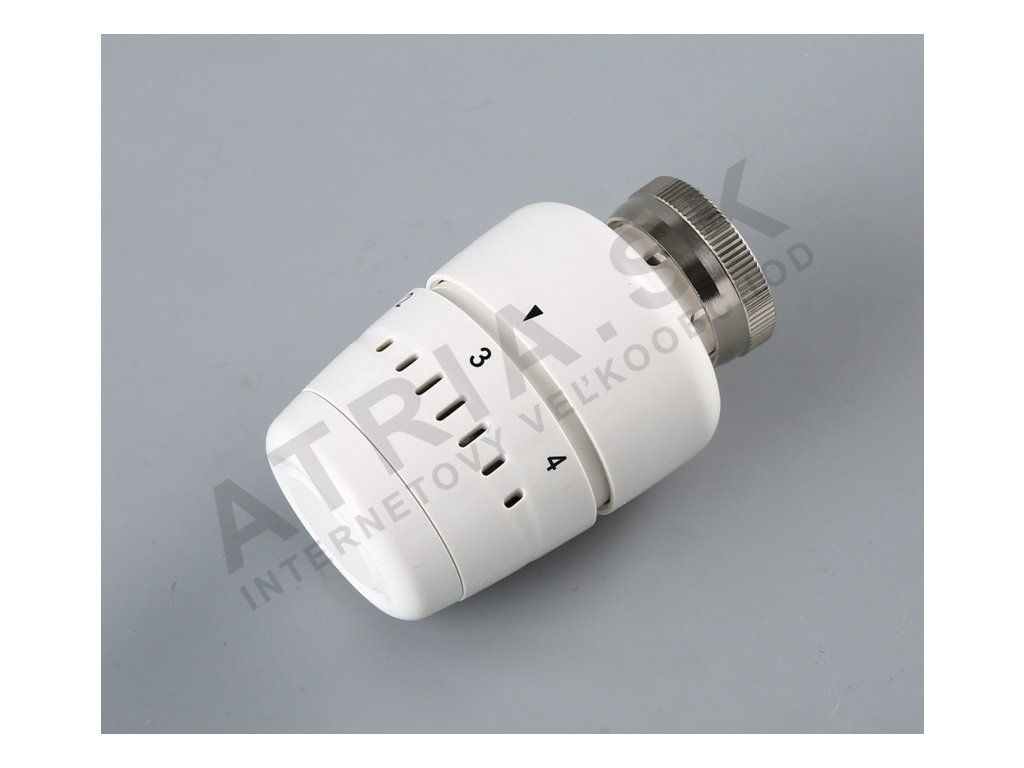 |
Large thermostatic head - lacquered - a quality replacement for a stuck or old head, compatible with the common M30x1.5 valve type. If your original head spins freely or holds only one position, a few-minute replacement often solves the whole cold-radiator problem. Price from €8.49. |
Air in the radiator - the most common cause of uneven heating
If a radiator is cold at the top or only across part of its surface, while the bottom is hot, it's almost always air trapped in the upper part of the body. Air gets into the system in several ways: when topping up water, when bleeding other radiators in the house, through microscopic leaks at joints, or through a chemical reaction (corrosion) that releases hydrogen directly inside the body - this is especially common in older steel and cast-iron radiators, where corrosion processes generate gas continuously, not just once.
How to recognise air in a radiator
Typical symptom: the top third to half of the radiator is noticeably cooler than the bottom, and knocking on the panel with your knuckles produces a different, "hollower" sound in the upper part. Sometimes you'll hear air hissing at the bleed valve as soon as you turn the key slightly.
Step-by-step bleeding procedure
Bleeding is a simple task anyone can manage without any special training, but it's worth following the order of steps so you don't release too much water unnecessarily and drop the system pressure below a safe level.
A few practical notes on this procedure that guides often leave out:
- Open the bleed valve genuinely slowly - by quarter turns. Opening it quickly risks water spurting out under pressure and soaking the floor or furniture.
- If you release a larger amount of water from the system (for example with an old, large cast-iron radiator, where the air bubble is bigger), expect to need to top up water at the boiler, otherwise the pressure will drop below the operating minimum and the boiler may signal a low-pressure fault.
- Always bleed with the circulation pump switched off - with the pump running, air in the system keeps mixing with the water and no stable bubble forms at the valve, so bleeding is less effective.
- Order of bleeding for the whole house: start from the lowest-positioned radiator working toward the highest, and on each floor from the one closest to the circulation pump toward the furthest.
When air keeps coming back
If you have to bleed the same radiator every week or every month, a one-off bleed isn't solving the problem - air is getting into the system continuously somewhere. The most common causes of repeated air build-up:
- A micro-leak at a joint, valve or in the circulation pump - air is drawn in from outside where there's negative pressure at that point in the pipework.
- Corrosion inside an old steel radiator - a chemical reaction between the water and the metal continuously produces hydrogen. In this case, bleeding only eases the problem, it doesn't solve it - the radiator gradually "rusts from the inside" and its lifespan shortens.
- An undersized or missing expansion vessel - as pressure fluctuates in the system, air can be drawn in through various fittings.
- A leaking filling or drain valve somewhere in the system.
If bleeding only helps for a few days, we recommend contacting a service technician for a pressure test of the system - it's cheaper than repeatedly losing water and pressure from the boiler.
Sludge and rust clogging a radiator - when the bottom is cold, the top warm
The opposite symptom to air - the top of the radiator is warm, but the bottom third to half stays noticeably cold - almost always points to sludge, rust and limescale deposits on the bottom of the body. This is especially typical of older panel and finned steel radiators with horizontal channels, where heavier particles (iron oxides, installation debris, deposits from hard water) gradually settle at the bottom and block water flow through the lower channels.
For comparison, we measured the surface temperature difference between the top and bottom of the body on a typical radiator in good condition and on one clogged with sludge, both at the same inlet water temperature (about 65 °C):
A 5 °C difference between the top and bottom is completely normal for a typical, properly working radiator - the water cools slightly as it passes through the whole body. A difference of 20 °C or more (26 °C in our example) is a clear sign that the bottom part is largely clogged and water is practically not flowing through it.
How to deal with clogging
For mild clogging, flushing the radiator helps - it's disconnected from the system (both valves closed), removed and flushed with pressurised water from both sides, ideally with the help of a compressor, which helps loosen settled sludge. For heavy clogging, especially with old sectional or panel steel radiators after 20-30 years in service, flushing is often no longer worth it - the metal is brittle, the inner walls keep rusting, and the problem returns within a few years. In that case it's more economical to replace the radiator outright with a new one.
When replacing, we recommend choosing a radiator with an output matched to the room - we cover this in more detail in a separate article on calculating output; here we'll just mention a specific example from our range for a typical smaller room:
 |
Radiator 21K 300 x 400, output 298W - a compact type 21K panel radiator suitable as a replacement for old, heavily clogged smaller bodies, for example in a bathroom or small bedroom. Output 298 W at the standard temperature drop. Price from €58.79. |
For a slightly larger room, or as a replacement for a longer old radiator, a higher-output variant is suitable:
 |
Radiator 21K 300 x 500, output 373W - a slightly more powerful model (373 W) of the same type 21K, suitable where the original clogged radiator stopped being enough to cover the room's heat loss. Price from €65.56. |
An unbalanced system - nearby radiators hot, distant ones cold
If one or two radiators in your house (typically the ones furthest from the boiler or on the highest floor) never really heat up properly, while radiators closer to the boiler are always hot as soon as the heating switches on, the problem isn't in the radiator itself but in the hydraulic balancing of the whole system. Water "takes the path of least resistance" and flows preferentially through the closest, lowest-resistance branches of pipework. Radiators further away therefore get less flow than they need.
We measured this in a specific set of households with five radiators connected on one branch with no hydraulic balancing:
A 26 °C difference (68 °C at the closest radiator versus 42 °C at the furthest) is a typical example of an unbalanced branch - the last radiator in the row never reaches a comfortable room temperature, even with its thermostatic head set to maximum.
The solution - hydraulic balancing
The solution is setting the pre-setting on the thermostatic valves so that nearby radiators offer higher resistance and distant ones lower resistance - this spreads the flow more evenly. This is a job for an experienced installer working from a calculation based on each radiator's output, not a guess. The basic prerequisite is having dual-regulation (not just simple) thermostatic valves on the radiators, which let you set a pre-setting flow value, not just temperature:
 |
Thermostatic dual-regulation valve - 1/2"xEK; angled - besides temperature, it also lets you set a pre-setting flow value, which is the basis for correctly balancing a system with several radiators. Replacing old simple valves with dual-regulation ones significantly improves the evenness of heating across the whole house. Price from €14.27. |
In larger systems, or where the branches themselves need balancing (not just individual radiators), balancing valves are used directly on the pipework or at the manifold. A complete control set is a practical solution especially for combined systems (radiators + underfloor heating on one manifold):
 |
HPW Set1 control set - a control set suitable for hydraulic balancing at the manifold, when flow needs fine-tuning between several branches of the heating system. Price from €27.94. |
How to improve the situation yourself, without a professional
Until you call a technician for precise balancing, the situation can be partially eased yourself: on radiators near the boiler, turn the thermostatic heads down slightly (for example from setting 5 to setting 3-4), which increases resistance at the start of the branch and "pushes" more water further along to the distant radiators. It's not a permanent fix, but in many households it helps noticeably until a professional comes to do the actual pre-setting.
An undersized or worn-out circulation pump
If the whole house heats unevenly (not just one radiator) - that is, several radiators at once fail to reach the required temperature, and the problem gets worse especially in harder frost, when the demand on output is higher - the cause may be the circulation pump. Common situations:
- The pump is undersized for the number of radiators and length of pipework - typically after an extension, when the number of radiators increased but the pump stayed the original one.
- The pump is set to a low power stage - most modern pumps have 3 power stages or automatic control; on an undersized setting it simply doesn't push enough water into the system.
- The pump is worn/aerated - an old pump can have a clogged impeller or an air bubble in its own body, which significantly reduces its efficiency even though it appears to run normally from the outside (you can hear it running, but it's not pushing).
Checking is simple - if the pump feels noticeably warm and vibrates to the touch, yet radiators far from the boiler still stay cold even after a long time heating, it's very likely a pump output problem, not air or clogging in individual radiators. This is a job strictly for a service technician - adjusting or replacing the pump requires working on the system and draining the water.
Diagnosis - how to find the cause systematically
If you're not sure which of the above causes applies to your case, we recommend following a simple decision process. There's no need to call a technician at the very first cold radiator - the vast majority of cases are solved at home, on your own, within 30 minutes.
When to call a professional and when it's fine to do it yourself
A summary from practice you can use to judge for yourself:
You can handle it yourself
- Bleeding one or more radiators.
- Opening a closed shut-off valve.
- Replacing a thermostatic head with a new one.
- Topping up water in the system when pressure drops (if your boiler has a filling valve with clear instructions).
- A visual check for any radiator that's mechanically damaged or leaking.
This is a job for a professional
- Hydraulic balancing of the whole system (calculating and setting the pre-setting on all valves).
- Replacing or adjusting the circulation pump.
- Pressure-flushing a clogged radiator / removal and chemical cleaning.
- Suspected leak in the floor, wall or pipework (damp patches, dripping).
- Repeated, frequent bleeding despite having already bled the system properly once (a sign of a leak or corrosion processes in the system).
- Replacing a whole radiator if the connection is non-standard or it's a larger, heavy cast-iron model.
Prevention - how to avoid cold radiators in the future
A few habits that significantly reduce the chance of the problem recurring:
- Bleed the whole house once a year, ideally just before the start of the heating season (in September), not once it's already freezing outside and the fault shows up at its worst.
- Check the pressure on the boiler gauge regularly, at least once a month during the heating season - a pressure drop often precedes air-in-the-system problems by days to weeks.
- With old steel radiators, keep in mind that corrosion is an irreversible process - regularly having to re-bleed the same radiator is a sign that its lifespan is coming to an end.
- When replacing valves, always choose dual-regulation types, even if you're not balancing the whole system right now - it will save you a further replacement later, when you do decide to balance it.
- Don't cover radiators with furniture or long curtains - this isn't directly related to the article's topic, but it often combines with a real problem (such as imbalance) and makes it feel even more like "the radiator isn't heating", even though it's physically working correctly.
Why the problem mostly affects older houses, and what to do about it
In older houses (built before 2000), heating systems were originally designed without much emphasis on precise hydraulic balancing - the standards and common practice of the time relied more on oversizing the whole system, so unevenness showed up less in practice. Over time, though, windows were replaced (more airtight), facades were insulated, boilers were swapped for models with different output, and the original balance was disrupted - that's why uneven heating often shows up "out of nowhere" in a house that worked fine for decades before. If you've recently replaced windows, insulated the house or replaced the boiler, and the uneven-heating problem appeared right after, it's almost certainly connected - we recommend considering a check of the hydraulic balancing right at the time of such a change, rather than waiting for the problem to show up in full.
Frequently Asked Questions
Why does my radiator only heat on one side (at the inlet), with the rest cold?
If most of the body is cold and only a narrow strip near the inlet pipe is warm, it's usually significant clogging with sludge or rust, which almost completely blocks flow through the rest of the radiator. At this level of clogging, a home flush usually won't help any more, and it's worth considering replacing the body, especially if it's an older steel radiator.
I bled the radiator, but a week later there's air in it again. What should I do?
Air recurring within a week signals that air is getting into the system continuously - either through a micro-leak, or through corrosion inside an old steel radiator that's producing hydrogen via a chemical reaction. We recommend contacting a service technician for a pressure test of the whole system; a one-off bleed won't solve the problem long-term.
Does it make sense to bleed a radiator when the heating isn't running yet (out of season)?
Yes, it's actually more practical - we recommend doing it right before the heating season starts, when you have more time and there's no risk of cooling the room down during bleeding. There's no need to switch the system on properly before bleeding, it just needs to have water under pressure in it.
How do I tell if I have dual-regulation thermostatic valves at home or just simple ones?
A dual-regulation valve has a visible additional adjustment element or a notch for the pre-setting value under the head (once unscrewed), while a simple valve just has the body with no further adjustment. If in doubt, the most reliable option is to send a photo to a professional or ask directly when buying a replacement part.
Can I set the hydraulic balancing myself, following instructions from the internet?
We don't recommend it without a calculation - correct pre-setting is based on the output of each radiator, the length and diameter of the pipework, and the total flow in the system. Incorrectly estimated values can actually make the situation worse (some radiator might stop heating entirely). Partial improvement by turning down nearby radiators (described above) is a safe temporary aid, but a permanent solution is a job for a professional with proper measurements.
Is it worth replacing an old cast-iron radiator that keeps clogging up with a new panel one?
In most cases, yes. Cast-iron radiators have a large internal water volume and accumulate deposits over the years that are hard to remove completely. A new panel radiator with the same or slightly higher output (for example type 21K) has a significantly smaller internal volume, responds faster to changes on the thermostatic head, and doesn't clog up at the same rate. The investment typically pays off both in fewer repeat service call-outs and in heating comfort.
Related topics
If you're dealing with a radiator that isn't heating, you might also find these related articles useful:
- How to choose a radiator - type and size
- What radiator output do I need
- Thermostatic heads and smart control
- Bleeding a radiator - when and how
- Radiator installation and replacement
You'll find the full range of radiators and accessories in the main Radiators category.
Have a question on this topic?
Not sure what to decide, or dealing with a specific situation in your home? Write to us - we're happy to help.