
How to Choose a Radiator - Type and Size
How to Choose a Radiator - Type and Size
Choosing a radiator looks simple at first glance - just buy "something that fits under the window". In practice, though, it's one of the decisions that most affects whether a room stays pleasantly warm even on the coldest days, or whether you'll keep turning up the boiler and still feel a chill in the corner of the room. A poorly chosen radiator can't be "fixed" through regulation - if it's undersized, no thermostatic valve or higher flow temperature will pull more heat out of it than its physical surface area and construction allow. In this article we'll go through the types of radiators available, how they differ in output, how to roughly calculate the output you need for a given room, and what to watch out for when choosing dimensions.
Why it pays to spend time choosing a radiator
The radiator is the most visible part of the heating system in most flats and houses - it's in every room, in plain sight, and replacing it means work on the wall and possibly on the pipework. That's exactly why it pays to get the decision right from the start rather than correct it a few years later. In practice we repeatedly see two opposite mistakes. The first is undersizing - someone buys a radiator based only on how much space is available under the window, regardless of the room's actual heat loss. The result is a room that never reaches the desired temperature in frosty weather, even with the boiler running at full output. The second mistake is unnecessary oversizing - the radiator heats the room perfectly, but at partial output (for example in spring and autumn) the regulation becomes imprecise, room temperature fluctuates, and the heating system works inefficiently because it's constantly forced to "throttle" the flow.
The good news is that calculating the required output isn't rocket science and can be done even without a designer, at least as an estimate. A precise heat-loss calculation (the so-called calculation per STN EN 12831) is of course more accurate and we recommend it for new builds or major renovations, but for a routine replacement of an old radiator in an existing house, a simpler estimate - shown below - is usually enough.
Radiator types - what the numbers 10, 11, 21, 22, 33 mean
Most panel radiators sold today are labelled with a two- or three-digit number - typically 10, 11, 20, 21, 22 or 33. This number isn't random; it describes the exact construction of the radiator:
- The first digit indicates the number of panels through which the heating water flows.
- The second digit indicates the number of rows of convector fins (the metal "corrugations") that increase airflow around the panel and therefore output.
In practice this looks like:
- Type 10 - one panel, no fins. Lowest output, thinnest construction (approx. 4-6 cm), suitable where space is tight or where a supplementary heat source is enough.
- Type 11 - one panel + one row of fins. A common "standard" radiator for smaller rooms.
- Type 21 - two panels + one row of fins between them. Today's best-selling type for ordinary living spaces - a good balance of output and depth (approx. 10 cm).
- Type 22 - two panels + two rows of fins. Noticeably higher output than 21, depth around 10-12 cm, suitable for rooms with higher heat loss (corner rooms, older houses with weaker insulation).
- Type 33 - three panels + three rows of fins. The highest output among commonly available types, but also the greatest depth (14-16 cm) - useful where there isn't enough width available but you need high output (for example bathrooms, large glazed walls, or - less commonly - passive houses with underfloor heating combined with a radiator as a booster, more often older buildings with high losses).
Practical consequence: two radiators of the same size (same width and height) can have completely different output depending only on their type. For example, a type 21 radiator measuring 300 x 400 mm will have noticeably lower output than the same dimensions in type 33. That's why, when comparing radiators across shops, you should always compare output in watts (W), not just physical dimensions.
As a rough guide, here are the approximate relative outputs of the individual types for the same panel area (type 10 = 100%, these are commonly used average coefficients - a specific manufacturer's figures may differ slightly):
- Type 10: approximately 100% (baseline)
- Type 11: approximately 131%
- Type 21: approximately 151%
- Type 22: approximately 189%
- Type 33: approximately 256%
In other words - a type 33 radiator delivers more than double the output of a type 10 for the same panel area. That's why smaller bathrooms, or rooms without enough space for a wider radiator, often use the higher types (22 or 33) - you get the output you need on a smaller wall area.
How to calculate the required radiator output
A precise heat-loss calculation takes into account wall thickness and material, window size, orientation to the compass points, ceiling height and climate zone. For everyday practice, though, a simplified estimate based on room area and insulation condition works well too:
- New build insulated to current standards: approximately 50-70 W per m² of floor area.
- Typical older house, partially insulated: approximately 80-100 W per m².
- Old uninsulated house, high ceilings, large glazed areas: 100-130 W per m² or more.
For the purposes of this article we'll use a middle value of 70 W/m², which corresponds to a typical, reasonably insulated house or flat - in practice it's often used as a sensible baseline when replacing an old radiator. If you're not sure about the insulation state of your house, it's safer to use a higher value (90-100 W/m²) - it's better to have a small reserve of output than to underheat the room.
Using the 70 W/m² coefficient, the approximate output needs work out as follows:
- Room of 12 m² → approximately 840 W
- Room of 16 m² → approximately 1120 W
- Room of 20 m² → approximately 1400 W
- Room of 25 m² → approximately 1750 W
These figures are the total output that needs to be delivered to the room, either by a single radiator or (more often in larger rooms with several windows) by the combined output of several radiators in that room.
A practical example - a 16 m² children's room
Consultations with installation companies keep coming back to one typical case: a children's room with one window, 16 m² floor area, in a standard block of flats or older house. According to our estimate (70 W/m²) such a room needs around 1120 W. Our range includes, for example, a 21K radiator sized 300 x 500 mm, with a declared output of 373 W. To cover the room's needs we would need either three such radiators (impractical), or - more realistically - one larger radiator with a similar output-to-size ratio, just wider or taller. That's why, when ordering, you should always check the output table for a specific radiator across all available sizes, not just one particular unit - manufacturers commonly offer the same type in dozens of width and height combinations, so you can put together exactly the output you need.
To illustrate the difference that "just" a different radiator length can make within the same type, let's compare two real products from our range - both are type 21K, differing only in length (width):
 |
Radiator 21K 300 x 400, output 298W - a compact radiator suitable for smaller spaces, bathrooms, or as a supplementary heat source under a small window. Price from EUR 58.79. |
 |
Radiator 21K 300 x 500, output 373W - a variant of the same type that's 10 cm longer, suitable where you need higher output and have a bit more wall width available. Price from EUR 65.56. |
The difference between these two variants is just 10 cm in length, yet output rises from 298 W to 373 W - an increase of 75 W, or about 25%. The price, meanwhile, rises by only EUR 6.77, roughly 11.5% - in other words, buying a larger size of the same type is usually a much cheaper way to gain extra output than moving up to a higher (more expensive) type or adding a second unit to the room.
Choosing a radiator step by step
Moving from theory to practice, the whole radiator selection process can be summed up in five connected steps:
- Measure the room - floor area in m², ceiling height, number and size of windows, orientation to the compass points.
- Estimate the heat loss - depending on the insulation condition, use a coefficient of 50-130 W/m² (see above); if unsure, use the higher value.
- Choose the radiator type - 21K for ordinary rooms with enough width available, 22K or 33K where space is tight and you need higher output on a smaller area.
- Choose the specific size - from the output table, pick a width and height so that the declared output covers your calculated need, ideally with a small 5-10% margin.
- Add the regulation - a thermostatic valve and head, plus a suitable connection to the pipework (side or bottom - covered in detail in a separate article, link below).
Material and construction - what to watch out for
Besides type (10-33), radiators also differ in material and finish, which affects lifespan and maintenance:
- Steel panel radiators - today's most common type, a good balance of price and output, quick response to changes in water temperature. Suitable for almost any ordinary household.
- Finned (column) radiators - popular mainly in commercial spaces, workshops and older buildings, higher thermal inertia (they take longer to cool and heat up), a more robust construction.
- Bathroom radiators (towel rails/ladders) - combine heating with towel drying, generally lower output per area, so bathrooms often call for a higher type or an electric heating element as a supplement.
For steel panels we also recommend checking the sheet thickness and the quality of the surface finish (powder coating), since this is what determines corrosion resistance - especially in bathrooms with higher humidity.
Accessories that determine real comfort
The radiator itself is only half the job - the other half is regulation. Without a good-quality thermostatic valve and head, even a correctly sized radiator will behave unpredictably, either overheating the room or failing to heat it fully. We recommend:
 |
Dual-regulation thermostatic valve, angled - 1/2"xEK - allows precise flow adjustment as well as preliminary system balancing, which matters especially if your home has several radiators of different sizes. Price from EUR 14.27. |
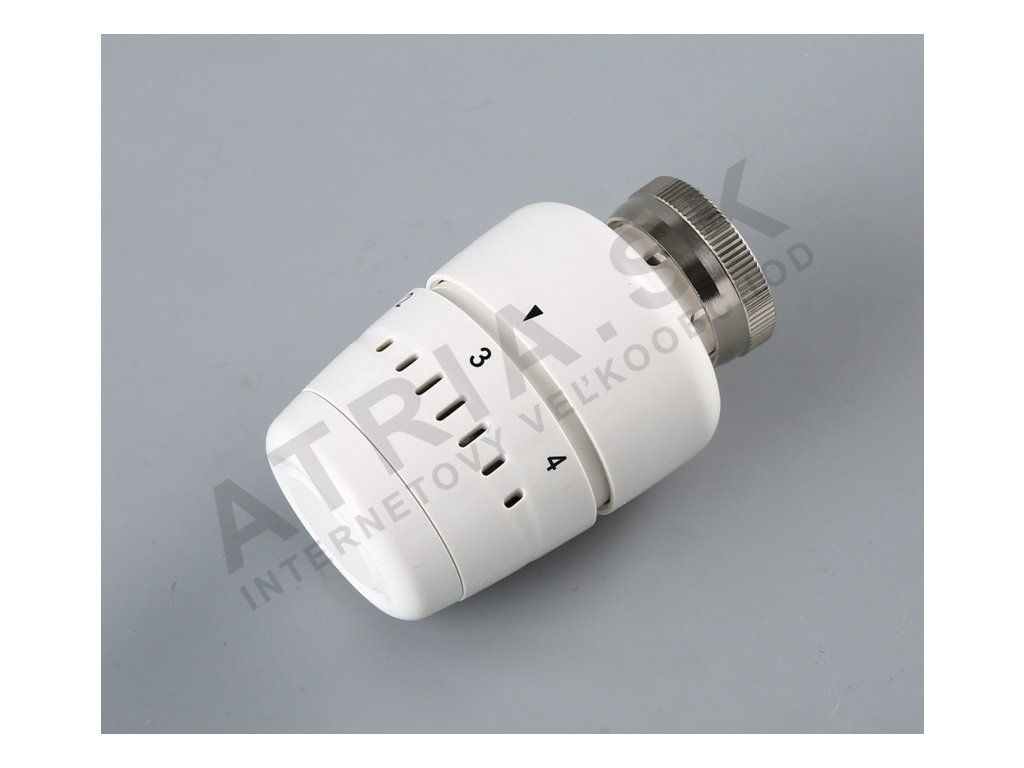 |
Large thermostatic head - painted finish - automatically regulates room temperature to the set value, reduces needless overheating and cuts energy costs. Price from EUR 8.49. |
If you're doing a full replacement including the connection to the pipework, a complete regulation set can also be useful:
 |
HPW Set1 regulation set - a complete set for connecting and regulating a radiator, including fittings - a practical choice when replacing both the radiator and its connection at once. Price from EUR 27.94. |
Installation location and positioning in the room
Even with correctly calculated output, a poorly chosen location can reduce real comfort. Tried-and-tested rules from installation companies:
- Under the window - the classic and still most effective placement; warm air rising from the radiator "counters" the cold air flowing down from the glass, preventing a chilly feeling when sitting near the window.
- Free space around the radiator - at least 10-12 cm from the floor and 10 cm from the windowsill is recommended, so air can circulate freely. Covering the radiator with furniture or a decorative cover can cut real output by as much as 10-20%.
- Interior walls - in rooms without a suitable window (for example small bathrooms or WCs), the radiator is placed on an interior wall, ideally where movement is most frequent (for example near the bath or shower).
Common mistakes when choosing a radiator
When working with customers we repeatedly encounter the same mistakes, all of which are easy to avoid:
- Choosing by price rather than output - the cheapest radiator of a given size may be type 10 or 11, meaning significantly lower output than a comparably sized type 21 or 22. Always compare watts, not just size and price.
- Ignoring the margin - an output that exactly matches the calculated need leaves no reserve for particularly cold days. A small 5-10% margin pays off.
- Overlooking the connection type - when replacing an old radiator with a new one, you need to know in advance whether it's a side or bottom connection, otherwise the new unit simply can't be connected to the existing pipework without modification. See our separate article for a detailed guide (link below).
- Forgetting to bleed the radiator - a new radiator must be properly bled after installation, otherwise it won't heat evenly across its whole surface even if the output was chosen correctly.
Frequently asked questions
Which radiator type is the most universal for an ordinary flat?
For most living spaces in flats and houses, type 21K is the most common choice - it offers a good balance of output, depth (approx. 10 cm) and price. If your room has little width available or higher heat loss, choose type 22 or 33 instead.
Can I use the same radiator type in the bathroom and the living room?
Yes, the type designation (10-33) on its own doesn't determine suitability for a bathroom - what matters more is choosing an appropriate shape (for example a bathroom towel-rail radiator) and sufficient output relative to the smaller wall area usually available in bathrooms.
What if I calculate that I need more output but don't have room for a wider radiator?
In that case it's better to move up to a higher type (for example from 21K to 22K or 33K) instead of increasing the width - the same dimensions in a different type deliver significantly higher output, as shown in the coefficient table above.
Is it better to have one large radiator or two smaller ones in a room?
In larger rooms with two windows, it's often recommended to split the required output between two radiators (one under each window) - this distributes heat more evenly around the room and reduces the feeling of cold near one of the windows.
How much does covering a radiator with a cover or furniture affect its output?
Significantly - a cover or furniture in front of a radiator can reduce real heat transfer into the room by 10 to 20%, because it blocks the free flow of air around the panel. If you're planning a cover, factor in this loss when choosing output and pick a somewhat larger radiator.
Can the calculated output be treated as final, or should I allow a margin?
We always recommend allowing a margin of 5-10% above the rough calculation, especially if you're not entirely sure about the building's insulation or if the room has unusually large glazed areas. A small output margin doesn't mean wasted energy, since the regulation (thermostatic valve) simply throttles back any surplus output.
Related topics
- What radiator output do I need
- Side vs. bottom radiator connection
- Comparison of radiator brands
- Thermostatic heads and smart regulation
- Radiator installation and replacement
You'll find the full range of radiators in the main category Radiators.
Do you have a question on this topic?
Can't decide, or dealing with a specific situation in your home? Write to us - we're happy to help.