
Circulation Pump Installation and Replacement
When it's time to deal with installing or replacing a circulation pump
A circulation pump is the heart of every heating system. Regardless of whether you have a gas condensing boiler, a heat pump, or a classic solid fuel boiler, it is this small device, with an output of just a few dozen watts, that drives hot water from the boiler to the radiators, underfloor heating, and back. When it fails, you feel the consequences immediately - cold radiators, uneven heating between rooms, or, conversely, a boiler that overheats and reports a flow fault.
In practice, we encounter questions about installing or replacing a circulation pump in three typical situations. The first is a complete failure of an old pump - a seized rotor, burnt-out motor windings, or a leaking seal that leaves wet patches on the boiler room floor. The second situation is planned modernisation - replacing an old classic pump with an electronically controlled one that can cut electricity consumption by tens of percent. The third is a new installation, when a pump is fitted as part of a new boiler, a solar system, or a pipework renovation.
This article will guide you through all three scenarios - how to recognise that a pump is on its way out, how to choose a replacement based on both dimensions and output, how the actual replacement proceeds step by step, what to watch out for during installation, and how much it will really cost you compared with continuing to run the old pump.
Signs that a circulation pump is on its way out
Before you go ahead with a replacement, it is worth checking that the problem is really being caused by the pump and not something else in the system (for example air in the system, a clogged filter, or an incorrectly set three-way valve). The most common signs of a pump fault include:
- Noisy operation - humming, squeaking, or knocking that gets worse over time. A typical electronic pump is practically inaudible in normal operation, so noise almost always signals worn bearings or air in the system.
- The pump does not turn at all - after the heating is switched on, the pump body stays cold, radiators do not heat up even though the boiler is running and calling for heat.
- Water seepage - a damp patch or dripping from the shaft seal, typical especially of older pumps with a mechanical seal after 8-12 years of operation.
- Uneven heating - some radiators are hot, others only lukewarm, which can mean the pump can no longer generate enough pressure to overcome the resistance of the whole system.
- High electricity consumption - old classic pumps run continuously at full output and draw 60-100 W throughout the whole heating season, which shows up on the bill.
- Age over 10-15 years - even if the pump still works, after this point the risk of a sudden failure grows, right in the coldest period of the year.
If you notice a combination of two or more of these symptoms, it is worth planning a replacement in advance, before the pump stops for good - ideally outside the heating season, when you have time to choose the right model and don't have to deal with an emergency in the middle of a frost.
Classic vs. electronically controlled pump - the real difference in consumption
Most older households have a so-called classic pump installed, with an asynchronous motor and a mechanical three-speed switch (1/2/3). Such a pump always runs at the set speed regardless of whether the house needs maximum output (a freezing morning) or just a minimum (mild autumn weather). The power draw of such a pump typically ranges between 60 and 100 W and is practically constant throughout the whole heating season.
By contrast, an electronically controlled pump (for example the DAB EVOSTA or EVOPLUS ranges) has a frequency converter that continuously adjusts the impeller speed to the system's actual needs. In mild weather or at night, when the heating only needs a fraction of the output, the power draw of such a pump can drop even below 3-5 W. Under full load on the coldest days, it rises to 30-45 W depending on the model and the set curve. On average across a whole season, the real electricity saving from switching from a classic to an electronic pump is 50 to 80%, depending on the size of the house and the settings.
For a typical family household, in practice this means a difference of approximately 250-450 kWh per heating season (with operation of approx. 4,000-5,000 hours a year) - at current electricity prices, that is on the order of €60-110 a year saved on the operation of just one pump. The investment in an electronic pump therefore typically pays for itself within 3-5 years on electricity savings alone, not to mention quieter operation and more precise heat control.
Comparison of power draw between a classic pump (constant 80 W) and an electronically controlled pump (3-45 W depending on system needs)
How to choose a replacement pump - dimensions and output
When choosing a new pump, two different parameters need to match up - the physical dimensions (so the pump can be fitted to the existing pipework) and the hydraulic performance (so it can circulate the required amount of water through the whole system).
Dimensional compatibility
What matters is the so-called installation length - the distance between the flanges or threads on both sides of the pump. The most common installation length for family houses is 130 mm or 180 mm, sometimes more for larger buildings. When replacing an old pump with a new one from the same range (for example DAB EVOSTA2), this length usually matches, so you simply remove the old body and screw the new one into its place without modifying the pipework. The second parameter is the connection type - threaded (most often a G1 or G1½ internal/external thread) or flanged, used more for larger diameters and commercial installations.
Hydraulic performance - flow and head
Correct pump sizing is based on two figures: the required flow rate (how many litres of water per hour need to circulate through the system) and the head (how much resistance the pump has to overcome in the pipework, radiators, and fittings, expressed in metres of water column). For a typical family house up to 150 m² with radiator heating, a pump with a head of 3-4 m is sufficient; for underfloor heating with longer circuits and multiple zones, a pump with a higher maximum (4-6 m) and adjustable characteristics is more suitable. We cover the exact calculation of flow and head for your particular house in a separate article on choosing pump output - if you are not sure, it is worth having the calculation confirmed by an installation company, since an undersized pump cannot evenly heat more distant rooms.
When choosing a specific model, it is worth reaching for proven types that have thousands of installations in typical family houses behind them:
 |
EVOPLUS SMALL 60/180 M electronic circulation pump for small heating and climate systems - threaded - 180 mm installation length, electronic speed control according to the system's actual needs, suitable as a replacement for a common classic pump in a family house with radiators as well as underfloor heating. Price from €625.40. |
 |
EVOPLUS SMALL 80/180 M electronic circulation pump for small heating and climate systems - threaded - a more powerful version with a higher head, suitable for larger houses or systems with longer underfloor heating circuits, where a standard "60" pump hits its hydraulic maximum. Price from €704.47. |
A set with backup power - protection against power outages
A specific situation we often deal with in practice is a power outage during freezing weather. If the house is heated by a solid fuel boiler or a fireplace with a water heat exchanger and the pump stops, an extended outage risks water freezing in the system and damaging the exchanger and pipework. The solution is a pump in a set with backup power (UPS), which automatically switches to battery power after a mains outage and keeps water circulating for several more hours, until power is restored or the boiler cools to a safe temperature.
 |
SET with fitting DAB.EVOSTA2 40-70/180 + backup power - special offer - a complete set with an electronic pump and fittings (flange nuts for connecting to pipework), plus UPS backup power in case of a power outage - we especially recommend it for solid fuel boilers and fireplace inserts. Price from €334.84. |
 |
SET without fitting DAB.EVOSTA2 40-70/180 with UPS backup power - special offer - the same electronic unit and backup power, without fittings - suitable if you already have a compatible connection on the pipework from the original pump and don't need to buy fittings again. A somewhat better price, from €294.05. |
Step-by-step procedure for installing and replacing a circulation pump
Replacing a circulation pump itself is one of those jobs that a competent DIY enthusiast with basic skills with wrenches can handle - it is simpler work than, say, replacing a boiler. Nevertheless, we recommend calling in a heating engineer for your first attempt, especially for safely draining and refilling the system and checking for leaks under pressure. The procedure is as follows:
- Switching off and letting the system cool. Switch off the boiler and wait until the water in the system has cooled to at least room temperature - handling hot water under pressure is dangerous and risks scalding.
- Closing the ball valves. Most installations have ball shut-off valves on both sides of the pump for exactly this purpose. If your installation doesn't have them, you will need to drain the whole system, or at least part of the circuit, via the drain valve at the lowest point.
- Draining residual water from the pump body. Even with the valves closed, a small amount of water remains in the pump body - slowly loosen the screws or flange nuts and let the water drain into a container placed underneath, with cloths ready.
- Disconnecting the electrical supply. Unscrew the terminal box cover on the pump head, photograph the wiring (live, neutral, possibly earth and control signals for some connections), and only then disconnect the wires.
- Removing the old body. Loosen the flange nuts or threaded connection on both sides and remove the pump. Check the condition of the seals - old sealing rings (o-rings) are always replaced with new ones when replacing a pump, usually supplied directly with the new pump.
- Fitting the new pump. Fit the new seals, insert the pump in the correct orientation - the arrow on the body must point in the direction of water flow - and tighten the nuts evenly on both sides so the body does not get jammed at an angle.
- Motor head position. The pump head with the electronics or control panel must be oriented horizontally (motor shaft horizontal), never pointing downward - in the wrong position there is a risk of moisture getting into the electronics and shortened bearing life.
- Connecting the electrics. Connect the wires exactly according to the photo from step 4 and the diagram in the new pump's manual, and tighten the terminal box cover properly for IP protection against moisture.
- Opening the valves and filling the system. Slowly open the shut-off valves, top up the system to the prescribed operating pressure (usually 1-2 bar depending on the height of the building and the boiler manufacturer's instructions), and check all joints for leaks.
- Venting the pump and the system. New pumps usually have a vent screw directly on the body - carefully loosen it for a few seconds until a steady stream of water flows without air bubbles. Also vent the radiators.
- Setting up and test operation. For electronic pumps, set the desired mode (constant pressure, proportional pressure, or fixed speed) according to the type of system, and let the heating run for at least a day to verify even heating in all rooms.
Eleven steps for safely replacing a circulation pump, from switching off the system to test operation
The most common installation mistakes
Over years of experience with complaints and service calls, a few typical mistakes keep recurring that can easily be avoided:
Reversed flow direction
Every pump body has an arrow stamped or embossed on it indicating the direction of water flow. If the pump is installed backwards, the impeller works against the natural flow direction - it either cannot generate enough pressure, or strains noisily and wears out quickly. We see this mistake surprisingly often precisely during DIY replacement in a cramped boiler room space, where the arrow is not immediately visible.
Vertical position of the motor head
As mentioned in step 7 above, the head with the electronics must be oriented horizontally. In practice, it happens that with limited space between pipes, an installer simply rotates the pump 90° to make it fit - the result can be earlier failure of the electronics or bearings due to condensation and incorrect lubrication.
Insufficient venting
An air bubble in the pump body causes a characteristic noisy humming, and in a worse case so-called dry running, where the impeller spins without sufficient cooling and lubrication from water. Venting directly via the screw on the pump body is usually faster and more reliable than relying only on venting the radiators.
Undersized or oversized pump
A pump that is too weak cannot evenly supply heat to more distant radiators, while one that is too powerful causes noisy flow through thermostatic valves and needlessly higher electricity consumption. Electronically controlled pumps partly solve this problem through automatic output adjustment, but you still need to start from the correct model range for the size of the house.
Missing or poorly tightened seals
Reusing old, already-compressed sealing rings is the most common cause of minor seepage a few days to weeks after replacement. New seals are a cheap part compared to a possible repair after flooding the boiler room.
How much does replacing a pump cost compared to running the old one
When deciding whether to invest in a new electronic pump, it is worth looking at total costs, not just the purchase price. The following overview shows real prices of selected pumps from our range, together with the estimated annual electricity saving from switching from a classic pump (80 W) to the given electronic solution, with average operation of 4,500 hours per season.
Approximate prices of pumps and sets with backup power in our range (always check current prices directly on the product page)
With an EVOPLUS SMALL type electronic pump, which under average operation draws an estimated 15-20 W instead of 80 W for a classic pump, the annual electricity saving at 4,500 hours of operation is approximately 270-290 kWh. At typical electricity prices, the investment in the price difference between a classic and an electronic pump typically pays for itself within 3 to 5 heating seasons - and this does not even count the higher reliability, quieter operation, and more precise heat control, which alone can reduce gas or electricity consumption for heating thanks to more even heat distribution around the house.
Sets with backup power (€334.84 and €294.05) sit in price between a simple and a full-featured electronic pump - their main added value is not electricity saving, but protecting the system from freezing during a power outage, which is worth considering especially for solid fuel boilers or in areas with more frequent power outages.
A specific case - pumps for condensate water and condensate drainage
Alongside heating system circulation pumps, in boiler rooms we often also encounter the need to drain condensate from a condensing boiler or air conditioning unit, or to pump wastewater from a location without a gravity fall to the sewer. Small sump or condensate pumps are used for this purpose, installed completely differently from a heating circulation pump - they are not part of a closed circuit, but switch on based on the water level in a collection tank.
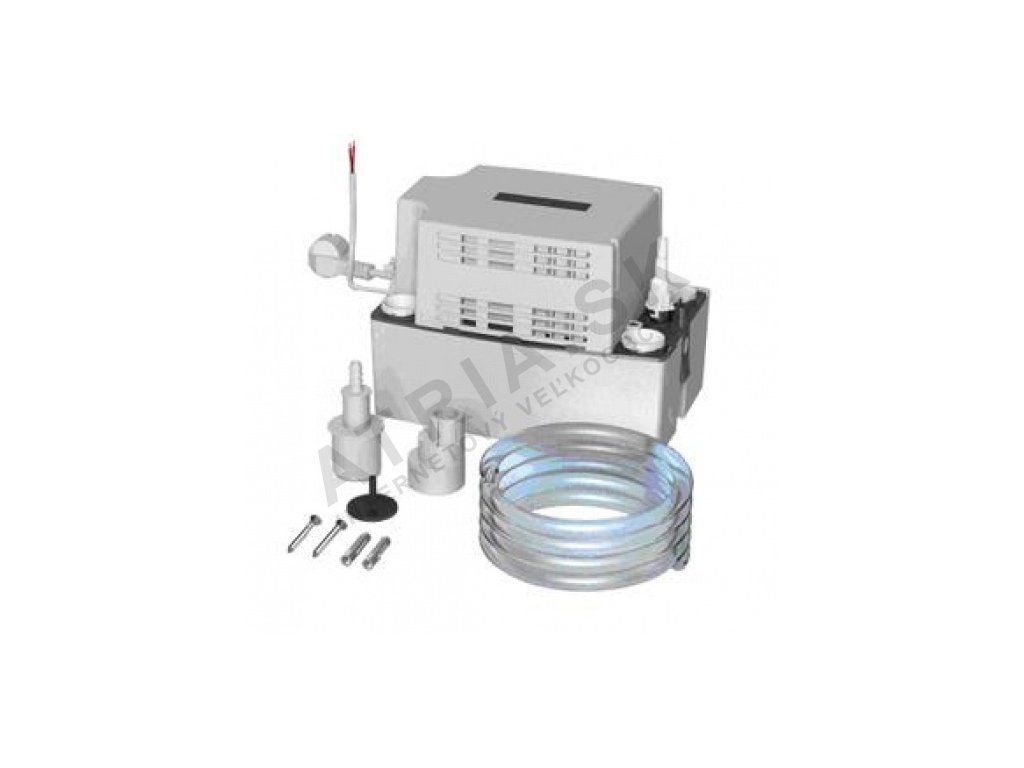 |
GRUNDFOS CONLIFT 1 - a compact pump for draining condensate from condensing boilers, air conditioning, or dehumidifiers, with automatic switching based on the level in the collection tank. A practical solution where a boiler or air conditioner cannot drain condensate directly into the waste by gravity. Price from €102.34. |
Installing such a pump is simpler than a heating circulation pump - it does not involve the closed heating circuit; you just need to connect the supply hose from the boiler, a discharge hose towards the waste (often with a rise of several dozen centimetres above the pump level), and an electrical connection to a socket or directly to the boiler, which switches the pump off on a fault via a contact.
Comparison of classic and electronic pumps - summary
Overview comparison of the key parameters of a classic and an electronically controlled circulation pump
A real-world example
A common case we come across in consultations: a family house with an old classic pump permanently set to the third (highest) speed, because on the second speed the more distant bathroom did not heat up sufficiently. After switching to an electronic pump with automatic pressure regulation, the distant bathroom heated evenly even at the medium setting, because the pump adjusted the pressure itself according to actual heat demand across all branches at once - something a classic pump with fixed speeds simply cannot do. Besides quieter operation, the owner also confirmed a real drop in the electricity line item on the annual statement.
A second typical case is a house with a solid fuel boiler, where power was cut for about four hours during a winter storm. Thanks to the set with backup power, the pump did not stop, water kept circulating, and the system did not risk local overheating at the boiler or freezing in outdoor pipework - the backup battery covered the whole outage without any intervention from the occupants.
Frequently Asked Questions
How long does a circulation pump last?
The typical lifespan of a quality circulation pump, with proper installation and no air in the system, is 10 to 15 years. Electronically controlled pumps usually have a somewhat longer expected lifespan thanks to gentler operation without needless overloading at full output.
Can the pump be replaced myself without a heating engineer?
With basic skills, and if the system has working ball shut-off valves on both sides of the pump, this is a manageable half-day job. However, we recommend at least having an expert available by phone in case of complications while filling and venting the system, or if the system has no valves and needs to be partially drained.
Do I need to readjust the boiler or thermostat after replacing the pump?
Switching from a classic to an electronic pump usually does not require changing the boiler's settings. With some modern boilers that have their own circulation control, it is worth checking whether the boiler has its own control signal for the pump (for example PWM or 0-10V), which needs to be correctly connected to the electronic pump according to the instructions - otherwise the pump will only run on its own internal control.
What is the difference between a 130 mm and 180 mm installation length?
This is the distance between the pump's connection ports. The shorter 130 mm installation length is used more for smaller domestic installations, while the longer 180 mm is more common in family houses with a standard boiler. When replacing a pump, you must keep exactly the same installation length as the original pump, otherwise the new body will not fit between the existing pipework without modifying it.
Is it worth buying a set with backup power even for a gas condensing boiler?
With a gas boiler with built-in electronics, the whole boiler stops working during a power outage anyway, not just the pump, so backup power just for the pump has limited value. It brings the most benefit with solid fuel boilers and fireplaces with a water heat exchanger, which keep producing heat even without electricity, and without water circulation they risk local overheating.
Why is the new pump noisy right after installation?
The most common cause is air trapped in the pump body after filling the system. Try carefully loosening the vent screw on the pump for a few seconds, until a steady stream of water flows without bubbles. If the noise persists even after venting, it could be incorrect orientation of the motor head, or the output being set too high for the system's capacity.
Related topics
- How to choose a circulation pump for heating
- What pump output and flow rate do I need
- Most common circulation pump failures
- Pump Is Noisy or Has Air in It - Causes and Solutions
- How Much Does Running a Pump Cost and How to Save
Have a question on this topic?
Can't decide on installing or replacing a circulation pump, or dealing with a specific situation in your boiler room? Write to us - we're happy to help.