
How Much Does Running a Pump Cost and How to Save
The purchase price of a circulation pump is only part of the story. Most family house owners think about how much they will pay for a new pump at the till, but far fewer people calculate what their pump costs them over an entire heating season - and over the years it runs. Yet the difference between an old classic pump and a modern electronically controlled type can amount to several dozen euros a year in operation, and over a ten-to-fifteen-year lifespan that figure runs into the hundreds of euros. In this article we break down what a pump's operating cost consists of, how you can calculate it yourself for your house, and what real steps will reduce consumption without you having to sacrifice heating comfort.
What a pump's operating cost consists of
A circulation pump is one of those appliances that run practically continuously throughout the whole heating season - unlike a washing machine or oven, which you switch on for an hour and then off. That is exactly why even a relatively small power draw of single or double-digit watts can add up to a noticeable line item on your electricity bill over a season. A pump's operating cost consists of three basic components:
- Pump power draw - how many watts the pump actually draws from the mains. For classic (unregulated) pumps, this figure is practically constant regardless of whether the house currently needs a lot of heat or just a minimum. For electronically controlled pumps, the power draw changes according to the system's current needs - at night or during transitional periods it can drop to a fraction of the maximum value.
- Number of operating hours per year - in Slovakia, a typical heating season runs around 200-230 days, which, with operation practically 24 hours a day (typical for boilers without intelligent circulation control), gives approximately 5,000-5,500 hours a year. For systems with weather-compensation control and night setback, the actual number of hours may be somewhat lower, but it is still thousands of hours a year - no other appliance in the household runs that long.
- Price of electricity - in this article we use an approximate price of €0.19/kWh, which corresponds to a typical household rate in Slovakia in 2026. Your actual rate may vary depending on supplier and tariff, but the calculation principle stays the same - just substitute your own price per kWh.
The formula is simple: power draw (kW) × operating hours × price per kWh = annual operating cost. It is precisely the first term of this equation - power draw - where old and new pumps differ the most, and where you can save the most without having to compromise on heating comfort.
Example calculation for a classic pump
Let's imagine a common old three-speed pump that the owner has set to the middle speed, with a power draw of 65 W, running non-stop throughout the season (5,500 hours). The calculation looks like this: 0.065 kW × 5,500 h = 357.5 kWh a year. At a price of €0.19/kWh, that works out to €67.9 a year - just for water circulating in the system, regardless of whether the house needs maximum or minimum output.
How much electricity a pump actually consumes - a graphical comparison
The following chart shows the difference in average power draw between three types of pump commonly found in Slovak households: an old classic three-speed pump on a fixed middle setting, a modern electronically controlled pump in adaptive mode for a typical family house, and a more powerful electronic pump for a larger system or underfloor heating with higher flow requirements.
The difference between 65 W and 8 W does not look dramatic at first glance, but once you multiply it by thousands of operating hours, the result is dramatic. For the type of household with a classic 65 W pump, annual consumption is 357.5 kWh, while an electronically controlled pump in adaptive mode with an average power draw of 8 W consumes only approximately 44 kWh a year (0.008 kW × 5,500 h). That is a difference of 313.5 kWh a year, which at €0.19/kWh represents a saving of approximately €59.5 per season - and that is just on the pump itself, without any other changes to the heating system.
Why an electronically controlled pump saves so much energy
The key to the saving is not that the electronic pump is "better built" in terms of material quality - the key is how it works. A classic pump has only a few fixed speed settings (typically 1-3), and regardless of whether the house currently needs little or a lot of heat, the pump keeps running at the same output the owner (or the installer, during installation) set once, and nobody ever revisits it. In practice, this means the vast majority of classic pumps run needlessly oversized - installers, out of caution, tend to set a higher speed "to be safe" so the system has "a margin", and that's where it stays for years.
An electronically controlled pump (for example the EVOSTA2 or EVOPLUS ranges) has a built-in frequency converter and pressure/flow sensors that continuously assess how much circulation the system actually needs. When it is not freezing outside and the boiler is running at low output, the pump automatically reduces its speed and, with it, its power draw - often down to single-digit watts. When a hard frost arrives and the system needs full flow, the pump increases output exactly to the level needed. The result is that the average annual power draw is significantly lower than the pump's rated maximum output, because the pump runs far below its maximum most of the time.
The second important mechanism is the so-called constant differential pressure or proportional pressure curve, which you can set on electronic pumps. This curve ensures the pump delivers exactly as much pressure as the currently open branches of the system need (for example only the part of the radiators with open thermostatic heads) - instead of pushing at full force into the whole system regardless of how many circuits are currently active.
Old vs. new pump - comparison in numbers
The following graphic summarises the whole comparison in one place - annual consumption in kWh and in euros for both types of pump, under the same input assumptions (5,500 operating hours a year, electricity price €0.19/kWh).
An 87% difference in consumption sounds like a marketing figure, but it is a direct consequence of physics - a pump's power draw does not grow linearly with flow, but roughly with the cube of the speed. Halving the speed therefore means power draw drops to roughly one eighth. This is exactly why electronically controlled pumps achieve such a significant saving compared to classic ones, even though on the surface it "just" looks like a different type of the same device.
A concrete example using products from our range
For a typical family house with a classic boiler and radiator heating, a typical choice is a replacement with a set consisting of a circulation pump and backup power, which ensures heating still works even during a short power outage:
 |
SET with fitting DAB.EVOSTA2 40-70/180 + backup power - special offer - a typical example of an electronically controlled pump for a typical family house, exactly the category we used above to calculate the €59.5 annual saving. The backup power supply also ensures heating does not stop even during a short power cut. Price from €334.84. |
For this specific set, simple payback works out as follows: an investment of €334.84 divided by an annual saving of €59.5 gives approximately 5.6 years. Since the lifespan of modern circulation pumps is commonly in the range of 10-15 years, once the investment has paid for itself the pump goes on genuinely saving extra money for several more years - not to mention that an old pump can fail at any time (bearings, a clogged impeller), and you will have to deal with a replacement one way or another, just in an emergency and possibly more expensively.
If you are dealing with a larger house, more heating circuits, or underfloor heating with higher flow demands, a more powerful pump is the typical choice:
 |
EVOPLUS SMALL 60/180 M electronic circulation pump - suitable for more demanding systems with higher flow, for example a combination of radiators and underfloor heating in a larger house. The same adaptive power draw principle applies here too - actual average consumption is far below the pump's rated maximum. Price from €625.40. |
If the "old" equivalent being compared for a larger system had a power draw of around 90 W (common for larger classic pumps), the annual consumption of the classic solution would be 90 W × 5,500 h = 495 kWh, i.e. €94 a year. An electronic pump with an average power draw of 15 W (see chart above) works out to 82.5 kWh, i.e. €15.7 a year - a saving of €78.3 a year. Payback on an investment of €625.40 works out to approximately 8 years, which is common for a larger, more powerful pump - in this case it is worth considering the switch mainly when the old pump fails, or during a larger renovation of the heating system, when the cost is spread across several changes at once.
 |
EVOPLUS SMALL 80/180 M electronic circulation pump - a step up in power for systems with even higher flow demands (long pipework, several underfloor heating branches). Same adaptive control principle; the somewhat higher purchase price translates into a longer, but still realistic, payback period. Price from €704.47. |
It's not just about the circulation pump - small pumps have their own consumption too
Discussions about operating costs usually only cover the main heating system circulation pump, but many households also run a second, smaller pump that is easy to forget - for example a condensate pump for a condensing boiler, which drains condensate to where gravity drainage into the sewer is not possible.
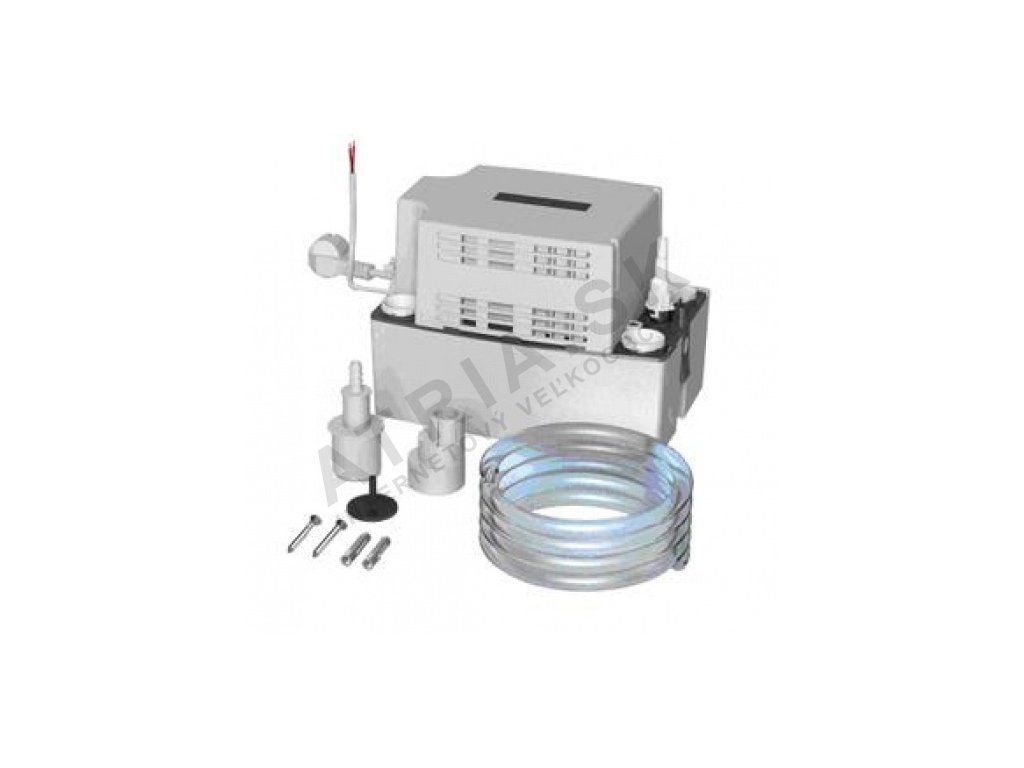 |
GRUNDFOS CONLIFT 1 - a condensate pump that, unlike a circulation pump, does not run continuously, only briefly when pumping out accumulated condensate. Its annual electricity consumption is therefore minimal (on the order of a few kWh a year), but it is worth mentioning, especially when considering the overall reliability of the boiler room - if this pump fails, a condensing boiler can shut down in an emergency stop. Price from €102.34. |
From an operating cost perspective, a condensate pump is therefore not a major item, but it belongs in a complete overview of "everything running on electricity in the boiler room" - especially if you are also considering total household consumption or backup power for outages.
How to correctly set up a pump to save as much as possible
Simply buying an electronically controlled pump does not guarantee maximum savings - much depends on how it is configured after installation. The following diagram summarises the procedure we recommend for every replacement or first setup of a new pump.
The most common mistake we see is that the installer sets the pump to a higher speed during installation "just to be sure the heat reaches everywhere", and this setting is then never revisited. Yet most family houses actually need significantly lower output than the pump is set to - especially if, in the meantime, the facade has been insulated, windows replaced, or radiators upgraded to more powerful ones. We therefore recommend, after replacing the pump (or even on an older system, if the speed can be lowered), trying a lower setting and checking whether the heat is even in all rooms even during the hardest frosts - if so, the lower setting can stay permanently.
Return on investment - when is a replacement worth it
The payback period for investing in a new pump depends on three things: the difference in power draw between the old and new pump, the number of operating hours, and the price of electricity. The following chart compares payback for three scenarios we calculated above - the cheaper set for a typical house, a more powerful pump for a larger system, and a scenario with a higher electricity price.
The chart shows an important point - payback is not governed only by the pump's purchase price, but also by how much electricity actually costs and how large the difference in power draw is. As the electricity price rises (last column, €0.24/kWh instead of €0.19/kWh), payback shortens, because the saving per kWh is higher. This means that in households with a higher electricity price (or a higher rate in a higher consumption band), the switch pays off even faster than our basic calculations show.
Other ways to reduce pump operating costs
Besides replacing the pump with an electronically controlled one, there are several other steps that can reduce operating costs without a major investment:
1. Reducing operating hours
If your boiler or control system has the option to set a night setback or heating time zones, the pump can run at lower speed during setback periods, or be temporarily stopped altogether (depending on the type of system and the boiler manufacturer's recommendation). Reducing actual operating hours, for example from 5,500 to 5,000 hours a year, represents a further saving of approximately 9% without any investment.
2. Venting and keeping the system clean
Air in the system, or clogged radiators and pipework, force the pump to work against higher resistance, which for an electronically controlled pump means a higher average power draw (the pump "thinks" it needs more pressure) and for a classic pump means worse heat circulation for the same consumption. Regular venting of radiators at the start of the season is a simple, free step worth doing every year.
3. Balancing the system (hydraulic balancing)
If some radiators heat too much and others barely at all, this is often not a pump problem but an unbalanced system - the pump then has to work at higher pressure to "push" water even into the most distant or most restricted branches. Hydraulic balancing (setting flow rates on individual radiators) can reduce the pressure needed, and therefore also the pump's required power draw.
4. Checking settings after every change to the system
As mentioned above, after insulating the house, replacing windows, adding or replacing radiators, or switching part of the house to underfloor heating, the actual need for flow and pressure also changes. It is therefore worth checking and, if necessary, lowering the pump setting again after every major change.
5. Backup power as protection against unnecessary costs
A seemingly unrelated point, but backup power (as with the DAB.EVOSTA2 set mentioned above) protects against a situation where water stops circulating in a system with a running boiler during a power outage - in an extreme case this can lead to overheating and a safety shutdown of the boiler, or greater wear on components from repeated outages. This is not directly a saving on the pump's electricity, but protection of the investment in the whole heating system.
Summary - is it worth dealing with?
For a typical family house with a classic unregulated pump, the annual saving after switching to an electronically controlled pump is on the order of €50-80, depending on the size of the system and the price of electricity, with a payback period of 4.5 to 8 years. Since pump lifespan is commonly in the range of 10-15 years, in most cases the investment pays for itself well within the pump's lifespan, and it also brings quieter operation and less wear on the system. The most rational moment to replace is when the old pump is on its way out anyway (noise, leaks, a seized impeller) - at that point, an investment in an electronically controlled type is worth it almost always, since the price difference compared to a classic pump is offset by electricity savings within a few years.
Frequently Asked Questions
Is it worth replacing a still-functional old pump just to save on electricity?
It depends on the specific figures for your house, but in most cases yes - for a classic pump with a power draw of around 60-90 W, an investment in an electronically controlled pump typically pays for itself within 5-8 years on electricity savings alone, while the pump has a lifespan of 10-15 years. If you add lower noise and gentler operation for the boiler, the switch makes sense even without waiting for a failure.
How do I find out the power draw of my current pump?
The power draw (in watts) is usually shown directly on the pump's label, typically on the motor head. If the label is not legible, it can be looked up online by the model designation and manufacturer, or an experienced installer can estimate it based on the type and age of the pump.
Does an electronically controlled pump also reduce system noise?
Yes, since the pump runs at lower speeds most of the time than a classic pump fixed at a higher setting, this is noticeable especially in the noise from water flow in the pipework and in vibrations transmitted into the structure of the house.
Does it make sense to worry about pump savings if I have underfloor heating?
Yes, quite the opposite - underfloor heating systems often have more circuits with different resistance, so the benefits of proportional pressure (the pump delivers output only where it is currently needed) show up even more strongly than with a simple radiator system.
How long does a new electronically controlled pump last?
The commonly quoted lifespan is around 10-15 years under normal operation; in practice, however, a lot depends on the water quality in the system, any corrosion and deposits, and whether the system is vented and hydraulically balanced.
Can pump savings be combined with boiler savings?
Yes - a correctly set pump also reduces the load on the boiler (fewer circulation losses, more even heat distribution), which indirectly shows up in gas or other fuel consumption too. So these are measures that complement each other, not mutually exclusive ones.
Related topics
- How to choose a circulation pump for heating
- What pump output and flow rate do I need
- Electronically controlled vs. classic pump
- Comparison of circulation pump brands
Back to the main category: Pumps for heating and water
Have a question on this topic?
Can't work out the saving for your specific system, or need help choosing the right pump? Write to us - we're happy to help.