
How to Choose a Circulation Pump for Heating
Why choosing a circulation pump is not a trivial matter
A circulation pump is the heart of every heating system - a quiet, rarely visible component that nonetheless decides whether heat from the boiler actually reaches the radiators and underfloor heating the way it should. Yet it is one of the most underrated purchases when renovating or building a new house. It commonly happens that an installation company or homeowner reaches for the pump "that was there before" or the cheapest unit currently in stock. The result is often a system that hums, wastes electricity, or fails to circulate enough water to the most distant room in the house.
In this article we look at what to actually pay attention to when choosing a circulation pump for heating - from head and flow rate, through connection type, to energy class and practical installation details. The goal is not to sell you the most expensive unit, but to help you choose one that will run reliably in your particular house without unnecessary operating costs for the next 10-15 years.
Classic vs. electronically controlled pump
The first fundamental question is whether to choose a classic pump with fixed manually selectable speeds (usually 3 steps), or an electronically controlled ("high efficiency" or EEI) pump, which regulates flow and speed itself according to the system's current demand. Classic pumps are cheaper to buy, but in practice run for most of the year at a higher output than needed - especially outside the heating peak. An electronically controlled pump, on the other hand, continuously measures the pressure differential in the system and adjusts its speed in real time, so on an average heating day it draws significantly less electricity.
We cover this topic in detail in a separate article, Electronically controlled vs. classic pump; here let's just summarise a practically usable rule: for a new installation or replacement of an old pump, we now almost always recommend the electronically controlled type - the price difference typically pays for itself within a few heating seasons through lower consumption, and these pumps also run more quietly, since they don't work needlessly at a higher speed than necessary.
Key technical parameters when choosing
Head and flow rate
The two basic parameters a pump must meet are head (measured in metres of water column, m) and flow rate (measured in m³/h or l/min). Head describes how much pressure resistance the pump can overcome - i.e. how much piping, how many elbows, valves and manifolds it can "pump through". Flow rate, on the other hand, describes how much water per unit of time the pump can deliver to the radiators or underfloor loops so they carry enough heat.
For an ordinary family house up to approximately 120-150 m² with a simple radiator system and shorter pipe runs, a pump in the class up to 6-7 m head is usually sufficient - typically the DAB EVOSTA2 series in the 40-70/180 version, which is among the best-selling on the Slovak market precisely for this segment. For larger houses, multiple heating circuits (for example a combination of radiators and underfloor heating on two floors), longer pipe runs, or buildings with higher hydraulic resistance (more elbows, manifolds, mixing valves), it is necessary to reach for a more powerful series, such as EVOPLUS SMALL, which exists in variants with a larger connection diameter (DN60, DN80) precisely for more demanding systems including air-conditioning circuits.
Below is an approximate overview of how the recommended pump class changes according to the size and demands of the system - the numbers are deliberately rounded and serve as an initial guide; the exact calculation always depends on the specific heating project:
Connection - threaded, flanged, and installation length
Another practical detail that is often overlooked when choosing is the connection type. Smaller domestic pumps (up to approx. DN32-40) most often connect directly to the piping via a threaded connection, while larger pumps for commercial or larger apartment-building systems connect via flanges. Equally important is the pump's installation length - i.e. the distance between the connection ports. The most common installation length for domestic pumps is 130 or 180 mm and is not compatible across manufacturers or series - if you are replacing an old pump with a new one, this length decides whether the new pump simply "fits" in place of the old one without modifying the piping, or whether you will need to buy reducers or modify the pipework. Before ordering, we therefore always recommend measuring the distance between the existing shut-off valves on the old pump.
How to proceed step by step when choosing
Once you put these parameters together, the choice can be simplified into a few steps that build on each other. There's no need to do them all at once - in practice it pays to go through them one at a time, since each step narrows the selection down to a smaller set of suitable models.
Most households can estimate the first step - determining the area and number of circuits - on their own. The second and third steps (head, flow rate, installation length) are worth discussing with an installation company, or at least comparing with the technical data sheet of the original pump if it is a replacement. If you are not sure, we recommend also reading the separate article What pump power and flow rate do I need, where the calculation procedure is described in more detail using specific examples.
Recommended pumps by building type
The following selection is based on common inquiries we handle from customers - from a smaller flat, through a classic family house, to larger buildings with multiple heating circuits.
Flat or smaller family house
 |
DAB.EVOSTA2 40-70/180 threaded SET + backup power supply - special offer - this is a typical example of a sensible compromise for a flat or smaller house: an electronically controlled pump in the class up to 7 m head, with a threaded connection and a UPS backup power supply built in, so heating won't stop even during a short power outage. Price from €334.84. |
 |
DAB.EVOSTA2 40-70/180 non-threaded SET with backup UPS power supply - special offer - the same performance segment as the previous set, just without the threaded fittings (suitable if you already have compatible connections from the original installation and want to save money). A practical choice when replacing an older classic pump with an electronically controlled one at the same installation length. Price from €294.05. |
Medium to larger family house, or combined with air conditioning
 |
EVOPLUS SMALL 60/180 M electronic circulation pump for small heating and air-conditioning systems - threaded - one class more powerful than the EVOSTA2 series, suitable where the house has several heating circuits at once (e.g. radiators + underfloor heating on two floors) or longer pipe runs with higher hydraulic resistance. It also handles air-conditioning systems, so it is worth considering wherever heating is combined with cooling. Price from €625.40. |
 |
EVOPLUS SMALL 80/180 M electronic circulation pump for small heating and air-conditioning systems - threaded - the largest connection in this family (DN80), intended for buildings with the highest hydraulic resistance or the largest number of parallel circuits. If you are not sure whether the 60/180 is enough or you need the 80/180 directly, we recommend having the flow rate and head calculated specifically according to your heating project, or consulting us directly. Price from €704.47. |
Additional pumps - condensate removal
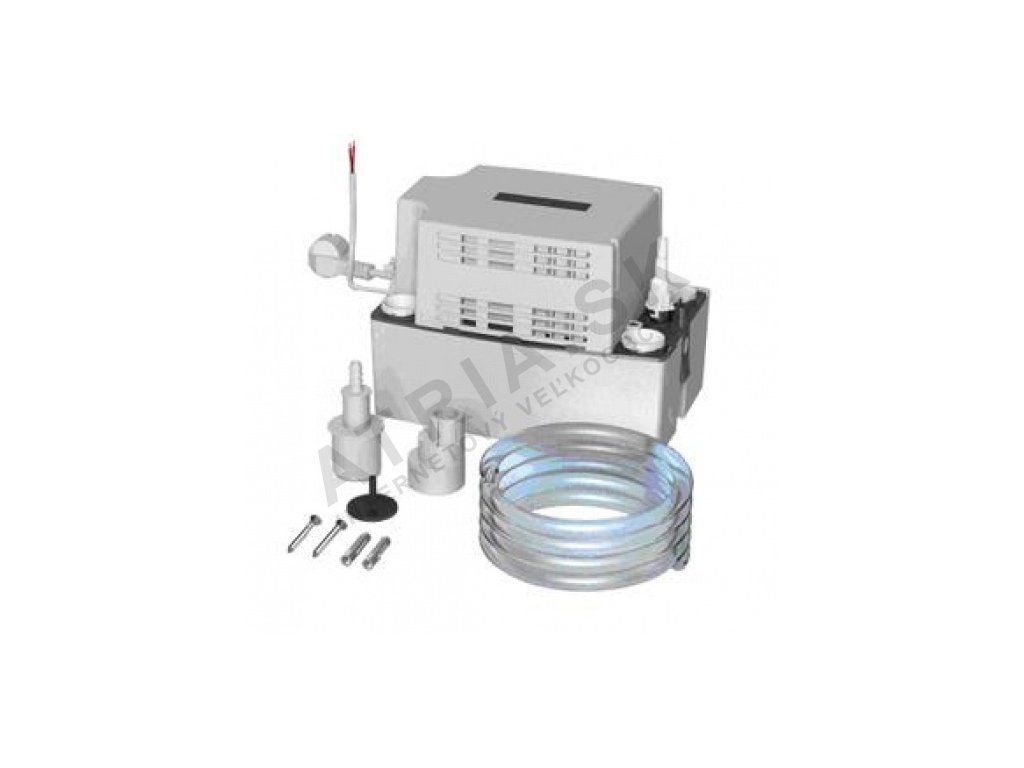 |
GRUNDFOS CONLIFT 1 - this is not a heating water circulation pump, but a small pump for removing condensate from a condensing boiler, air conditioner, or dehumidifier where the condensate cannot be drained by gravity directly into the waste system. If you are planning a complete condensing boiler installation in a basement, or anywhere the drain is higher than the condensate outlet, it is worth including this pump in the budget from the start, not as an afterthought. Price from €102.34. |
Energy class and operating costs
Since the introduction of the European ErP (ecodesign) directive, modern domestic circulation pumps must meet a minimum energy efficiency index (EEI). In practice this means that old classic pumps with three fixed speed steps, which have run for years in many households, have significantly higher consumption than today's electronically controlled models in the same output class. The difference is not negligible - while an older classic pump tends to be set to a constant draw of around 60-80 W regardless of the system's current demand, a modern electronically controlled pump in a comparable class often reduces its own power draw outside peak times to as little as 5-10 W.
If we calculate this over an entire heating season (approximately 5-6 months, i.e. roughly 4,000 operating hours), the difference in electricity consumption at a typical electricity price can amount to roughly €15-25 per year for one pump. With two or three pumps in a system (e.g. a separate circuit for underfloor heating, radiators, and the domestic hot water tank), this saving multiplies. The following chart illustrates this difference using a model example of a single pump over a full season:
This saving may sound modest for a single pump, but in practice it is the main reason we now almost never recommend a classic pump for a new installation - the higher purchase cost pays for itself within a few years through lower consumption, and an electronically controlled pump also treats the whole system more gently (fewer pressure surges, quieter operation at low draw at night).
Backup power supply (UPS) - why it's worth considering
A power outage on a freezing day can cause more damage than it might first appear - if the pump stops while the boiler keeps running, or the system loses heat at low outdoor temperatures, there is in extreme cases a risk of the water in the pipes freezing, especially in less-heated parts of the house or in exterior pipework. That is why some circulation pump sets are also offered in a variant with a UPS backup power supply, which can bridge a short-term mains outage and keep the pump running until the power supply is restored or a backup source (e.g. a home generator) kicks in.
We recommend considering this option especially in areas with more frequent power outages, in houses with longer exterior pipe runs (e.g. heating an outbuilding, workshop, or pool), or simply wherever you want the certainty that a short mains outage won't stop your heating at the worst possible moment. The DAB EVOSTA2 sets with UPS mentioned above are exactly this kind of solution for an ordinary family house.
Installation, orientation and practical details
Even though replacing a circulation pump is, at first glance, a simple task (disconnect the old one, screw in the new one), in practice it pays to follow a few principles that affect the pump's service life and noise level:
- Shaft orientation - most pumps must have the motor (the head with the control electronics) oriented horizontally, never pointing downwards, otherwise there is a risk of water ingress into the electronics and a shortened service life.
- Bleeding - after replacement the system must be thoroughly bled; air in the pump is the most common cause of noise and reduced output right after installation.
- Shut-off valves - it's worth investing in quality ball valves on both sides of the pump, so that any future replacement is a matter of minutes, not draining the whole system.
- Flow direction - an arrow indicating flow direction is usually marked on the pump body; incorrect orientation can significantly reduce efficiency even though the pump is physically "running".
A detailed step-by-step installation procedure, including photographs and common mistakes, can be found in the article Installation and replacement of a circulation pump.
Comparison of recommended models at a glance
The following graphic summarises the models mentioned above by approximate price and recommended use, so you have a quick overview when deciding:
Real-world examples
The first common case we deal with is replacing an old, noisy classic pump in a flat or smaller house - after years of use, a customer notices that the pump is humming, or that their electricity bill has gone up, and on inspection it turns out to be the original classic pump from the boiler installation. In this case a direct replacement with an EVOSTA2 set at the same installation length (180 mm) is usually enough; an ordinary heating engineer can install it within an hour, and the difference in noise and consumption is noticeable immediately.
The second common case is a new-build with underfloor heating on two floors and a separate radiator circuit in the utility room - here a single small pump is no longer enough, and the project usually plans either for one more powerful pump (EVOPLUS SMALL) combined with manifolds, or several smaller pumps on individual circuits. This decision always depends on the specific heating project and is better discussed beforehand, not after the pipework has been built into the walls.
The third common case concerns condensing boilers located in a basement or where the condensate drain is not available by gravity - here a small condensate removal pump, such as the Grundfos Conlift 1, comes into play. It's a cheap item compared to the whole boiler, but leaving it out of the budget can cause an unpleasant surprise just before final inspection.
Frequently asked questions
How do I recognise that my old pump is undersized?
A typical symptom is that the most distant or highest-located radiators in the house stay lukewarm even at full boiler output, while radiators closer to the boiler are hot. It's equally suspicious if the system needs a noticeably longer time to heat up after a temperature drop (e.g. after night-time setback).
Can I replace the circulation pump myself?
For a simple replacement of a pump with the same installation length and connection type, a technically capable DIYer can manage it - it involves draining part of the system, disconnecting the old pump, installing the new one, and refilling and bleeding the system. However, we always recommend at least a phone consultation with a professional, especially if you are unsure of the system type or if it involves a combination of several circuits.
What if I don't know the exact head and flow rate for my house?
In practice you can go by the parameters of the original pump (if it's a replacement) or by an approximate calculation based on area and heating type, which we discuss in the article on pump power and flow rate. If in doubt, it's always better to choose a slightly more powerful model from the given family than to risk undersizing.
Is it worth paying extra for an electronically controlled pump?
In most cases, yes - the difference in purchase price typically pays for itself within a few heating seasons through lower electricity consumption, and an electronically controlled pump is also quieter and gentler on the whole system.
Do I need a backup power supply (UPS) too?
It depends on your location and house type. If you have frequent power outages, longer exterior pipe runs, or simply want peace of mind during frosts, a backup power supply is worth it. With a stable electricity supply in a city, it's more of an added comfort than a necessity.
How long does a circulation pump last?
The typical service life of a quality circulation pump with correct installation and system bleeding is around 10-15 years; electronically controlled models also have the advantage of lower mechanical wear, since they run at lower speeds most of the time compared to classic pumps with a fixed setting.
Related topics
If you'd like to explore this topic in more detail, also see:
- What pump power and flow rate do I need
- Comparison of circulation pump brands
- Electronically controlled vs. classic pump
- Installation and replacement of a circulation pump
You can find the complete range of pumps for heating and water in the category Pumps for heating and water.
Do you have a question about this topic?
Can't decide, or dealing with a specific situation in your household? Write to us - we're happy to help.