
Most Common Circulation Pump Failures
A circulation pump is the heart of every heating system - it runs quietly, practically continuously, throughout the whole heating season, and hardly anyone notices it while it is working. The problem is that this is exactly why a house owner often only notices a fault once the radiators go cold or an unusual sound starts coming from the boiler room. In this article we look at which circulation pump faults are most common in practice, how to recognise them by their symptoms, when it makes sense to repair the pump, and when it is worth replacing it with a new one straight away. We base this on experience from routine service calls on boilers and heating systems in family houses and flats across Slovakia.
Why a circulation pump fails - the most common causes
A circulation pump is a mechanical-electrical device that easily clocks up 3,000-4,000 hours during a heating season. It is therefore no surprise that it gradually shows the effects of wear and the influence of water quality in the system. From the point of view of routine servicing practice, circulation pump faults can be divided into five main groups based on how often technicians encounter them:
- Air in the system (approximately 30% of cases) - air in the pump's circulation chamber or in the whole heating circuit, causing noisy operation, insufficient flow, or complete stoppage of circulation.
- Deposits and limescale (approximately 25% of cases) - dirt, sludge, and calcium deposits that get into the circulation chamber and block or slow down the rotor.
- Worn bearing and shaft (approximately 20% of cases) - mechanical wear after years of operation, showing up as noise and vibration.
- Faulty electronics or capacitor (approximately 15% of cases) - usually the capacitor on older classic pumps, and the control unit on electronically controlled ones.
- Leaks and clogged filters (approximately 10% of cases) - water leaking through the shaft seal, or a clogged filter before the pump restricting flow.
These figures are of course not a universal statistic that applies to every household, but they reflect what service technicians encounter most often during routine checks and complaints. Importantly, the first two causes - air and deposits - together make up more than half of all cases. This means a large share of faults can either be completely prevented, or at least significantly delayed, through regular maintenance and good water treatment in the system.
How to identify each fault by its symptoms
When diagnosing a circulation pump fault, the most important thing is to listen and observe carefully how the pump behaves. Most faults have a typical, well-recognisable symptom well before the pump stops working completely. The following simple diagram shows how the most likely cause can be estimated based on the initial symptom - the percentages in brackets correspond to the share of total faults given above.
Air in the system
Air in the system is clearly the most common cause of circulation pump problems we see in practice. Air gets into the system when filling, after heating has been shut down, from minor leaks at joints, or after replacing a radiator or valve. It shows up as a typical humming or gurgling sound directly from the pump body, or as cold radiators in the upper part of the house while those on lower floors heat normally. The solution is simple - venting via the vent valve on the pump (usually a small screw or cross-head screw in the centre of the front), or venting the whole system via the vent valves on the radiators. If air keeps recurring regularly, it is usually a sign that there is a microscopic leak somewhere in the system, or that the expansion tank does not have the correct pre-charge pressure - it is worth having a service technician check this, since venting alone only treats the symptom, not the cause.
Deposits, limescale, and dirt in the circulation chamber
The second most common cause of faults is deposits - sludge, rust, residue from sealing compounds after installation, or limescale, which forms faster in a system with harder water than most people would think. These impurities gradually settle in the pump's circulation chamber, around the rotor, and on the bearing bushing. The result is a slowed-down or completely blocked rotor - the pump just hums when switched on but does not turn, or turns only intermittently. This fault very often appears after an extended summer shutdown, when deposits have time to "cake" and the rotor partially sticks while at rest.
In many cases, careful mechanical release of the rotor helps (on most pumps you can carefully turn it with a screwdriver via the screw on the front), but if the problem recurs, it is a sign that there is a higher amount of sludge in the system, and it is worth considering a chemical flush of the system or fitting a dirt filter before the pump. If the pump is older and the deposits have already damaged the bearing or shaft, repair usually does not pay off, and it is time for a replacement. For situations exactly like this, we carry proven sets with backup power:
 |
SET with fitting DAB.EVOSTA2 40-70/180 + backup power - special offer - a complete set with a circulation pump and backup power is a practical replacement precisely when an old pump has become blocked by deposits and repair is no longer worthwhile; the backup power supply also protects heating during a power outage. Price from €334.84. |
Worn bearing and shaft - noise as a warning sign
If, after years of operation, a pump starts squeaking, grinding, or vibration is transmitted through the pump body into the pipework, the most likely cause is a worn bearing or shaft bushing. This type of fault is mechanical and progressive - at first the sound is faint and appears only occasionally, growing louder over the course of weeks to months. Unlike air in the system, which can be resolved with venting in a matter of minutes, a worn bearing cannot be repaired - the individual rotor and bearing parts of standard domestic circulation pumps are not sold separately, since they are part of a sealed wet-rotor unit. The practical solution is therefore to replace the whole pump. If the original pump was a classic single-speed model, this is also a good opportunity to switch to an electronically controlled model, which can automatically adjust output to the system's needs and save electricity - we cover this in the next section of the article.
Faulty electronics or capacitor
On older classic pumps with a speed switch, a common cause of complete failure is a burst or dried-out capacitor in the motor's starting circuit - in that case the pump just quietly hums but does not start, or only turns after the rotor is manually spun by hand. On electronically controlled pumps, it is more often a fault in the control electronics - for example after a mains voltage surge, a lightning strike near the power line, or simply the electronic components reaching the end of their life. The symptom is that the pump is completely silent, no indicator light is on, or it flashes an error code (on models with a display). Repairing electronics is practically never done on standard domestic pumps - this is again a case where replacement with a new pump pays off, ideally one with automatic output regulation, which prevents future faults caused by motor overload.
Leaks and clogged filters
The last group of faults relates to sealing and flow passage. The shaft seal (mechanical seal) can start leaking slightly after years of operation - this shows up as a damp patch or dripping water directly under the pump body. With minor leaking it is more of a cosmetic problem, but it needs to be monitored, since increased moisture can over time also damage the pump's electronics. The second common case is a clogged filter or strainer before the pump (if one is fitted in the system) - a clogged filter restricts water flow, and the pump works "in vain" against resistance, straining itself unnecessarily and making noise. The filter should be removed and flushed regularly, at least once per heating season.
Electronically controlled vs. classic pump - which is less fault-prone
One question we get asked most often when dealing with a fault is: "Is it worth buying the same type of classic pump again, or should I go for an electronically controlled one?" From the point of view of both fault rate and operating costs, an electronically controlled pump has a clear advantage. A classic single-speed or switchable pump runs practically all the time at full or near-full output regardless of whether the system currently needs maximum flow - meaning higher mechanical stress on the bearing as well as higher electricity consumption. An electronically controlled pump, by contrast, continuously changes speed according to the heating circuit's actual needs, saving both energy and mechanical wear.
In numbers, this looks as follows: a typical classic circulation pump running continuously at a medium-to-higher setting draws approximately 80 W and, over a full heating season (approx. 8,760 hours of continuous operation including summer domestic hot water circulation), consumes roughly 700 kWh a year. A modern electronically controlled pump such as the EVOPLUS or EVOSTA2 type operates in a range of approximately 3 to 45 W depending on actual demand, with an average consumption of around 20 W, which works out to approximately 175 kWh a year - roughly 75% less. Average lifespan also differs similarly: while a classic pump is commonly replaced after 8 to 10 years, electronically controlled models with a quality ceramic bearing reach 12 to 15 years in practice, precisely because they are not needlessly overloaded.
That is exactly why, when replacing a faulty classic pump, we recommend switching to an electronically controlled model to most customers. In practice, the smaller output variants for a typical family house prove most popular:
 |
EVOPLUS SMALL 60/180 M electronic circulation pump for small heating and climate systems - threaded - a suitable replacement for a worn-out classic pump in a typical family house, automatically adapting output to the system's actual needs. Price from €625.40. |
 |
EVOPLUS SMALL 80/180 M electronic circulation pump for small heating and climate systems - threaded - a more powerful variant for larger pipework or longer runs, offering the same advantages of automatic control and low consumption. Price from €704.47. |
Repair or replace? When a new pump is worth it
Not every fault means the pump has to be replaced immediately. For air in the system or a temporarily clogged filter, routine maintenance is enough and the pump continues working without problems. For mechanical wear of the bearing, an electronics fault, or repeated blocking of the rotor by deposits, repair usually no longer pays off - a service call (a technician's visit, possible disassembly and a new part, if one can even be found) for a standard domestic pump often gets close to the price of a new pump, while the old pump still remains old, with uncertain remaining lifespan.
A practical rule that works well in servicing practice: if the pump is older than 8 years and the fault is not just air in the system, it is worth replacing it straight away. If the pump is younger than 3-4 years and it looks like an obvious manufacturing defect, the warranty with the retailer should be checked first. Between these thresholds (4-8 years), it is worth weighing both options - the cost of repair versus the cost of a new, more energy-efficient pump, which partly "pays for itself" through additional electricity savings within a few years.
When dealing with boiler room faults, it is also worth thinking about related pumps that are often part of a condensing heating system - for example the condensate pump for a condensing boiler. Here too, clogging or blockage is resolved in the same way as with a circulation pump, and a proven model is a reliable solution in case of a fault:
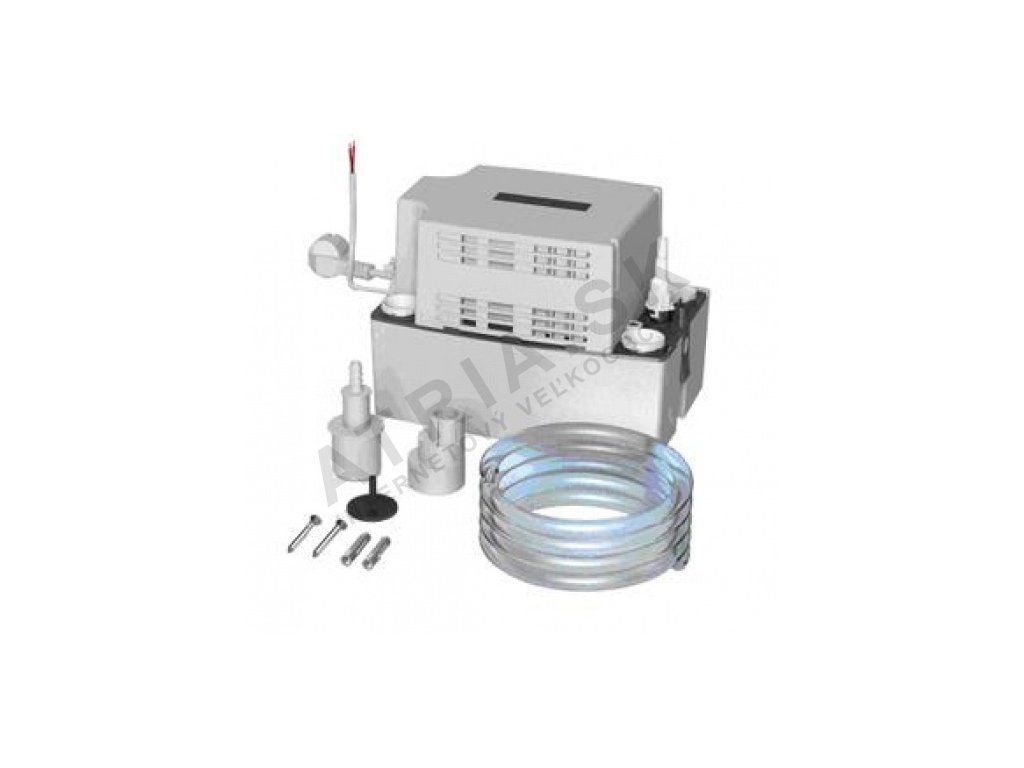 |
GRUNDFOS CONLIFT 1 - a compact pump for draining condensate from a condensing boiler, a practical replacement if, alongside the circulation pump, you are also dealing with a fault in the condensate drainage in the boiler room. Price from €102.34. |
DIY procedure for replacing a circulation pump
If you decide to replace the pump, the installation itself is not complicated with a standard screw-threaded connection, and most competent DIY house owners can do it themselves - the important thing is just to follow the order of the steps and not forget new seals. If you are not sure, or the connection is welded, we recommend calling in a heating technician.
For steps 4 and 5, the most important thing is to check the flow direction - most pump bodies have an arrow stamped on them, which must point in the direction of water flow in the pipework. It is equally important to replace all seals (o-rings or flat gaskets under the flanges) with new ones, even if the old ones still look fine - once removed, they usually cannot be safely reused. After starting up the system, don't forget to properly vent both the pump and the whole circuit, otherwise it may seem like the new pump "isn't working", when in fact it's just air in the system.
How to extend a pump's lifespan - simple maintenance
Most of the faults described above can be at least partially prevented with regular but undemanding maintenance. We recommend doing the following once a year, ideally before the start of the heating season:
- Check and, if necessary, vent the pump and the whole heating system.
- Visually inspect the pump body - damp patches or drops indicate a developing seal leak.
- If a filter or strainer is fitted before the pump, remove it and flush it.
- Listen to the sound of the pump running at full output - note any new squeaking or vibration and monitor how it develops.
- With harder water, consider treating the water in the system (a softener or chemical treatment), which slows down limescale formation.
- Check the pre-charge pressure in the expansion tank - incorrect pre-charge pressure increases the risk of recurring air in the system.
This simple annual check usually takes less than half an hour, but it can reveal a developing fault before it causes a heating outage on exactly the coldest days of the year - and that is precisely the situation worth avoiding.
Frequently Asked Questions
Why does my pump just hum and not turn?
The most common cause is air in the system or a rotor blocked by deposits - first try venting the pump via the vent screw, or carefully turn the rotor with a screwdriver via the front screw. If the problem recurs, it is probably deposits in the circulation chamber, and you should consider a replacement or a thorough flush of the system.
How do I know a pump is completely faulty and needs replacing?
If the pump does not respond at all (no sound, no vibration, does not turn even after venting and freeing the rotor), or if it makes loud squeaking and vibration even after cleaning, it is usually a mechanical or electronic fault that is not repaired on standard domestic pumps - the solution is replacement with a new one.
Is it normal for an old pump to be noisier than a new one?
A slight hum is normal even for a working pump, especially at a higher output setting. However, if the noise gradually increases month by month, or a new sound appears (squeaking, knocking), that is a sign of bearing wear, not a normal operating state.
Is it worth switching from a classic to an electronically controlled pump when replacing?
In most cases, yes. An electronically controlled pump consumes approximately 75% less electricity than a classic one (approx. 175 kWh/year versus 700 kWh/year with continuous operation) and, on average, reaches several years longer lifespan, since it is not needlessly overloaded.
How often should a circulation pump be checked?
We recommend at least once a year, ideally before the start of the heating season - a visual check for leaks, a check for noise, and venting the system. For systems with harder water or older pipework, it is a good idea to be more attentive during the season too.
Can a circulation pump be repaired, or does the whole thing always need replacing?
In standard domestic circulation pumps, the rotor is usually sealed together with the bearing as one non-dismountable unit, so mechanical faults (a worn bearing, a damaged shaft) cannot be repaired - the solution is to replace the whole pump. The exception is air in the system, a clogged filter, or minor dirt, which can be resolved without a replacement.
Related topics
- How to choose a circulation pump for heating
- What pump output and flow rate do I need
- Electronically controlled vs. classic pump
- Circulation pump installation and replacement
- Pump Is Noisy or Has Air in It - Causes and Solutions
You can find the complete range of circulation and auxiliary pumps in the main category Pumps for heating and water.
Have a question on this topic?
Can't decide, or dealing with a specific situation in your household? Write to us - we're happy to help.