
Electronically Controlled vs. Classic Pump
Electronically Controlled vs. Classic Pump: What Really Matters When Choosing
When it comes to a heating circulation pump, most people only think of one decision - "three-speed, or the more modern one with a display?". In practice, there is far more behind this difference than just looks and price. It is about how much electricity the pump uses over 15-20 years of operation, how the system behaves under partial load, whether you'll hear humming in the flat above the boiler room, and, ultimately, whether a service technician tells you in a few years' time "this isn't made anymore, you need a full replacement" or "you just need to replace this module". In this article we look at both types of pump practically - not through marketing slogans, but through real consumption figures, price differences, and specific situations where it is worth reaching for the more expensive electronically controlled model, and where a classic pump is perfectly sufficient.
How a classic (unregulated) circulation pump works
A classic circulation pump - sometimes labelled in catalogues as "unregulated" or "three-speed" - works on a simple principle. The motor turns the impeller at a constant, pre-set speed. This speed can be switched manually, usually with a switch directly on the pump body, between three levels (for example speed 1, 2, 3). But there is something important to understand: the pump cannot react on its own to what is happening in the system. If thermostatic heads on the radiators close slightly because it is warmer outside, or if underfloor heating zones close, the pump keeps pushing the same amount of water with the same force. The result is that pressure in the pipework rises, noise develops at the thermostatic valves (so-called "hissing" or "whistling" at throttling elements), and the pump consumes electricity completely regardless of whether the system actually needs it.
The typical power draw of a classic circulation pump for a typical family house ranges from approximately 45 W at the lowest speed up to 90-95 W at the highest. Since house owners usually set the middle or higher speed (to make sure "it will definitely be enough") and leave it there throughout the heating season and beyond, average real-world draw in practice runs at around 60-70 W all year round - including summer, when the pump only circulates domestic hot water, or is simply left on because nobody switched it off.
How an electronically controlled (regulated) pump works
An electronically controlled pump works on a completely different principle. Inside it has a frequency converter and electronics that continuously measure the differential pressure (the pressure difference between the pump's outlet and inlet) and change the motor speed in real time accordingly. When thermostatic heads close and resistance in the system increases, the pump automatically reduces its speed - and vice versa. The result is that constant or proportional pressure is maintained in the system (depending on the chosen control mode), radiators and underfloor circuits operate more quietly, and, above all, the pump draws exactly as much energy from the mains as the system actually needs at that moment.
The power draw of modern electronically controlled pumps ranges from approximately 3 W (in setback, for example at night or with zero heat demand) up to 45 W (at full output under the highest demand, for example on a freezing morning). Since the system does not need maximum output for the vast majority of the heating season (except for a few of the coldest days of the year), the average annual draw of such a pump works out at roughly 10-15 W. It is exactly this difference between "always flat out" and "exactly as needed" that is at the heart of this whole comparison.
Diagram: where the difference in control lies
The following diagram gives a simplified view of what happens inside both types of pump from the moment heat demand in the system changes (for example a thermostatic head closes slightly) to the pump's response.
This difference in control is not just theoretical - it translates directly into your electricity bill, into the lifespan of thermostatic valves, and into whether the pipework will be audible in the flat above the boiler room.
Real figures: how much electricity a pump actually consumes
Let's move on to concrete numbers we can also verify in practice. Take a typical family house, where the pump operates practically year-round (heating in winter, domestic hot water circulation, and partial operation outside the season) - i.e. approximately 8,760 hours a year.
- Classic unregulated pump: average real power draw approx. 65 W (common setting at speed 2 or 3, unchanged throughout the year) → annual consumption approx. 570 kWh.
- Electronically controlled pump (EEI class ≤ 0.20): average real power draw approx. 12 W thanks to continuously adapting output to demand → annual consumption approx. 105 kWh.
The difference is therefore approximately 465 kWh a year in favour of the electronically controlled pump - that is roughly an 82% saving on electricity consumption for the circulation pump. At a current electricity price of around €0.20/kWh, this means:
- Classic pump: approx. €114/year in electricity just for circulating water in the system.
- Electronically controlled pump: approx. €21/year.
- Saving: approx. €93/year.
Chart: annual energy consumption
Purchase price vs. long-term costs
Here comes the most common objection: "an electronically controlled pump costs several times more than a classic one, so it will never pay for itself for me". Let's look at this honestly, with real prices from our catalogue.
A complete set with the electronically controlled DAB EVOSTA2 40-70/180 pump including backup power (important with boilers where the pump stopping during a power outage can cause overheating) costs around €300-335 at special offer prices, depending on the fitted or non-fitted variant. By comparison, a standard classic three-speed pump in an equivalent version can be found from as little as approx. €60-90. The difference in purchase price is real, no "discovery" is being sugar-coated here.
However, if you divide the price difference (approx. €220-250) by the annual electricity saving (approx. €93/year), the payback period works out at approximately 2.5-3 years. With a typical circulation pump lifespan of 10-15 years, this means the remaining 7-12 years the pump is generating pure savings - add to that quieter operation, less wear on thermostatic valves, and the fact that since 2015 (EU regulation No. 641/2009 under the ErP directive) classic unregulated pumps with a high EEI have officially been practically discontinued for new sale - so in the event of a major failure of an old pump, today you will practically always end up with an electronically controlled replacement, whether you want it or not.
Comparison as a graphic
When an electronically controlled pump really pays off
It is not black and white - in some cases the difference is fundamental, in others less significant. From the experience of installation companies and the questions we get most often, a few typical situations stand out:
1. A system with thermostatic heads on radiators or zoned underfloor heating
This is the strongest argument for an electronically controlled pump. If your house has several rooms with their own temperature control (heads, room thermostats, underfloor heating zone valves), the actual flow demand keeps changing throughout the day - in the morning all rooms need heat, during the day some zones close slightly, in the evening they open again. In this situation, a classic pump either constantly "pushes flat out" (wasting energy and causing noise), or is set low and cannot deliver enough flow at peak moments. An electronically controlled pump solves this problem on its own, without any user intervention.
2. Long-term operation with no planned replacement within 5 years
If you plan to live in the house and heat it for another 10, 15, or more years, the investment in an electronically controlled pump will pay for itself several times over. Conversely, for a cottage used a few weekends a year, or a building where the pump will soon be fully replaced anyway (e.g. a planned boiler room renovation), a classic solution is also worthwhile in the short term.
3. A boiler with backup power / a requirement for uninterrupted circulation
With condensing boilers, it is important that the pump keeps running even after a power outage, or at least that the system copes with a short outage without damage. This is exactly why our catalogue includes complete pump sets with backup power (UPS) - for example the DAB EVOSTA2 40-70/180 set. This is a typical example where an electronically controlled pump and backup power go hand in hand.
4. Larger systems with higher flow (more radiators, more distant circuits)
In larger houses, where a higher pump head is needed (for example with EVOPLUS SMALL 60/180 or 80/180 type models), the difference in consumption between a classic and an electronically controlled pump grows even further - simply because the classic output itself is higher too, and so the absolute saving from switching to control is greater.
When a classic pump is entirely sufficient
To be fair - an electronically controlled pump is not always unambiguously the best choice. For a simple system with a single circuit without thermostatic heads (for example a small garage, a workshop with one radiator, or a temporary/provisional solution), where flow practically never changes, the advantage of automatic control practically disappears - the system never operates in a variable regime that electronics would have anything to regulate. In that case, the lower purchase price of a classic pump is entirely justified, and the payback on a more expensive model would be disproportionately long.
Recommended products from our catalogue
Below you will find specific electronically controlled pumps and related products we currently keep in stock. When choosing output, always take into account the actual flow rate and head of your system - if in doubt, we recommend consulting an installation company or writing to us via the form at the end of the article.
 |
SET with fitting DAB.EVOSTA2 40-70/180 + backup power - special offer - a complete solution for a typical family house, an electronically controlled pump with automatic pressure control plus backup power that keeps circulation running even during a short power outage. Ideal as a replacement for an old classic pump on a condensing boiler. Price from €334.84. |
 |
SET without fitting DAB.EVOSTA2 40-70/180 with UPS backup power - special offer - the same electronically controlled pump, a variant without fittings for cases where you need a different type of connection to existing pipework. A good choice when replacing an old classic pump with an electronic one of the same installation length. Price from €294.05. |
 |
EVOPLUS SMALL 60/180 M - electronic circulation pump for small heating and climate systems - higher head for larger systems with several circuits, fully electronic speed control according to actual heat demand. Also suitable for combined heating and cooling (climate systems). Price from €625.40. |
 |
EVOPLUS SMALL 80/180 M - electronic circulation pump for small heating and climate systems - the most powerful variant in this range, suitable for larger houses with longer pipework or a greater number of radiator circuits, where higher flow is needed while retaining automatic control. Price from €704.47. |
Besides circulation pumps for the heating circuit, the same category of our online shop also contains pumps for a completely different purpose - for example a pump for draining condensate from a condensing boiler, when a gravity fall into the sewer is not possible:
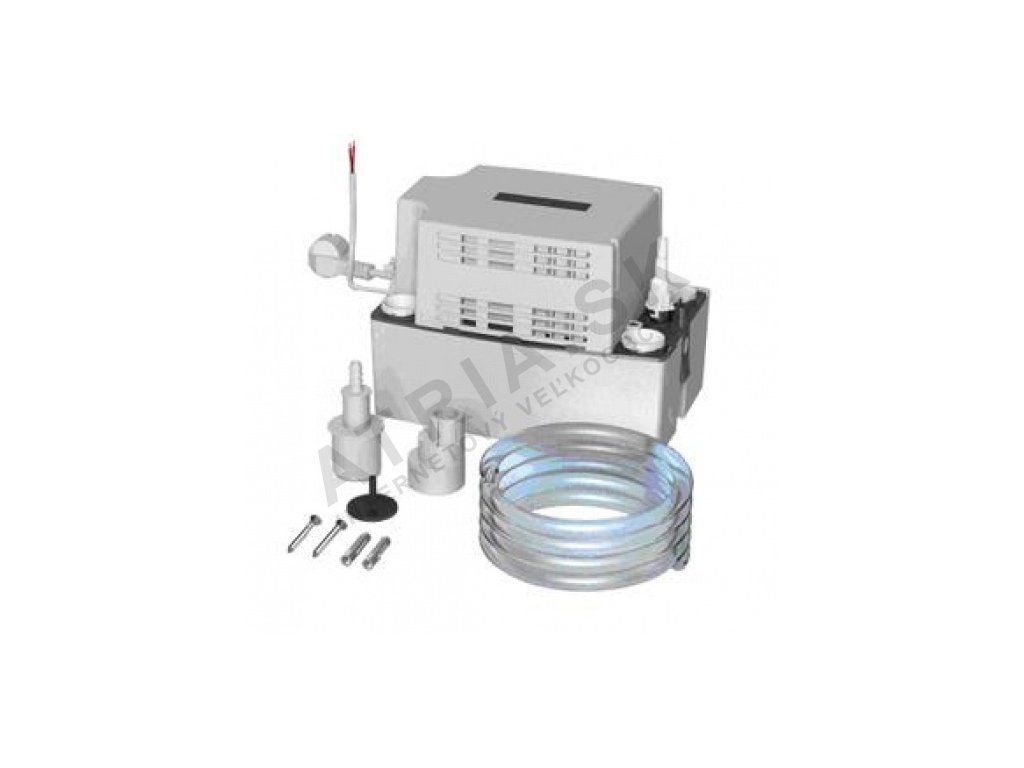 |
GRUNDFOS CONLIFT 1 - a small condensate pump for a condensing boiler, heat pump, or air conditioning, when condensate needs to be pumped up into a higher-positioned sewer. This is not a heating circuit circulation pump, but it is often dealt with at the same time as replacing the main pump. Price from €102.34. |
What to watch out for when replacing a classic pump with an electronically controlled one
Based on the experience of installation companies we have spoken to, it is worth highlighting a few practical details that are easy to overlook:
- Installation length and flange/thread spacing - electronically controlled pumps usually have different body dimensions from old classic models. Before ordering, always measure the existing spacing and connection type (threaded vs. flanged), and compare with the specific model's datasheet.
- Flow direction and position of the control head - electronic pumps often have a display or control panel that needs to be readable and accessible - when installing in a cramped boiler room space, also think about being able to comfortably reach the settings.
- Control mode - most electronically controlled pumps offer several modes (constant pressure, proportional pressure, constant speed, or automatic night setback). Proportional pressure is usually recommended for a system with thermostatic heads, while underfloor heating with its own control often calls for constant pressure - correct settings significantly affect both noise and savings, so it is worth having them set up by an experienced technician during installation.
- Backup power for boilers that require it - if the boiler manufacturer requires the pump to keep running even during a power outage, address this either with a set that includes backup power, or a separate UPS module - don't assume a standard electronically controlled pump without backup will "sort it out" on its own.
- EEI class for inspection/certification - if you are dealing with a new build or a major renovation, an energy audit may require proof of the EEI class of the pump used - electronically controlled models commonly meet the EEI ≤ 0.20 requirement, which today can no longer even be guaranteed with classic unregulated pumps, since they have essentially stopped being made for new installations.
Decision diagram: classic, or electronically controlled?
An environmental and regulatory perspective
Besides the personal saving on your bill, switching to electronically controlled pumps also has a wider impact. According to European Commission estimates during the preparation of the ErP directive (regulation 641/2009), before these rules were introduced, circulation pumps in homes and buildings represented one of the single largest electricity-consuming appliances in households after the fridge and washing machine - precisely because they run practically continuously all year round, even outside the heating season (domestic hot water circulation). This is exactly what led to unregulated pumps with a high energy index being gradually withdrawn from the market and replaced with electronically controlled models as the standard. So if you find mostly electronically controlled models in our catalogue today, it is neither a coincidence nor an attempt to sell more expensive goods - it reflects the real development of regulated energy efficiency in this segment.
A practical example from a typical household
A family house, a gas condensing boiler, five radiator circuits with thermostatic heads, and one underfloor heating circuit in the bathroom. The original classic three-speed pump was set to the second speed (to make sure "it would definitely be enough even in frosts") and ran continuously all year round - including summer, when only domestic hot water circulation was running in the house. After switching to an electronically controlled pump with automatic pressure control, in summer, when heat demand is minimal, the pump's power draw dropped to single-digit watts, while in the winter peak it briefly rose to 35-40 W. After a year of operation, the owner reported a noticeably quieter boiler room (the whistling at the thermostatic valves in the attic disappeared), and on the annual electricity statement a real drop corresponding to approximately the calculated €90 - which practically matches exactly the model calculation earlier in this article.
Frequently Asked Questions
Can an electronically controlled pump be fitted onto old pipework without modifications?
In most cases, yes - it just needs the connection type (threaded/flanged) and the screw spacing or thread length to match. We recommend comparing the dimensions of the old pump with the datasheet of the new model before ordering, or consulting us directly via the form below.
Is an electronically controlled pump worth it even in a small flat with a single radiator circuit?
With a simple system without thermostatic heads or zone control, the effect of automatic regulation is minimal, because flow practically never changes. In that case it is worth considering a classic pump with a lower purchase price too.
How do I recognise that a pump is electronically controlled when buying a replacement?
Electronically controlled pumps usually have a display, or at least an LED indicator, and a rotary control for selecting the control mode (constant pressure, proportional pressure, or automatic night setback). Classic pumps only have a simple mechanical switch for 3 fixed speeds, with no display. The control type is always stated in the product description in our catalogue.
Do I need backup power for an electronically controlled pump?
It depends on the boiler manufacturer's requirements. If the pump is required to keep running after a power outage, address this with a set that includes backup power (for example DAB EVOSTA2 with backup power) or a separate UPS module. If there is no such requirement, backup power is not essential, it just increases comfort and safety during outages.
How long does an electronically controlled pump last compared with a classic one?
The lifespan of both types, for quality products, is similar, on the order of 10-15 years under normal operation. The electronics in a controlled pump are now commonly resistant to surges and voltage fluctuations, so the difference in actual lifespan between the types is not significant - it depends more on the quality of the specific manufacturer and model.
Do I need to configure an electronically controlled pump somehow, or does it work "on its own"?
The basic setup (choosing the control mode, or a night setback curve) is done once during installation, usually by a technician. After that, the pump continues to work fully automatically without needing intervention - that is exactly its main advantage over manually switching speeds on a classic model.
Summary
An electronically controlled pump costs more to buy, but for a system with thermostatic heads, zone control, or long-term operation, the investment typically pays for itself within 2.5-3 years on electricity savings alone, without even factoring in quieter operation and less wear on fittings. A classic unregulated pump has its place only in simple, small systems without their own flow control, where the benefit of electronics would be practically unused. If you are not sure which type and what output you need for your specific system, we are happy to help.
Related topics
- How to choose a circulation pump for heating
- What pump output and flow rate do I need
- How Much Does Running a Pump Cost and How to Save
- Circulation Pump Installation and Replacement
Have a question on this topic?
Can't decide, or dealing with a specific situation in your household? Write to us - we're happy to help.