
What Pump Power and Flow Rate Do I Need
The question "how powerful a pump do I actually need" is one that most people only ask when they are standing in front of a shelf with three or four models that differ from each other in output, price, and designation. Yet the answer is not complicated maths or laborious measuring - you just need to know two numbers that describe your heating system and know how to translate them into pump parameters. In this article we explain flow rate and head in practical terms, using real examples of a flat, a family house with radiators, and a house with underfloor heating, and show how these calculations translate into a specific pump choice.
An oversized or undersized pump is not just a theoretical problem. A pump that is too weak will not sufficiently heat distant rooms, the system "gurgles", and the boiler overheats unnecessarily because heat does not leave it fast enough. A pump that is too powerful, on the other hand, is noisy, wastes electricity (although with electronically controlled models this difference is now small) and in older systems can cause erosive wear on valves and noise at thermostatic heads. Correct sizing therefore pays off in terms of comfort, service life, and operating costs.
Two key parameters: flow rate and head
Every circulation pump in the catalogue has (or can be derived from its curve) two basic figures: maximum flow rate and maximum head. To know which pump is right for your house, you need to know the approximate value of both parameters in your own system as well.
Flow rate (Q) - how much water you need to circulate
Flow rate tells you how many litres (or m³) of heating water the pump must push through the circuit per hour in order to transfer heat from the boiler to the radiators or underfloor loops in the required amount. Flow rate is therefore directly linked to the output of the heat source (boiler, heat pump) and to the temperature drop, i.e. the difference between the water temperature at the outlet and at the inlet of the boiler.
The formula that every heating designer actually checks when designing a system is simple:
Q [m³/h] = P [kW] × 0.86 / ΔT [°C]
where P is the output of the heat source in kilowatts and ΔT is the temperature drop (the difference between the flow and the return). The number 0.86 comes from the thermal capacity of water and is a constant that does not need to be derived - it just needs to be used.
The larger the temperature drop a system allows, the smaller the flow rate you need at the same output - and vice versa. Radiator systems commonly work with a drop of around 15 °C (for example 55/40 °C), while underfloor heating needs a much lower drop, typically 5 °C (for example 35/30 °C), because the surface temperature of the floor must not be too high. This is precisely why underfloor heating, at the same boiler output, requires several times higher flow rate than radiators - and this is why the pump is often changed when switching from radiators to underfloor heating.
Head (H) - how much resistance the pump has to overcome
Head (sometimes also called discharge head) indicates how much hydraulic resistance the pump can overcome - i.e. the sum of the friction losses in the pipes, elbows, valves, filters, the boiler's heat exchanger, and in the radiators or the underfloor heating manifold. It is measured in metres of water column (m). It is therefore not the physical height to which the pump pushes the water (no height needs to be overcome for this, since the circuit is closed and the water returns), but a measure of the resistance that must be overcome for the water to flow at the required speed.
Head increases with the length of the piping, the number of elbows and branches, the number of connected radiators or circuits, and especially with the presence of high-resistance devices - typically long underfloor heating loops or very thin piping. The exact calculation of head is a task for a designer (the sum of the pressure losses of the individual sections), but for an ordinary household an approximate estimate based on the size and type of system, which we show below, is sufficient.
Three real-world examples
Instead of dry theory, let's look at three common situations we encounter most often at atria.sk - a small flat with a single radiator circuit, a medium-sized family house with several radiator circuits, and a family house with underfloor heating. For each we give a real calculation according to the formula above.
Example A: 65 m² flat, 10 kW boiler/exchanger, radiators
For a radiator system we count on the standard temperature drop of 15 °C. Substituting into the formula gives:
Q = 10 × 0.86 / 15 = 0.57 m³/h (rounded to 0.6 m³/h)
This is a single compact circuit with short piping (on the order of up to 20-25 metres of pipe run there and back), so the head remains low - estimated at around 1.5 m. This is a typical situation for a smaller pump from a lower output class.
Example B: 150 m² family house, 20 kW boiler, radiators, two circuits
In a larger house it is common for the system to have two or more branches (for example the ground floor and upper floor separately), which lengthens the pipe run and adds branches and shut-off fittings.
Q = 20 × 0.86 / 15 = 1.15 m³/h
With a longer run (estimated at 50-70 metres of equivalent length including elbows and valves), the head is around 3 m. Here we typically reach for a more powerful model that has some reserve for possible future modifications to the system (adding a radiator, upgrading to a larger one).
Example C: 180 m² family house, 18 kW boiler, underfloor heating
With underfloor heating the situation is different - the low temperature drop of 5 °C means a much higher required flow rate on the main circuit before the manifold:
Q = 18 × 0.86 / 5 = 3.10 m³/h
Important note: this is the flow rate on the main circuit between the boiler and the manifold. Individual underfloor heating loops have their own regulation at the manifold (or even their own small circulation pumps for larger manifolds), so an individual loop needs considerably less - typically 0.3 to 0.6 m³/h per circuit. The head of the main pump before the manifold in an ordinary house is around 2.5 m, which, given the higher flow rate, generally already requires a pump from a higher output series.
The chart below summarises the required flow rate in all three examples - it shows how significantly the flow rate rises with underfloor heating compared to radiators, even though the output of the heat source is similar in all three cases.
How to estimate head without a complex calculation
An exact hydraulic calculation of head (the sum of the pressure losses of every pipe section, every elbow, valve, and appliance) is a job for a heating engineer or designer. For a routine pump replacement in an existing system, or an approximate choice during construction, however, these practical rules based on common installations are enough:
- Small flat or house up to 80 m², one compact circuit: head 1-2 m.
- Medium-sized house 100-180 m², one to two radiator circuits: head 2-4 m.
- Larger house over 200 m², multiple branches or longer pipe runs: head 4-6 m.
- Underfloor heating, main circuit before the manifold: head 2-3 m (the loops themselves have their own flow regulation at the manifold), but if the system is very branched with many loops and long runs, a higher reserve may be needed.
If you are not sure which category your house falls into, it is always better to lean towards the higher value - a pump with a slight output reserve is not a problem at all, because modern electronically controlled models automatically adapt their output to actual demand (more on that below). An undersized pump, on the other hand, cannot be "made up for" by any setting.
The following diagram summarises the whole calculation procedure in three steps - from entering the boiler and temperature drop to choosing the specific pump.
It is equally useful to compare the second parameter as well - head. While flow rate is most affected by the type of system (radiators vs. underfloor heating), head is most related to the size of the house and the length of the pipework, as shown in the following chart with values from our three examples.
Electronically controlled pumps - why they make more sense today
Older pumps only had a few fixed speed steps (typically 1-3), between which the owner switched manually - and mostly stayed set to the highest step "to be sure it's enough". This meant unnecessary electricity consumption and noise, especially under partial system load (for example in the transitional spring and autumn period, when the boiler runs at only part of its output).
Electronically controlled (so-called EEI, high-efficiency) pumps instead continuously measure the pressure differential in the system and automatically adjust their speed precisely according to current demand. In practice this means that under partial load they run more quietly and consume significantly less electricity than older classic models - the saving on the pump's own electricity consumption over a full year of operation typically amounts to tens of euros annually, depending on the system's size and the electricity price. This is why, when replacing an old pump today, switching to an electronically controlled model is almost always recommended - not only because of the savings, but also because it adapts its output automatically even if you slightly underestimate or overestimate your flow rate and head calculation.
The difference between a classic and an electronically controlled pump, including the advantages and disadvantages of both types, is discussed in detail in a separate article, Electronically controlled vs. classic pump.
Recommended pumps by installation type
Based on the three examples above and the common requirements of Slovak households, we recommend these specific models from our range. All of them are electronically controlled, high-efficiency circulation pumps.
 |
DAB.EVOSTA2 40-70/180 threaded SET + backup power supply - special offer - suitable precisely for the smaller installations in Example A (flat, smaller family house, one compact radiator circuit). This set also includes a backup power supply (UPS), so the pump keeps running briefly even after a power outage - especially valuable with boilers where a loss of circulation during coast-down can cause overheating. Price from €334.84. |
 |
EVOPLUS SMALL 60/180 M electronic circulation pump for small heating and air-conditioning systems - threaded - mid-range class suitable for the situation in Example B (family house with two radiator circuits, higher flow rate and head than in a flat). The electronic control finds the optimal operating point on its own, even with seasonal changes in the system's load. Price from €625.40. |
 |
EVOPLUS SMALL 80/180 M electronic circulation pump for small heating and air-conditioning systems - threaded - the most powerful in this series, recommended precisely for Example C (family house with underfloor heating, where the required flow rate on the main circuit is considerably higher) or for larger houses with several radiator branches at once. Price from €704.47. |
The following graphic gives an approximate comparison of which pump category suits which of the three examples - according to the growing need for flow rate and head.
Exact catalogue flow rate/head curves (the so-called H-Q curves) can be found in the technical documentation of each product - the recommendations above are approximate, based on common installations, and do not replace consultation with a heating engineer for an atypical or larger system. If you are not sure, we are happy to advise you via the contact form at the end of the article, based on your house's specific parameters.
Condensate pump - a frequently overlooked detail
When addressing "what pump do I need", it is worth mentioning one more type of pump that is often forgotten during planning - a condensate removal pump. Condensing boilers produce condensate during operation (slightly acidic water arising from the condensation of flue gases), which needs to be safely drained into the sewer system. If the boiler is located above the level of the waste pipe or where a gravity drop is not possible (for example in a basement, in a room without a nearby drain), gravity drainage is not enough and a small automatic condensate pump is needed.
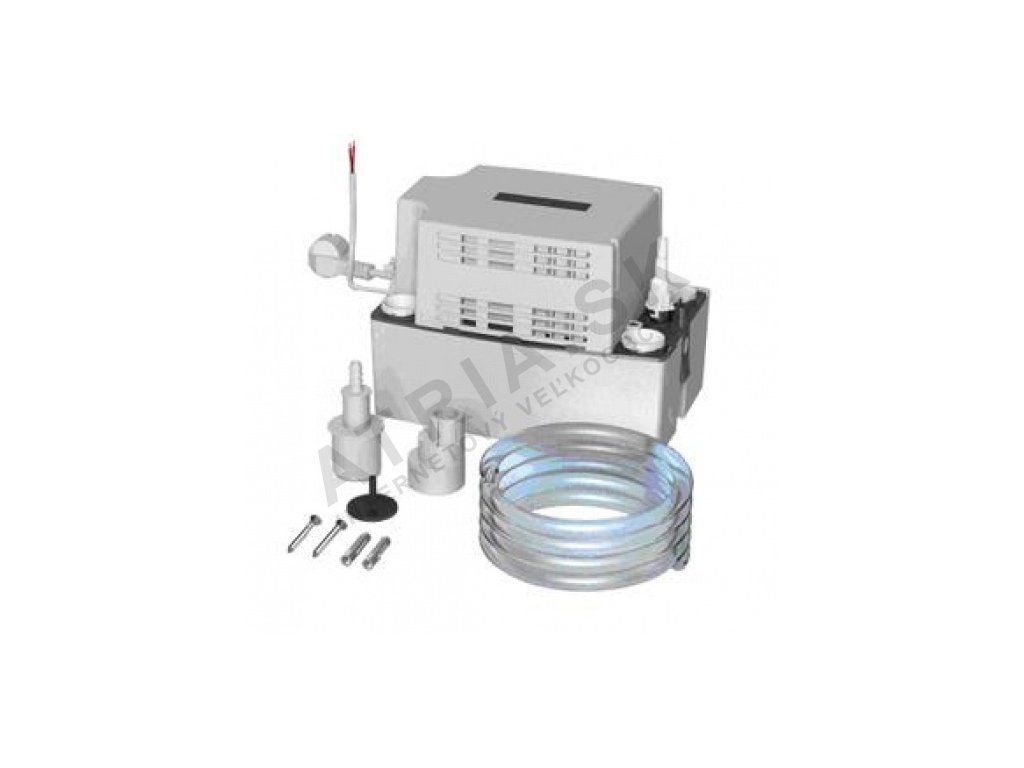 |
GRUNDFOS CONLIFT 1 - a compact automatic pump designed exactly for this purpose: removing condensate from a condensing boiler (or also from an air conditioner or dehumidifier) where a gravity drop into the sewer system is not available. It is therefore not a heating water circulation pump, but an additional, though in practice important, part of a complete condensing boiler installation. Price from €102.34. |
The most common mistakes when choosing pump output
Across the dozens of installations we have accompanied with advice and material supply via atria.sk, we repeatedly encounter a few typical mistakes:
1. The pump is chosen only based on "what's always suitable for this boiler brand"
Many sellers and installation companies reach for the same pump model regardless of the actual size and type of the system - simply because "that's how we always do it". In a small flat this means an unnecessarily oversized (and more expensive) pump, while in a larger house with underfloor heating it means an undersized solution that cannot handle sufficient flow.
2. Mixing up the temperature drop of radiators and underfloor heating
If the wrong temperature drop is used when calculating flow rate (for example 15 °C instead of the actual 5 °C for underfloor heating), the result comes out roughly three times lower than the system actually needs. This is one of the most common reasons why underfloor heating "doesn't heat as it should" even with a correctly sized boiler.
3. Ignoring future system modifications
If you plan to add a radiator, finish an attic, or partially switch to underfloor heating within a few years, it is worth choosing a pump with a slight output reserve - with electronically controlled models this does not mean any loss of efficiency at the currently lower load.
4. Underestimating head in larger systems
In houses with long pipe runs, multiple floors, or many branches, head accumulates quickly. If the pump cannot overcome this head, flow practically stops at the most distant points in the system - typically this shows up as a cold last radiator at the far end of a branch, even though the other radiators heat normally.
Summary - a quick step-by-step procedure
If you want to choose a pump yourself, without calling a technician, proceed as follows:
- Find out the output of your boiler or heat source in kW (stated in the boiler's documentation or on its nameplate).
- Determine the temperature drop according to the type of system - 15 °C for radiators, 5 °C for underfloor heating.
- Calculate the required flow rate using the formula Q = P × 0.86 / ΔT.
- Estimate the head based on the size of the house and the type of system (table above), and add a slight reserve if you plan to expand the system in the future.
- Choose a pump whose maximum flow rate and head match or slightly exceed the calculated need - electronically controlled models will fine-tune the rest themselves.
- With a condensing boiler without gravity condensate drainage, don't forget a separate condensate pump.
If, despite this procedure, you are still not sure which model is best for your specific house, write to us - just tell us the boiler output, the type of system (radiators/underfloor heating), and the approximate size of the house, and we will be happy to recommend a specific model from our range.
Frequently asked questions
Can I use a more powerful pump than the calculation gave me, "just to be sure it's enough"?
Yes, a slight output reserve is not a problem, especially with electronically controlled pumps, which adjust their speed to the system's actual demand and don't run needlessly at full output. A significantly oversized classic (unregulated) pump, however, can cause system noise, "buzzing" thermostatic heads, and increased electricity consumption, so here too it makes sense to stick to the calculated estimate with a reasonable reserve of 10-20 %, not a several-times-higher value.
How do I find out the temperature drop of my existing system if I don't know whether it's 15 °C or something else?
The easiest way is to measure with a thermometer (or read from the boiler's display, if it shows it) the temperature of the flow and return pipes during normal boiler operation at or near the design outdoor temperature. The difference between these two values is your real temperature drop. For common radiator systems in Slovakia it is, in the vast majority of cases, around 15 °C, and for underfloor heating around 5 °C, but a specific project or boiler setting may differ slightly.
I have a house with both radiators and underfloor heating - which drop should I use?
In a combined system, the lower temperature drop of the underfloor heating (5 °C) is generally used as the deciding factor for calculating the main circulation pump before the manifolds, since the underfloor part has higher flow requirements. The radiator branch then usually receives water through a separate mixing unit with its own temperature and flow control, so the main pump does not need to be calculated separately for each branch - it is enough to add up the total output of both parts and use a drop of 5 °C.
What happens if I buy a pump with a lower flow rate than the system needs?
The system will not heat sufficiently at the most distant or hydraulically most unfavourable points - typically the last radiator on a branch stays cold or lukewarm even though the boiler is running at full output and the other radiators heat normally. With underfloor heating this shows up as uneven heating of individual rooms, or a longer time needed to reach the required temperature.
Is there a difference between a circulation pump for radiators and one for underfloor heating?
The pump itself is structurally the same - the difference is in the flow rate and head the system requires of it, as we showed in the examples above. With underfloor heating, a manifold with its own flow control for each loop is also almost always added (or with its own small pumps for larger manifolds), so the main circulation pump before the manifold only handles the total flow into the manifold, not the distribution between individual loops.
When replacing an old pump with a new one, do I also need to deal with the threaded connection and dimensions?
Yes, when replacing an existing pump it is important to also check the bolt spacing (the axial distance between connections) and the thread diameter, so the new pump physically fits in place of the old one without modifying the piping. This information is always given in the technical parameters of the specific product - if you are not sure, we are happy to check this with you before ordering via the contact form below.
Related topics
If this topic interested you, we recommend continuing with these articles from our Knowledge Center:
- How to choose a circulation pump for heating
- Electronically controlled vs. classic pump
- Installation and replacement of a circulation pump
- How much does running a pump cost and how to save
You can find the complete range of circulation and special pumps in the main category Pumps for heating and water.
Do you have a question about this topic?
Can't decide which pump to choose for your specific house, or dealing with an atypical situation (multiple circuits, a combination of radiators and underfloor heating, long pipe runs)? Write to us - just tell us the boiler output, the type of system, and the approximate size of the house, and we'll be happy to advise.