
Pump Is Noisy or Has Air in It – Causes and Solutions
Pump Is Noisy or Has Air in It - Causes and Solutions
Humming, knocking, hissing, or regular "rattling" from a circulation pump is one of the most common reasons customers write or call us during the heating season. The good news is that in the vast majority of cases it is not a fault requiring immediate pump replacement - the most common cause is air in the system. The bad news is that sometimes something else hides behind "just air" - a clogged impeller, worn bearings, cavitation, or simply the end of a pump's life after 12-15 heating seasons. In this article we go through, practically and step by step, how to tell the sounds apart, how to properly vent the system, when to call for servicing, and when it is worth simply replacing the pump with a new electronically controlled one.
We base this on common complaints and service calls we encounter with customers who have family houses and smaller apartment buildings across Slovakia. This text is not a guide for repairing live electrical components - before handling the pump in any way, always disconnect the power supply first and isolate the system according to the manufacturer's instructions.
Why a pump makes noise in the first place - overview of causes
Before we go through the individual steps, it is useful to know that pump noise in practice has only a few typical sources. We would divide them into three groups based on how quickly and cheaply they can be resolved:
1. Air in the system (most common, approx. 60-70% of cases) - shows up as bubbling, gurgling, "rattling" when the pump starts up, and occasionally complete stoppage of flow. Solved simply by venting - either via an automatic vent valve directly on the pump body, or by topping up water and venting the radiators.
2. Cavitation (approx. 15-20% of cases) - occurs when the pump operates at too low a pressure on the suction side, or at too high a speed for the given system. Water locally "vaporises" into microscopic bubbles, which then implode - this creates a typical sharp, metallic, "cracking" sound, similar to fine gravel.
3. Mechanical wear (approx. 10-15% of cases) - worn rotor bearings, deposits (sludge, rust, limescale) in the impeller, or simply the end of the pump's lifespan. In this case, venting or changing the speed usually does not help - it is resolved either by servicing or replacement.
The following diagram summarises how these three groups relate to specific symptoms and what the first step is for resolving each of them:
Air in the system - how to recognise it and how to vent it
Air most often gets into a heating circuit after topping up water (for example after a repair, after replacing a radiator, after shutting the heating down for summer and restarting it), from microbubbles dissolved in the water that release when heated, or through a leak in the system that slowly draws in air even while the system is running. The typical symptom is an intermittent, "gurgling" sound that changes with the pump's speed, and sometimes also radiators on the top floor staying cold at the top while being warm at the bottom.
The venting procedure is simple, and most house owners can handle it themselves, without calling a service technician:
Step by step - venting a circulation pump
1. Switch off the pump and let the system settle for a few minutes, so the air in the pump body collects at the highest point.
2. Find the vent valve - on most modern electronically controlled pumps, this is a small screw or cap directly on the front of the motor (below the terminal box or on the front cover). On older classic pumps, the vent screw is usually on the pump head.
3. Carefully loosen the valve by half a turn, ideally with a screwdriver, with a cloth ready to catch water - air will escape from the opening first (a hissing sound), then water will start spraying. Once a steady stream of water flows without bubbles, close the valve.
4. Check the pressure in the system on the boiler's pressure gauge - after venting, the pressure usually drops slightly, so water needs to be topped up through the fill valve to the prescribed value (commonly 1.0-1.5 bar for family houses, check the exact figure in your boiler's manual).
5. Switch the pump on and listen - if the sound persists, repeat the procedure after 10-15 minutes of operation, since more air may have released from the water once circulation restarted.
6. Vent the radiators too - if they remain cold at the top or unevenly warm, use a bleed key to loosen the valve on the radiator until water flows without bubbles. In multi-storey houses, start from the top floor and work your way down.
If air keeps recurring (the system needs venting more often than once a season), it is worth looking for a leak - most commonly at radiator valve connections, on the expansion tank, or on the fill valve. Continuous microscopic air ingress is more common than you might think, especially in older systems with many joints and branches.
Cavitation - when a pump "crackles" and it's not just air
Cavitation differs from ordinary air noise in the character of the sound - instead of soft bubbling, you hear a sharper, more metallic, "grinding" or "cracking" sound, as if there were fine gravel or sand inside the pump. Physically, what happens is that at the point of lowest pressure (at the inlet to the impeller), vapour bubbles form locally, which then implode violently when they move into a region of higher pressure - this microscopic "explosion" gradually damages the surface of the impeller (cavitation erosion) and over time reduces both efficiency and lifespan.
The most common causes of cavitation in domestic heating systems:
Pump speed too high for a small, simple circuit - typical of an oversized pump set to maximum output in a small flat or smaller house, where a much lower flow rate is sufficient. Solution: for electronically controlled pumps, simply reduce the requested output (setting directly on the display or rotary switch); for classic pumps, switch to a lower speed.
Low pressure in the system - if the expansion tank is undersized, the air cushion inside it has lost its prescribed pre-charge pressure, or the system is simply losing water (a microscopic leak), the pressure on the suction side of the pump drops below a safe threshold. Solution: check and top up the pressure, or have a service technician check the pre-charge pressure of the expansion tank.
Clogged filter or blocked suction side - dirt, sludge, or a partially closed ball valve before the pump restricts the water supply, which also causes a local pressure drop. Solution: clean the filter (if fitted) and check that all shut-off valves are fully open.
Mechanical wear and the end of a pump's lifespan
If the sound resembles a steady hum, grinding, or squeaking that does not change with venting or with speed changes, it is probably mechanical wear. The most common culprits are:
Worn rotor bearings - after years of operation (commonly 10-15 years for a quality pump, less for cheaper ones or with hard/dirty water), the rotor bearings wear out, showing up as a deeper, "rattling" hum, sometimes also vibrations transmitted into the pipework.
Deposits in the impeller - limescale, sludge, or rust from steel radiators and old pipework gradually build up in the impeller and the rotor chamber. Unevenly distributed deposits cause imbalance in the rotor, showing up as a regular, rhythmic hum synchronised with the speed.
A seized or partially blocked rotor - after an extended summer shutdown, deposits sometimes "stick" and the rotor struggles to start up the first time it runs in autumn, accompanied by a loud hum lasting a few seconds to minutes until it gets going. If it does not start at all, the pump is just "heating up" without turning - that is already a reason for immediate action, since there is a risk of the motor overheating.
Electronically controlled vs. classic pump - the effect on noise and consumption
One reason why a large share of our customers, when dealing with a noisy old pump, end up switching to a new electronically controlled one (for example the EVOSTA or EVOPLUS SMALL ranges from DAB), is the combination of lower noise, lower electricity consumption, and automatic adjustment of output to system needs. Classic 3-speed pumps always run at one of three fixed speeds regardless of actual heat demand - this means that for a large part of the heating season they run needlessly "at full blast", which increases the risk of cavitation on small circuits as well as overall electricity consumption. Electronically controlled pumps continuously adjust their speed to the current differential pressure in the system, so they run exactly as much as needed - typically their consumption is in the single digits to low tens of watts, instead of the 40-90 W that older classic types run at on a higher setting.
The following chart illustrates the difference in the typical power draw range between a classic 3-speed pump and a modern electronically controlled pump (the values are an approximate range typical for these two categories, not the parameter of a specific model):
The difference between the extreme values (3 W versus 90 W) translates in practice into the annual electricity cost of the pump alone - with year-round operation (heating and hot water), the difference between an old classic pump on a higher setting and a new electronically controlled one can amount to tens of euros a year on pump consumption alone, plus you should add the lower risk of failure and service costs.
Recommended electronically controlled pumps
If, after venting, checking the pressure and speed, you have confirmed the problem persists, or your pump is older than 10-12 years, it is worth considering a replacement. Here are three proven models we have good practical experience with in typical family houses as well as smaller flats:
 |
SET with fitting DAB.EVOSTA2 40-70/180 + backup power - special offer - a popular choice specifically when replacing an old noisy classic pump, because the set also includes threaded fittings for easy installation onto existing pipework without unnecessary thread-cutting, plus a UPS backup power supply in case of a power outage during frost. Electronic control automatically adapts the speed to actual demand, so the risk of cavitation from oversizing is practically eliminated. Price from €334.84. |
 |
SET without fitting DAB.EVOSTA2 40-70/180 with UPS backup power - special offer - the same electronically controlled pump as above, without fittings - suitable if you already have compatible connections from the original installation and want to save. A good choice if you are replacing a pump with a new one of the same thread type. Price from €294.05. |
 |
EVOPLUS SMALL 60/180 M electronic circulation pump for small heating and climate systems - threaded - a more powerful model suitable for larger family houses or systems with several heating circuits, where an ordinary small pump can be undersized (which is also one route to cavitation and noise). Electronic flow control reduces the risk of excess pressure as well as system noise. Price from €625.40. |
When choosing a replacement pump, it is important to first check the original parameters (head, flow rate, distance between flanges/threads), so the new pump fits onto the existing pipework without modifications - a detailed procedure can be found in a separate article on choosing a circulation pump, which we link to below.
Comparison of approximate prices for the pumps mentioned
For a quick overview, here is a price comparison of five pumps and accessories mentioned in this article - prices are current at the time of publication; check the current price directly on the product page:
As you can see, the price range is considerable - from the simple condensate pump Grundfos Conlift 1 (which solves a completely different problem, more on that below) to more powerful EVOPLUS SMALL sets for larger systems. For a typical family house with one condensing boiler and a classic radiator or underfloor circuit, an EVOSTA2 set is usually enough.
Careful - don't confuse a circulation pump with a condensate pump
So-called condensate pumps (for example the Grundfos Conlift 1) form a separate category - they do not circulate heating water in a circuit, but drain condensate from a condensing boiler to where the condensate cannot be drained into the waste by gravity. If you hear humming or "clicking" directly at the boiler, and not from the circulation pump on the heating circuit, it could be this pump - its noise is usually short and intermittent (it only starts when there is enough condensate in the tank), unlike the continuous noise from a circulation pump.
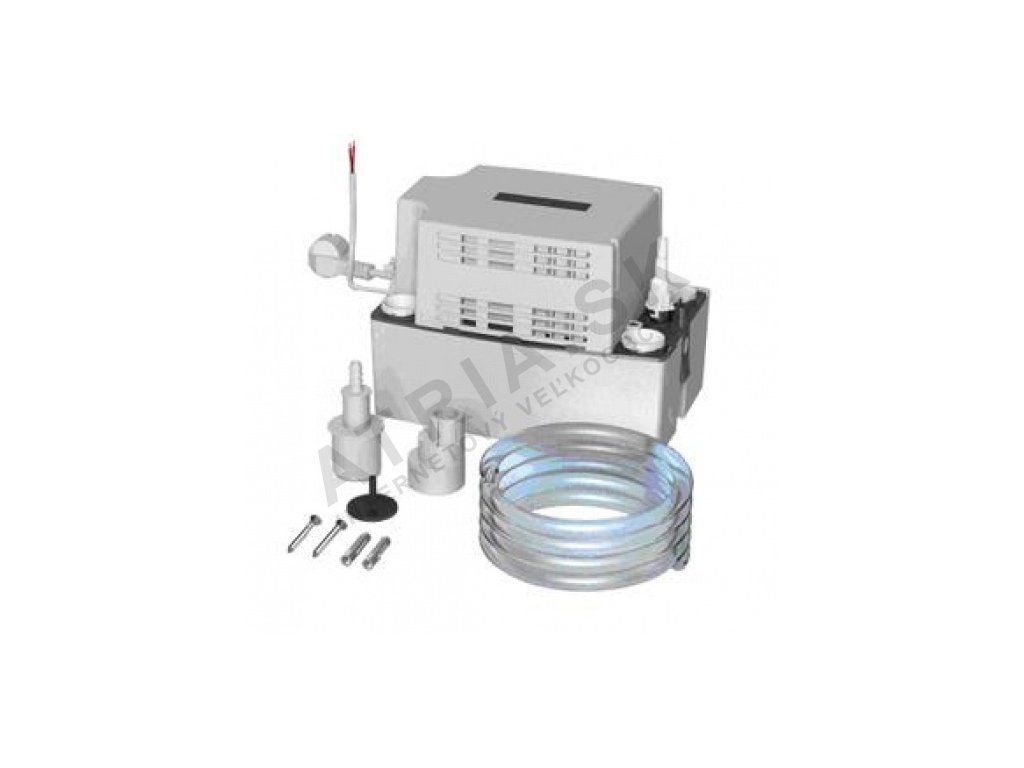 |
GRUNDFOS CONLIFT 1 - a compact condensate pump for draining condensate from condensing boilers, when gravity drainage is not possible. If your "noise" is coming from a small box next to the boiler and not from the circulation pump body on the pipework, this is probably the source of the sound - and it is resolved with a completely different procedure than venting the circuit. Price from €102.34. |
Practical checklist - step-by-step procedure
For a quick overview, we have summarised the whole recommended procedure into a simple diagram - go from top to bottom, and at each step decide whether the problem continues or is resolved:
When to call a service technician and when DIY is enough
Venting, topping up pressure, and checking the speed setting are steps most house owners can handle safely without professional help - this is routine maintenance, not work on live gas or electrical equipment. However, you should contact a service technician in these cases:
The pump is still under warranty - a DIY intervention inside the pump (not routine venting via the designated valve, though) can affect the warranty, so if you suspect a mechanical fault, it is better to contact the retailer or manufacturer.
The pump does not turn at all or just hums without starting up - there is a risk of the motor overheating; in that case switch the pump off immediately and do not let it run "on trial" for more than a few seconds.
You find a water leak from the pump body or from the seal (shaft seal) - this is no longer air or cavitation, but a mechanical leak requiring replacement of the seal or the whole pump.
The system keeps losing pressure even after topping up - this suggests a leak somewhere in the circuit (not necessarily at the pump) that needs to be found and repaired, otherwise the noise and cavitation problem will keep coming back.
You are not sure which pump and version you need as a replacement - an incorrectly sized pump (too powerful for a small circuit) is one of the most common causes of exactly this cavitation and noise, so it is worth getting advice when choosing a replacement, or reading the detailed selection guide we link to below.
Prevention - how to reduce the risk of noise and air ingress in the future
A few simple habits significantly reduce the likelihood of the problem recurring:
Vent the system at the start of every heating season, before the first proper frosty day - especially if the system was shut down over summer or you topped up water during the year.
Check the system pressure and the expansion tank's pre-charge pressure once a year - a pressure drop is often the first sign of a developing leak, which is cheaper to fix before it causes cavitation.
With an electronically controlled pump, let the automatic control do its job - don't tinker with the settings without reason; modern pumps regulate differential pressure themselves according to the system's actual needs.
With hard water or old steel pipework, consider a dirt filter before the pump - it will limit deposits in the impeller and extend bearing lifespan.
When replacing a pump after years of operation, also check the correct sizing - the system may have changed in the meantime (for example radiators replaced with larger ones, an extension, insulation), so the original pump's parameters may no longer be optimal.
Frequently Asked Questions
How often is it normal to vent a pump?
If you vent the system once at the start of the season and the problem doesn't reappear, that is completely normal. If you have to vent repeatedly during the season (once a week or month), it is almost certainly a leak somewhere in the system that needs to be found and fixed, not just repeatedly "treating" the symptom.
Can a noisy pump damage the boiler?
Not the boiler directly, but insufficient water circulation caused by air or a pump fault can lead to local overheating of the heat exchanger in the boiler, which in an extreme case shortens its lifespan. That is why it is worth dealing with a noise problem as soon as possible, not just "putting up with it" for the season.
Is it safe to leave a pump with air in it running until there is time to fix it?
In the short term, yes; long term, it is not recommended - running dry or with interrupted flow increases bearing wear and the risk of overheating. If you notice air in the system, venting is a simple job that takes a few minutes; there is no need to put it off.
How do I know when a pump needs replacing rather than just repairing?
As a rough guide: age over 10-12 years, repeated faults even after servicing, noise despite correct pressure and venting, or simply the fact that spare parts for the old model are no longer readily available. For a classic 3-speed pump, replacing it with an electronically controlled one is worth it almost always - the lower consumption covers the price difference within a few years.
Can cavitation be completely eliminated just by reducing the speed?
In most typical domestic systems, yes - by reducing the speed, or switching to an electronically controlled pump with automatic differential pressure regulation, cavitation disappears in the vast majority of cases. If it persists even at the lowest setting, the system pressure and the condition of the expansion tank need to be checked.
Is it worth buying a pump with backup power (UPS)?
Yes, especially if you live in an area with frequent power outages in winter - backup power keeps water circulating even during a short outage, protecting the system from local overheating or frozen outdoor pipework during frost.
Related topics
How to choose a circulation pump for heating
What pump output and flow rate do I need
Most common circulation pump failures
Electronically controlled vs. classic pump
Have a question on this topic?
Can't decide, or dealing with a specific situation in your household? Write to us - we're happy to help.