
Well Pumps - Which Type and Power to Choose
Well Pumps - Which Type and Power to Choose
If you are deciding between the public water mains and your own well, or you already have a well and need to decide what pump to fit in it, you are facing a decision that will affect the comfort of your household for the next ten to fifteen years. A bad choice means either weak water pressure upstairs, or, conversely, a needlessly oversized and expensive pump that switches on too often and wears out faster. In this article we go step by step through the types of well pumps that exist, how to calculate the required output, what else you need besides the pump itself (pressure tank, switching automatics, check valve), and real-world practical examples you can use to check whether you have made the right choice.
Why the type of well is key when choosing a pump
The first question to ask is not "which pump is best", but "what kind of well do I have". A dug well with an 80-100 cm diameter shaft and a depth of 4-8 metres needs a completely different pump from a drilled well with a 4-6 inch bore (about 100-150 mm) and a depth of 30, 50, or even 80 metres. The difference is not just in the type of pump (submersible vs. surface), but above all in how many metres of vertical distance the pump has to overcome and what flow rate the well (or rather the surrounding rock) can actually provide.
In practice we encounter three basic scenarios:
1. A dug well to a depth of approximately 7-8 metres
Here the water level is close to the surface, so in theory even a self-priming surface pump placed, for example, in the house's utility room should be sufficient. The physical limit of vacuum suction is approximately 10 metres (in practice, because of losses in the pipework and altitude, realistically 7-8 metres), so if the water level is deeper, a surface pump can no longer cope and a submersible pump is needed.
2. A drilled well to a depth of approximately 20 metres
This is a typical case for a family house in the countryside. Here a smaller-diameter (4 inch) submersible pump is almost always used, lowered directly into the bore on a steel cable or on its own discharge pipe.
3. A deep drilled well 20-80 metres (or more)
For greater depths, more powerful multi-stage submersible pumps with a higher head are used, capable of overcoming a large height loss while still delivering sufficient pressurised flow to the house.
The following diagram summarises which type of pump suits which depth category - exactly the same ranges we just described:
Submersible vs. surface pump - what the real difference is
A surface (self-priming) pump sits outside the well, usually in a basement or a separate shaft next to the well, and draws water through a suction pipe with a foot valve at the end (the so-called suction strainer). The advantage is simple servicing - the pump is always "within reach", no need to pull it out of the well in case of a fault. The disadvantage is limited suction height (the 7-8 metres mentioned above) and more noise, since the motor runs outside the water and nothing dampens the noise.
A submersible pump is lowered directly into the water, usually suspended on its own discharge pipe and a safety cable. The motor is cooled by the water flowing around it, so it is practically inaudible and has no theoretical depth limit (it is limited only by the head of the pump itself, i.e. how many metres it can "push" upward). The disadvantage is more demanding servicing - in case of a fault the pump needs to be pulled out of the bore, which at 40-60 metres is neither a simple nor a cheap matter (often a special winch or a service company is needed).
A practical rule we repeatedly confirm in the field: if the water level in the well is permanently deeper than approximately 6-7 metres below ground level, don't even consider a surface pump and go straight for a submersible one - this will save you the later disappointment of a surface pump failing to prime once the level drops in summer.
How to calculate the required pump output
The output of a well pump is not determined by depth alone, but by a combination of three parameters: head (how many metres the water has to travel from the water level to the highest draw-off point in the house, including a pressure margin), the required flow rate (how many litres of water per hour the house actually needs), and losses in the pipework (length and diameter of the pipes, number of elbows and fittings).
Estimating flow rate for a typical household
As a guide: a typical four-person household with one bathroom, a kitchen, and a washing machine needs a peak flow rate (for example in the morning, when the shower and washing machine run at the same time) of approximately 2.5-3.5 m³/h at a pressure of 2-3 bar at the outlet. If the house also has garden irrigation or a pool, you need to allow for a higher peak, easily 4-5 m³/h.
Head
The calculation includes the sum of: the depth of the water level below ground + the height difference between ground level and the highest outlet in the house (for example an upstairs bathroom) + the required residual pressure (commonly calculated as an additional 20-25 m) + friction losses in the pipework (roughly 10-15% of the previous sum). For a 20-metre well and a two-storey house, the actual head the pump needs to be designed for often works out at 45-55 metres, not just the 20 metres of bore depth - this is the most common mistake we see in our advice service: people only count the depth of the well and forget the height of the house and the pressure margin.
The following diagram shows the approximate motor output most commonly paired with each well category from the previous chapter:
Pressure tank and switching automatics
The pump itself is only half of the system. Without a pressure tank (so-called hydrophore), the pump would switch on literally every time a tap is opened, which would wear it out within a few years. The pressure tank acts as a pressure reservoir - inside it has a rubber diaphragm that separates an air cushion from the water, and thanks to this the system holds pressure for a while even after the pump switches off.
The size of the tank is chosen based on the size of the household and the number of outlets:
- 24 litres - cottage, holiday home, 1-2 people, seasonal use
- 50 litres - typical family house, 3-4 people, standard bathroom and kitchen
- 100 litres or more - a house with several bathrooms, garden irrigation, or if you want the pump not to switch on too often, preserving its lifespan
The switching automatics (pressure switch or electronic control module) then decides at what pressure the pump switches on and off - typically a range of 1.5-3.0 bar or 2.0-3.5 bar depending on the height of the house. More modern submersible pumps have this module built directly into the pump head (a so-called plug&play solution), while older systems need a separate pressure switch box.
The whole chain from the well to the tap in the bathroom looks schematically like this:
Additional pump equipment you will probably also need
A well pump is not used in isolation in most households - it is only the first link in a chain of devices that bring water into the house, distribute it in the heating system, and in some cases also drain condensate or wastewater to where gravity is not enough. To be fair, we should say straight away: the following products are not well pumps in the strict sense, but they are equipment that the same household almost always buys at the same time as, or shortly after, dealing with the well - which is why we list them here.
Circulation pumps for distributing heat once the water has reached the house
Once water from the well has filled the system and the house is heated by a boiler or a heat pump, something is needed to distribute the hot water to the radiators or underfloor heating - that is the job of a circulation pump, not a well pump. The electronically controlled DAB EVOSTA2 and EVOPLUS SMALL circulation pumps are exactly the kind of equipment atria.sk offers, complementing the heating system of a house connected to its own well.
 |
SET with fitting DAB.EVOSTA2 40-70/180 + backup power - special offer - when a house is connected to its own well, it is common to have a backup on the heating side too, in case of a power outage - this set includes a circulation pump plus its own UPS backup power, so heating does not stop even during a short power cut (which indirectly affects you too when it comes to well pumps - without electricity, the well pump doesn't run either). Price from 334.84 EUR. |
 |
EVOPLUS SMALL 60/180 M electronic circulation pump for small heating and climate systems - threaded - suitable for smaller family houses, where the heat source is a boiler or heat pump connected to the same water system as the well. Electronic speed control reduces electricity consumption compared to an older classic pump. Price from 625.40 EUR. |
 |
EVOPLUS SMALL 80/180 M electronic circulation pump for small heating and climate systems - threaded - a more powerful variant of the same range, suitable for larger houses or longer heating pipework, where a higher pump head is needed for heating. Price from 704.47 EUR. |
 |
SET without fitting DAB.EVOSTA2 40-70/180 with UPS backup power - special offer - the same circulation pump as above, just in a version without fittings (for flange connection), again with backup power in case of a power outage. Price from 294.05 EUR. |
Pumping condensate and wastewater where gravity cannot reach
Houses connected to their own well often also have to deal with the opposite direction of flow - draining condensate from a condensing boiler, or wastewater from a basement utility room, from where it cannot be drained by gravity into the sewer or septic tank. Small lifting pumps like the GRUNDFOS CONLIFT 1 are used for this.
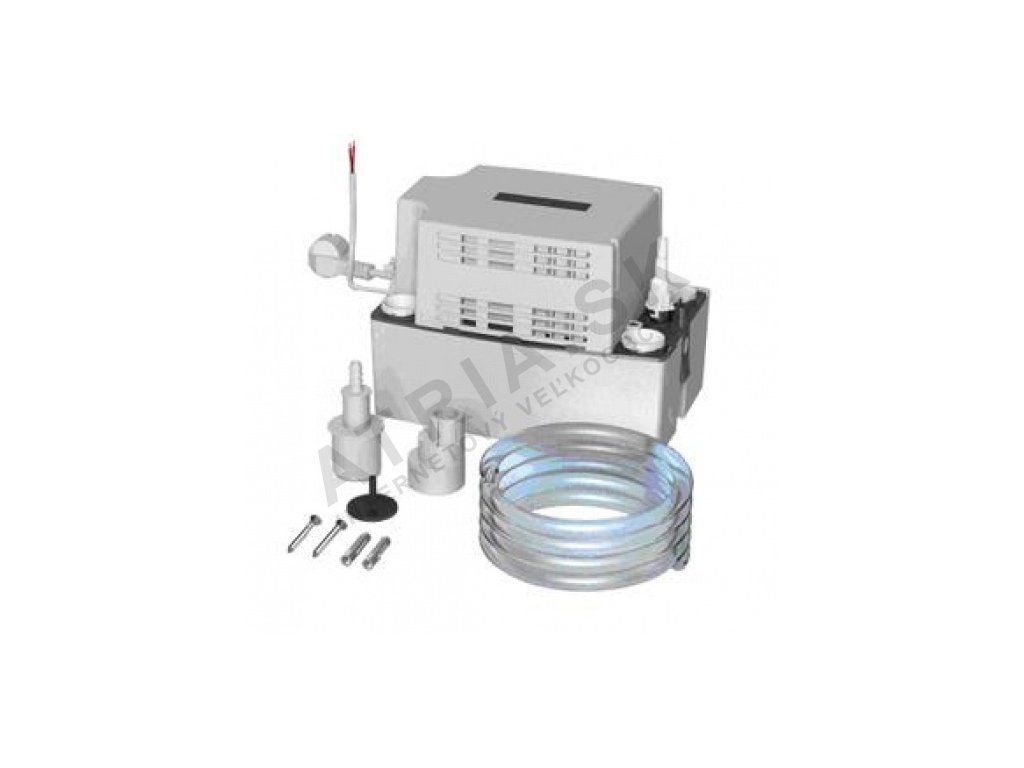 |
GRUNDFOS CONLIFT 1 - a small compact pump for draining condensate from a boiler or minor wastewater (for example from a basement sink), where a gravity connection to the sewer is not possible. A practical addition in houses where the utility room with the well system is located below ground level. Price from 102.34 EUR. |
Practical examples from the field
Example 1 - dug well, single-storey house
Water level 4 metres below ground, single-storey house with one bathroom. In this case a surface self-priming pump with an output of around 0.37-0.55 kW and a smaller 24-50 litre pressure tank is usually sufficient. This is the lowest investment in the whole range, with the simplest servicing.
Example 2 - 18-metre drilled well, two-storey house with 4 people
Here it is clearly a submersible pump, output around 0.75 kW, 50-litre pressure tank, switching at 2-3.5 bar. The actual head for the pump design works out at around 45-50 metres (18 m depth + house height + pressure margin + losses).
Example 3 - 60-metre deep bore, house with garden irrigation
A more powerful submersible pump, 1.1-1.5 kW, 100-litre pressure tank (because of higher demand during irrigation), and consideration of a frequency inverter for very irregular demand (for example when only the kitchen tap is used alternately, and then suddenly the whole garden irrigation system runs at once).
The following overview summarises all three examples side by side, with exactly the figures we just gave:
How to extend the lifespan of a well pump
A few practical recommendations that apply almost universally regardless of the type of well:
- Don't over-size, but don't under-size either. A pump that is too large switches on briefly and often, which stresses the switching elements. One that is too small runs at full output for a long time and wears out faster.
- Never let the pump run dry. Submersible pumps are cooled by the water around the motor - if the level drops below the pump's suction part (for example in a dry summer), the motor overheats and gets damaged. The solution is a float switch or an electronic dry-run sensor.
- Check the pressure tank once a year. The air cushion in the diaphragm tank loses pressure over time, causing the pump to switch on too often. Topping up the air through the valve (similar to a tyre) takes a few minutes.
- Keep an eye on the check valve. If it is worn or leaking, water flows back into the well after the pump switches off, and the pump has to "re-prime" every time it starts again - this shortens its lifespan and extends the time needed to reach pressure.
- For deep bores, consider a frequency inverter. A smooth start-up and speed that literally adapts to actual demand saves mechanical wear on the pump as well as energy.
The most common mistakes when designing a well system
Over the years we have dealt with this topic, a few mistakes keep recurring that we can name in advance and that are easy to avoid.
Mistake No. 1 - counting only the depth of the bore, not the water level
A bore can be 60 metres deep, but the groundwater level might already be at 15 metres - it is this value (not the total bore depth) that determines the choice of pump and the calculation of head. A hydrogeological survey or the drilling company that made the well will tell you this figure.
Mistake No. 2 - underestimating the height difference in the house
For a two-storey house, the head is calculated up to the highest-placed outlet (an upstairs bathroom, or possibly the attic), not up to ground floor level. A difference of a few metres between the ground floor and the second floor shows up noticeably in the total head, especially when a pressure margin also needs to be allowed for a shower head or aerator.
Mistake No. 3 - too small a pressure tank "so it doesn't get in the way"
A smaller tank means the pump switches on more often. With a 24-litre tank in a house for a family of four, the pump can switch on several times a minute when several outlets are used at once - this shortens the lifespan of the motor and the switching contacts far faster than if the tank were correctly sized at 50 or 80 litres.
Mistake No. 4 - choosing a pump by price alone, ignoring the performance curve
Two pumps with the same nominal motor output (for example both 0.75 kW) can have a completely different performance curve - one delivers 3 m³/h at a head of 40 metres, the other only 1.8 m³/h. What matters is the number of impellers (stages) and their diameter, not just the motor's wattage. When choosing, it is therefore always better to look at the flow-vs-head graph (the so-called Q-H curve) given by the manufacturer in the pump's datasheet, rather than just the nameplate output.
Winterising and seasonal operation
For holiday wells and cottages, where the system is not used over winter, it is essential to drain the system before the first frost, or ensure sufficient insulation and heating of the utility room. Water left in the pipework or in the pressure tank expands in volume when it freezes and can rupture the pipework, the pressure tank's diaphragm, and the pump body itself. For year-round occupied houses with a well at a frost-free depth (soil usually stops freezing below 1-1.2 metres), this risk does not apply, but water pipes run through unheated spaces (for example a garage or an extension) still need to be insulated or fitted with a self-regulating heating cable.
Water quality and its effect on pump lifespan
Not all well water is equally "friendly" to a pump. Sandy or muddy water from an inadequately cased well (a missing or damaged filter in the bore casing) causes mechanical wear on the impellers and clogging of the pump - in that case, either additional casing of the well with a filter sleeve helps, or positioning the pump higher above the bottom of the bore so it does not draw in sediment. A high iron and manganese content causes gradual fouling of the pipework and pump with deposits (so-called ochre fouling) - regular inspection helps here, and in worse cases, treating the water by filtration before it enters the house system. Before buying a pump, it is therefore a good idea, if possible, to have at least an approximate water analysis done, or to ask a neighbour with a similar well nearby about their experience.
Electrical connection and safety
Well pumps, especially submersible ones with an output above 0.75 kW, are usually connected via a separate circuit breaker and, in many cases, also via a residual current device. For larger outputs (1.1 kW and above), we recommend always leaving the wiring to a qualified electrician - this is not just about functionality, but also safety, since the pump operates directly in water. The cable leading to a submersible pump must be watertight along its entire length and mechanically resilient, since it is not pulled out for years at a time.
Summary - what not to forget when choosing
Before buying a well pump, prepare the following information: the exact depth of the water level (not the depth of the bore), the height difference between ground level and the highest draw-off point in the house, the number and type of outlets (bathrooms, kitchen, garden), and whether you are planning any future expansion (pool, irrigation, extension). With this information, the head and required flow rate can be calculated precisely, allowing you to choose a pump that will serve reliably without unnecessary oversizing. If in doubt, it is always better to ask for advice in advance than to find out after a month that the pump can't keep up or switches on too often.
Frequently Asked Questions
What is the difference between a well submersible pump and a bore (deep-well) submersible pump?
In principle it is the same type of device (a submersible pump); the difference is mainly in diameter (smaller 4" pumps for narrower bores) and in the power range - deep-well bore pumps tend to be multi-stage with a higher head for depths above 20-30 metres.
Can I use a surface pump even for a deeper well if I buy a more powerful motor?
No, the motor doesn't change anything when it comes to suction - the physical limit of suction is set by atmospheric pressure (theoretically 10 m, practically 7-8 m), and no motor output can overcome it. For a deeper water level, the only working solution is a submersible pump directly in the water.
How often does a submersible well pump need servicing?
In normal operation in a family house, a visual check of the pressure tank and switching automatics is recommended once a year; the submersible pump itself is only pulled out for inspection when output drops or a fault occurs - with trouble-free operation this can be as long as 8-10 years without intervention.
What happens if the well "runs dry" in summer or the water level drops significantly?
If the pump is left without a sufficient supply of water, there is a risk of it running dry and damaging the motor. The solution is to install a float switch or electronic dry-run protection, which automatically switches the pump off before damage occurs, and switches it back on once the level recovers.
Do I also need a frequency inverter with a well pump?
It is not essential for a typical household with stable demand, but for irregular consumption (alternating between a tap and garden irrigation) or for deep bores, a frequency inverter significantly extends pump lifespan and saves electricity thanks to smooth speed regulation instead of hard on/off switching.
Can heating and a boiler also be connected to a well system?
Yes, water supplied by a submersible pump is commonly also used to top up and operate a heating circuit - in that case, however, a separate circulation pump is used to distribute the heat within the house, not the well pump, as described above.
Related topics
- How to choose a circulation pump for heating
- What pump output and flow rate do I need
- Comparison of circulation pump brands
- Circulation pump installation and replacement
Back to the main category: Pumps for heating and water
Have a question on this topic?
Can't decide, or dealing with a specific situation in your household? Write to us - we're happy to help.