
Comparing Brands of Professional Heating Equipment
Comparing brands of professional heating equipment
When an installation company or building manager selects components for a professional heating system, they choose between dozens of brands that at first glance look almost the same - manifolds in similar cabinets, valves with similar parameters, fittings with the same threads. The difference only shows up after years of operation: in how long the seal holds, how easily a spare part can be sourced, how precisely the installation dimension fits the prepared installation, and how much a service intervention costs when something breaks three years after final approval. This article looks at comparing brands of professional heating equipment not from the point of view of manufacturers' marketing materials, but from the point of view of the practical criteria that decide real projects - apartment buildings, industrial halls, agricultural facilities, or larger office buildings.
Professional heating equipment differs from an ordinary domestic installation in both scale and requirements. Whereas a family house has one boiler and a few circuits, a professional installation handles dozens of branches, multiple heat sources, precise hydraulic balancing, and often also the requirements of inspection technicians or insurers for certified components. That is exactly why it's worth spending more time comparing brands than is usually devoted to simpler installations.
Why brand choice matters in professional installations
In a domestic installation, an error in component choice at worst results in replacing one part for a few euros. In a professional installation with dozens of branches and hundreds of metres of pipework, the cost of a mistake is completely different - a low-quality manifold or a leaking valve in concealed pipework means breaking open plaster, interrupting building operation, and losing the investor's trust. That is why, for larger projects, it pays to compare brands according to four basic criteria:
1. Material quality and workmanship
Valve and manifold bodies made of brass with a higher copper content resist corrosion and limescale deposits better. Cheaper alternatives often use thinner walls or lower-quality seals, which only shows up after several years of operation - exactly when the repair is most expensive, because the component is already built into a wall or concealed in a technical room without easy access.
2. Availability of spare parts and service
A brand with a regular distributor in Slovakia allows quick replacement of a seal, cartridge, or the whole valve within a few days. For niche or imported brands without local representation, a service technician may end up waiting weeks for a part from abroad - which is unacceptable for an operational building.
3. Dimensional and thread compatibility
Professional pipework is often built and expanded gradually, sometimes years apart. If the first stage chooses a manifold or fitting with a non-standard spacing, the second stage may not connect well to the existing system. Brands with established, industry-standard dimensions (typically 50 mm spacing for manifolds) make future expansion easier.
4. Certifications and standards compliance
For professional projects (especially public buildings, industry), the inspection technician often requires certificates of conformity, pressure test reports, and certification under current standards. Not every brand has this documentation ready in Slovak or in an easily accessible form, which can delay final approval.
Manifolds and manifold cabinets - comparing the N-MAX and N-KLASIK ranges
Manifold cabinets are a fundamental building block of every larger heating or water installation with multiple branches. In the atria.sk range we commonly come across two comparable ranges - N-MAX and N-KLASIK - which differ mainly in cabinet width (and therefore branch capacity) and price. When choosing the correct cabinet size, it is key to know in advance how many branches the manifold will serve, because enlarging the cabinet later, after it has been built in, is practically impossible without demolition work.
The N-MAX range offers several sizes, from the smallest (450 mm) up to larger versions with a length of 1250 mm for installations with a higher number of circuits. The N-KLASIK range is designed as an alternative with a slightly different price-to-size ratio, suitable especially where a smaller number of branches needs to be served without an unnecessarily large cabinet.
 |
N-MAX 1 wall-mounted manifold cabinet - 450mm - the smallest version in the N-MAX range, suitable for smaller facilities or flats with a limited number of heating circuits, where a compact cabinet without an unnecessary space margin is enough. Price from 132.84 EUR. |
 |
N-MAX 5 wall-mounted manifold cabinet - 1250mm - the largest version in the range, intended for professional installations with a higher number of branches, typically apartment buildings or larger operational halls, where multiple separate circuits need to be served from one location. Price from 204.67 EUR. |
 |
N-KLASIK 2 wall-mounted manifold cabinet - 530mm - a medium size from the alternative N-KLASIK range, a good-value alternative to N-MAX at a comparable internal capacity, suitable especially if the project doesn't require the exact dimensions of the N-MAX range. Price from 114.14 EUR. |
Comparing price to size, it's interesting that the N-KLASIK 2 (530 mm) works out cheaper than the smallest N-MAX 1 (450 mm), despite the larger cabinet width. This is a typical example of a situation where it doesn't pay to go by the range designation alone, but to actually compare price, internal space, and compatibility with the planned manifold.
Procedure for selecting components in a professional project
Experienced designers and installation companies follow an established sequence of steps when designing a professional installation. Skipping one of them is the most common cause of additional adjustments during installation:
The step "ensuring air venting of the system" is often underestimated in practice, yet incorrect or missing venting is one of the most common causes of complaints for larger systems - air bubbles cause noise, reduce heating efficiency, and in hydraulically more complex systems with multiple branches can cause uneven heating of individual circuits.
Air vent valves - automatic versus manual solution
In professional installations, two types of air vent valves are commonly combined - automatic and manual. The choice between them is not a question of "better/worse", but of suitable placement in the system.
Automatic air vent valve
The automatic valve is fitted at the highest points of the pipework, where air naturally collects (most often on top of the manifold or on the highest risers). An internal float opens the valve when air accumulates and closes itself once it has escaped - without needing operator intervention. This is especially advantageous for pipework that isn't normally accessible (for example concealed in a ceiling void or technical shaft).
Manual air vent valve
A manual valve requires physical intervention - opening it with a key or screwdriver when the operator judges that there is air in the system (typically when a radiator's output drops or gurgling is heard). It is cheaper and simpler, so it is often fitted at points with normal access, for example directly on radiators or on smaller branches, where a regular manual check can be carried out without difficulty.
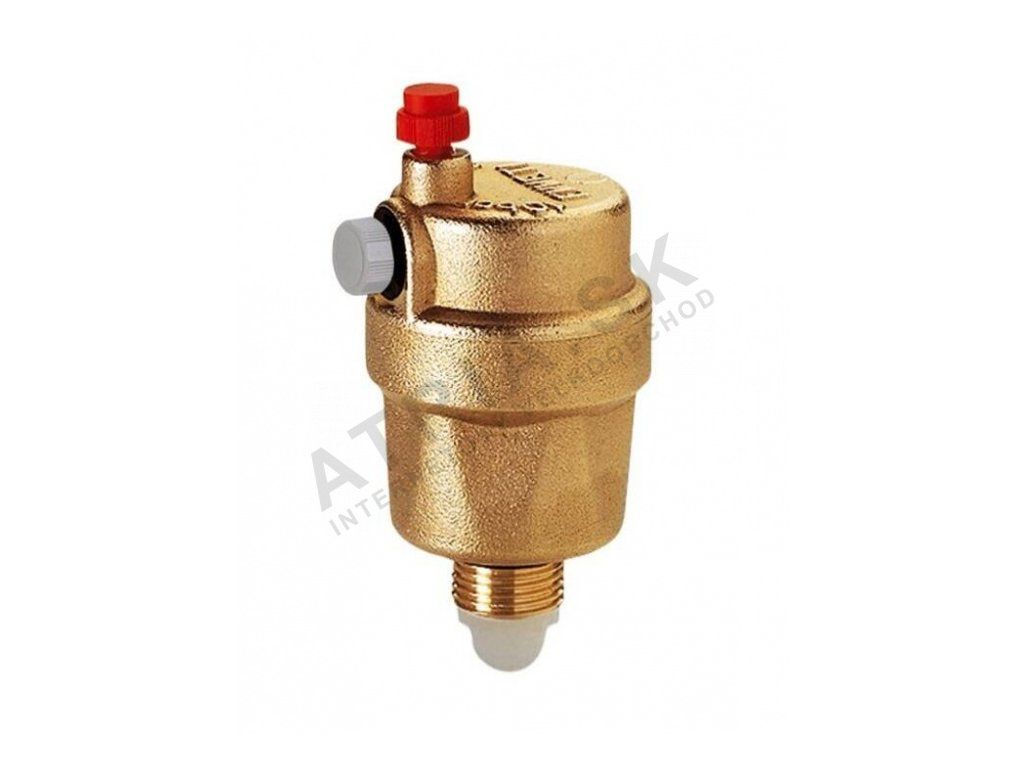 |
Automatic air vent valve - 1/2" - suitable for the highest, harder-to-reach points of the manifold or risers, works independently without operator intervention. Price from 12.01 EUR. |
 |
Manual air vent valve - 1/2" - a cheaper alternative for points with normal access, for example directly on radiators or smaller branches of the pipework. Price from 2.10 EUR. |
The price difference between an automatic (12.01 €) and a manual (2.10 €) valve is significant - roughly sixfold. With a larger number of branches, some installation companies therefore combine both types: automatic valve at the main, harder-to-reach points, and manual on individual radiators, saving money without losing functionality.
The sixfold price difference between a manual and an automatic air vent valve shows why it pays to combine both types depending on the installation location - automatic only where it's really needed, manual everywhere there is normal access.
Shut-off elements and fittings in professional pipework
Besides manifolds and venting, every professional pipework system also includes a set of shut-off fittings - ball valves that allow individual branches to be isolated during servicing or a fault without having to drain the whole system. The quality of a ball valve shows up especially over long-term use - cheap versions tend to "seize up" or leak after years, exactly at the point where they should work reliably for an emergency shut-off.
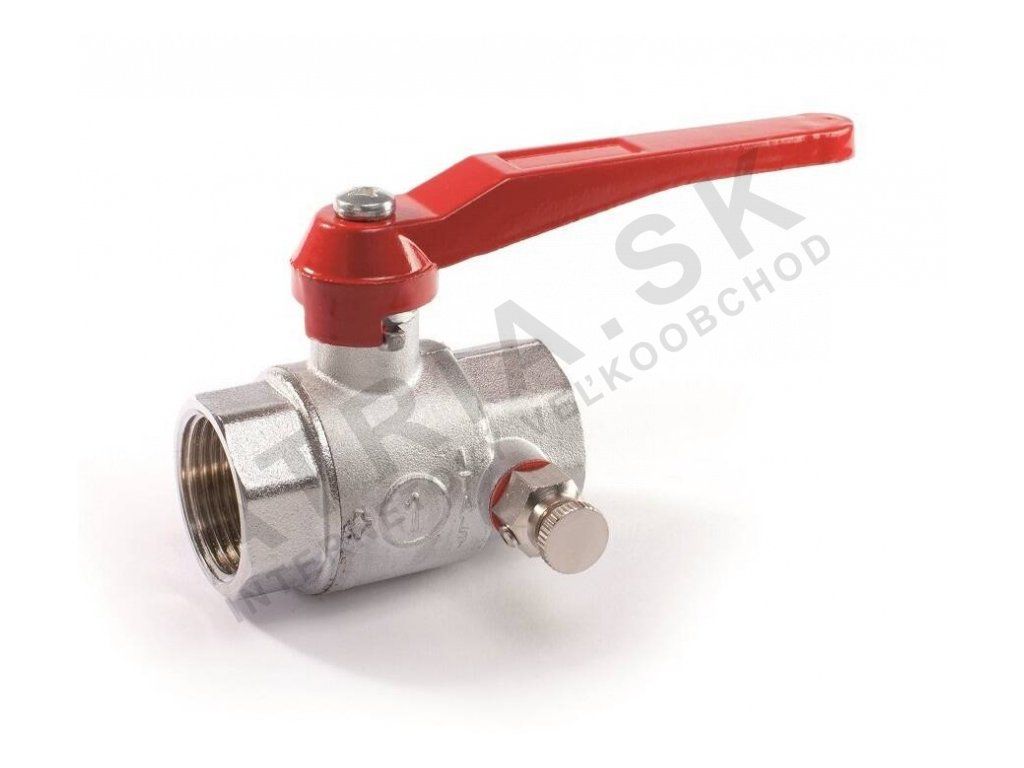 |
Ball valve for water - with drain - 1/2"FF; lever - a practical solution for individual pipework branches, the integrated drain allows a specific branch to be drained during servicing without having to shut down the whole system. Price from 14.86 EUR. |
The combination of a ball valve with drain and a manifold cabinet is a typical example of why it pays to plan component selection together - if the manifold is meant to allow individual branches to be isolated, fittings with drain capability need to be ready too, not just ordinary shut-off valves.
Brands we most often encounter on professional projects
On the Slovak market for professional heating equipment, a handful of brands keep coming up that have built a reputation with installation companies over the years. The following overview is not a "best/worst" ranking, but rather a description of why individual companies choose these brands for specific types of projects.
Brands focused on pipework and fittings
Manufacturers focused on manifolds, valves and fittings (typically of Italian or Central European origin) have established themselves on the market mainly thanks to a wide range of dimensions, allowing components from different ranges to be combined without compatibility problems. Installation companies especially appreciate that spare parts (seals, cartridges, floats for air vent valves) are commonly available separately, so the whole component doesn't have to be replaced for a minor fault.
Brands focused on control and metering
In professional systems with multiple zones, mechanical fittings are increasingly combined with electronic controls - remote-controlled thermostatic heads, motorized valves, or heat meters for apartment buildings with cost allocation. Here, brand choice is also tied to the question of software compatibility and the availability of a service technician trained on the specific system.
Brands focused on tanks and heat exchangers
For larger installations with a central heat source (boiler room, heat exchanger station), the brand of tank or plate heat exchanger is chosen mainly according to pressure rating, volume, and the possibility of future capacity expansion. Here the difference between brands often lies in whether they offer modular solutions (the option to add another tank to the existing system) or only closed units with no option for expansion.
When choosing a specific brand for a given project, it's worth asking three practical questions: Does this brand have a local distributor who keeps spare parts in stock? Is it already used by other companies in the region, from whom a reference can be obtained? And does the documentation (installation manual, certificates) meet the requirements the inspection technician will require at final approval?
Practical installation experience - what most often gets sorted out on site
In real projects, a handful of situations keep recurring that determine whether installation goes smoothly or brings additional costs:
Incorrectly estimated number of branches
If a designer or installation company underestimates the number of future circuits (for example in an apartment building where underfloor heating is later added in one of the units), the built-in manifold cabinet doesn't have enough capacity. The solution is either to fit a larger cabinet with a margin right from the start (for example N-MAX 5 instead of N-MAX 1, even at the cost of a higher initial investment of 204.67 € versus 132.84 €), or to plan a second, supplementary cabinet next to the first one - which is a less suitable solution architecturally and aesthetically.
Underestimating venting in multi-storey buildings
In multi-storey buildings, air collects mainly at the highest points of every riser. If only a single central venting point on the manifold in the basement is planned, the system can have a long-term problem with noise and uneven heating on the upper floors. Experienced companies therefore fit automatic air vent valves on every riser separately, not just on the central manifold.
Missing options for isolating individual branches
During a service intervention on one branch (for example replacing underfloor heating in one flat of an apartment building), it's inconvenient if the whole system has to be shut down because the individual branches have no shut-off fittings of their own. Investing in ball valves with drain on every branch (14.86 € apiece) pays off at the very first service intervention, when the whole pipework doesn't have to be drained and refilled.
Underestimating future system expansion
In industrial halls or agricultural facilities, the system is often expanded gradually as operations grow. Choosing a brand with established, commonly available dimensions (for example 50 mm spacing on manifold connections) makes it easier to add another branch later without having to replace the whole manifold with a different type.
Summary - how to approach comparing brands
Comparing brands of professional heating equipment shouldn't be done based on the initial component price alone. Four factors we've covered above are decisive - material quality, availability of service and spare parts, dimensional compatibility with future expansion, and certification documentation for the inspection technician. With manifold cabinets, we saw that the difference between the N-MAX and N-KLASIK ranges isn't just in the name, but really in the price-to-capacity ratio (114.14 € to 204.67 € depending on size). With air vent valves, the choice between automatic (12.01 €) and manual (2.10 €) type is a question of placement in the system, not just price. And with fittings with drain (14.86 €), the investment pays off at the very first service intervention.
For installation companies and investors planning a larger professional project, the safest approach is to proceed systematically - first map out the exact number of branches and future expansions, then choose a suitable manifold cabinet size with a margin, add a combination of automatic and manual air vent valves according to the accessibility of individual points in the system, and finally ensure the option to isolate each branch separately with quality shut-off fittings.
Frequently asked questions
What is the difference between the N-MAX and N-KLASIK manifold ranges?
Both ranges perform the same basic function - splitting the main circuit into multiple separate branches in a clear cabinet. They differ mainly in the price-to-cabinet-size ratio and in the specific dimensions of individual sizes. When choosing, it's worth comparing the specific size the project needs, not just the range name - for example the N-KLASIK 2 (530 mm, 114.14 €) can work out better value than the smallest N-MAX 1 (450 mm, 132.84 €) despite having more internal space.
Do I need both an automatic and a manual air vent valve at the same time in a professional installation?
For most professional pipework systems, yes - combining both types is common and proven practice. The automatic valve is fitted at the highest, harder-to-reach points (top of the manifold, risers), the manual valve at points with normal access, typically directly on radiators, where the cheaper alternative is sufficient.
Why is it important to have a separate shut-off valve on every branch?
Without a separate shut-off valve on every branch, any service intervention (replacing a radiator, fixing a leak) requires shutting down and draining the whole system, meaning heating is interrupted on all branches at once. A ball valve with drain allows only the specific problem branch to be drained and isolated, while the rest of the system keeps running without interruption.
How large a manifold cabinet should I choose if I don't know the exact future number of branches?
In most cases it pays to choose a cabinet one size larger than the project currently needs, especially if future expansion is anticipated (for example an extension, a change in flat layout, adding underfloor heating). Modifying a built-in cabinet later is significantly more expensive and complicated than a slightly higher initial investment in a larger size.
Can a manifold from one brand be combined with fittings from another brand?
In most cases yes, as long as the thread and connection dimensions match (most commonly 1/2" or 3/4" for smaller pipework). However, it is recommended to verify compatibility in advance, especially for specialized components with a non-standard spacing, or for systems requiring a certified assembly as a whole for inspection documentation.
How often do these components need to be checked and serviced in professional operation?
It is recommended to check the functionality of the air vent valves at least once a year (especially automatic ones, where the float can become clogged with impurities over time), and to check the tightness of the shut-off fittings on individual branches once every few years, especially if they haven't been used for a long time. In professional facilities with regular boiler room inspections, this check is usually included directly in the planned service inspection.
Related topics
How to choose professional heating components
Differences between a domestic and a professional heating system
Installation of professional heating systems
Maintenance and servicing of professional heating equipment
You will find the complete range of professional heating components in the main category Professional Heating.
Do you have a question on this topic?
Not sure what to decide, or dealing with a specific situation in your home? Write to us - we're happy to help.