
Frequently Asked Questions for Installation Companies and Heating Engineers
Why installation companies deal with different questions than a regular customer
When a household buys a heating system, they usually focus on boiler output, brand and price. An installation company or a tradesperson with a business ID has a completely different perspective – what matters is the availability of goods in stock at the moment the construction is underway, the option to order a larger quantity at once, invoicing to the company, technical support in non-standard situations on site, and a warranty they can defend to their own customer. That is why we have collected in one place the questions that installation companies and plumbers/heating engineers ask us most often – by phone, email and directly in the shop. This article is part of the Professional Heating section, where you will also find a wider range of components intended directly for professional installation.
The text is not just theoretical – it is based on real situations that keep recurring when designing manifolds, choosing air vent valves, shut-off fittings, and in everyday communication around orders. If your question is missing from the list below, the fastest way to get it answered is directly through the form at the end of the article – we will answer specifically for your situation, not just in general terms.
Questions on selecting and ordering components
Which manifold and which cabinet should I choose based on the number of circuits?
This is probably the most common question we deal with together with installation companies for both underfloor and radiator heating. The answer is not just about the number of circuits, but also about how much space you actually have in the installation shaft or partition wall, and whether you are planning for future expansion (for example adding another room or replacing the heat source).
In practice we distinguish three typical situations:
- Smaller flat or small family house with 1–3 circuits – a compact cabinet is enough here, such as the N-MAX 1 wall-mounted manifold cabinet with a width of 450 mm.
- Medium-sized family house, 3–4 circuits, possibly a combination of underfloor and radiator heating – the N-KLASIK 2 wall-mounted manifold cabinet with a width of 530 mm has proven itself here, giving a bit more room for handling the manifold and the fittings around it.
- Larger house, multiple floors or multiple zones (e.g. a separate zone for the upper floor and ground floor) – here we recommend planning straight away with a wider cabinet, typically the N-MAX 5 wall-mounted manifold cabinet with a width of 1250 mm, because expanding the cabinet later after it has been built in or plastered over is practically impossible.
The difference in width between the individual variants is significant, which is exactly why it pays to think through the size before the shell construction stage, not only at the point of installing the manifold:
When choosing, also think about the depth of the cabinet and the option of installing control heads directly on the manifold – if you plan to use room thermostats with actuators, you need physically more space in the cabinet for cabling than with purely manual flow adjustment.
 |
N-MAX 1 wall-mounted manifold cabinet - 450mm - a compact size suitable for smaller flats and houses with 1-3 circuits, where there is no room for a larger cabinet. Price from 132.84 EUR. |
 |
N-KLASIK 2 wall-mounted manifold cabinet - 530mm - a medium size, proven for combinations of underfloor and radiator heating with 3-4 circuits. Price from 114.14 EUR. |
 |
N-MAX 5 wall-mounted manifold cabinet - 1250mm - the widest variant for larger houses with multiple zones, where future system expansion is also taken into account. Price from 204.67 EUR. |
Can I order in larger quantities and with an invoice made out to a company?
Yes, this is a standard request and we can handle it without any problem. If you work regularly on multiple projects, we recommend registering with us as a business customer – we can then process repeat orders faster and keep a purchase history under a single contact, which greatly simplifies any complaints or documenting the origin of materials at final building inspection. Specific commercial terms for larger orders (volume discounts, invoice due date, delivery method) should be agreed directly with our sales team via the form below or by phone – we are happy to prepare an offer tailored to a specific project, not just an indicative price list.
What is the difference between an automatic and a manual air vent valve, and when should each be used?
This is a question where we can save installation companies real money and time on site, if they decide correctly already at the design stage. An automatic air vent valve is installed in places you can no longer reach once the ceiling or pipe cladding is closed up – the highest points of the system, the top of manifolds, circulation pumps with an integrated air vent, and similar locations. Air is released from it automatically, without operator intervention, which is exactly what you need for concealed pipework.
A manual air vent valve (often also called a "bleed valve") is, on the other hand, installed where access is guaranteed even after the construction is finished – typically on radiators or at accessible points of the manifold, where the end user or service technician can occasionally bleed the system themselves with a key or screwdriver.
The price difference between the two types is significant, which makes sense – the automatic valve contains a float mechanism and is designed for permanent, unattended operation:
In practice this means: on a single manifold we often combine both types – an automatic valve at the top, where air naturally collects and which becomes inaccessible once the cover is fitted, and a manual valve or test cock at points that remain accessible for routine servicing.
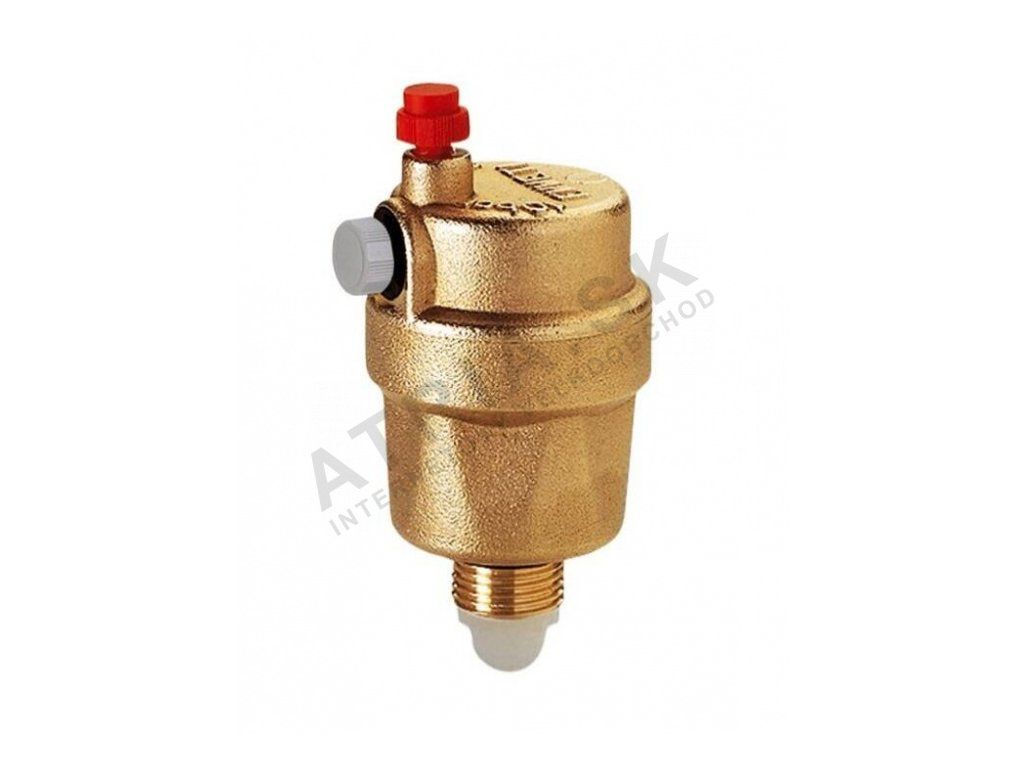 |
Automatic air vent valve - 1/2" - ideal for concealed points in the system where there is no repeated access after the construction is finished. Price from 12.01 EUR. |
 |
Manual air vent valve - 1/2" - a cheaper variant for accessible locations, where bleeding is occasionally carried out by a service technician or the user. Price from 2.10 EUR. |
Where should a ball valve with drain be located in the system, and why do companies often underestimate it?
Unfortunately, this is a question we often only get at the point when the system needs to be drained for servicing or replacing a component, and the company discovers that it has no shut-off fitting with drain capability anywhere along the line. A ball valve with drain belongs on both the inlet and outlet of every separately isolatable section – typically before and after the manifold, before the boiler, and before the domestic hot water tank. Thanks to the side drain cock, you can shut off the given section and then drain it without having to drain the entire system, which on larger installations saves dozens of litres of water as well as the time needed to refill and re-vent the system.
We recommend drawing this fitting into the project already at the design stage, not adding it later – additional installation almost always means cutting into pipework that has already been insulated.
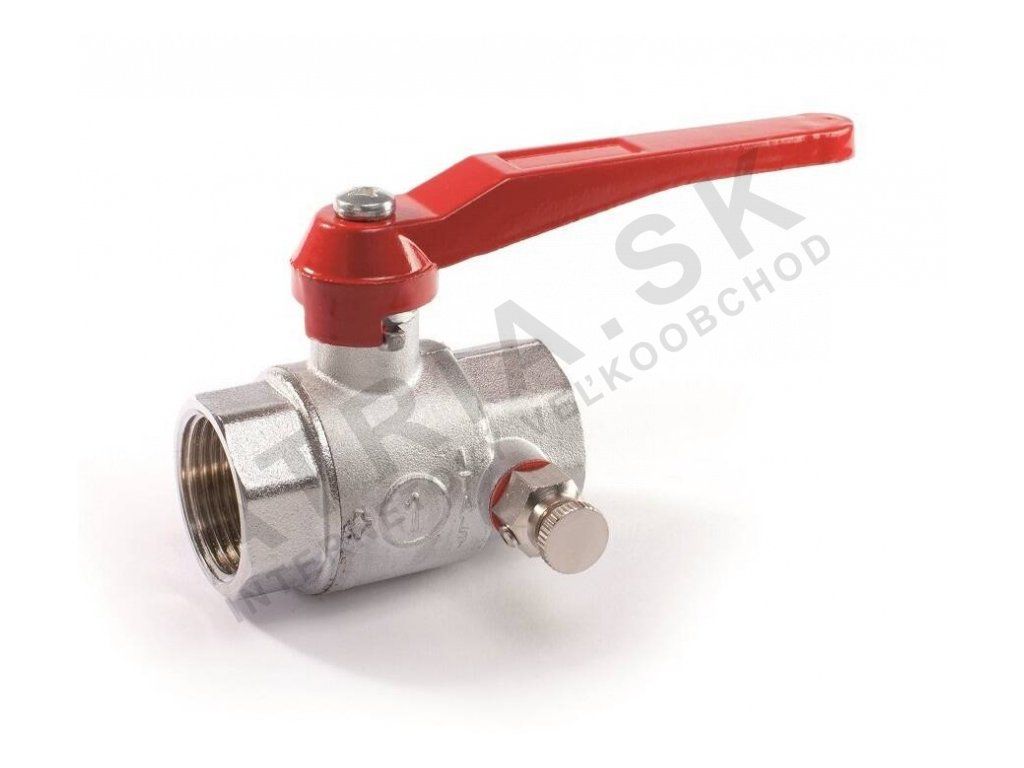 |
Ball valve for water - with drain - 1/2" FF; lever - allows only a specific section of the system to be drained without having to drain the entire circuit. Price from 14.86 EUR. |
Questions on cooperation, orders and delivery times
How quickly will I get a price quote, and how long does delivery to the site take?
With professional orders we know that time is often the deciding factor – a construction schedule cannot simply be pushed back a week if a supplier is late. That is why we try to keep a simple and predictable process, from the first inquiry all the way to installation:
The exact delivery date always depends on the current availability of the specific item – for common components such as manifold cabinets, valves or fittings, goods are usually in stock, while for specific sizes or larger quantities we recommend ordering well in advance of the planned installation date, so that you do not have to deal with waiting directly on site.
What if I need the goods urgently because the construction schedule has shifted?
This happens more often than we would like – a date change on the part of the construction company, an additionally discovered error in the project, or simply bad weather that has pushed back the shell construction. In such a case we recommend contacting us directly by phone or via the form with a clear description of exactly what and by when you need it – we can check the current stock situation and tell you realistically whether the deadline can be met, or suggest an equivalent alternative that is available sooner.
Can unused material be returned if the project has changed in the meantime?
Yes, for unused and undamaged goods in their original packaging, the standard return conditions apply, the same as for a regular purchase. For business orders we recommend discussing the situation with us in advance – especially if it concerns a larger quantity or items ordered specifically to measure for a particular project, where it is better to agree individually rather than order goods "just to be safe" in excess quantities.
Questions on installation, standards and technical support
Where can I find technical data sheets and installation instructions for components?
For every product in the e-shop you will find the available technical documentation supplied by the manufacturer in the product detail. If an installation manual or data sheet for a given item is missing, or if you need additional data (for example flow characteristics, material sheets for final building inspection, or certificates), we are happy to find them and send them directly to your email – just write to us via the form below with the exact product name.
Who is responsible for correct installation – the component supplier, or the installation company?
This is important to clarify right at the start of cooperation, so there is no misunderstanding in the event of a complaint. As the supplier, we are responsible for the delivered component matching its declared parameters and being free of manufacturing defects. Responsibility for the correct design of the system (sizing, placement of elements, pipe fall, choice of suitable materials for a given type of distribution) and for professional installation in accordance with the installation manual lies with the installation company or the heating engineer carrying out the work.
A typical scheme we see when installing a manifold with shut-off and air-vent fittings looks like this:
When handing over the work, we recommend that installation companies photograph the wiring before it is covered up and keep the photo documentation together with the proof of purchase of the components – in the event of any complaint in the future (even after years), this significantly simplifies the whole process.
How do we handle a complaint when a defect in a component is only discovered by the end customer years later?
This also happens in practice – the installation company hands over the work, the system runs without problems for several years, and then a leak or fault appears on a specific element, for example on a fitting or valve. In such a case, the fastest way is for the installation company itself (as the original buyer) to contact us directly with the invoice or order number – this way we can clearly verify the origin of the goods and the warranty terms. If the company does not have the invoice to hand, we can also help if we can trace the order by name, date, or company number in our system. We therefore recommend keeping a simple internal record of which components each site received, precisely for situations like this that may arise years later.
Practical observations from everyday operation
Over the years of working with installation companies and heating engineers, we have noticed several recurring situations that can be easily avoided already at the design stage:
- Undersized manifold cabinet. The company chooses the cheapest, narrowest variant, and during installation discovers that the manifold with heads and cabling physically does not fit. It pays to allow a margin, especially if additional controls are planned in the future.
- Missing shut-off valve with drain. During the first servicing or component replacement, it turns out that only part of the system cannot be drained and the entire circuit has to be drained – an unnecessary loss of water, chemicals in the system, and time.
- Mixing up automatic and manual air vent valves. An automatic valve installed in an accessible location is an unnecessarily expensive solution where a cheaper manual type would suffice; conversely, a manual valve in an inaccessible location means the air in the system is never properly vented.
- Last-minute ordering with no margin for delivery time. Even normally in-stock goods are worth ordering with a slight lead time before the planned installation, especially when it involves a larger quantity of pieces at once.
These points are not made-up scenarios – they are recurring patterns we see across various projects, from flats to family houses with multiple heating zones.
Related topics
How to choose professional heating components
Installation of professional heating systems
Maintenance and servicing of professional heating equipment
How to choose a supplier and installation company
You will find the complete range for installation companies in the main category Professional Heating.
Do you have a question on this topic?
Not sure what to decide, or dealing with a specific situation in your home? Write to us - we're happy to help.