
How to Choose Professional Heating Components
When someone says "professional heating components", most people picture mainly the boiler or heat pump itself. In practice, however, the reliability and lifespan of the whole heating system is largely built on the so-called small, "boring" elements - manifolds, shut-off fittings, air vent valves, filters, and the cabinets everything is housed in. It is precisely these components that determine whether a system will be maintenance-free and quiet in real operation, or whether the installation company will be coming back a few months later over a complaint. In this article we look at how to choose professional components - what to actually look at when choosing, which parameters are key, and where it pays to invest a bit more, even if it looks like an unnecessary extra cost at first glance.
The article is intended primarily for installation companies, designers, and operators of larger buildings (apartment buildings, facilities, office buildings), but will serve just as well for a more experienced homeowner having a larger heating renovation done, who wants to know what to discuss with the contractor.
What exactly distinguishes professional components from ordinary domestic ones
The difference between a "domestic" and a "professional" component isn't just a marketing label. In practice it comes down to three specific, measurable things:
1. Material and workmanship
Professional fittings (ball valves, manifolds, valves) are almost always made of CW617N brass or stainless steel, with a precisely defined wall thickness and pressure class (PN10, PN16, PN25). Cheaper domestic alternatives tend to be made of thin-walled brass or galvanized steel, which gradually corrodes from the inside with long-term contact with heating water (especially at the higher pH commonly used in systems with corrosion inhibitors). In practice this means that while a quality ball valve lasts 15-20 years without major intervention, a cheap substitute can start leaking after just 3-5 years.
2. Sealing and repeated operation
Professional components are designed for repeated opening and closing without loss of tightness - a lifespan of thousands of cycles is typically stated. This matters especially for manifolds and shut-off valves on individual circuits, which are opened and closed repeatedly during servicing or seasonal system adjustment. Domestic versions are often designed on the assumption that they'll be set once at installation and not touched again.
3. Documentation, certification, and spare parts availability
Professional ranges usually come with an issued declaration of conformity, a data sheet with precise flow and pressure characteristics (Kvs values, pressure losses at a given flow), and above all - long-term availability of spare parts (seals, cartridges, heads). For a larger installation that will be serviced for years, this is often a more important criterion than the purchase price itself.
Below is a simple diagram summarizing the recommended procedure for choosing professional components for a specific project - from the brief all the way to the actual order.
Manifolds and manifold cabinets - the heart of both underfloor and radiator pipework
The manifold is where a single central circuit from the boiler or heat pump splits into individual branches - to radiators, underfloor circuits, or other appliances. In professional installations (flats, family houses with multiple zones, commercial spaces), it is practically always necessary to place the manifold in a separate cabinet - partly for aesthetic reasons (concealing pipework and fittings), and partly for protection against mechanical damage and any water leaks.
Several parameters are key when choosing a manifold cabinet:
- Number of outputs/circuits - this determines the cabinet width. The more circuits, the wider cabinet needed, because enough space needs to be allowed for installation, servicing, and future modifications.
- Cabinet depth - must match the thickness of the wall/partition (wall-mounted vs. recessed version), while also providing enough space for the manifold itself and the fittings on it.
- Door material and surface finish - painted sheet metal, the possibility of ceramic tiling for a recessed version, and similar.
At atria.sk we offer a whole range of N-MAX and N-KLASIK wall-mounted manifold cabinets, which differ precisely in the number of outputs and width. As a specific example - the cabinet for 1 output is 450 mm wide, while the version for 5 outputs already needs 1250 mm of width. That is practically a threefold increase in width when going from one circuit to five, which is good to keep in mind already when designing the technical room or determining the position of the installation partition wall - it often happens that a designer plans for a small cabinet, but once the actual number of zones is calculated (for example 4-5 underfloor circuits plus 2 radiator branches), it turns out a considerably larger cabinet is needed than originally planned.
 |
N-MAX 1 wall-mounted manifold cabinet - 450mm - suitable for simpler installations with a single manifold circuit, for example a smaller flat or a separate underfloor heating zone. Compact dimensions allow installation even in smaller technical spaces. Price from 132.84 EUR. |
 |
N-KLASIK 2 wall-mounted manifold cabinet - 530mm - medium size for two separate circuits, typically used for a combination of radiator and underfloor heating in a smaller family house. Price from 114.14 EUR. |
 |
N-MAX 5 wall-mounted manifold cabinet - 1250mm - the largest variant in the range, suitable for larger installations with five separate circuits, for example a larger family house with multiple heating zones or a smaller apartment building. Price from 204.67 EUR. |
The following chart compares the actual width of the three cabinets above depending on the number of outputs - it clearly shows that the relationship between the number of circuits and the required cabinet width is not linear, but grows more steeply with a higher number of outputs, since space also needs to be allowed for fittings and handling.
A practical note from the field: when ordering a cabinet, it always pays to allow for one or two spare positions, even if the current project calls for exactly that number of circuits. Clients very often buy an extra heating zone after a few years (for example glazing in a terrace, converting a garage into living space), and without a margin in the cabinet this means a complete replacement with a larger unit, including demolition work around the partition wall.
Shut-off fittings - ball valves and their role in professional installation
Ball valves (ball cocks) may be the cheapest item in the whole system in terms of price, but from the point of view of operational safety they are among the most important components. Their role is to allow individual circuits or devices (boiler, tank, pump) to be isolated from the rest of the system during servicing, replacement, or a fault - without having to drain the whole system.
For professional installations it is recommended to choose shut-off valves with drain - that is, ones that have a built-in drain cock in the body. This detail might seem like a minor thing, but in practice it saves dozens of minutes of work at every service intervention, because it allows only the given branch to be drained without disconnecting the whole pipe run.
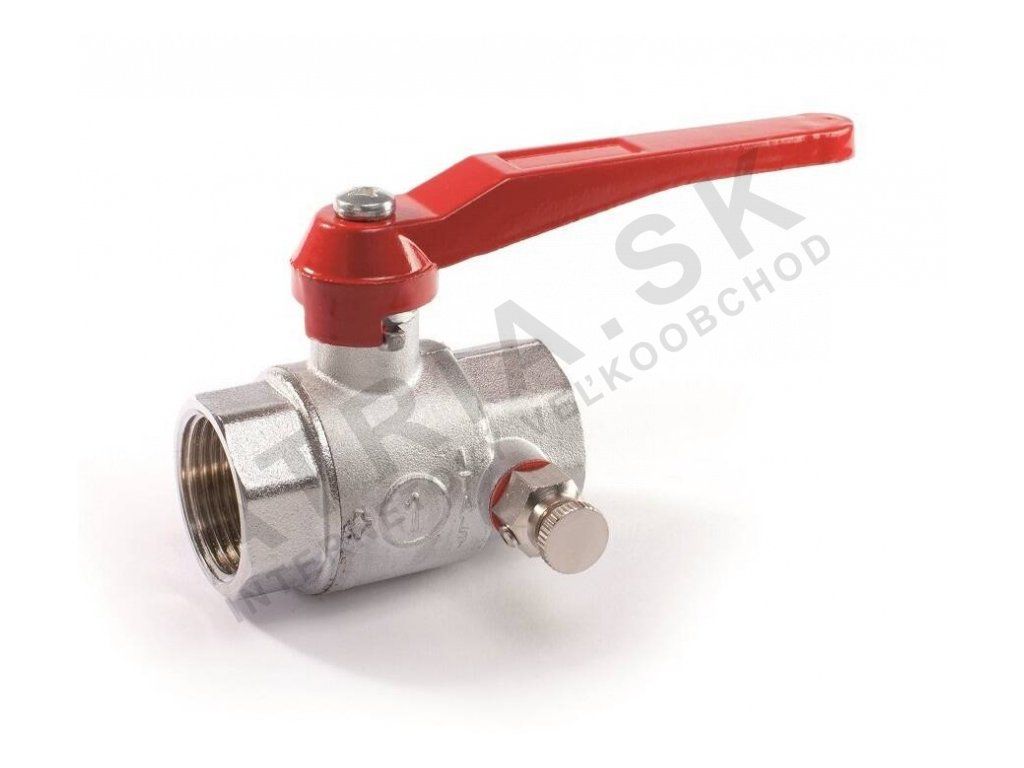 |
Ball valve for water - with drain - 1/2"FF; lever - thanks to the integrated drain valve, it allows quick and clean draining of the given branch during servicing without affecting the rest of the system. We recommend it for every circuit that will be serviced separately in the future. Price from 14.86 EUR. |
When choosing shut-off valves, it is also important to pay attention to the type of control (lever vs. butterfly handle), the seal material (Teflon, PTFE), and the nominal pressure rating, which must match the pressure class of the rest of the system. For ordinary heating circuits in family houses and smaller facilities, PN10 is enough; for larger industrial or district systems, PN16 or PN25 is already commonly required.
Air vent valves - a small part with a big impact on noise and efficiency
Air in the system is one of the most common sources of heating problems - it causes gurgling and knocking in the pipework, reduces heat transfer efficiency on radiators (cold upper parts of the body), and can cause cavitation in circulation pumps, shortening their lifespan. A professional solution therefore always includes a combination of automatic and manual air vent valves at strategic points in the system - the highest points of the pipework, manifold heads, the boiler outlet.
An automatic air vent valve works on the principle of a float mechanism - when air accumulates in the valve body, the float drops and opens a vent through which the air escapes, then closes again. The advantage is that it works without operator intervention throughout operation. A manual air vent valve (the so-called bleed key), by contrast, is used in a targeted way when a circuit needs to be manually vented, for example on radiators or when first filling the system.
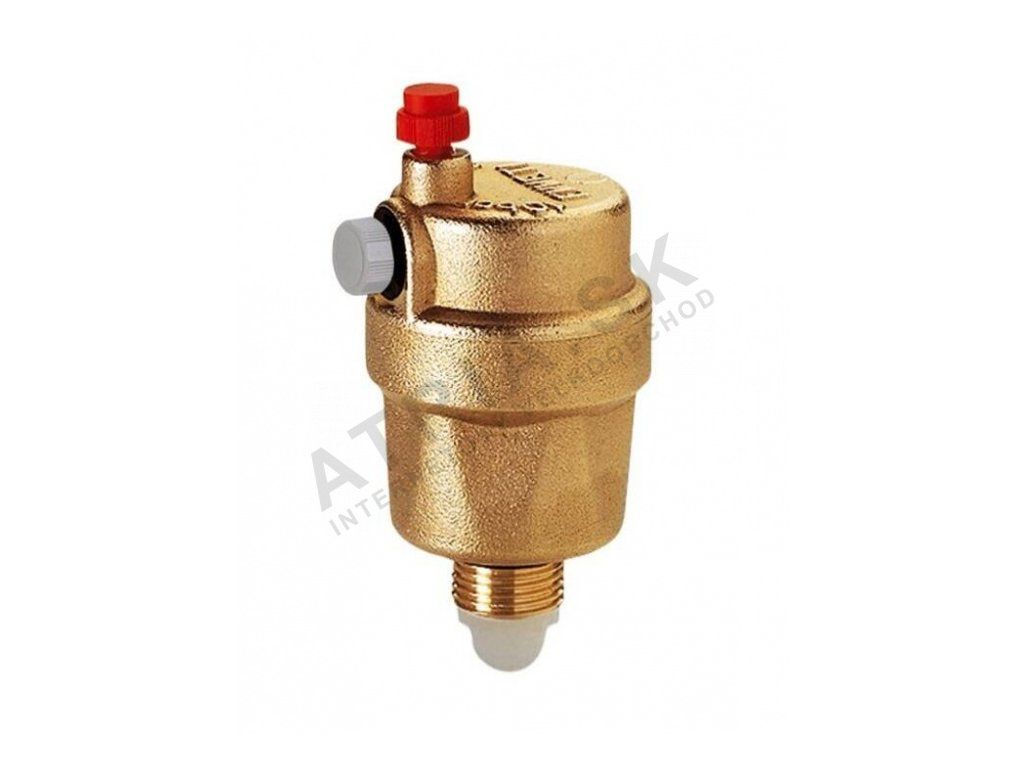 |
Automatic air vent valve - 1/2" - suitable for the highest points of the pipework and for manifold heads, where it continuously releases air without needing operator intervention. In professional installations it is recommended to fit one on every manifold and on the boiler outlet. Price from 12.01 EUR. |
 |
Manual air vent valve - 1/2" - a cheap but essential supplementary solution on radiators and when first filling the system, when a larger amount of air needs to be released in a targeted way at once. Price from 2.10 EUR. |
The price difference between the two types is significant - an automatic valve costs 12.01 EUR, while a manual one costs only 2.10 EUR, meaning the automatic one is roughly 5.7 times more expensive. Despite this, both types are almost always combined in professional installations, because they solve different situations: the automatic one works continuously without an operator, the manual one is used in a targeted way during service interventions or filling.
Materials for professional components - when to choose brass, when stainless
When choosing fittings, installation companies most often decide between brass and stainless steel (occasionally also plastic components, typically for filters or sealing elements). Each material has its place:
- Brass (CW617N) - the most common material for ball valves, manifolds, and air vent valves in residential and family house construction. A good ratio of price to durability, sufficient lifespan for normal heating water composition. The disadvantage is sensitivity to more aggressive media or very soft water with low pH.
- Stainless steel - chosen where there is a greater risk of corrosion (for example systems with added glycol, industrial applications, or where extremely long service-free lifespan is expected). The price is usually higher, but resistance to corrosion and mechanical wear is considerably better.
- Plastic (POM, PP) - used more for filter bodies, some types of manifolds for low-temperature systems, or components where high pressure is not a priority. The advantage is low weight and corrosion resistance, the disadvantage lower mechanical resistance at high temperatures.
The following diagram gives a simplified comparison of the three main properties most often considered when choosing a material - purchase price, corrosion resistance, and mechanical resistance at higher pressure. This is an indicative comparison based on experience from everyday installation company practice, not a laboratory measurement of specific samples.
Sizing - why it pays to calculate, not estimate
One of the most common mistakes we see in professional installations is underestimating the pipe and fitting sizing calculation. In practice this means the DN (nominal diameter) is chosen "by eye" or according to what was used on a previous similar job, regardless of the actual heat output and required flow of the given branch.
The basic relationship to remember is simple: with a larger temperature spread (the difference between the inlet and outlet temperature of the circuit), a lower flow is needed for the same transferred output, so a smaller pipe and fitting diameter can be used. Conversely, for low-temperature systems (for example underfloor heating with a small spread of 5-7 °C), a considerably higher flow is needed, requiring a larger pipework diameter and a manifold with a sufficient number and diameter of outputs.
That is exactly why, when ordering a manifold, it is important to know in advance not only the number of circuits, but also the approximate output and type of heating elements on each branch (radiators vs. underfloor heating), so that the chosen cabinet and manifold match the actual flow requirements, not just the number of connections.
Common mistakes when choosing professional components
From installation companies' experience, a handful of typical mistakes keep recurring that can easily be avoided already at the design stage:
- Underestimating the margin in the manifold cabinet. As already mentioned above, clients very often buy an additional zone after some time. Without spare space in the cabinet, this means a complete replacement, including demolition work.
- Combining incompatible materials without electrical isolation. Directly connecting brass and aluminium or steel components without a dielectric insert can cause galvanic corrosion already within the first few years of operation.
- Absence of shut-off valves with drain at key points. Without them, the whole system has to be drained at every service call, extending the intervention time and increasing the cost of topping up and venting the water after refilling.
- Fitting only one type of air vent valve. Relying only on automatic valves without the option of manual venting (or vice versa) reduces flexibility in dealing with air problems in the system.
- Choosing fittings by lowest price alone, regardless of pressure class. In larger or taller buildings, the system may have a higher static pressure than a cheaper fitting is rated for.
- Not accounting for spare parts availability. Choosing an unknown or too niche a brand can mean that, a few years later, it's impossible to source a replacement sealing cartridge or head, requiring a complete component replacement.
Good practice is to keep a simple table of the components used for larger installations (type, DN, manufacturer, installation date) - for future servicing or system expansion, this significantly shortens the time needed to identify and order the correct spare parts.
How to approach the choice in practice - summary
If we had to summarize the whole process of choosing professional heating components into a few steps, it would look like this: first precisely define the number and type of circuits (radiator, underfloor, combined), then calculate or have calculated the flows and pressure losses for each branch, based on that choose the appropriate pipe diameter and fitting material, add shut-off elements with drain at key points and a combination of automatic and manual venting to the system, and finally place everything in a sufficiently large manifold cabinet with a margin for future expansion. Only after going through all these steps does it make sense to compare specific prices and brands - choosing the "cheapest" component without this context, in the vast majority of cases, turns out to be the more expensive solution over the following years of operation.
Frequently asked questions
Is it worth investing in professional components for a family house, or are ordinary domestic ones enough?
For a family house intended for long-term use (15 years or more), where the cost of repairing a concealed pipe run is high (breaking open partition walls, flooring), professional components are clearly worth it. The price difference between an ordinary and a professional fitting is usually on the order of a few euros per piece, while the cost of repairing a hidden fault can run into hundreds of euros.
What is the difference between the N-MAX and N-KLASIK cabinet?
Both ranges are wall-mounted manifold cabinets, differing mainly in design and size range - N-KLASIK is typically the choice for a smaller number of circuits (for example 2 outputs at a width of 530 mm), while the N-MAX range covers a wider range from the smallest (1 output, 450 mm) up to larger installations with five outputs (1250 mm). The choice between them depends on the specific number of circuits and the available space in the technical room.
Do I need to fit both an automatic and a manual air vent valve, or is one type enough?
In professional installations, a combination of both is recommended. The automatic valve handles continuous venting without operator intervention at the highest points of the system, the manual valve is used in a targeted way during servicing, first filling, or when venting individual radiators, where it isn't practical (or economical) to fit an automatic valve on every unit.
How often do ball valves and air vent valves need to be checked?
It is recommended to check the functionality of the shut-off valves at least once a year (typically before the heating season) - that is, to turn them from one position to the other to prevent the mechanism from seizing up due to deposits. Automatic air vent valves should be visually checked every so often (water leakage, float functionality); manual valves are used as needed when air is detected in the system.
Can a ball valve with drain also be used as a substitute for an ordinary shut-off valve without this feature?
Yes, a valve with drain performs the same basic function as an ordinary shut-off valve (closing/opening the flow), and additionally offers the option of draining the medium via a built-in cock. For a new installation, therefore, in the vast majority of cases there is no reason to choose the cheaper version without drain, since the price difference is usually minimal and the feature is almost always useful in the future.
Where can I find the technical parameters (Kvs values, pressure losses) for specific components?
This data is usually part of the manufacturer's data sheet, which is generally available directly with the product or on request. When designing a larger installation, we recommend contacting us directly - we are happy to help choose the correct diameter and type of component based on the specific parameters of your system.
Related topics
- Differences between a domestic and a professional heating system
- Comparing brands of professional heating equipment
- Installation of professional heating systems
- The most common mistakes when designing a heating system
You will find the complete range of professional components in the main category Professional Heating.
Do you have a question on this topic?
Not sure what to decide, or dealing with a specific situation in your home? Write to us - we're happy to help.