
Electric, water-fed or combined heated towel rail
Electric, water-fed or combined heated towel rail - how to make sense of it
A heated towel rail (sometimes also called a towel dryer or bathroom radiator) is found in almost every modern bathroom today. The question we deal with from clients every day, though, is not quite what it first appears to be - it's not just "how tall and wide should it be", but above all "should it be connected to water, to electricity, or to both at once". This choice affects how the radiator works in winter, how it works in summer, how much it will cost to run, and what construction work you will need before installation.
In this article we go through all three variants - electric, water-fed and combined - one by one, using real examples with specific outputs, prices and everyday situations. The goal is that by the end you will know exactly which type belongs in your bathroom, cottage, or for example in a toilet without central heating.
Why the type of connection matters at all
A heated towel rail has two jobs in the bathroom - heating (warming up the room, especially during transitional periods) and drying (towels, bath sheets, swimwear). It's precisely this second function that is the reason why the connection solution for heated towel rails differs from an ordinary panel radiator in the living room. In winter you also need heat in the room, but in summer the central heating gives you nothing - the boiler is off, the pipes are cold - and yet you still want somewhere to dry a towel. This is exactly where the decision is made between a water-fed, electric, or combined solution.
Water-fed heated towel rail
A water-fed heated towel rail works exactly like a classic radiator in the living room - it's connected to the central heating distribution (boiler, heat pump, or possibly district heating) and heat flows into it via hot water. The typical output of heated towel rails in this version ranges from around 400 W for smaller models up to 1200 W for larger or double-row units - it depends on the height, width and number of rungs.
The biggest advantage of the water-fed solution is a low running cost - the heat is "free" in the sense that the boiler is already producing it for the whole house, and the radiator just draws off part of the existing heating circuit. You don't need any additional electrical wiring, no socket circuit near the bath or shower (which is always a sensitive topic from a safety perspective in a wet environment), and the radiator simply connects into the already existing heating system just like any other radiator in the flat.
The disadvantage is exactly the flip side of the same coin - outside the heating season (in Slovakia the heating season is typically around 200 days a year, roughly from mid-September to mid-May, so for the remaining roughly 165 days the boiler doesn't heat), the radiator is completely cold. So in summer you have nowhere to properly dry a towel, and during transitional periods, when it's cold outside but the heating hasn't officially been switched on yet, the radiator simply doesn't warm up.
Electric heated towel rail
An electric heated towel rail is powered independently from the mains via a heating rod (also called an electric cartridge or heating insert) with its own thermostat. The typical output of such a rod ranges from 150 W for smaller radiators in a toilet or smaller bathroom, up to 300-600 W for larger units also intended to top up the heating of the room.
The main advantage is independence from the central heating - the radiator works at any time of year, so in summer too, during transitional periods, and even at a cottage without a central heating distribution. The thermostat on the rod lets you set the required temperature or a timer (for example switching on in the morning and evening to dry bath sheets), so electricity consumption is under control and easy to estimate.
Let's go through a specific consumption example so you know what kind of amounts we're talking about. A heating rod with an output of 150 W, which you use in summer for, say, 4 hours a day to dry towels (the thermostat doesn't actually keep it on continuously, but for a simple estimate let's calculate with full output for that time), consumes 0.6 kWh per day. At an electricity price of around €0.19/kWh, that's roughly €0.11 per day, which works out to just under €3.50 for a 30-day month. Even with year-round operation (365 days a year instead of just the summer months), the real annual cost of an electric rod with reasonable use typically comes to tens of euros a year, not hundreds - the exact figure of course depends on how long and how often the rod actually runs.
The disadvantage of the electric solution is precisely the need for an electrical socket or a fixed electrical connection near the radiator, which must meet stricter safety requirements for wet areas (protection rating, residual current device). If your bathroom is missing a socket at the right distance from the radiator, you need to allow for additional electrical wiring - that's extra work you don't have to deal with in a water-fed solution.
Combined heated towel rail
A combined heated towel rail joins both systems in one unit - it has a connection to the central heating distribution just like the water-fed variant, and at the same time has a built-in electric heating rod with a thermostat, exactly like the electric variant. In most versions there is a switching valve (a so-called diverter fitting) between the two systems, which lets you leave the radiator running purely on water during the heating season (the cheapest operation) and switch to the electric rod outside the season, which heats the unit on its own.
In practice this solution is the compromise chosen by most clients who have central heating but want a warm radiator in the bathroom all year round - in other words, exactly what neither the water-fed nor the purely electric variant can achieve on its own. The disadvantage is a higher purchase price (you're essentially buying both systems at once) and somewhat more demanding installation, since both the water and electrical connections need to be made at the same time.
Comparison at a glance
To see the difference between the individual types at a glance, we've prepared a simple chart showing how many days a year the radiator is actually able to heat, depending on the type of connection (water-fed only during the roughly 200-day heating season, electric and combined all year round, i.e. 365 days):
How a combined radiator works in practice
Many clients imagine a combined radiator as something complicated, but in reality the principle is simple. Below is a simplified wiring diagram - the water circuit comes from the boiler via the distribution pipework, the electric rod is connected in parallel via a diverter fitting, and it's precisely this fitting that decides which heat source is used at any given moment.
So in winter the diverter fitting lets hot water flow from the boiler - the cheapest way of heating, since the boiler is running anyway. In summer, when the boiler is off, the fitting switches over and the electric rod with its own thermostat heats the radiator - exactly as if you had a separate electric radiator. The result is a unit that is warm (or at least ready to be warm) all year round, without compromises in any season.
A practical example from a typical installation
A typical situation we come across: a family house with a gas boiler and central heating, the bathroom already has pipework run to an old panel radiator that is being replaced with a heated towel rail. In this case the water connection is done "for free" - you just use the existing pipework. So the question is whether to also buy an electric rod (i.e. choose the combined variant), or stay with a purely water-fed one.
If the bathroom already has a socket at a safe distance from the bath/shower and the family values a warm towel even in summer, the combined variant pays off - the surcharge for an electric rod with thermostat on standard models is typically in the order of tens of euros more than a purely water-fed unit of the same size, which is practically negligible compared to the overall investment in the bathroom (tiling, bath, sanitaryware). If, on the other hand, there is no socket and adding one would mean breaking into the tiling, it's worth first considering whether the investment in electrical wiring is even worthwhile, or whether it's simpler to stick with the water-fed solution and manage in summer with, for example, a portable dryer.
A second common situation is a cottage or recreational property without central heating, or a toilet or utility room without a boiler connection - here the clear choice is a purely electric variant, since a water connection simply isn't available and running a whole heating circuit just for one radiator would be disproportionately expensive.
Specific models and their price comparison
To give you an idea of real prices, let's look at specific models from our range. The following chart shows the purchase price of five commonly sold products - notice that a standalone electric heating rod with thermostat is significantly cheaper than the radiator body itself, since it's just an accessory for an already existing (for example water-fed) radiator:
Below you'll find direct links to these models, along with a brief explanation of where they work best.
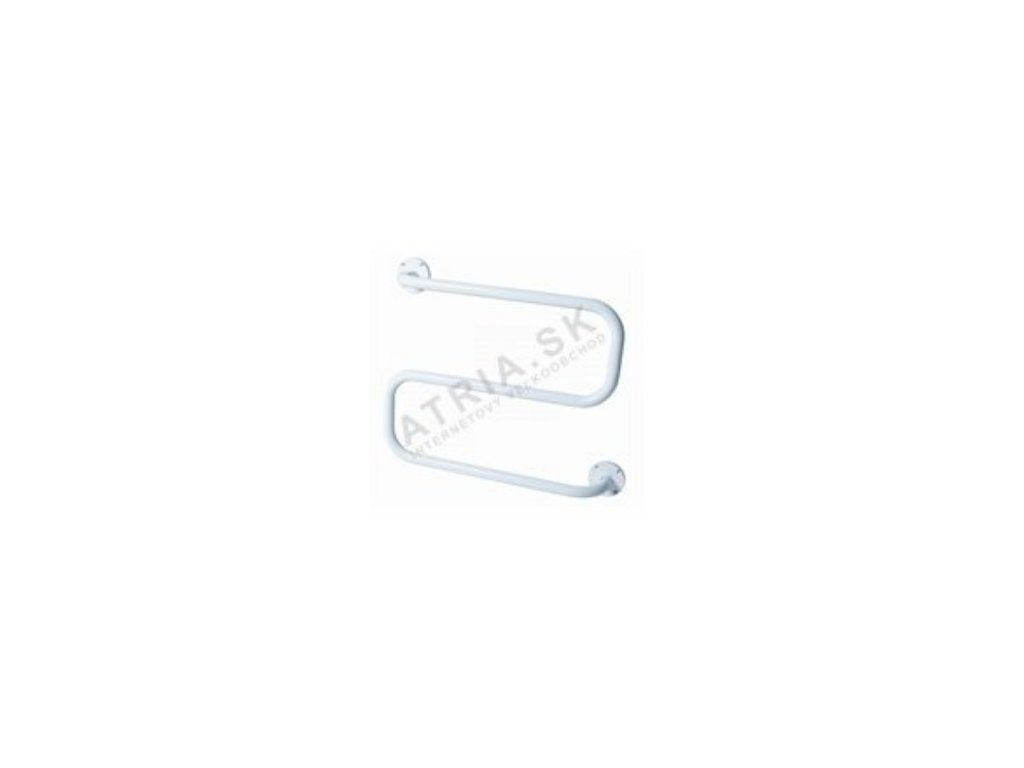 |
DEVIrail S White - a popular mid-sized heated towel rail, suitable as a purely water-fed unit for a bathroom with central heating, or as a base for later adding an electric rod and diverter fitting if you'd like to switch to combined mode. Price from EUR 94.91. |
 |
DEVIrail S Chrome - the same construction as the white model, its chrome surface suits bathrooms with a more modern, cooler style of fittings (taps, shower enclosures). Also ready for water-fed or later combined connection. Price from EUR 99.81. |
 |
DEVIrail U White - the most affordable model in the DEVIrail line, a good choice for a smaller bathroom or toilet, where a lower output and water-fed connection to an existing pipework are enough. Price from EUR 90.02. |
 |
DEVIrail W White - the largest and most powerful model of the compared quartet, suitable for a larger bathroom where, besides drying towels, the radiator should also genuinely help heat the room itself. Price from EUR 115.46. |
 |
Electric rod with thermostat, 150 W - white - a standalone electric heating rod suitable for retrofitting any water-fed heated towel rail that has the preparation (mounting holes) for combined operation. It's precisely this combination that turns an originally purely water-fed unit into a year-round functional combined radiator. Price from EUR 54.87. |
Clear summary of the differences
The following graphic sums up the three key questions we're asked most often when choosing - does the radiator work outside the heating season, does it need its own electrical connection, and what is the approximate purchase price compared to the basic water-fed model.
Installation - what to watch out for
For water-fed and combined radiators, it's essential to know the exact distance between the connection points (the gap between the lower inlets) in mm, so they match your existing pipework or the planned pipe position - this value differs between models and is always stated in the product's technical specification. With a combined radiator, you also need to sort out in advance the position of the electrical socket, which must be located outside the so-called protection zones around the bath and shower enclosure according to the applicable standard for electrical installations in rooms with a bath or shower - we always recommend having this assessed by an electrician, not estimating it by eye.
Installing a purely electric radiator is simpler - the unit is fixed to the wall in the same way as a water-fed radiator (anchor screws, brackets), but instead of connecting to pipework, an electric heating rod is inserted into the prepared opening and then connected to the mains. Here it's important to check that the length of the rod matches the internal diameter and length of the radiator's lower distribution profile - a rod that is too short or too long won't work properly or can't be fitted at all.
Operation and maintenance
Maintenance of all three types is largely the same - regular wiping of the surface, checking the tightness of the joints (for water-fed and combined variants) and occasionally bleeding air if the radiator doesn't heat evenly along its whole height. For the electric rod, we additionally recommend checking the thermostat's function from time to time (simply set it to maximum and confirm the unit actually heats up) and visually inspecting the power cable for damage, especially since the radiator is in a room with high humidity.
A common mistake we encounter in practice is leaving a combined radiator switched to water even in summer, when the boiler is off - the result is a cold radiator and needless disappointment ("but I bought a combined one, why isn't it heating"). The solution is simply not to forget to switch the fitting to the electric rod when you turn off the heating for summer, ideally at the same time you normally switch off the boiler itself.
Summary - how to decide
If you have central heating at home and it's enough for your bathroom radiator to be warm only during the heating season, a purely water-fed variant is the simplest and cheapest choice - no electrical wiring, no extra running costs. If you don't have central heating at all (cottage, standalone toilet, utility room), or you want the radiator warm all year regardless of heating, the electric variant with a heating rod is a direct and reliable choice. If you want the best of both worlds - cheap operation in winter and warmth in summer - a combined radiator is the solution that requires a somewhat higher initial investment and slightly more demanding installation, but delivers the greatest comfort in the long run.
Frequently asked questions
Can a water-fed heated towel rail be converted to combined later?
In most cases yes, if the radiator has a prepared opening at the bottom (a so-called blind flange or mounting hole) for fitting an electric rod. So before buying a rod it's always good to check whether the specific model of heated towel rail offers this option - you'll find this information in the product's technical specification, or you can just ask us directly.
How much electricity does an electric heating rod really consume?
At an output of 150 W used 4 hours a day, that's roughly 0.6 kWh per day, which at an electricity price of around €0.19/kWh works out to about €0.11 a day, i.e. roughly €3.50 a month. Real consumption is often lower, since the thermostat cyclically switches the rod off as soon as the set temperature is reached.
Is an electric rod in the bathroom safe?
Yes, as long as the installation is carried out according to the applicable standards for rooms with a bath or shower (correct IP protection rating, residual current device, socket placed outside the protection zones). This connection should always be carried out or at least checked by a qualified electrician, not done by a layperson unaided.
Is a combined radiator worthwhile even in a flat with year-round hot water from district heating?
If the heat supply to your flat is limited only to the heating season (a common situation with district heating), the combined variant makes just as much sense as with a gas boiler - in summer a radiator without an electric rod simply won't heat. If your heat supply were set up year-round (rare), the electric rod loses its purpose.
Does the diverter fitting on a combined radiator have to be manual?
Most commonly sold models have a manual diverter fitting, which you switch by hand twice a year (at the start and end of the heating season). Automatic or thermostatically controlled variants also exist, but they are more expensive and not essential in ordinary household use.
What output of electric rod is enough to top up drying on a larger radiator?
For a standard bathroom with a heated towel rail, a rod with an output of 150-300 W is enough if it's primarily for drying towels. If you want the electric rod to also provide noticeable top-up heat for a larger room outside the season, go for an output closer to 400-600 W - but then you also need to check the capacity of the supply electrical circuit.
Related topics
How to choose a heated towel rail for the bathroom
What output of heated towel rail do I need
Installing a heated towel rail
Heating rods and spirals - how to choose
Heated towel rails
Have a question on this topic?
Can't decide, or dealing with a specific situation in your home? Write to us - we're happy to advise.