
Frequently asked questions about towel radiators
At first glance a towel radiator looks like a simple piece of metalwork - a few horizontal tubes resembling a ladder, hung on a bathroom wall. In practice, though, it raises a surprising number of questions, and they come up at three separate stages: when choosing (water, electric or combined?), when installing (where exactly, at what height, connected to what supply?), and during operation (how much does it cost, what to do outside the heating season, why is it cold at the top and hot at the bottom?). In this article we have collected the questions we hear most often from customers by phone, email and in the product discussions, and we answer them in practical terms, with real figures and specific examples from typical Slovak bathrooms.
The aim is not to convince you to buy a particular model, but to show how you can logically arrive at the right decision - and where it makes sense, we also add a specific product that solves the situation in question.
How a towel radiator works - water, electric and combined
The first question most people ask is simple: what type do I actually need? The answer depends on one thing - whether your bathroom has access to the central heating supply (i.e. piping from the boiler or from underfloor heating), or not.
Water towel radiator
Connected to the house's existing heating system in the same way as a classic panel radiator. Heat flows into it from the boiler, heat pump or central supply. The advantage is clear - as long as you're heating the flat or house, the bathroom heats up too, at no extra cost for electricity. The downside shows up in summer: outside the heating season the radiator is cold, even though you'd like to dry your towels in July as well.
Electric towel radiator
Works independently of the house's heating - it has its own heating rod or element plugged into a socket, which heats the fill (usually oil or a mixture of water and antifreeze) inside the tubes. You can switch it on any time, even in August, even when the boiler is shut down. The running cost goes straight through the electricity meter, so it's important to know the rod's power rating - more on costs below.
Combined towel radiator
Has both - it's connected to the central heating supply and also has an electric heating rod with its own thermostat built into the lower tube. In winter it works as an ordinary water radiator; outside the season you switch the valve (or it switches automatically via a thermostatic head and non-return valve) and heat only electrically. It's the most versatile option, but also structurally the most complex and generally the most expensive solution.
Deciding between these three types can be summed up in a simple scheme - if your bathroom has access to the central heating supply, a water or combined type makes sense; if it doesn't (for example a cottage, a studio flat with no heating of its own, or a bathroom far from the riser), the solution is an electric radiator or adding a separate heating rod to your existing towel radiator.
If you already have a water or combined radiator at home and just need to solve drying outside the season, you don't need to replace the whole radiator - it's enough to fit it with a separate electric heating rod with its own thermostat, for example the Electric heating rod with thermostat, 150 W - white. It's a cheaper solution than buying a new combined unit, as long as the connection into an ordinary internally-threaded tube suits you.
 |
Electric heating rod with thermostat, 150 W - white - its own thermostat keeps the set temperature without you having to switch the rod off by hand, and the 150 W output is enough to dry towels in an ordinary bathroom without unnecessarily high consumption. Price from 54.87 EUR. |
What power output does a towel radiator really need
The second most common question is: "Is 400 W enough, or do I need more?" An exact heat-loss calculation is done by a designer, but for a standard, adequately insulated bathroom in a flat or new building you can use a practical rule of thumb - roughly 100 W per square metre of bathroom floor area, if the radiator is the only or main heat source in the room. For older, less well insulated houses or a bathroom with a lot of glazing, add a margin of 20-30%.
In practice this looks like: a small bathroom of around 4 m² (typical flat) is fine with an output of around 400 W, a medium-sized bathroom of around 6 m² needs around 600 W, and a larger bathroom with both a bathtub and a shower cubicle at 8 m² already needs around 800 W, if the radiator is also expected to contribute to heating the room, not just dry textiles.
This rule of thumb assumes the radiator is a supplementary heat source alongside the house's regular heating (for the water type) or the main source only for short-term drying (for the electric type used for drying towels). If the radiator is to be the sole heat source in a bathroom used year-round with no other heating, it's better to add a power reserve, because towel radiators have a smaller radiating surface than classic panel radiators of the same output.
When choosing a specific model it's also worth looking at the dimensions - a taller and wider radiator of the same construction type generally also means a higher output, because it has more rungs and a larger tube surface. For example the DEVIrail S Biely is one of the more compact, affordable models suitable for smaller bathrooms of around 4 m², while the DEVIrail U Biely has a different construction shape (a U-shape instead of straight rungs), which some customers prefer both visually and in terms of how the towel-hanging space is arranged in a smaller room.
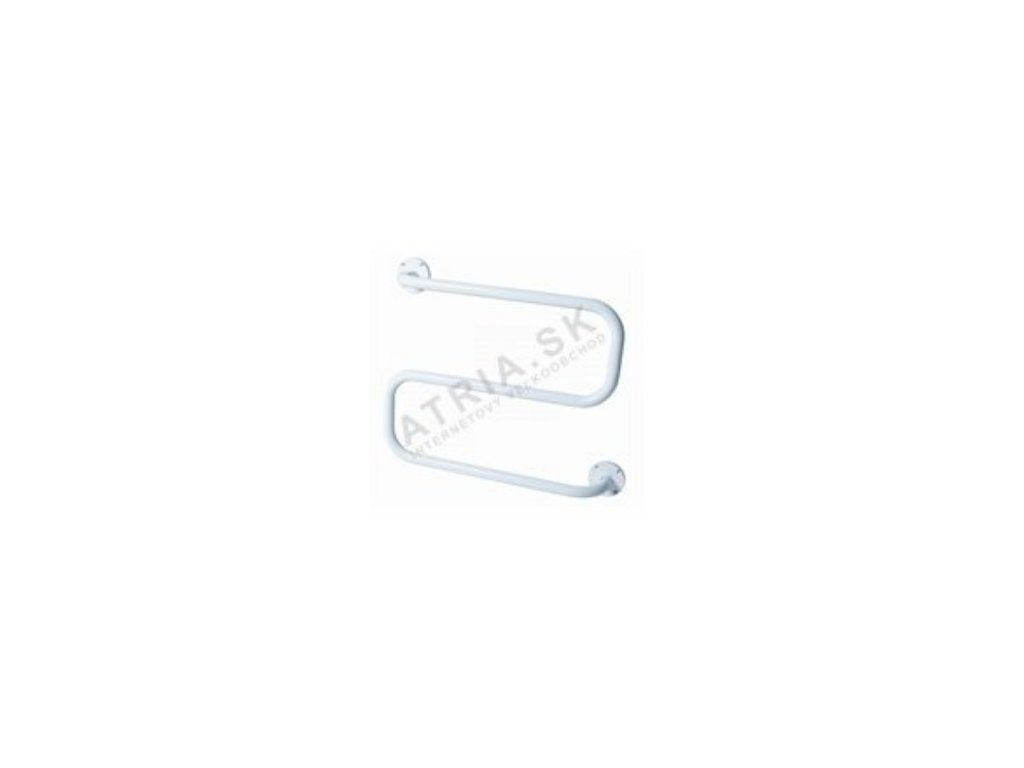 |
DEVIrail S Biely - a compact towel radiator suitable for smaller bathrooms, where an approximate output of around 400 W is enough; the white finish matches most tiling. Price from 94.91 EUR. |
 |
DEVIrail U Biely - a variant with U-shaped rungs that gives a different layout of towel-hanging area at a comparable price level. Price from 90.02 EUR. |
Installing a towel radiator - the most common questions from practice
The third group of questions concerns installation. Even though hanging the radiator on the wall isn't complicated in itself, the order of steps and a few details determine whether the radiator will stay leak-tight and work reliably for years.
What height should the radiator be hung at?
The bottom edge is usually mounted around 20-30 cm above the floor, so the floor can easily be mopped underneath and there's still enough room for towels above the ground. The top edge should be within arm's reach, roughly up to 160-180 cm, otherwise the top rungs are practically unused.
Do I have to drain the whole system for installation?
For both the water and combined type, yes - before disconnecting the old radiator or connecting a new one you need to shut off the supply and return (ball valves at the radiator, if fitted) or drain the relevant branch of the system. In a flat in an apartment building this sometimes means notifying the building manager if a shared riser needs to be drained.
What's the correct step-by-step installation procedure?
Regardless of the radiator type it's worth keeping the same order: first precise measuring and marking of the mounting points (according to the bracket spacing supplied by the manufacturer), then shutting off the water or disconnecting from the electricity, then fitting the brackets and hanging the radiator, then connecting to the supply (or screwing the electric rod into the lower tube), and finally bleeding the air and testing for leaks at full pressure.
Can an electric radiator be plugged into an ordinary socket?
For most models with an output up to 300-400 W, yes, as long as the socket complies with the regulations for high-humidity rooms (protection rating, distance from the bath/shower according to STN 33 2000-7-701, RCD). For higher outputs or a fixed connection without a plug, we recommend having an electrician connect it directly to the wiring, not improvising with an extension cable running across the whole bathroom.
Operation outside the heating season and electricity costs
This is a question that determines real comfort for owners of flats and houses - in summer you want dry towels, but you don't want to fire up the whole boiler just for that. That's exactly what the electric rod is for, whether standalone or part of a combined radiator.
The cost can be estimated fairly precisely if you know the rod's power rating and the running time. At a typical electricity rate of around 0.20 EUR/kWh (an indicative value for a household in 2026), the monthly cost for 4 hours of daily operation works out as follows: a rod with an output of 150 W uses 0.6 kWh over 4 hours, which is 18 kWh a month (30 days), i.e. around 3.60 EUR. A stronger rod with an output of 300 W under the same regime comes to 36 kWh a month, i.e. around 7.20 EUR. If you were to run a more powerful full radiator at 600 W the same way (for example as the main heat source in a small bathroom with no other heating), you'd reach 72 kWh a month, i.e. around 14.40 EUR.
These numbers show that an ordinary 150 W rod used to dry towels adds only a few euros a month with sensible use (not continuous 24-hour operation) - genuinely the least costly option for a household that wants a warm bathroom outside the heating season too, without a major impact on the electricity bill. Most modern rods also have a built-in thermostat that automatically switches the rod off once the set temperature is reached, saving further consumption compared with continuous operation at full power.
If you want a warm bathroom automatically, without having to switch the rod on by hand before every shower, it's worth going for models with a digital or at least mechanical thermostat built into the rod itself, or a combined radiator that switches its heat source automatically depending on whether the central heating is on.
Surface finish and design - white, chrome or something else
The question of colour and surface finish seems purely aesthetic, but it also has a practical side. A chrome surface withstands humidity better over the long term without changing shade, and looks visually "cooler" and more modern, which suits bathrooms with stainless steel or glass elements. A white lacquered surface, on the other hand, matches classic tiling better and looks visually less dominant on the wall, which is appreciated especially in smaller bathrooms where you want the radiator to "blend in" with the wall.
In terms of price, the difference between the same model in white and chrome versions is usually small - for example the DEVIrail S Biely costs 94.91 EUR, while the chrome version of the same line, the DEVIrail S Chróm, costs 99.81 EUR. A difference of a few euros isn't really a deciding factor - what matters more is which one fits better with the overall look of your bathroom and which type of towel bars (straight rungs, shaped U or W) suits you functionally.
 |
DEVIrail S Chróm - the same construction as the white version; the chrome surface handles permanent humidity well and suits bathrooms with stainless steel or glass accessories. Price from 99.81 EUR. |
For more demanding spaces or larger bathrooms, where higher output and a larger towel-hanging area is needed, a model with shaped W rungs is a good choice, offering more hanging points across the same wall width.
 |
DEVIrail W Biely - shaped W rungs give more room for hanging towels and bath sheets across the same wall width, suitable for larger or family bathrooms. Price from 115.46 EUR. |
Maintenance and the most common operating problems
A towel radiator is a structurally simple appliance, yet a few typical problems still come up repeatedly in practice, and most can be solved without a service call.
The radiator is cold at the top, warm at the bottom (water type). This is almost always air trapped in the system - the solution is to bleed it through the air vent at the top of the radiator. If the problem keeps recurring, it may indicate a leak that keeps drawing air into the system, or an incorrectly set circulation pump head.
The electric rod heats weakly or not at all. The most common cause is a faulty or incorrectly set thermostat, or a burnt-out heating element inside the rod after several years of use. On rods with a replaceable element, only the inner part needs replacing, without having to change the whole radiator.
Rust spots on the surface. This is rare on quality products with a lacquered or chrome-plated finish, but if the surface coating is damaged (for example by an impact during moving or painting), moisture can reach the base material. It's recommended to treat the damaged spot as soon as possible so the corrosion doesn't spread further.
Dripping or wet patches at the connection. This is usually an under-tightened or poorly sealed joint from installation - checking and, if needed, retightening the joints shortly after installation, once the system has been through its first heating and cooling cycle, is common and recommended practice.
The radiator "knocks" as the heating starts up. This is usually caused by the metal expanding as the temperature rises quickly, combined with loose fitting in the brackets - tightening the brackets or adding a rubber pad that dampens small vibrations usually helps.
Frequently asked questions
What's the difference between a towel radiator and a classic panel radiator in the bathroom?
A towel radiator is built from horizontal tubes instead of flat panels, which lets you hang towels on it and dry them at the same time while it's heating. A panel radiator has a larger radiating surface for the same output, but no option for hanging textiles. That's why small bathrooms almost always favour the towel radiator type, even though it's somewhat more expensive for the same output.
Can I connect an electric towel radiator myself, or does it need an electrician?
For models connected via an ordinary plug into a socket with protection suitable for damp rooms, a handy DIYer can manage it. For a fixed connection without a plug, higher outputs, or if there's no socket in the right place, we recommend an electrician - this is a high-humidity space where stricter standards apply to the placement and protection rating of the wiring.
Can a water towel radiator be converted into a combined one later?
Yes, on most water radiators that have free space with an internal thread in the lower tube, an electric heating rod with a thermostat can be fitted afterwards. You just need to check the thread diameter and rod length against the dimensions of the specific radiator, so the rod physically fits inside the tube.
How much does it cost to run an electric heating rod during summer?
For an ordinary 150 W rod running around 4 hours a day, the monthly cost is roughly 3.60 EUR at an electricity price of 0.20 EUR/kWh. For a stronger 300 W rod it's around 7.20 EUR a month. Actual consumption depends on how long the rod runs on average per day and whether it has its own thermostat that switches it off once the target temperature is reached.
Do I have to drain the whole house heating system when installing a new radiator?
Not the whole system, just the relevant branch or riser the radiator is connected to - in a flat with shut-off valves right at the radiator, it's enough to close just those. If the valves are missing, or it's a shared riser in an apartment building, it may be necessary to temporarily shut down a larger part of the system, ideally after agreeing this with the building manager.
Why is my towel radiator only partially warm?
For the water type, the most common cause is air in the system, which can be solved by bleeding it through the valve at the top of the radiator. Another possible cause is the radiator becoming clogged with debris from the supply system after years of use, or an incorrectly set thermostatic head restricting flow more than necessary.
Related topics
If you're dealing with a more specific situation, these articles may also help:
- How to choose a towel radiator for the bathroom
- Electric, water or combined towel radiator
- Installing a towel radiator
- Heating rods and elements - how to choose
You'll find the full range in the main category Towel radiators.
Have a question on this topic?
Can't decide, or dealing with a specific situation in your home? Write to us - we're happy to help.