
Most common towel radiator faults
A towel radiator is one of the most reliable pieces of heating equipment in a household - it has no moving parts, doesn't need servicing like a boiler, and with normal use it will easily last two decades. Even so, we get dozens of questions a month in our service department and advice line that all boil down to the same thing: "the radiator is cold", "water is dripping from the valve", "the rod heats, but only halfway". Over the years we've been selling and installing DEVIrail towel radiators and thermostatic heating rods, we've built up a fairly precise picture of which faults recur most often, why they happen, and what you can do before calling a service technician.
In this article we go through the five most common types of faults one by one - air in the system, leaks, faults in the electric heating rod and thermostat, corrosion and deposits, and finally mechanical damage from frost or careless handling. For each fault we cover how it shows up, why it happens, and what to actually do about it - including when it's worth replacing the unit instead of repairing the old one.
Why towel radiators fail in the first place
Before going through the individual faults, one thing needs to be clear: a towel radiator isn't one product, but three different technical solutions with completely different failure patterns.
A water towel radiator is connected to the house's heating circuit; heat is carried into it by the heat-transfer liquid (usually water, sometimes with added antifreeze) from the boiler or heat pump. Its faults relate almost exclusively to the water in the system - air, leaks, deposits.
An electric towel radiator has no connection to the heating circuit at all. Inside it has a sealed fill (a mixture of water and glycol, or oil) and a heating rod with a thermostat that heats the fill similarly to an electric kettle. Its faults are mostly electrical - a faulty thermostat, a burnt-out heating element, a damaged cable.
A combined towel radiator has both - it's connected to the water circuit and also has its own electric rod, which you switch on, for example, in summer when the boiler is off and you want warm towels. Logically it therefore combines the risks of both the previous types, but it also has the advantage that when one part fails, the other still works.
Looking at the fault statistics we work with (based on several hundred service and advisory cases over the recent period), the breakdown of causes looks roughly like this: air in the system 35%, a fault in the heating rod or thermostat 25%, leaks at joints 18%, corrosion and deposits 12%, and mechanical damage (frost, impact, careless installation) the remaining 10%. Keep these figures in mind, we'll refer back to them below in the chart.
Air in the system - the most common fault on water radiators
If you have a water or combined towel radiator at home and the top half - or, conversely, just the bottom rungs - feels cold while the rest is hot, it's almost certainly air trapped inside the body. Air gets into the system every time the heating is topped up with water, after a shutdown, after a valve replacement, or simply through gradual micro-ingress via seals and joints over months of operation.
It typically shows up like this: with the heating on, the radiator hums or gurgles, it's cold to the touch at the top and warm at the bottom (air rises and pushes the water down), or it can even be cold all over despite the valve being fully open. In an extreme case an air pocket can block circulation enough that it doesn't heat up at all.
The fix is simple though, and anyone can do it without a service technician - bleeding the air. Towel radiators usually have a small air vent valve in the top corner (often a small screw with a square or flat head). The procedure is as follows, and we recommend having a cloth ready under the valve, since a little water will also come out while bleeding.
If the radiator heats up evenly after bleeding, the problem is solved - the air was released and flowed out. If air keeps reappearing every few weeks, it means air is continuously being fed into the system somewhere (for example a leaking auto air vent on the boiler, suction-side negative pressure on the pump, or a micro-leak somewhere in the circuit) and it needs to be dealt with systemically rather than endlessly bleeding the same radiator. In that case we recommend contacting a heating technician, since the cause usually isn't the radiator itself.
Leaks and water loss at joints
The second most common group of faults on water and combined radiators is leaks. They show up as water dripping from the valve, a wet patch on the wall or floor under the radiator, or a gradual pressure drop in the heating system that you'll notice on the boiler's pressure gauge.
There are three most common leak points: the connecting union between the radiator and the supply pipework (tightening with a spanner is often enough here, occasionally the sealing ring needs replacing), the air vent valve itself (after years of operation the seal wears out and needs replacing, a cheap part), and welded or soldered joints directly on the radiator body (this is a manufacturing or material issue, and if it shows up it's usually a warranty claim, not a DIY repair).
An important warning: never try to force-tighten a union at full pressure "with strength", because the brass and chrome-plated parts of towel radiators have a precisely specified tightening torque - overtightening damages the thread or seal even further and the leak gets bigger. If tightening by hand or with light spanner pressure doesn't help, the seal needs replacing, not more force.
Faults in the electric heating rod and thermostat
On electric and combined towel radiators, this category is the second-biggest group of faults (25% of all cases) and is also the most common reason customers come to us for a replacement rod instead of a whole new radiator - the radiator body itself lasts considerably longer than the electronics in the rod.
The radiator doesn't heat up at all
If the electric rod doesn't heat at all after switching on, check in this order: the fuse in the distribution board (this often trips due to humidity in the bathroom, especially if the socket has an RCD that has tripped), the socket itself (try a different appliance), and finally the rod itself - unplug it and visually check the cable where it enters the rod, a point that often suffers mechanical stress and a cracked conductor.
If everything else checks out and the rod still doesn't heat, it's highly likely a burnt-out heating element inside the rod - a part that wears out over time similarly to the element in an electric kettle, especially if the rod is run with an insufficient fill inside the radiator body (an air pocket around the rod causes the element to overheat and fail sooner).
The radiator heats only weakly or doesn't reach the set temperature
This is a typical symptom of a faulty thermostat in the rod - either it's sensing the temperature incorrectly, or it's switching the heating on/off at the wrong intervals. If you have an older-type rod without an electronic display, the thermostat is mechanical and adjusting or replacing it is straightforward - for example our Electric heating rod with thermostat, 150 W, which can be used as a replacement for most common towel radiators with a suitable thread.
 |
Electric heating rod with thermostat, 150 W - white - the most common replacement when the original rod fails. The built-in mechanical thermostat also solves the "heats weakly or won't switch off" problem without needing to replace the whole radiator. Price from €54.87. |
Error message or blinking indicator light (electronic rods)
More modern rods with a display and WiFi control report faults directly on the display or by blinking the indicator light in a certain pattern. Always check the manual for the specific model first - the error code will usually clearly identify whether it's a temperature sensor fault, overheating, or a communication failure. For faults like this, DIY disassembly of the electronics isn't recommended; it's a warranty or post-warranty repair through the manufacturer or an authorised service centre.
Corrosion and deposits - the quiet enemy of durability
The third large group of faults relates to the long-term effect of water and humidity on the radiator's surface. In terms of materials, the bathroom is one of the most demanding environments in a household - high humidity, condensation, cleaning products containing chlorine or other aggressive substances all put long-term stress on the surface finish.
On cheaper or older radiators with low-quality chrome plating, small rust spots appear after years, especially around welds or fittings. On radiators with a white coating (powder coat), the risk instead is mechanical scratching of the surface during cleaning with a coarse sponge - at the scratch point, moisture reaches the metal underneath and starts corroding it from beneath the coating, which only shows up later on the surface as a blister or peeling paint.
From our experience (and also from the warranty-claim statistics of DEVI, whose products we sell), the approximate lifespan of surface finishes under normal bathroom use looks like this: a quality chrome-plated surface lasts 12 to 15 years without visible corrosion, a white powder coating similarly 12 to 15 years, as long as it isn't scratched during cleaning, and untreated stainless steel lasts practically the radiator's entire lifespan, i.e. 20 years or more, since there's nothing underneath the surface to corrode.
Prevention is simple and cheap - use only a soft cloth and an ordinary detergent without abrasive grains for cleaning, ventilate the bathroom after showering so moisture doesn't stay condensing directly on the radiator's surface, and check every so often whether a rust spot is starting to form anywhere - if so, it can be sanded lightly with fine sandpaper and re-coated with clear metal lacquer at an early stage, before the problem spreads.
Uneven heating - when one branch stays cold
On "U" or "W" type towel radiators with several parallel branches, it sometimes happens that one or two rungs stay cold while the rest of the radiator is normally warm. This is a different phenomenon from general air in the system (where typically the whole top part is cold) - here it's more likely a local blockage of a specific branch by deposits, or an uneven flow distribution due to a poorly set regulating valve.
If you have, for example, a U-profile model like the DEVIrail U Biely at home, its symmetrical-branch design is somewhat more resistant to this phenomenon than more complex W profiles, since it has fewer places where flow can be distributed unevenly. On W profiles, such as the DEVIrail W Biely, it's worth making sure the flow is properly balanced during installation, according to the installer's instructions, to prevent this kind of uneven heating from the start.
 |
DEVIrail U Biely - a simpler symmetrical profile with a lower risk of uneven flow between branches compared with more complex shapes. Price from €90.02. |
 |
DEVIrail W Biely - higher heating output thanks to a more complex profile; correct flow balancing across all branches must be ensured during installation. Price from €115.46. |
Cracks and frost damage
This fault occurs least often (roughly 10% of cases together with other mechanical damage), but it's among the most serious, since it can cause a large water leak and damage to the floor or furniture. It typically occurs in recreational cottages or rooms that aren't heated over winter - water inside the water radiator body freezes, expands, and the body or a joint cracks. When it thaws again, water leaks out of the crack, and it's often only noticed in spring when the heating is switched back on.
Prevention is clear-cut - if you're leaving a building unheated over winter, either drain the system completely (including towel radiators), or use an antifreeze mixture at a sufficient concentration for the expected temperatures. If you have a combined radiator, the electric rod can be run in a limited "frost protection" mode (usually set to a few degrees above zero) to keep the body above freezing even without the boiler running, which is a practical solution for cottages used intermittently.
How to diagnose a fault before calling a service technician
The following simple flowchart summarises the steps we recommend going through before booking a service technician - in many cases you can identify, and sometimes even fix, the fault yourself in a few minutes.
How to prevent faults - simple routine maintenance
Most of the faults described above can be prevented, or at least significantly delayed, with regular, but minimally time-consuming, maintenance. We recommend the following simple annual cycle.
At the start of the heating season (typically in September or October), bleed all water and combined radiators in the house, even if they didn't seem cold over summer - air builds up gradually and may not be noticeable yet. At the same time check the pressure in the heating system on the boiler's gauge and top up water if needed.
Once a month during the heating season, visually check all joints and valves on the radiators for any damp patch or drip - catching a micro-leak early saves a later repair to the floor or plaster.
When cleaning the radiator, always use only a soft cloth and non-abrasive detergent, never a wire scourer or coarse sponge. After wet cleaning, ventilate the bathroom so moisture doesn't condense on the surface long-term.
For an electric or combined rod, check the cable at the point it enters the rod and check that the thermostat works once a year (for example during the boiler's service inspection) - a simple test is to set the rod to maximum temperature and confirm the radiator actually becomes hot to the touch along its whole length.
Before winter shutdown of an unheated building (cottage), either drain the system, or top it up with antifreeze mixture at a sufficient concentration, or leave the electric rod in frost-protection mode if the radiator has one.
When to fix a fault yourself and when to call a service technician
Bleeding air, tightening a loose union by hand, replacing a simple mechanical heating rod with a standard thread, or cleaning off early-stage corrosion from the surface can be done by practically anyone without professional help - it's routine household maintenance, not an intervention in the heating system.
On the other hand, we always recommend a service technician or heating company when there's recurring air in the system despite regular bleeding (a sign of a bigger systemic fault), a leak directly at a weld or soldered joint on the radiator body (a potential warranty claim), any electrical fault on electronic rods with a display or WiFi control, and of course any suspected crack in the body after frost, where a sudden and larger water leak is a risk.
When deciding whether to buy a replacement heating rod or a whole new radiator instead of repairing an older unit, it's also worth considering the age of the original radiator - if the radiator body is already 12 years old or more and, on top of a rod fault, there are also signs of corrosion, it often makes more economic sense to invest straight into a new unit with a more modern rod than to keep repeatedly repairing an ageing unit. For example the DEVIrail S Biely model or its variant the DEVIrail S Chróm are among the best-selling compact towel radiators precisely thanks to the simple S-profile construction, which by its nature has fewer places for a potential fault than more complex shapes.
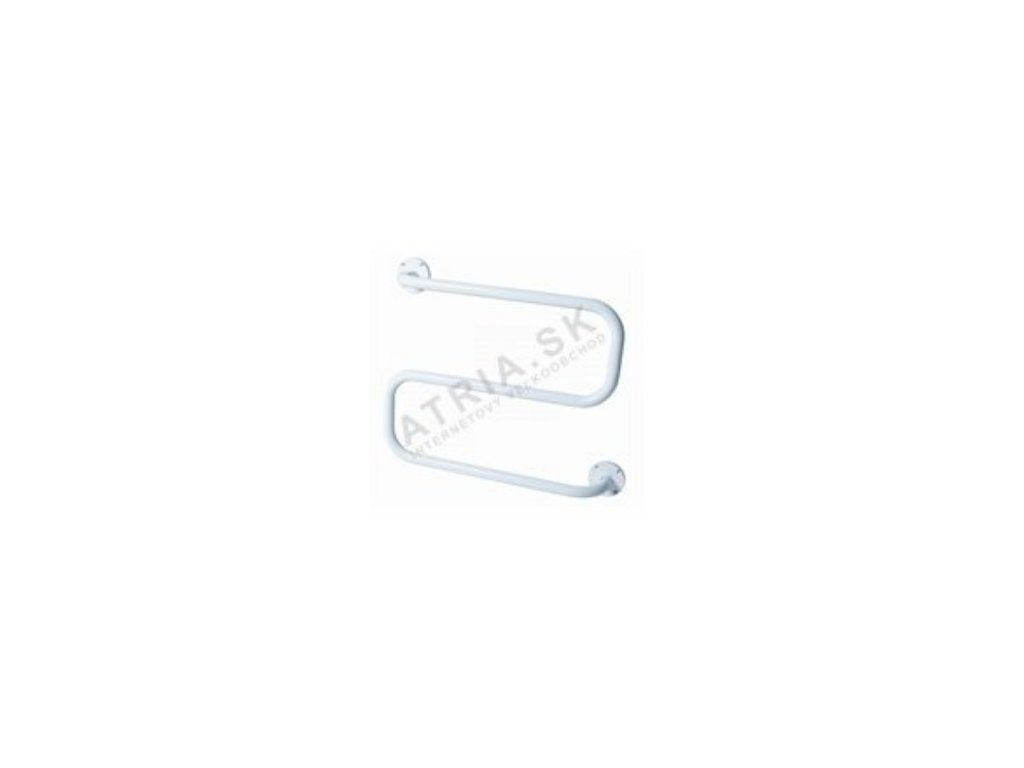 |
DEVIrail S Biely - a simple S-profile with fewer joints, meaning a lower risk of leaks compared with more complex shapes. A good choice when replacing an ageing radiator with a new one. Price from €94.91. |
 |
DEVIrail S Chróm - the same reliable construction as the white variant, quality chrome plating with a stated lifespan of 12-15 years without corrosion under normal care. Price from €99.81. |
Frequently asked questions
Why is my towel radiator cold at the top and warm at the bottom?
This is a classic symptom of air trapped in the top of the body. Air is lighter than water, so it collects at the top and blocks the flow of hot water there. The solution is simple bleeding through the small valve in the top corner of the radiator, the procedure is described earlier in this article.
How often should a towel radiator be bled?
We recommend bleeding all water radiators at the start of the heating season, even if they don't seem cold. If air appears more often, for example every month, it means air is continuously leaking or getting into the system somewhere, and the cause needs investigating rather than endlessly bleeding the same radiator over and over.
Can just the heating rod be replaced without replacing the whole radiator?
Yes, on most common towel radiators with a standard thread (most often G1/2"), the original rod can be unscrewed and replaced with a new one, for example the Electric heating rod with thermostat, 150 W. You just need to check the thread is compatible and the maximum output suits the fill volume of your specific radiator.
Can an electric heating rod cause a fire or short circuit?
With a quality, certified rod properly connected through a socket with an RCD (which is legally required in bathrooms), the risk is minimal. Even so, we recommend regularly checking the condition of the cable where it enters the rod, and never using a rod with a visibly damaged cable or casing.
Why does water keep dripping from the radiator even after tightening the joint?
If tightening by hand or with light spanner pressure didn't help, the seal itself is probably worn, not a loose joint. In that case replacing the sealing ring helps, not further forceful tightening, which can damage the thread.
Is it worth repairing a 15-year-old radiator, or better to buy a new one?
If the fault is in the heating rod itself, it's worth replacing just the rod, since that's considerably cheaper than a whole radiator. But if a rod fault is combined with visible corrosion on a radiator body older than 12-15 years, it's often more economical to invest in a new unit, which also comes with a more modern, more efficient rod with a more accurate thermostat.
Related topics
How to choose a towel radiator for the bathroom | Electric, water or combined towel radiator | Installing a towel radiator | Heating rods and elements - how to choose
See the full range: Towel radiators
Have a question on this topic?
Can't decide, or dealing with a specific situation in your home? Write to us - we're happy to help.