
What output of heated towel rail do I need
What output of heated towel rail do I need
The question "what output of heated towel rail should I buy" sounds simple at first glance, but in practice it is one of the most common causes of disappointment after purchase. A customer picks a nice designer radiator based on colour and size, then finds at home that the towels won't dry, the bathroom is cold, and the radiator is just decoration. The opposite extreme is just as common - an oversized radiator in a small bathroom that stays uselessly overheated most of the year and you can't even touch it in summer. In this article we go through how the output of heated towel rails is actually calculated, what to watch out for with both electric and water-fed versions, and how to avoid the most common mistakes we see when advising customers.
Right at the start, one important note: in the vast majority of Slovak households, a heated towel rail (often also called a "bathroom radiator" or "dryer") has a dual function - it should heat the room and dry towels and textiles at the same time. These two functions have different output requirements, and this is exactly where most misunderstandings arise. A radiator that is more than enough for drying two towels may not be enough to heat a larger bathroom in a block of flats with a large window, and vice versa.
Why output is a key parameter - more than design
Heated towel rails are sold primarily as a design element - colour, the shape of the rungs, and the surface finish (white, chrome, anthracite) are often the first selection criteria. Output is often addressed only second, sometimes not at all. Yet it is precisely the output (expressed in watts, W) that determines whether the radiator will be able to:
- maintain the required room temperature even on the coldest days of the year,
- dry towels and laundry within a reasonable time,
- function as the sole heat source in the room (typical for smaller bathrooms without another radiator), or only as a supplementary source alongside underfloor heating.
An undersized radiator is very difficult to "fix" afterwards - you either need to buy an additional heat source or replace the whole radiator. That is precisely why it is worth spending 15-20 minutes calculating the output before buying, rather than dealing with dissatisfaction after the first winter.
How radiator output is stated and what delta T means
The output of water-fed and combined radiators is most often stated in technical sheets at the so-called delta T of 50°C - the difference between the average water temperature in the radiator and the air temperature in the room (typically water around 75°C, air 20-25°C in a bathroom). At a lower heating water temperature (for example with a heat pump, where a lower-temperature flow system is common, delta T 30), the real output of the same radiator is lower - roughly 35-45% less than the figure stated on the label at delta T 50. This is one of the most common reasons why a radiator in a household with a heat pump appears "weaker" than the catalogue promised - it isn't a fault of the radiator, but a different operating regime.
With electric heated towel rails and electric heating rods, the situation is simpler - the output is fixed by the electrical input (for example 150 W, 300 W, 600 W) and does not depend on the temperature spread of the heating system, since it is a direct-heating element.
Basic calculation - how many watts per m² of bathroom
For a typical, averagely insulated Slovak home (brick building, plastic windows, apartment block or newer family house), the rule of thumb used in practice is roughly 90-110 W per m² of bathroom floor area, if the radiator is meant to serve as the main heat source in the room. This figure is not a law of physics, but proven practice that works for most typical bathrooms with a standard ceiling height (2.5-2.7 m) and one smaller window.
If the bathroom is in an older, uninsulated building, has a large window, is a corner room with two external walls, or is above an unheated space (for example a garage), we recommend calculating with a higher coefficient, roughly 130-150 W/m², i.e. a third to a half more. Conversely, in a very well insulated new-build or passive house, where the radiator serves only as a supplement to underfloor heating (not as the main source), 50-70 W/m² is usually enough, since most of the heat loss is covered by the underfloor heating and the radiator only handles drying comfort and top-up heat.
Calculation procedure step by step
- Measure the bathroom area in m² (length × width).
- Choose the coefficient according to insulation and purpose (50-70 / 90-110 / 130-150 W/m²).
- Multiply the area by the coefficient - you get the approximate target output.
- Add a drying reserve if you plan to use the radiator intensively for drying larger amounts of textiles (family with children, frequent drying of bath sheets) - roughly +10 to +20% of the calculated output.
- Check the real output of the specific model at the delta T corresponding to your heating system (delta 50 for a classic boiler, delta 30 for a heat pump - see above).
Water-fed, electric and combined radiator - impact on output and choice
The type of connection fundamentally affects how you can work with the output in practice:
Water-fed heated towel rail
Connected directly to the house's heating system (boiler, heat pump). Advantage: the output is generally higher and the radiator heats automatically whenever the whole house is heating, without needing to switch it on separately. Disadvantage: outside the heating season (summer) the radiator is cold and won't dry towels unless it has an additional electric element.
Electric heated towel rail
Has its own electric element (often with a thermostat) and works independently of the heating system. Advantage: it works in summer too, can be timed precisely (for example on in the morning before a shower), and the output is stable and independent of the boiler's temperature spread. Disadvantage: running costs for electricity, and a limited maximum output (typically up to around 600-800 W on more compact models).
Combined heated towel rail
The most versatile solution - it heats from the water system during the season (higher output, lower running costs), and outside the season or for extra drying it can be topped up with the electric rod. We recommend it wherever the bathroom is used intensively all year round and you don't want to depend on just one heat source.
A specific choice between versions from our range:
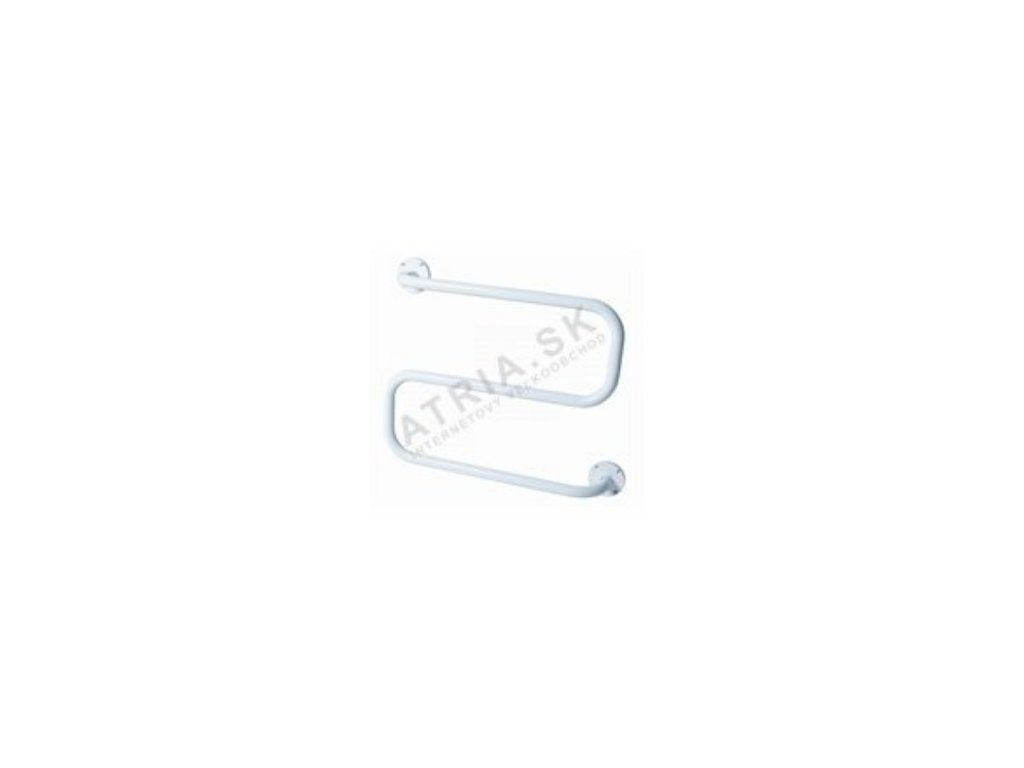 |
DEVIrail S White - a more compact model from the S line, suitable for smaller bathrooms (roughly up to 4-6 m²) or as a supplementary radiator alongside underfloor heating. The white finish suits most interiors. Price from EUR 94.91. |
 |
DEVIrail S Chrome - the same size and output parameters as the white version of the S line, only with a chrome surface - suitable if you prefer a glossy metal look instead of white. Price from EUR 99.81. |
 |
DEVIrail W White - a higher line with a larger rung area, suitable for larger bathrooms or wherever you need more output and space for several towels at once. Price from EUR 115.46. |
Price comparison of individual models
Price alone is not a direct indicator of output, but within a single line (e.g. DEVIrail), taller and larger versions with a higher output tend to cost more. For orientation in the price range of our heated towel rails and the supplementary heating rod:
Practical examples from everyday practice
Example 1 - small flat bathroom, 3.5 m²
A bathroom in a block of flats, one small window, well-insulated building, radiator meant to be the main heat source and towel dryer for a 2-person household. Calculation: 3.5 m² × 100 W/m² = 350 W, plus a drying reserve of about 15% = roughly 400 W. In this range a more compact model is fully sufficient, for example DEVIrail S White or DEVIrail U White - both are a suitable choice for smaller spaces of this type.
Example 2 - larger bathroom in a family house, 8 m², corner room
A corner bathroom with two external walls and a larger window, older building with average insulation. Here we recommend a higher coefficient, roughly 130 W/m²: 8 × 130 = 1040 W, plus a drying reserve for a family of four (more bath sheets at once) +15-20% = roughly 1200-1250 W. In this case it's worth reaching for a larger model with higher output, such as DEVIrail W White, or considering adding a second, smaller radiator or another heat source in the room, since a heated towel rail alone in this range may already be at the limit of its capability - we recommend always checking the output of the specific model in its technical sheet for your real temperature spread.
Example 3 - bathroom with underfloor heating, radiator only for top-up drying
A new build with underfloor heating that covers most of the room's heat loss. Here the radiator does not serve as the main heat source, but purely for drying textiles and top-up heating during transitional periods (spring/autumn), when the underfloor heating is not yet switched on. In this case a lower output is enough, roughly 50-70 W/m², and a very practical solution is an electric or combined model with its own thermostat that can be switched on independently of the central heating - for example adding a separate electric rod with thermostat, 150 W - white to a classic water-fed radiator, which allows the radiator to run outside the heating season without having to start up the whole house heating system.
What to do if the output is insufficient - topping up with an electric rod
A very common situation in practice: a water-fed heated towel rail goes completely cold in summer because the boiler or heat pump doesn't heat outside the season. If you need the radiator to work for drying even outside the heating season, the solution isn't to replace the whole radiator, but to add an electric heating rod with a thermostat, which is fitted into the radiator's lower outlet instead of the blanking plug. This type of top-up heating is one of the most often underestimated, yet cheapest ways to significantly extend the real usability of the radiator throughout the year - the electric rod with thermostat, 150 W - white is a typical example of such a supplementary solution, priced from EUR 54.87.
When choosing the output of the heating rod, similar logic applies as for the whole radiator - 150 W is usually enough to maintain drying and provide mild top-up heat in a smaller bathroom, while in larger spaces or for faster drying it's worth considering a higher-output rod (300 W and above), if your radiator model supports it.
Most common mistakes when choosing output
1. Choosing only by size, not by the technical sheet
Two radiators of the same height and width can have a different output depending on the number and thickness of the rungs, the construction and the material. Size is only an approximate guide; the decisive factor is the stated output in watts at a specific delta T.
2. Forgetting about the different output at a lower water temperature
As stated above, with a heat pump or a low-temperature boiler the real output is significantly lower than the catalogue value at delta T 50. If you are planning to install, or already have, a heat pump, allow a reserve.
3. Underestimating corner and heavily glazed bathrooms
Rooms with two external walls or large glazing lose significantly more heat than an interior room of the same area - here it is worth using a higher calculation coefficient, not the basic 100 W/m².
4. Radiator as the sole heat source without backup
If the heated towel rail is the only heat source in the bathroom and is water-fed only, in the event of a boiler fault or outside the season the room is left without any heating or drying capability. Combining it with an electric rod eliminates this risk.
5. Excessively oversized output "just to be safe"
An unnecessarily large radiator means higher purchase and running costs, and in practice often an unpleasantly hot surface in summer if it runs at full output just to dry a few towels. Calculating based on the real area and insulation pays off more in the long run than "better bigger, just to be safe".
Summary - how to proceed when choosing
If you're not sure, we recommend proceeding in this order: first measure the bathroom area and assess its insulation, then calculate the approximate target output using the procedure above, next consider whether the radiator will be the main or only a supplementary heat source, and finally choose a specific model based on its real output for your type of heating system (classic boiler vs. heat pump). If you're torn between two options, in most cases it's wiser to choose a slightly higher output with thermostat control than a marginally undersized model.
Frequently asked questions
What output of heated towel rail is enough for an average 5 m² bathroom?
For an averagely insulated home, roughly 450-550 W (5 m² × 90-110 W/m²); for a less well insulated room or a corner bathroom, allow for the upper end of this range or slightly more.
Why is the real output of my radiator lower than stated in the catalogue?
Catalogue output is usually stated at delta T 50°C (hot water around 75°C). If you have a heat pump or a low-temperature boiler with a lower heating water temperature, the real output can be 35-45% lower. This is not a fault of the radiator, but a result of the lower temperature spread.
Is it worth buying a combined radiator instead of a purely water-fed one?
If you want to be able to dry towels even outside the heating season or when the boiler happens to be switched off, yes - combining a water-fed radiator with a supplementary electric rod (for example 150 W) solves this for a relatively low additional investment.
Can I retrofit an electric heating rod into an existing water-fed radiator?
In most cases yes, as long as the radiator has a free lower outlet with a blanking plug of a suitable diameter that can be replaced by a rod. We recommend checking the outlet size on your specific model before buying.
Is a radiator with an output calculated only by area enough, or do other factors need to be considered?
The basic calculation by area is a good starting point, but you should also take into account the number of external walls, window size, above-standard ceiling height, and whether the radiator will be the sole heat source or only a supplement to another heating system (e.g. underfloor heating). If in doubt, it's better to choose a higher output with regulation.
Is there a difference in output between the white and chrome versions of the same model?
For the same model (for example DEVIrail S White and DEVIrail S Chrome), the construction and output are identical - the only difference is the surface finish and aesthetics, not the performance parameters.
Related topics
- How to choose a heated towel rail for the bathroom
- Electric, water-fed or combined heated towel rail
- Heating rods and spirals - how to choose
- Installing a heated towel rail
You'll find the complete range of heated towel rails in the main category: Heated towel rails.
Have a question on this topic?
Can't decide, or dealing with a specific situation in your home? Write to us - we're happy to advise.