
Comparison of towel radiator surface finishes
When customers choose a towel radiator for the bathroom, they almost always ask first about the output in watts or the spacing between the tubes. The surface finish gets dealt with last - yet it's exactly the finish that, after five years of use, determines whether the radiator still looks new or whether it already shows stains, dull patches and visible fingerprints. In this article we look at the differences between white paint, chrome, brushed stainless steel and coloured RAL shades - not just in terms of looks, but also real-world maintenance, price and lifespan in the environment of a Slovak bathroom, where relative humidity commonly reaches 60-80% while showering, and where the radiator is touched by damp hands and towels several times a day.
Why the radiator's surface matters at all
A towel radiator isn't just a heating appliance - in the vast majority of flats and houses it's also the only spot in the bathroom where several towels, bath sheets and often laundry get dried every day. That means the surface is repeatedly exposed to damp textiles, soapy water, and sometimes disinfectants during routine cleaning. While the same load on a cold surface (for example a cabinet under the washbasin) wouldn't be a problem, the radiator is also warm, which speeds up moisture evaporating right on the metal surface and, with a poor-quality or damaged finish, increases the risk of local corrosion.
The second reason it's worth paying more attention to choosing the finish is purely economic. For the same radiator model, the price difference between a white and a chrome version can be a few to a few dozen euros, but once the surface is damaged (scratches, rust, peeling paint), a cheap repair usually can't be done DIY without a visible result - in practice most such cases end with replacing the whole unit. Investing in the right finish from the start therefore pays off more in the long run than it might seem at first glance.
The third reason relates to exactly where the radiator hangs. In a small bathroom with no window, where moisture has practically nowhere to escape, the same surface will be stressed differently than in a spacious bathroom with a good window and extraction. It's also true that in households with small children or pets, small scratches and fingerprints appear much faster, and these are far more visible on glossy surfaces (chrome) than on matte ones (white, brushed stainless steel).
White paint (RAL 9016) - the universal, best-selling choice
White paint, specifically the shade RAL 9016 (traffic white), has long been the best-selling surface finish for towel radiators on the Slovak market. The reason is simple - it suits almost any interior, doesn't visually take up space, and matches white sanitaryware, which still dominates most bathrooms. Technically it's a powder coating (epoxy-polyester powder applied electrostatically and then baked at high temperature), which forms a fairly durable, even layer with good adhesion to a steel or aluminium base.
The advantage of white paint is that small scratches and fingerprints are far less visible on a matte surface than on glossy chrome. The downside is sensitivity to mechanical damage - if the powder coating gets scratched right through to the metal (for example from careless handling of tools during installation, or an impact from a metal object), the damaged spot is at risk of gradual corrosion, which over time shows up as a rust stain showing through the paint. Practical experience from installations shows the most common damage spot is the bottom of the radiator, where installation tools or a stepladder tend to lean against the body during fitting or moving.
With white paint you also need to reckon with slight yellowing over the years, especially in rooms with direct sunlight or near a heat source with a higher heat-transfer medium temperature. On electric and combined radiators, where the surface temperature is thermostat-controlled and generally more stable, this risk is somewhat lower than on water radiators connected directly to a boiler with higher flow-water temperature.
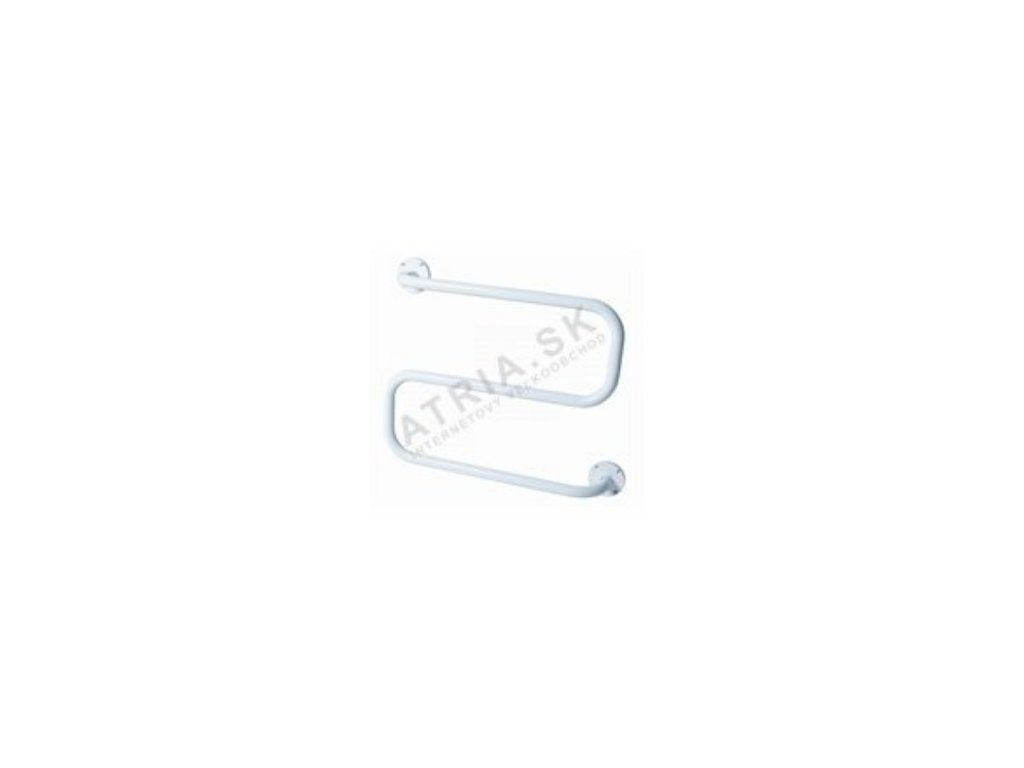 |
DEVIrail S White - a typical example of quality powder coating in the RAL 9016 shade, suitable for an ordinary family bathroom as well as smaller rooms, where white is the safest choice. Price from €94.91. |
Chrome - a glossy look with higher care demands
A chrome-plated surface looks modern and technical, complements stainless steel or chrome-plated sanitaryware (taps, shower fittings, accessories) well, and remains a popular choice in more upscale bathrooms. Technically it's a galvanically applied layer of chrome over a base layer of nickel, applied directly onto a steel or brass base. The resulting surface is harder and more scratch-resistant than ordinary paint, but has one key property customers often forget - it's highly glossy, and therefore extremely visible for fingerprints, water droplets and limescale.
In practice this means a chrome-plated radiator in a household with harder water (common especially around Bratislava and in south-western Slovakia) needs to be wiped dry more often than a white or matte surface, otherwise visible limescale spots form on it. With regular cleaning using a soft cloth and an ordinary cleaning product without abrasive ingredients, though, a chrome surface can keep its shine for many years without any loss of quality.
The second important property of chrome is sensitivity to chemically aggressive cleaning products - especially those containing acids (for example limescale removers based on citric or acetic acid in concentrated form) can, with prolonged use, damage the glossy surface and cause it to dull or even develop microscopic cracks, through which moisture later penetrates to the base metal. The practical recommendation is simple - use only ordinary, non-aggressive detergents on chrome, or products intended specifically for chrome-plated surfaces.
 |
DEVIrail S Chrome - the same model as the DEVIrail S White, just with a galvanically chrome-plated surface - ideal for showing directly how much more the chrome version costs on an identical body. Price from €99.81. |
The price difference on an identical model - real figures
To show the difference between white and chrome finishes as concretely as possible, the best approach is to compare the same model in both versions. The DEVIrail S radiator in the White version costs from €94.91, while the same model in the Chrome version costs from €99.81. The difference is therefore €4.90, which for this specific model is roughly a 5.2% price increase for galvanic chrome plating over powder coating. For other models and larger sizes (more chrome-plated surface, a more complex towel-rail shape), the percentage difference in practice usually runs somewhere between 4% and 10%, since the chrome-plating process is more time-consuming and technically demanding than powder coating.
Stainless steel - brushed, practically maintenance-free
Brushed stainless steel is a minority choice among surface finishes, but is probably the best solution in terms of long-term durability. It's a material that's inherently corrosion-resistant (it's not just a surface layer applied over a different metal, as with painting or chrome plating), and its matte, finely textured surface hides fingerprints and small scratches well. That's exactly why brushed stainless steel is showing up more and more often in new builds and renovations, where the owner is planning for long-term use with no planned replacement.
The downside of stainless steel is a higher purchase price compared with painted versions of the same size, and a somewhat more limited range of colour variants - in practice stainless steel is sold mostly only in its natural metal shade, while paint can be ordered in dozens of RAL shades. With normal care, it's enough to wipe the surface with a dry or slightly dampened cloth, with no need for special products - which makes it the simplest choice in terms of routine maintenance.
Coloured RAL shades and anthracite/graphite - a design accent
Besides classic white, several towel radiator manufacturers also offer coloured versions - most commonly anthracite/graphite grey, but also black, beige, or, on request, practically any RAL shade. Technologically it's the same powder coating as with white paint, so durability properties are comparable - the main difference is visual. Darker shades have the advantage that small marks and dust aren't as visible on them as on white, where every bit of dirt stands out immediately.
The downside of coloured, and especially dark, shades is that small surface scratches (for example from handling towels with zips or metal clasps) can actually be more visible, because the contrast between the dark paint colour and the light-coloured scratched spot is higher than with white. Coloured versions are also usually only available as a special order with a longer delivery time, since most manufacturers keep mainly the white and chrome versions in stock as the best sellers.
How each finish behaves in the bathroom's damp environment
The following comparison summarises the four main criteria described above - resistance to moisture and corrosion, visibility of marks and stains, how demanding routine maintenance is, and the approximate price level. The rating is based on everyday installation and warranty-claim experience, not laboratory tests, but it illustrates the relative differences between the finishes well.
Maintenance and cleaning by surface type
How often you need to clean is in practice mainly affected by water hardness in your area and the number of people in the household, but a rough recommendation can be given by surface type. A chrome surface, the most prone to visible water spots, is best wiped dry around once a week, or after every shower if the radiator is directly in the splash zone. Brushed stainless steel gets by with wiping roughly once every two weeks. White paint needs routine dusting once every two to three weeks, since water spots aren't as prominently visible on a matte surface. Coloured and dark RAL shades can be cleaned least often, usually once a month is enough, since small limescale spots are almost unnoticeable on a dark background.
Decision process - how to choose the right finish
If you're not sure which finish to choose, it's worth going through a simple set of questions in order. First answer how humid your bathroom is - a small room with no window and several people showering intensively every day will place higher demands on durability than a large, well-ventilated bathroom. The second question is who will use the radiator daily - a household with small children or pets will get more fingerprints and small scratches, which favours matte surfaces. The third question is budget, and finally the fourth question is how much time you're willing to spend on regular cleaning.
Electric, water or combined radiator - the effect on surface finish
The type of heating circuit has a smaller, but real, effect on choosing the surface finish. On purely electric radiators, where the thermostatic heating rod is the only heat source, the surface temperature is generally more stable and more precisely controlled, which reduces the thermal stress on the paint or chrome compared with water radiators connected directly to a heating circuit with a fluctuating flow-water temperature. On combined radiators (a water circuit plus an electric rod for summer operation), you need to reckon with the electric rod being used mostly outside the heating season, when bathroom humidity is also often higher due to more frequent showering in the warmer months - the surface finish should therefore be able to handle year-round use, not just the heating season.
When choosing an electric thermostatic heating rod, which can be fitted afterwards into most existing towel radiators, you don't need to worry about the radiator's own surface finish - the rod is fitted into an existing thread and its own surface (usually white or chrome plastic/metal, depending on the radiator model) is already matched to the common finishes on the market.
 |
Electric heating element with thermostat, 150 W - white - a suitable add-on for an existing towel radiator, for year-round finishing off of towel drying independent of the heating circuit. Price from €54.87. |
Different towel-rail shapes and surface finish - why it matters here too
A surface finish doesn't behave exactly the same across different towel radiator shapes. A straight, simple shape (for example the S-type model) has fewer corners and joints where the paint or chrome layer could get locally damaged during installation. Conversely, more complex shaped models with more rungs or a double-sided towel rail (for example the U or W type) have more welds and corners, where extra care is needed during installation and subsequent cleaning, so a cloth or towel doesn't catch on a sharper edge and cause micro-scratches right at the weld, where the paint layer is usually thinnest.
For larger, more complex models, practical installation experience therefore suggests choosing a more matte, less glossy surface (white or brushed stainless steel), because any small irregularities in a weld are visually less noticeable on a matte surface than on glossy chrome, where even a minimal irregularity would create a visible broken reflection of light.
 |
DEVIrail U White - a more complexly shaped model with more rungs, where a white matte finish hides small irregularities in the welded joints well. Price from €90.02. |
 |
DEVIrail W White - a double-sided towel rail with the largest drying area, where white is also recommended for easier subsequent care given the larger number of rungs. Price from €115.46. |
Practical experience from installations and warranty claims
From everyday installation and warranty-claim experience, a few recurring patterns can be observed. The most common reason for a claim on a white radiator's surface isn't a manufacturing defect but mechanical damage during installation - typically the paint getting scraped by a spanner or installation tool at the point where the connecting fitting is tightened. The recommendation is simple - use a protective cloth or soft jaws on the spanner during installation, and never tighten a joint with a metal tool directly against the painted surface.
On chrome-plated radiators, the most common "problem" customers come to the seller with is exactly limescale and fingerprints, which they mistakenly interpret as a surface defect - in reality it's almost always a normal consequence of harder water and not wiping often enough, not a manufacturing fault. Explaining this difference in advance, before purchase, can prevent unnecessary disappointment after a few months of use.
Claims on brushed stainless steel are rarest of all, confirming its reputation as the lowest-maintenance solution - the only recurring finding is small scratches caused by using unsuitable abrasive sponges when cleaning, which can easily be avoided by using a soft cloth instead of a wire scourer or an abrasive-sided sponge.
For made-to-order coloured RAL shades, the most common point that needs discussing with the customer in advance is the longer delivery time - since it's usually a made-to-order production run, the waiting time can be several weeks instead of the usual few days for a stocked white or chrome version. This is worth keeping in mind especially when planning a renovation with a fixed completion date.
Summary - which finish to choose
If you're looking for a universal, safe and affordable solution, white RAL 9016 paint is still the most sensible choice for most households. If you care about a modern, glossy look and are willing to wipe the radiator somewhat more often, chrome offers an attractive appearance for a modest price premium. If you're after the lowest possible maintenance and the highest durability and don't mind a higher purchase price, brushed stainless steel is the most reliable long-term investment. And if you want the radiator as a design element matched to your wall or furniture colour, coloured RAL shades offer that option at the cost of a longer delivery time.
Frequently asked questions
Can scratched paint on a radiator be repaired DIY?
Small surface scratches that don't go through to the metal can be partly masked with touch-up spray paint in the RAL 9016 shade, commonly available in hardware stores. If the scratch is deeper and bare metal is visible, the spot needs treating with an anti-corrosion primer first and only then repainted, otherwise the corrosion process can carry on hidden underneath the new layer of paint.
Is a chrome radiator worth it in a small bathroom with no window?
Chrome itself resists corrosion well, but in an environment with permanently high humidity and insufficient ventilation, visible water spots form on it faster and it needs wiping more often, potentially after every shower. If ventilation is weak, white or brushed stainless steel tends to be the more practical choice.
Is brushed stainless steel really maintenance-free?
Not completely maintenance-free, but significantly less demanding than the other finishes - an occasional wipe with a soft cloth is enough, with no need for special cleaning products. Corrosion resistance comes from the material itself, not just a surface layer, which is its main advantage over painted or chrome-plated surfaces.
Does the type of heating medium (water/electric) affect the choice of surface finish?
Not directly in a major way, but electric radiators with a thermostat generally have a more stable surface temperature than water radiators connected to a boiler with a fluctuating flow-water temperature, which slightly reduces thermal stress on the surface layer. For combined radiators, you need to plan for year-round use, i.e. also higher humidity in the summer months.
Why is the chrome version of the same model more expensive than white?
Galvanic chrome plating is a more technologically demanding and time-consuming process than powder coating - it requires several steps, including applying a base layer of nickel before the chrome plating itself. For the DEVIrail S model, this difference is specifically €4.90 (€94.91 white versus €99.81 chrome), i.e. roughly a 5.2% price increase.
Can a thermostatic heating rod be fitted to any towel radiator afterwards?
Most towel radiators designed as water or combined types have a thread already prepared for fitting an electric heating rod, but you always need to check the exact thread diameter and the radiator's dimensions before ordering a rod, to make sure it fits your specific model.
Related topics
How to choose a towel radiator for the bathroom
Electric, water or combined towel radiator
Installing a towel radiator
Most common towel radiator faults
Towel radiators
Have a question on this topic?
Can't decide, or dealing with a specific situation in your home? Write to us - we're happy to help.