
Straight vs. curved towel radiator
When choosing a towel radiator for the bathroom, most customers deal with two questions at once - how much heat the radiator will deliver, and whether it will even fit on the available wall. That second question is exactly why, alongside classic straight towel radiators, curved variants are increasingly sold too - models with rounded corners (U shape) or a wavy, undulating rung layout (W shape). This article compares both shapes from a practical point of view: installation, heating output, price and visual impression, so you can decide based on your actual bathroom, not on which one looks better in an e-shop photo.
What exactly "straight" and "curved" towel radiators mean
A towel radiator (sometimes also called a "dryer" or "bathroom radiator") consists of two vertical collector pipes, between which the rungs are placed horizontally or at a slight angle. The straight and curved models differ exactly in the shape of these rungs and the side collectors:
- Straight towel radiator - the vertical collectors are two straight, parallel profiles, with the rungs between them being straight horizontal tubes at regular spacing. Seen from the front or the side, it's a clean rectangle. This is the oldest and still the best-selling shape, because it's the simplest and cheapest to manufacture.
- Curved towel radiator - we usually group two subtypes here. The first is the "U" shape, where the side collectors are rounded at the top or bottom, so the radiator looks visually softer and suits, for example, a corner installation or a sloped attic ceiling. The second subtype is the "W" or wavy shape, where not just the collectors but the rungs themselves are wavy - from a distance the radiator looks more like a design statement piece than a purely functional appliance.
Based on what we hear from installation companies through everyday customer contact, as well as from our own range, the sales ratio is roughly three straight models to one curved one - not because the curved type is worse, but because most bathrooms simply have a plain flat wall with no particular shape requirements.
Heating output and radiating surface
This is the point where most customers get it wrong - they automatically assume a curved or wavy shape must have a smaller radiating surface because "it's more complicated". In fact it's exactly the opposite. The wavy rung layout (W shape) increases the actual tube length within the same footprint width, so at the same height and width a wavy model can achieve a higher or at least comparable output compared with a straight model of the same outer dimensions. The difference in practice isn't dramatic (a few percent at the same surface area), but it runs the opposite way from what you'd intuitively expect.
More important than the shape itself when choosing output is always the actual bathroom area, the wall's heat-transfer coefficient, and whether the radiator is only for finishing off drying towels or is meant to be the main (often the only) heating appliance in the room. Rung shape (straight/curved) only has a secondary effect on this - first work out the commonly recommended approximate output of around 60-100 W per m² of bathroom at a standard ceiling height and insulation level, and only then, as a second step, choose the shape based on the wall layout.
Where the shape does make a real difference is the evenness of the heat output. A straight radiator radiates heat evenly across its whole height; the U curved shape has a slightly lower rung density in the rounded top section (due to the curve), so that part looks visually nicer but in practice works more as supplementary textile drying than as a full heating surface.
Space requirements and suitability for a specific layout
This is where the difference between the shapes is most practical. A straight radiator needs a continuous flat wall with no obstructions at least as wide as its profile, ideally with a clearance of at least 3-5 cm from side corners or tiling trim for the brackets. If the wall is short, or if there's a sloped ceiling in the room (an attic bathroom), a straight model sometimes simply doesn't fit - it's either too narrow to reach the required output, or too tall and hits the slope.
The curved U shape offers a real advantage here: the rounded top section allows installation closer to the sloped ceiling or into a room corner without the sharp edge of a straight profile visually "poking" into the space. The wavy W shape solves the opposite problem - when the wall is wide enough but low, the waved rungs let you increase the length of heating tube without the radiator looking like a plain rectangle.
From an installation company's point of view, the rule of thumb is simple: if you're not sure and the wall is an ordinary flat wall with no obstructions, go for the straight model - it's more universal, spare parts are easier to find, and it's usually somewhat cheaper too. Consider the curved shape specifically when a straight model genuinely doesn't fit the layout, or when the bathroom's design is a priority over pure function.
Price and value for money
The price difference between a straight and a curved model of the same brand and output class in our range is typically a few to a few dozen euros - the main price factor is always output (size), the surface material and the operation mode (water, electric, combined), not the shape itself. For example the DEVIrail S Biely (straight shape) costs €94.91, while the DEVIrail U Biely (curved U shape) is actually cheaper, €90.02 - it's a bit smaller in size. The DEVIrail W Biely (wavy W shape, the most demanding to manufacture), on the other hand, costs €115.46, the highest price of the three, since shaping the wavy rungs is more complex to produce.
This gives us a practical rule: don't pay extra for the shape purely for the looks if your priority is output at a reasonable price - in that case compare models by actual wattage and size, not by shape category. But if the bathroom is a design space as a whole (for example during a full renovation), the extra cost of a curved or wavy shape is worth considering as part of the overall room-design budget, similar to choosing tiling or sanitaryware.
Recommended products for this topic
Below are real models from our range where the difference between the straight and curved shape shows up best - all of them are also available in an electric version with a separate thermostatic heating rod.
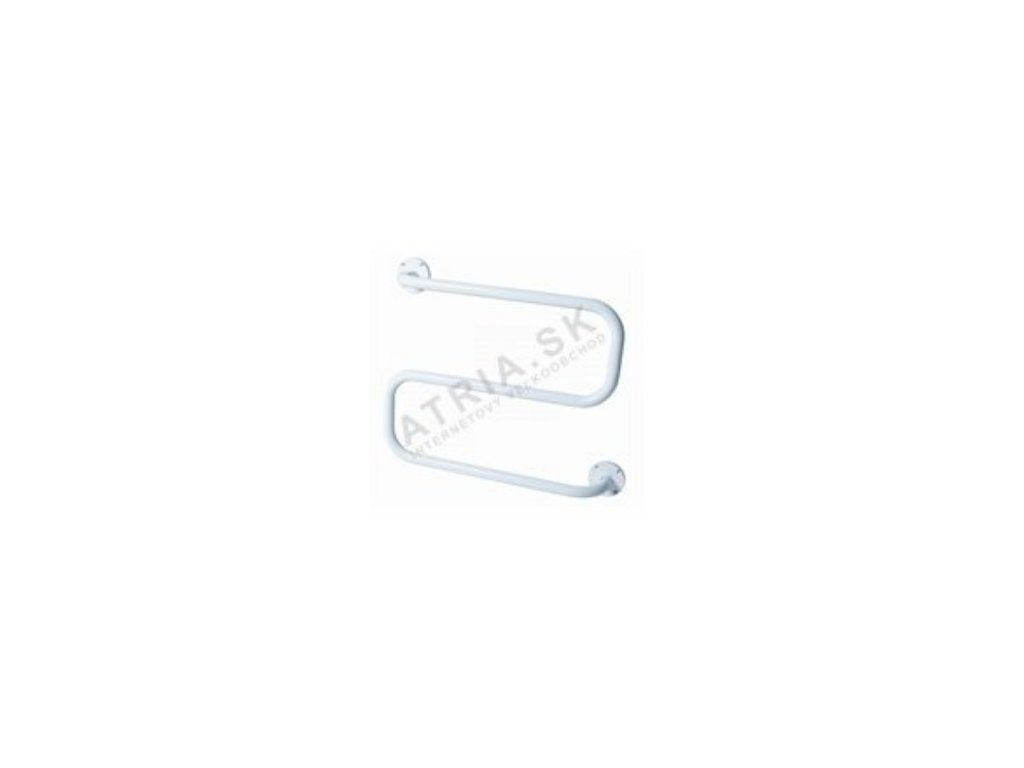 |
DEVIrail S Biely - a classic straight towel radiator, ideal for a continuous flat wall with no corner obstructions. The most universal and most affordable choice if your priority is output and simple installation. Price from €94.91. |
 |
DEVIrail U Biely - curved shape with rounded collectors, a practical choice for a room corner or a sloped attic bathroom ceiling, where a straight profile would run into the structure. Price from €90.02. |
 |
DEVIrail W Biely - wavy designer rung shape, suitable if the bathroom is conceived as a design space and the radiator is meant to be a visual element, not just a functional appliance. Price from €115.46. |
 |
Electric heating rod with thermostat, 150 W - white - a heating rod for standalone electric or combined operation, works equally well on a straight or curved radiator, and lets you finish drying towels outside the heating season without switching on the boiler. Price from €54.87. |
A practical example from a real installation
To make the differences more concrete, let's look at two typical cases we see in practice during flat bathroom renovations. The first case is a bathroom core in a panel building - the bathroom measures roughly 1.8 × 2.2 metres, with one longer wall completely free, with no window and no corner bathtub in the way. In this case the simplest and cheapest choice is a straight model such as the DEVIrail S - the wall is long enough, nothing gets in the way, and there's no reason to pay extra for a shape that brings no practical advantage. The required output is calculated the same way as for any other straight model - based on the room area and the need to finish drying textiles.
The second, somewhat more complex case is an attic bathroom in a family house, where only a short section of vertical wall is available (for example 60 cm) before the ceiling starts to slope. Here a straight radiator of standard height simply doesn't fit without hitting the slope, or it would have to be extremely low and wide, which looks impractical. In cases like this that we're familiar with, the curved U shape has proven itself - the rounded top of the collector lets the radiator "follow" the transition from the vertical wall into the slope, so the space that would otherwise be wasted with a straight model, or would force a smaller radiator than the room actually needs, gets fully used.
The third, less common but real case is a full design renovation of a larger bathroom (for example during a family house rebuild), where the owner treats the bathroom as a whole - tiling, wall covering, sanitaryware and accessories are all meant to form one visual concept. In jobs like this the wavy W shape comes up more often, because its striking shape can work as a standalone design element, similar to a statement light fixture or coloured tiling - in this context the extra cost over a straight model makes sense, because it's not being compared just to "an ordinary radiator" but to the overall room-design budget.
Surface finish - white or chrome
Regardless of the rung shape, almost every towel radiator model can also be ordered in a different surface finish, most commonly white or chrome (and in some models also anthracite or other shades). Choosing the surface finish is a separate decision from the rung shape, and we recommend dealing with it as a second step, once you're clear on the shape based on the room layout. A white finish suits bright, minimalist bathrooms and draws less visual attention, so it suits better if the radiator is meant to be more of a functional element than a design statement. Chrome, on the other hand, stands out better against darker tiling or an industrial interior style, where the contrast of shiny metal against matte surfaces is used. In terms of price, the chrome finish typically runs slightly higher than white for the same model and size, which is also common in other bathroom-technology categories, not just towel radiators.
Installation - where the shapes differ
From installation companies' experience, mounting the brackets on the wall (drilling, anchoring, levelling) is practically the same for both shapes - the brackets are always fixed to the vertical collectors, not to the shaped rungs, so the rung shape doesn't complicate installation. The difference comes up when connecting to the water supply on water and combined models: the curved U shape has its bottom connections slightly closer together (because rounding the top of the collectors sometimes also changes the spacing of the bottom connections), so it's important to always check the exact connection spacing in the technical sheet of the specific model before ordering, not just estimate it based on a straight radiator you fitted previously.
For the electric or combined version (with a heating rod such as the Electric heating rod with thermostat 150 W mentioned above), the radiator's shape has no effect at all on fitting the rod - the rod is always fitted into the bottom connection point of the collector the same way, regardless of whether the rest of the radiator is straight or curved.
Maintenance and cleaning
In everyday use, cleaning a straight radiator is simpler - the straight rungs at regular spacing can be wiped with a single pass of a cloth from top to bottom. The wavy W shape has more nooks where dust and limescale can settle (especially with harder water and insufficient bathroom ventilation), so for this type we recommend wiping with a dry cloth somewhat more often, and possibly treating the surface with a limescale-prevention product if the bathroom is exposed to high humidity without extraction. The U shape sits somewhere in between in terms of maintenance - the curve itself doesn't collect any more dust than a straight profile, it's only slightly more fiddly to wipe the curved top section itself.
When to choose straight and when curved - a practical summary
Summing up experience from typical installations, the decision can be simplified into three practical questions to ask in this order:
- Do you have a continuous flat wall of sufficient width with no obstructions? If yes, the straight shape is the simplest, cheapest and most universal choice - there's no reason to complicate your decision with a shape that brings no practical advantage.
- Is there a corner, sloped ceiling or other spatial obstruction at the installation spot? Here it's worth considering the curved U shape, which can adapt better to an irregular room geometry without losing heating output.
- Is the bathroom part of a larger design renovation, where the radiator is meant to be a visible aesthetic element? In this case consider the wavy W shape, which for a comparable output offers a different visual character, for a reasonable extra cost of roughly €20-30 over a straight model of similar class.
In none of these three cases is the radiator's shape a reason to compromise on output - always work out the required output based on the room's area and insulation first, and only then choose the shape among the suitable models based on layout and aesthetics. Doing it the other way round (choosing a shape based on looks first, and only afterwards checking whether the output fits the room) is the most common mistake we see in practice behind "radiator doesn't heat enough" complaints - the problem usually isn't the shape, but an undersized output for the chosen model.
Frequently asked questions
Does a curved shape have lower output than a straight one at the same outer dimensions?
No, in most cases it's the opposite or comparable - especially the wavy W shape has a longer heating tube within the same footprint, so the output isn't lower. Always check the exact wattage in the model's technical sheet though, don't rely purely on an estimate based on shape.
Can a curved radiator be fitted afterwards onto an otherwise flat wall?
Yes, the radiator's shape isn't tied to a specific type of wall - a curved U or W shape can be mounted on a completely flat wall with no obstructions too, you just won't be using its main practical advantage (adapting to a corner or slope) in that case, and you're paying more for the design.
Is installing a curved radiator more expensive or more demanding than a straight one?
Anchoring the brackets themselves is comparable for both shapes. There can be a slight difference in connecting to the water supply on water models, where you need to check the exact connection spacing in the technical sheet before ordering - for electric versions with a heating rod, this difference disappears entirely.
Is it worth paying extra for the wavy W shape purely for the looks?
If the bathroom is part of an overall design renovation and the radiator is meant to be a visible element, an extra cost of roughly €20-30 over a straight model of similar class is comparable to the extra cost of other design elements in the room (for example better tiling), and it's a legitimate decision. If you're purely after function and output, the extra cost brings no practical advantage.
Does the radiator's shape affect how demanding cleaning and maintenance are?
Yes, slightly. The straight shape is easiest to clean (straight rungs, one pass with a cloth), the wavy W shape has more nooks where dust or limescale can settle in high humidity, so it needs slightly more frequent maintenance. The U shape is comparable to straight in terms of maintenance, only the curve itself is a bit slower to wipe.
Can straight and curved radiators be combined in the same household?
Yes, without any problem - for example a straight model in the main bathroom, where there's enough flat wall, and a curved model in a smaller attic bathroom with a sloped ceiling. Visual consistency is better achieved through the same surface finish (e.g. white or chrome) than through the same rung shape.
Related topics
- How to choose a towel radiator for the bathroom
- Electric, water or combined towel radiator
- What output does my towel radiator need
- Installing a towel radiator
Back to the main category: Towel radiators
Have a question on this topic?
Can't decide, or dealing with a specific situation in your home? Write to us - we're happy to help.