
How to run a towel radiator outside the season
Why it's worth paying attention to your towel radiator outside the heating season too
Most households associate a towel radiator purely with the heating season - it comes on in October, goes off sometime in April, and for the remaining five or six months many people forget about it completely. Yet this period of "silence" is, from a practical point of view, just as important as the heating season itself. How the radiator is (or isn't) run in summer directly affects the condition you'll find it in come autumn, how long it lasts without corrosion or airlock, and whether it will still work as a practical towel dryer all year round.
In practice we see two extremes. The first is complete shutdown - the radiator is switched off, the valves are left in whatever position and nobody looks after it further. The second extreme is the opposite - especially with electric and combined towel radiators in the bathroom, people leave them running at full power even in summer simply because they use them to dry towels, regardless of whether that's sensible from an electricity-consumption point of view. The right approach lies somewhere in between - and that's exactly what this article is about.
We'll look at how summer operation differs between water, electric and combined towel radiators, what steps to take when switching from winter to summer mode, how much it really costs to dry laundry on an electric rod over summer, what to watch out for during a long shutdown, and which mistakes lead to the problems we see most often during autumn service calls.
Three radiator types, three different approaches to summer operation
Before getting into the specific steps, it's worth clarifying which type of towel radiator you have in your bathroom or hallway, because the summer procedure differs significantly between types.
Water towel radiator
Connected to the central heating, with hot water from the boiler as its only heat source. When the boiler is shut down for summer (typically for a combi boiler that also heats domestic hot water, or when the household has a separate hot-water tank), the radiator body has no heat at all and essentially becomes a cold piece of metal hanging on the wall. Its summer "operation" is therefore limited purely to questions related to the water inside the body - bleeding air, system pressure, possible corrosion.
Electric towel radiator
Works independently of the boiler - a heating rod fitted into the bottom of the body heats the heat-transfer liquid inside (usually oil or a water-glycol mixture) completely regardless of whether it's the heating season. This means an electric towel radiator can work as a towel dryer 12 months a year, independent of when the radiators in the living room are running. That's exactly its main advantage over a purely water-based solution.
Combined towel radiator
Has both circuits - in winter it's heated by the central heating, in summer (or at any time of year) it can be topped up or run independently via the built-in electric rod with its own thermostat. From the point of view of summer operation it therefore behaves like the electric type, with the one difference that it also has a water circuit which needs to be looked after the same way as the purely water type when the boiler is shut down.
Step by step: switching to summer mode
The following procedure applies to a typical household with central heating, where the heating season genuinely ends (the boiler is switched off or switches to domestic hot water only). We recommend going through it once in spring, once it's clear the heating won't be used again, and once in reverse in autumn before switching it back on.
1. Check the pressure in the water circuit
Before shutting the boiler down completely, check the pressure gauge on the boiler or the expansion vessel. If the pressure is significantly below the value recommended by the manufacturer (typically 1-1.5 bar for common household systems), top up the system according to the manual before summer - it's not pleasant to discover in autumn that the pressure has dropped away completely in the meantime and the system needs treating as a major repair instead of a routine top-up.
2. Bleed the radiator
Air that builds up inside the radiator body during the season causes a typical autumn problem - the top of the towel radiator stays cold even though the heating is running at full power. Using a bleed key or screwdriver (depending on the valve type), release the air until a continuous stream of water without bubbles starts flowing. This is one of the most common causes of "radiator not heating" complaints, yet it's a two-minute task that needs no service call.
3. Leave the valves slightly open
A common mistake is closing both the thermostatic and the shut-off valve completely for the whole summer. A valve left in one position for months tends to "seize up" - the pin inside the thermostatic head can get stuck in the closed position and won't move in autumn. We recommend leaving the valve slightly open, or "exercising" it manually once a month by turning it to both end positions and back.
4. Set the electric rod to summer or eco mode
On electric and combined towel radiators with a thermostat, most models offer several modes - comfort (higher temperature, fast drying), eco/energy-saving (lower temperature, slower but cheaper heat maintenance) and a timer. Over summer it makes the most sense to use either eco mode switched on just to dry a particular batch of laundry, or manual switching with a button rather than continuous operation.
5. Visually check for corrosion and check the joints
Check especially the areas around the screw joints and the air vent valve, where the risk of small leaks and subsequent corrosion is highest. A small stain or trace of moisture in spring is far cheaper to deal with than advanced corrosion discovered only in winter, under full system pressure.
The electric rod as a year-round dryer - what it really costs
This is the question we hear most often from customers - "is it worth leaving the rod on over summer too, so I always have dry towels?" The answer depends on the rod's power output and how many hours a day it actually runs.
Take a typical 150 W model (exactly the output of the thermostatic rod we recommend below) and an average household electricity price of around €0.20/kWh. The calculation is simple: 150 W = 0.15 kW, multiplied by the number of hours of daily operation, the number of days in the month (30), and the price per kWh.
- 2 hours a day (just to finish drying towels after a shower): 0.15 kW × 2 h × 30 days × €0.20/kWh = €1.80 a month
- 4 hours a day (morning and evening showers in a multi-person household): 0.15 kW × 4 h × 30 days × €0.20/kWh = €3.60 a month
- 8 hours a day (the rod runs practically all day, set to continuous operation): 0.15 kW × 8 h × 30 days × €0.20/kWh = €7.20 a month
These figures show that even in the highest scenario above, the amount is comparable to the price of a single lunch out - certainly not an expense that should put anyone off using a towel radiator as a dryer. A sensible compromise is to set the thermostat or timer so the rod only runs when laundry is actually being dried, not continuously 24 hours a day regardless of need.
Combined towel radiator - the most flexibility in summer
If you're deciding which type of radiator to choose specifically because of summer use, the combined type is the most versatile in this respect. In winter it works as a full water radiator connected to the central heating; in summer it's simply switched over to the electric rod with its own thermostat and serves as an independent dryer regardless of whether the boiler is running or not.
A practical example from an ordinary household: a family of four in a flat with central heating originally had a purely water towel radiator in the bathroom. Over summer it was completely useless to them - a cold piece of metal on which towels dried just as slowly as on a regular rail. After switching to a combined model with an electric rod, they were able to dry towels and bath sheets year-round, while still using the cheaper heat from the boiler in winter and switching the electric rod on only occasionally to top up.
 |
DEVIrail W Biely - a combined towel radiator that runs on the water circuit in winter and can be operated independently in summer via its built-in electric rod - exactly the kind of flexibility described above. Price from €115.46. |
A water towel radiator with no rod fitted - what to do with it over summer
If you have a purely water type without an electric rod and don't want to invest in replacing the whole unit, there's a simpler solution - an additional electric heating rod with a thermostat that screws into the radiator's bottom outlet in place of the original plug. This type of add-on essentially turns a purely water radiator into a combined one without having to replace the whole body, which is a significantly cheaper solution.
 |
Electric heating rod with thermostat, 150 W - white - exactly the rod used in the cost calculations above (€1.80 to €7.20 a month depending on how long it runs). It lets you fit a water radiator afterwards and run it independently of the boiler over summer too. Price from €54.87. |
Recommendations based on where and how you use the radiator
When choosing or upgrading a radiator for year-round use, it's worth taking the specific room and way of using it into account too. Not every bathroom needs the same solution.
Smaller bathroom, occasional drying
For a smaller space, where it's enough to occasionally finish drying one or two towels, a more compact model with a lower-output rod and a simple thermostat, without the need for complex programming, is sufficient.
 |
DEVIrail U Biely - a more compact towel radiator suitable for smaller bathrooms, where occasional year-round drying is enough without needing a large output. Price from €90.02. |
Larger household, multi-person family
In a larger bathroom, where a bigger amount of laundry is dried every day (typically the 4-hours-a-day scenario from the calculation above), it's worth going for a model with a higher output or a larger body surface, so towels dry more evenly across the whole height of the radiator.
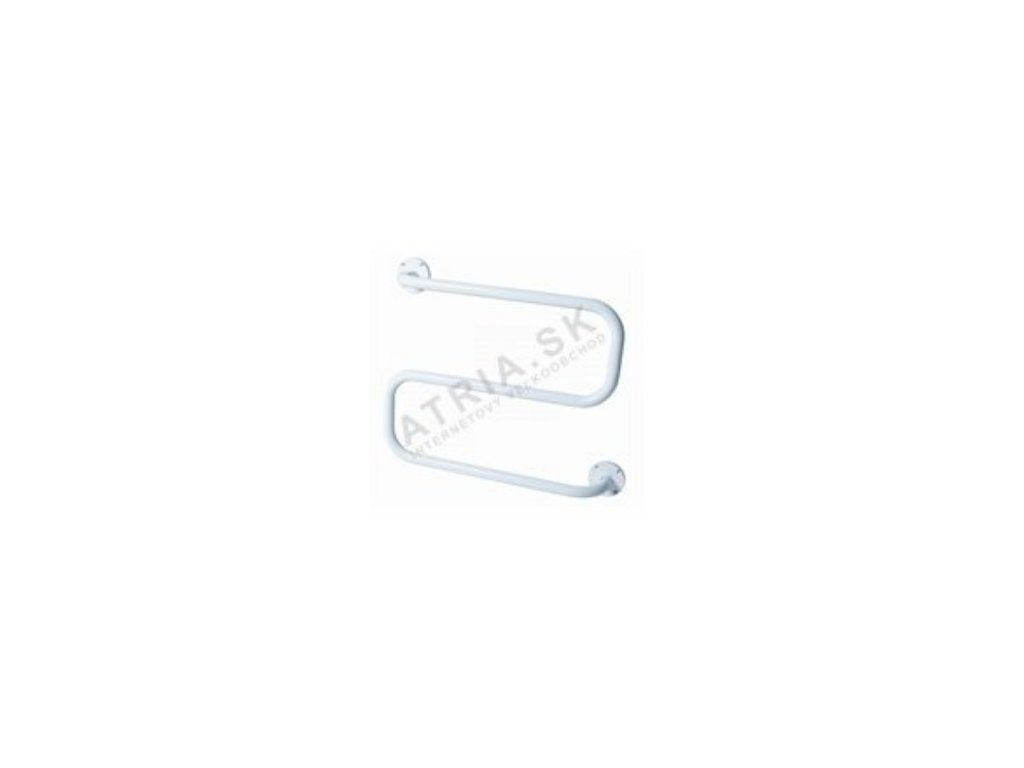 |
DEVIrail S Biely - a popular mid-sized model, suitable for an ordinary family bathroom with year-round drying use. Price from €94.91. |
Chrome design option
For those who prefer a chrome surface over white lacquer (for example to match other bathroom accessories), the same model is also available in a chrome finish with identical operating parameters.
 |
DEVIrail S Chróm - the same proven model as the DEVIrail S Biely, just in a chrome finish, for matching with other bathroom accessories. Price from €99.81. |
The most common mistakes in summer operation
Years of experience with servicing and advising customers show the same handful of mistakes coming up again and again, responsible for most of the problems discovered only when the heating is switched back on in autumn.
Closing the thermostatic valve completely for the whole summer
As mentioned above, a valve left in one position for months tends to seize up. The solution is either to leave it slightly open, or to "exercise" it regularly, once a month.
Forgetting the electric rod running continuously
Some users set the rod to maximum output the first time they use it and never come back to the setting. For a 150 W rod running continuously (24 hours a day, a scenario that exceeds even our highest example above), the monthly cost climbs well past €21 - and that's only because nobody switched it to a more economical or timed mode.
Ignoring small traces of corrosion
A small rust spot at a joint won't get dramatically worse over summer, but if left untreated, it can develop into a real leak in autumn once system pressure rises again. Checking once every few weeks takes less than a minute.
Draining the whole system "just in case"
Some homeowners decide to fully drain the system for summer. For an ordinary sealed system in a family house, this usually isn't necessary and brings more risk (air in the system, refilling, risk of a mistake when restarting) than benefit. It's enough to keep the system under mild pressure and check it regularly.
The effect of summer operation on humidity and mould in the bathroom
Besides heating itself, a towel radiator in the bathroom has another important function that's often forgotten over summer - it helps remove moisture from the room after a shower or bath. In winter this drying happens almost automatically thanks to the heat from the central heating, since the radiator runs practically continuously. In summer, when the water circuit is shut down, this function disappears completely - and it's precisely during this period, when windows are often opened less thoroughly because of the heat (for example only briefly because of air conditioning), or conversely the bathroom stays closed because of cold air conditioning in other rooms, that moisture can build up just as intensely as in winter.
This is exactly where the advantage of an electric rod or combined radiator shows itself fully. Even a short period of low-power operation after an evening shower (for example one to two hours, corresponding to the lower end of our cost calculation, i.e. around €1.80 a month) significantly reduces the risk of mould forming in tile joints, behind furniture or in ceiling corners. An investment of a few euros a month is negligible compared with the cost of mould remediation, which can spread through a poorly ventilated bathroom over the course of a single summer.
The recommended approach is simple - after every shower or bath, let the rod run for a short time (typically 30 to 60 minutes), then switch it off or let it drop into eco mode. On models with a programmable timer, this cycle can be set once and then left alone - the rod starts automatically at the times the household normally showers (for example morning and evening), and stays off or at minimum output the rest of the day.
Service check before the end of summer - what to prepare in advance
To make the transition back into the heating season go smoothly, it's worth preparing a check during August, before the first cooler night arrives and most households switch their boiler on at once (which traditionally also means service technicians are busier, should you happen to need professional help).
Prepare the following - note down the current system pressure value you recorded in spring when switching to summer mode, so you can compare whether it has dropped significantly over summer (which would indicate a hidden leak). Check that all the thermostatic valves on the radiator turn smoothly across their whole range - if one is stiff or sticks, it's better to find out now, with plenty of notice, than on the first cold evening when you need heating immediately. Finally, check whether any new traces of corrosion have appeared on the radiator's surface or at the joints during summer, which could develop into a real leak once pressure rises again in autumn.
For combined and electric models, also check the condition of the power cable and plug - during summer, when the bathroom is often more humid due to more frequent showering, it's worth making sure the cable insulation shows no cracks and the plug isn't damp or corroded. This is a routine safety check that takes less than a minute but significantly reduces the risk of problems during year-round operation.
Summary - what to take away from this article
Summer isn't a period when you don't need to look after your towel radiator at all - on the contrary, it's a good opportunity to carry out a few simple tasks that extend its life and save you trouble in autumn. Check the pressure and bleed the water circuit, don't leave the valves in one position for months, choose a sensible mode for the electric rod instead of continuous operation, and check the condition of the joints and surface from time to time. If you miss having a purely water radiator as a dryer over summer, an additional electric rod or switching to a combined model can solve this shortcoming at a reasonable price and with low running costs of just a few euros a month.
Frequently asked questions
Do I have to switch the radiator off completely for summer?
A water radiator "switches off" automatically along with the boiler shutting down - there's nothing special to do besides checking the pressure and bleeding air. You don't need to switch the electric rod off at all - just switch it to a more economical or timed mode and use it as needed for drying.
Is it safe to leave the electric rod on when nobody is home?
Quality thermostatic rods are designed for long, uninterrupted operation and have a built-in thermal cut-out. Even so, for longer absences (a holiday of more than a week) we recommend switching the rod off, the same way you would with any other electrical appliance that doesn't need to keep running.
How much do I actually save by switching the rod from continuous operation to a timer?
For a 150 W rod, the difference between 8 hours a day (€7.20 a month) and 2 hours a day (€1.80 a month) is around €5.40 a month, which over three summer months amounts to roughly €16 saved without any reduction in comfort for drying a normal amount of laundry.
Do I need to drain the water from the radiator before summer?
For an ordinary sealed heating system in a family house or flat, this isn't necessary and usually brings more risk (refilling, air in the system) than benefit. It's enough to keep the system at the recommended pressure.
Can an electric rod be fitted into an existing water radiator afterwards?
Yes, as long as the radiator has a free or closable bottom outlet suitable for fitting a rod - in that case it's enough to replace the plug with an electric heating rod with a thermostat, which turns a purely water radiator into a combined one without having to replace the whole body.
Why is the top of the radiator cold even when the heating is running?
The most common cause is air that built up in the top of the body during the summer shutdown. The solution is simply to bleed it through the air vent valve, which should be part of the routine autumn check before switching the heating on.
Related topics
How to choose a towel radiator for the bathroom
Electric, water or combined towel radiator
Most common towel radiator faults
Have a question about running your radiator in summer?
Can't decide which mode to set, or dealing with a specific situation in your bathroom? Write to us - we're happy to help.