
Frequently Asked Questions about Bathroom Fixtures and Taps
Frequently asked questions about bathroom fixtures and taps
The bathroom and kitchen are among the rooms where plumbing problems show up the fastest and most painfully - a dripping tap, a clogged trap or a burst hose can cause damage in a few hours that takes weeks to repair. When choosing fixtures and taps, customers keep asking us the same things over and over: which type of tap to choose, why the water flow is too weak or, conversely, dangerously strong, what material the sink should be made of, how often to replace hoses, and what to do when a tap starts dripping. In this article we have gathered the most common questions we encounter when advising on our range of bathroom fixtures and taps, and we answer them practically, without unnecessary sales pitches - where it makes sense to recommend a specific product, we mention it; otherwise we stick to plain facts and installation experience.
Why is the topic of fixtures and taps so complicated?
At first glance it looks like a simple product category - a tap lets water through, a sink drains it away, a trap prevents sewer odour. In practice, however, several variables come into play at once: the pressure in your water supply, the pipe material, water hardness, the type of installation (concealed versus surface-mounted), the space available under the sink, and even aesthetic requirements for colour and finish. This combination of factors is why the same tap can work flawlessly for ten years for one customer and start dripping or humming within a year for another. That is why, in the answers below, we try to explain the "why" behind each recommendation, not just the "what to buy" itself.
What is the difference between the various types of bathroom and kitchen taps
The first question most customers ask is: pillar-mounted, or wall-mounted tap? A pillar tap is installed directly into a hole in the sink or basin, with the water connections running underneath it - this is the more common, cheaper and easier variant to install and later replace, because it can be accessed from below without breaking any tiling. A wall-mounted (concealed) tap emerges directly from the wall above the basin or bath, giving a cleaner and more modern look, but its installation and any subsequent repair requires work on the wall and usually the presence of a plumber already at the shell-construction stage, because the concealed body has to be built into the wall before tiling.
An example of a good pillar-mounted solution is the LOOP sink tap, which we regularly recommend for kitchen setups precisely for its easy installation and durable construction:
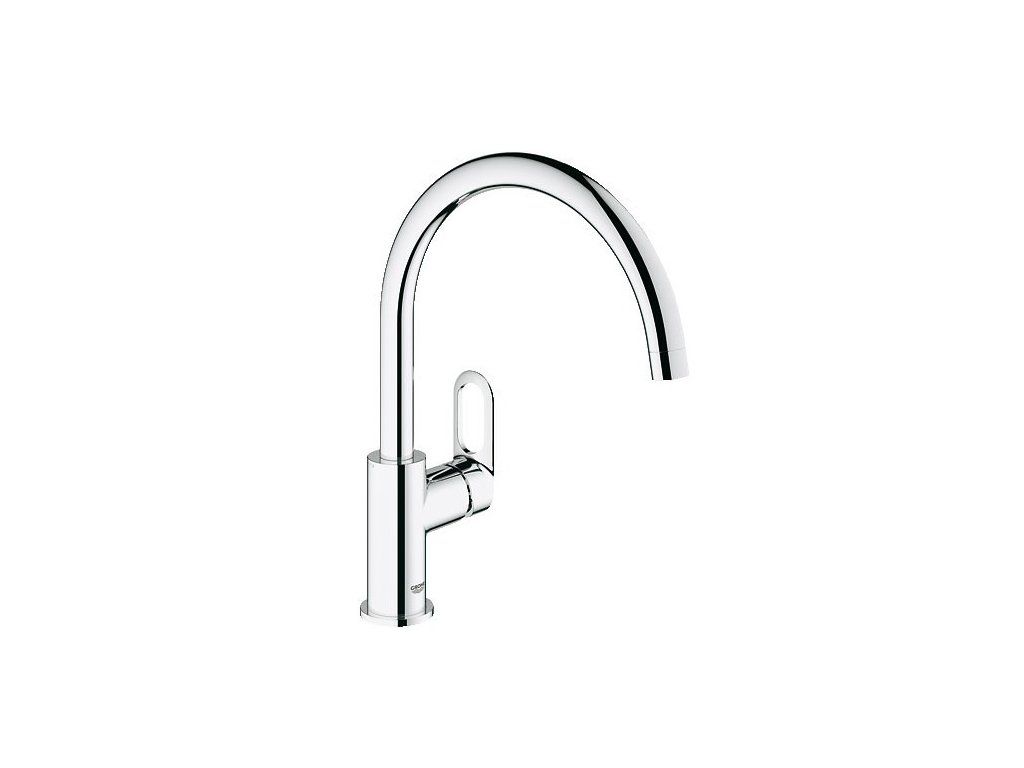 |
946487 pillar-mounted sink tap, LOOP - a pillar-mounted design means easy installation and servicing without touching the wall, a suitable replacement during a kitchen renovation without breaking any tiling. Price from 114.75 EUR. |
The second important choice is the type of control - a lever (single-lever) tap is now the standard, because it allows smooth regulation of both temperature and flow with a single motion and has fewer moving parts that can wear out, compared to older two-tap fittings with separate hot and cold controls. Inside the lever, a ceramic cartridge is now used almost exclusively - two ceramic discs that slide against each other as the lever is turned, closing or opening the flow. A ceramic cartridge is significantly more durable than the older rubber seals and is also the main reason a quality tap can go for years without dripping - problems only start once dirt or limescale gets into the cartridge, which is covered in more detail below in the troubleshooting section.
Why water pressure matters and when you need a reducing valve
This is the question customers underestimate most often, yet it has a direct impact on the lifespan of absolutely all the fixtures in a household - taps, washing machine, dishwasher and water heater alike. An ordinary domestic water supply is designed for an operating pressure of roughly 2 to 4 bar. If a household is located lower in the terrain or close to a water utility pumping station, the pressure in the public mains can reach 6 to 8 bar, and in extreme cases even more. Excessive pressure shows up outwardly as "strong" water from the tap, which feels pleasant, but in reality it puts excessive strain on seals, cartridges and hoses - a cartridge rated to last ten years at 3 bar can start dripping after just two years at 7 bar, because the rubber and ceramic sealing surfaces are constantly exposed to higher contact pressure.
The solution is a pressure reducing valve fitted right after the main water shut-off, which lowers and stabilises the inlet pressure to a safe value regardless of how much the public mains delivers. A typical household reducing valve has a 1/2" connection, is rated for an inlet pressure of PN 25 bar (meaning it can handle brief spikes up to 25 bar without damage), and has an adjustable working (outlet) range of 1 to 6 bar, while being equipped with a pressure gauge with a range of 0 to 10 bar, on which you can directly read the value the pressure is currently set to. The maximum operating water temperature for such a valve is typically +40 °C, which corresponds to domestic hot water - this type of valve is not used on hot-water heating circuits.
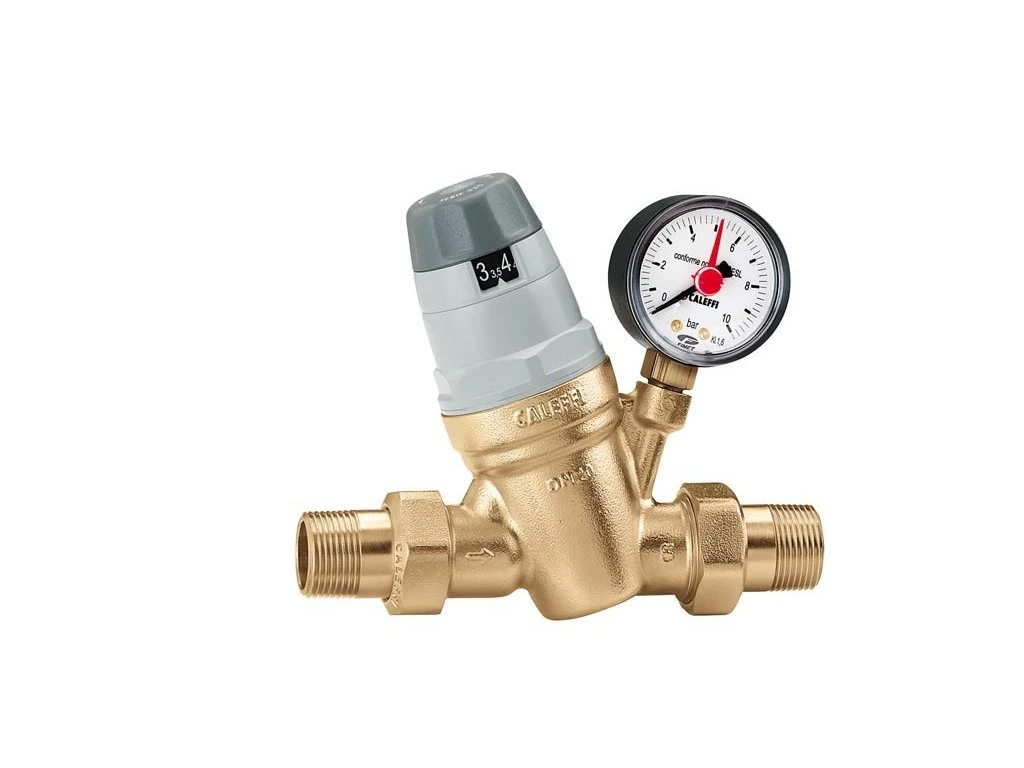 |
Pressure reducing valve 1/2", PN 25bar, working range 1-6 bar, T max. +40 °C, pressure gauge 0-10 bar - a good first investment if you suspect high pressure in the supply, protecting every tap and appliance downstream. Price from 90.73 EUR. |
How do you find out whether you actually have high pressure? The simplest sign is that a tap "bangs" or briefly hums when closed abruptly, or that water flows out forcefully and splashes even with the lever only slightly open. The definitive answer comes from fitting a pressure gauge, or a reducing valve with a built-in gauge, right after the main shut-off, where you can read the pressure directly from the black needle on the dial.
What sink or basin material to choose
When choosing a kitchen sink, or a bathroom basin, the choice is most often between ceramic, stainless steel and granite (composite) material. Ceramic is the traditional choice for basins, looks clean and hygienic, but can crack or chip if a heavy object is dropped on it. A stainless steel sink is resistant to impact and high temperatures and is easy to clean, but with harder water and the wrong cleaning product it can lose its shine over time, and fine scratches can appear on the surface, which are more visible on glossy finishes than on brushed ones.
A granite sink - more precisely, a composite material made of quartz granulate and acrylic resin - is a very popular choice for kitchens today, because it combines the durability of stainless steel with quieter operation (water and pots and pans do not resonate as loudly in it as in thin stainless steel) and with the option to choose a colour shade that matches the kitchen units - for example, a dark, almost black finish looks very elegant combined with a dark worktop and also hides small limescale marks better than light-coloured surfaces.
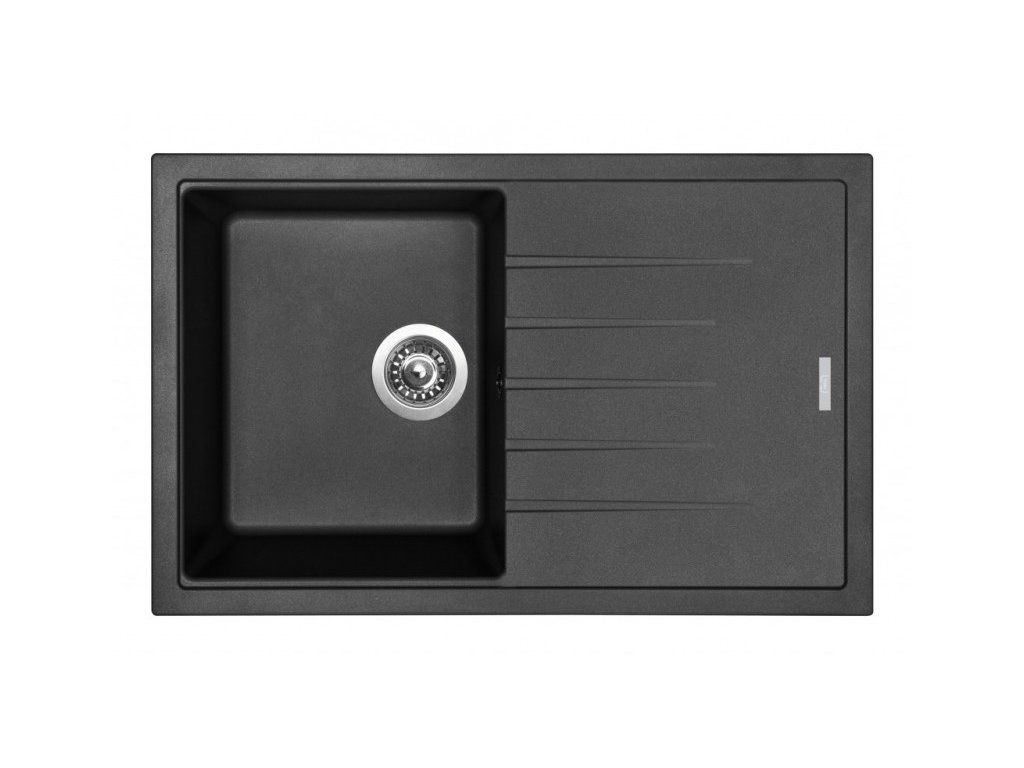 |
Granite sink Sinks BEST 780 Metalblack - a dark granite surface resistant to scratching and heat, a good choice combined with dark or neutral kitchen units, quieter in use than thin stainless steel. Price from 170.98 EUR. |
When choosing between materials, we recommend considering above all how the kitchen is actually used for cooking - if heavy cookware is often used (cast-iron pans, large pots), both granite and stainless steel are a safer choice than fragile ceramic. If the priority is easy cleaning and resistance to coffee or red wine stains, a darker shade of granite is generally more practical than a light one.
What a trap is for and how to choose one
A trap is a part of the drainage system that, thanks to its curved shape, permanently holds a small amount of water in its lower section - this water seal is the only thing that prevents odour from the sewer pipe rising back up through the drain into a basin, bath or sink. If you do not use a trap for a long time (for example a drain in a utility room or a bath in a flat you do not stay in for extended periods), the water in the seal eventually evaporates and sewer odour starts spreading into the room - the solution is simply to regularly run at least a little water into every drain in the household, including the ones you do not use daily.
For baths, a so-called automatic trap with fill and overflow function is now commonly used - it combines a classic drain trap with an overflow opening (protects against overfilling the bath) and a mechanical or remotely operated closure, which allows you to fill the bath without needing to return to it during filling to manually plug the drain with a stopper.
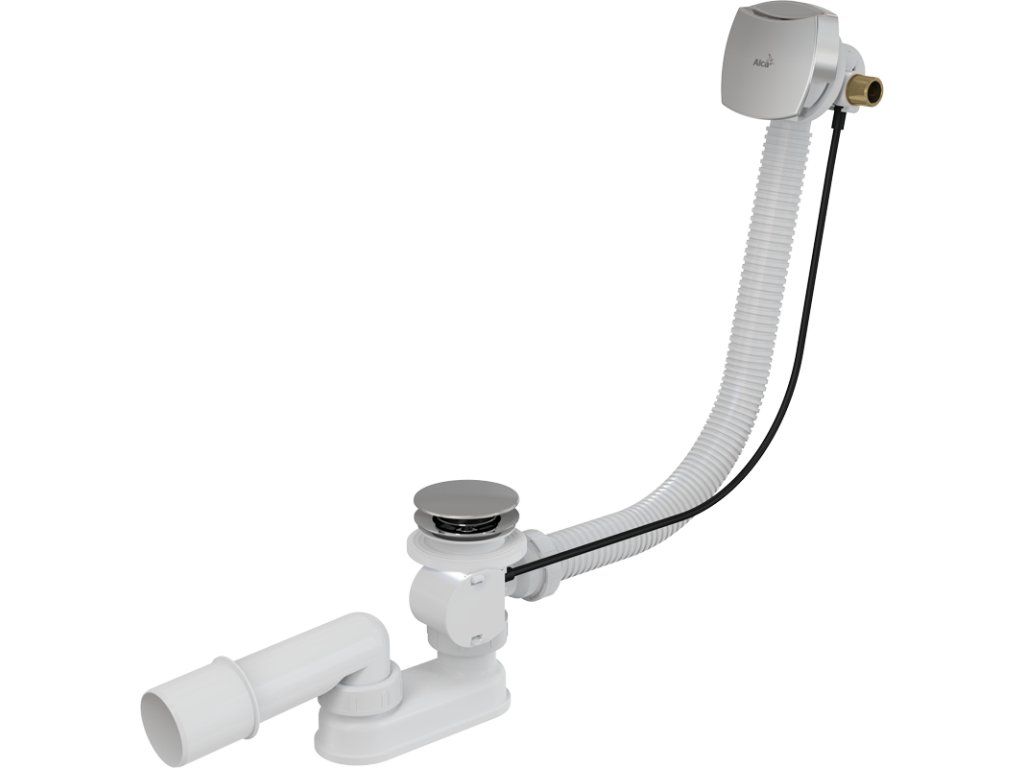 |
Bath trap, automatic, with filling overflow, chrome - combines drain, overflow and filling mechanism into a single unit; the chrome-plated surface matches most of today's taps. Price from 102.08 EUR. |
When choosing a trap, the main thing to pay attention to is that the diameter and type of connection match the given basin, sink or bath - universal traps with a telescopic (sliding) connection are more convenient to install, but for baths with automatic opening you should always verify that the mechanism is compatible with the specific type of bath, especially for deeper or unusually shaped baths.
How to choose connection hoses and when to replace them
A connection (flexi) hose links the shut-off valve in the wall or floor to the inlet on the tap, and it is the component most underestimated in the case of flooding incidents - yet a burst hose is one of the most common causes of major water damage in households, because bursting often happens at night or while the owners are away, when nobody stops the leaking water right away. The recommended replacement interval for connection hoses is 5 to 8 years regardless of whether the hose looks fine on the outside - the rubber core inside the braid ages even without visible external signs, and its cracks are not visible from the outside.
A quality hose should have a stainless steel braid and stainless steel fittings (not galvanised or chrome-plated brass, which corrode over time) and be certified for drinking water, which is particularly important for hoses that are in direct contact with water intended for drinking and cooking, i.e. at kitchen sinks.
 |
Stainless steel extendable hose PROFI S for drinking water with stainless steel fittings - stainless steel braid and fittings, certified for drinking water, extendable design makes installation easier in the tight space under a sink. Price from 11.07 EUR. |
Practical advice from installations: when you replace a tap, always replace the connection hoses at the same time, even if they still look fine - their cost is negligible compared to the work involved in taking the trap and cabinet apart again in case of a later flood, and since you already need access to the supply lines while replacing the tap, this is the cheapest possible moment for a preventive replacement.
How a typical bathroom or kitchen tap installation works
Installing a pillar-mounted tap on a sink or basin follows, in most cases, the same sequence of steps, which is useful to know before you attempt a replacement yourself, or so you know what a fitter is doing in your home.
- Shutting off the water supply - first the main or local shut-off valve for both cold and hot water is closed, then the remaining pressure in the pipework is released by opening the old tap.
- Removing the old tap - disconnecting the old connection hoses and unscrewing the mounting nut from under the sink or basin.
- Checking and preparing the hole - verifying that the hole in the sink/basin matches the diameter of the new tap, and fitting a sealing washer if needed.
- Fitting the new tap - passing the body of the tap through the hole from above, tightening the mounting nut from below without overtightening (so as not to damage the seal).
- Connecting the new hoses - screwing the new connection hoses onto both the cold and hot water inlets, taking care to get the order right (hot on the left, cold on the right, by standard convention).
- Turning on the supply and checking for leaks - slowly opening the shut-off valves, checking all the joints for dripping, and tightening if needed.
- Bleeding air and functional test - running the water for a few minutes to bleed air out of the system, checking that the lever moves smoothly and that flow is even.
Most common problems with fixtures and taps and how to solve them
A dripping tap is by far the most common problem customers bring to us. In most cases it is a worn or dirty ceramic cartridge inside the lever - the solution is usually to replace the cartridge itself (it can be bought separately as a spare part), not the whole tap, as long as the body of the tap and its finish are otherwise fine. If dripping persists even after replacing the cartridge, the cause may be excessive pressure in the supply, which we wrote about above - in that case even a new cartridge will not last long, and the cause needs to be addressed, not just the symptom.
Low flow or "spitting" water from the tap's spout is usually caused by a clogged aerator (the mesh at the end of the outlet), where limescale and small debris from the pipework accumulate. The aerator can usually be unscrewed by hand or with small pliers, cleaned by soaking in a vinegar solution and brushing, or cheaply replaced with a new one, since it is a standardised threaded part.
Odour from a drain, as we mentioned with traps, usually means a dried-out water seal at a drain that is not being used - it is enough to run water for a minute into every drain in the household once every few weeks. If the odour persists even after filling the trap, the seal of the trap itself may be damaged or leaking and needs to be replaced.
Noise or "buzzing" in the pipework when a tap is closed (so-called water hammer) is another typical sign of high or unstable water pressure, which again is most reliably solved by fitting a pressure reducing valve with an adjustable outlet pressure, possibly combined with a water hammer arrestor if the problem persists even after the pressure has been reduced.
Corroded or limescale-covered connection hoses, recognisable by white deposits at the fittings or by braid that has lost its flexibility, should be replaced immediately, not left until they burst - as noted above, the recommended interval is 5 to 8 years even without visible symptoms.
Comparison of approximate prices of selected products from the range
To give a better idea of the price range of common items from our fixtures and taps range, here is a comparison of the approximate prices of five products mentioned above - from the cheapest connection hose to the granite sink.
The comparison shows that prevention (a reducing valve, hose replacement) is always significantly cheaper than subsequent repairs or the complete replacement of more expensive components such as a sink or a whole tap - which is why it pays to invest in a reducing valve and regular hose replacement before the first signs of trouble even appear.
How to decide between chrome and other finishes
Chrome remains the most universal and generally the most affordable finish for taps and accessories, because it matches practically any bathroom or kitchen style and is also the most resistant to mechanical damage compared to matte or coloured finishes (brushed nickel, matte black), on which fingerprints and small scratches are more visible. If you are choosing between several finishes within a single room (tap, trap, shower head), we recommend keeping the finish consistent across all elements - combining glossy chrome and matte black in one small room often looks unintentionally disjointed, unless it is a deliberate design choice.
As mentioned above, even a connection hose that looks flawless on the outside has a recommended replacement interval of 5 to 8 years from installation, because its rubber core ages independently of the condition of the outer braid.
Frequently asked questions
What water pressure is ideal for a household?
An operating pressure in the range of 2 to 4 bar is generally recommended. Higher pressure (from around 6 bar upwards) shortens the lifespan of seals, cartridges and hoses, and it is advisable to reduce it with a pressure reducing valve with an adjustable outlet range, for example the 1 to 6 bar range mentioned above.
How often do connection hoses to a tap need to be replaced?
The recommended interval is 5 to 8 years regardless of the visual condition of the hose, because the rubber core inside the braid ages even without visible external signs. When replacing a tap, it is worth replacing the hoses at the same time, since access to the supply lines is needed anyway.
Why does my tap drip even though it is still fairly new?
The most common cause is a dirty or slightly worn ceramic cartridge, often as a result of high pressure in the supply or debris from the pipework. The solution is to replace the cartridge, possibly combined with fitting a reducing valve if the problem is related to pressure.
Which sink material is the most durable?
Stainless steel and granite (composite) material are, in practice, the most resistant to impact and high temperatures. Granite also dampens noise during use and offers a wider range of colours, which is an advantage when matching it to kitchen units.
Why does the drain in my bathroom or utility room smell of sewage?
The most common cause is a dried-out water seal in the trap of a drain that has not been used for a long time. It is enough to regularly (once every few weeks) run water into every drain in the household. If the odour persists, the seal of the trap itself needs to be checked.
Can a pillar-mounted tap be replaced by yourself, or is a plumber necessary?
With basic skill and access from under the sink/basin, replacing a pillar-mounted tap can be handled yourself following the procedure described above. For wall-mounted (concealed) taps, where work on the wall is required, we recommend calling in a professional, since a mistake in a concealed installation can only be corrected by breaking the tiling.
Related topics
If this topic interests you, take a look at other articles from our knowledge centre too:
- How to choose bathroom taps
- Installing a bathroom tap - a guide
- Most common tap problems and how to solve them
- Bathroom fixtures and tap maintenance
You can find the whole range of bathroom fixtures and taps in the main category Bathroom, sanitary fixtures, taps.
Have a question about this topic?
Not sure what to decide, or dealing with a specific situation in your home? Write to us - we're happy to help.