
How to Choose a Bathroom Faucet
How to Choose a Bathroom Faucet – a Practical Guide Without the Unnecessary Theory
A bathroom faucet is one of the few fixtures in a household that you use literally every day, several times a day, year after year without a break. Yet surprisingly little attention is usually paid to choosing one – buyers often pick based on the design in an online photo and only discover at home that the faucet doesn't match the water pressure in the house, that its spout is too short for the sink, or that the chrome layer starts peeling off the head after two years. In this article we'll go step by step through everything that actually matters when choosing a bathroom faucet – from the type based on location, through construction and material, to water pressure, accessories and installation. The goal isn't to sell you the most expensive piece, but to help you choose a faucet that will last and work exactly as you expect.
Types of Bathroom Faucets by Location
The first decision you have to make isn't about brand or design, but about exactly where the faucet belongs. Each position has different requirements for spout length, outlet height and the way it's operated.
A basin faucet is the most common type, both purchased and replaced. It stands directly on the basin or on the counter around it, has a shorter spout (typically 15–20 cm) and a lower outlet so it doesn't splash outside the basin. The normal operating pressure at which it works reliably is approximately 0.5 to 5 bar, which covers practically every Slovak household except tall apartment buildings without a booster station.
A bathtub faucet can be deck-mounted (on the edge of the tub), wall-mounted (on the wall above the tub) or part of a shower set with a bath/shower diverter. It works with a higher flow rate than a basin faucet, so it needs more stable pressure, generally from 1 to 6 bar, so the tub fills in a reasonable time while avoiding water hammer in the pipes when closing.
A shower faucet has the highest requirements for pressure stability, because any fluctuation immediately shows up as an unpleasant cold or hot shock while showering. The recommended range is 1.5 to 6 bar, ideally with a thermostatic element if the house supplies several outlets at once (for example a washing machine running at the same time as the shower).
A kitchen sink faucet isn't part of the bathroom, but the selection principles – lever cartridge, material, pressure range – are identical, so we'll occasionally mention it in the text as a reference.
Construction and Mechanism – Why the Lever Faucet Is Today's Standard
Older two-tap faucets (separate hot and cold water) can still be found in older apartments, but have almost disappeared from new installations. The reason is simple – with one hand and one movement you set both temperature and flow, which is faster, more economical and less demanding on the seals, which wear out over time in taps and start to drip.
The heart of a modern lever faucet is a ceramic cartridge – two ceramic discs that rub against each other and, depending on the lever's position, let through more or less water from both supplies. A quality cartridge (high-density ceramics) withstands hundreds of thousands of opening and closing cycles without leaking; a cheap cartridge made of lower-quality ceramics can start to leak after just one or two years of intensive use. When buying a faucet, it's worth checking the stated number of cartridge cycles in the technical sheet, if the manufacturer publishes it – it's a better indicator of lifespan than price alone.
The second important mechanical element is the aerator at the end of the spout – a fine mesh that mixes water with air. It reduces water consumption by up to 30% compared to a full stream without you noticing it during normal use, and at the same time prevents splashing. The aerator is also the most common place for limescale buildup, more on that in the maintenance section below.
This diagram shows the typical path of water in a family house with a well or with variable pressure from the public water supply – the reducing valve is fitted right after the main shut-off to protect the whole distribution system, including all faucets and appliances downstream. If your household suffers from fluctuating pressure (typically villages with wells or higher floors of apartment buildings supplied by a shared pump), this is exactly the point where the problem is solved systemically – not by replacing one faucet after another.
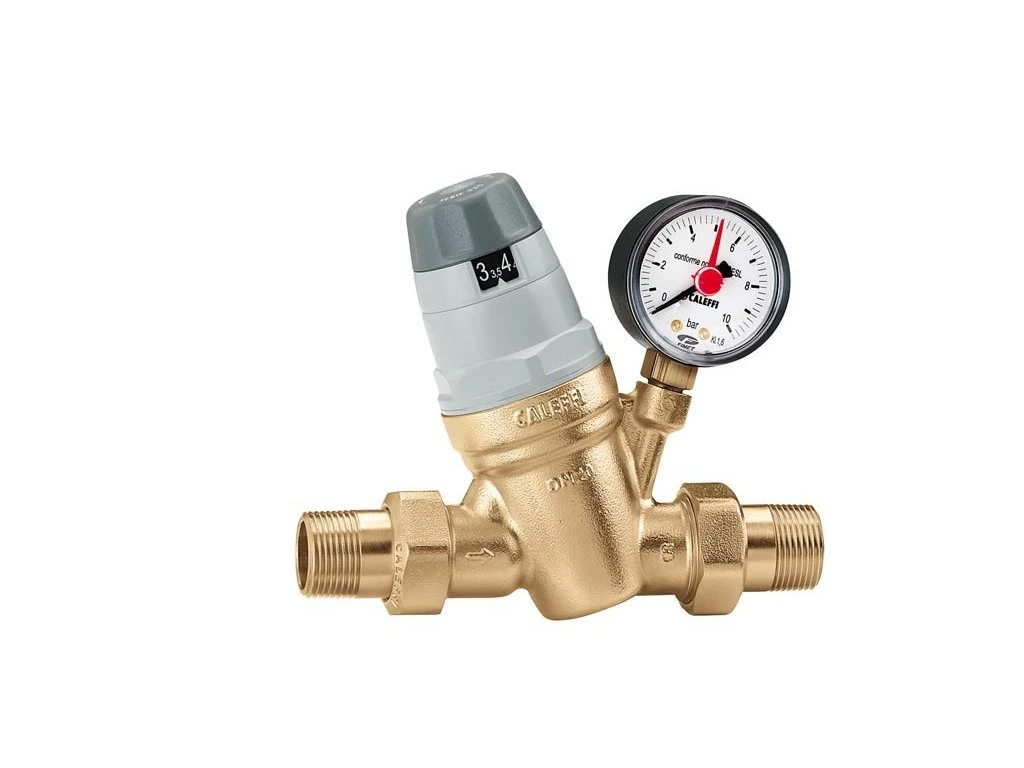 |
Pressure reducing valve 1/2", PN 25bar, working range 1-6 bar, T max.+40 °C, pressure gauge 0-10 bar - exactly the 1–6 bar range that bathtub and shower faucets need for reliable operation, with a pressure gauge right on the valve body so you can see the pressure without any further measurement. Price from 90.73 EUR. |
Material and Surface Finish – What Really Lasts
In terms of looks, chrome, brushed stainless steel and matte black compete on almost equal terms today, but what's underneath the surface makes a bigger difference to lifespan than you'd expect.
- Brass body is a long-proven standard – resistant to corrosion, holds threads and seals well, withstands temperature changes without deforming. With normal use and proper maintenance it lasts 15 to 20 years.
- Zinc die-cast (zamak) is used mainly in cheaper faucets – it's easier to machine and cheaper to produce, but is more brittle and more prone to internal corrosion, especially if the water contains more minerals. Real-world lifespan tends to be 5 to 8 years, sometimes less with hard water.
- Stainless steel is the most resistant to both corrosion and mechanical wear, suited especially to environments with more aggressive water or to wellness/commercial premises. Lifespan is usually around 20 to 25 years, though the price is higher.
The surface finish (most often chrome) is another layer that can be damaged independently of the body's quality – aggressive cleaning agents with acids or abrasive sponges can scratch or dull chrome even on a quality brass faucet. A damp cloth and a mild detergent are enough for cleaning, or a solution of water and vinegar to remove limescale, but never steel wool.
Water Pressure – the Most Commonly Underestimated Factor When Choosing
While most people think through the design and material of a faucet, water pressure in the household only gets addressed once the faucet "isn't working as it should" – weak flow, temperature fluctuations while showering, loud banging in the pipes when the lever closes. Yet most of these problems aren't a fault of the faucet, but a mismatch between the pressure in the system and the range the faucet was designed for.
As mentioned above, ordinary faucets work reliably in a range of roughly 1 to 6 bar. If your house has a well with its own pump, pressure can fluctuate significantly depending on how many outlets are open at once, or it can be permanently too high, which shortens the life of the seals and cartridges in all the faucets at once. The solution isn't to replace the faucets one by one, but to fit an adjustable-range reducing valve right after the main shut-off – the same principle shown in the diagram above, with the valve set precisely to a range of 1 to 6 bar and a built-in pressure gauge for instant checking.
Practical field advice: if you're not sure of the current pressure in your system, the cheapest and quickest diagnosis is precisely the pressure gauge on the reducing valve – within a few seconds you'll see the real value instead of guessing "the water is weak" or "the water is strong".
Accessories That Determine Installation Reliability
The faucet itself is only one link in the chain. Connection hoses and the drain trap can cause just as unpleasant problems (dripping, odor, clogging) as a poorly chosen faucet, and yet they get far less attention when shopping.
Connection Hoses
Cheap rubber or plastic hoses harden and crack over time and are the most common cause of a flooded bathroom when they fail during the night or a vacation. A stainless steel braided hose costs only a few euros more, but is significantly more resistant to cracking, pressure surges and UV radiation if routed near a window.
 |
Stainless steel expandable hose PROFI S for drinking water with stainless steel fittings - an expandable length of 50-100 cm makes installation easier even where the exact distance to the shut-off isn't known in advance, and the stainless steel fittings withstand pressure surges better than plastic ones. Price from 11.07 EUR. |
Drain Trap
With both basin and bathtub faucets, the trap is the thing most often forgotten, even though it's exactly what prevents odors escaping from the drain and ensures smooth drainage. An automatic trap with control right from the top part (no need to reach under the basin or tub) is now a common standard in mid and higher-tier faucets.
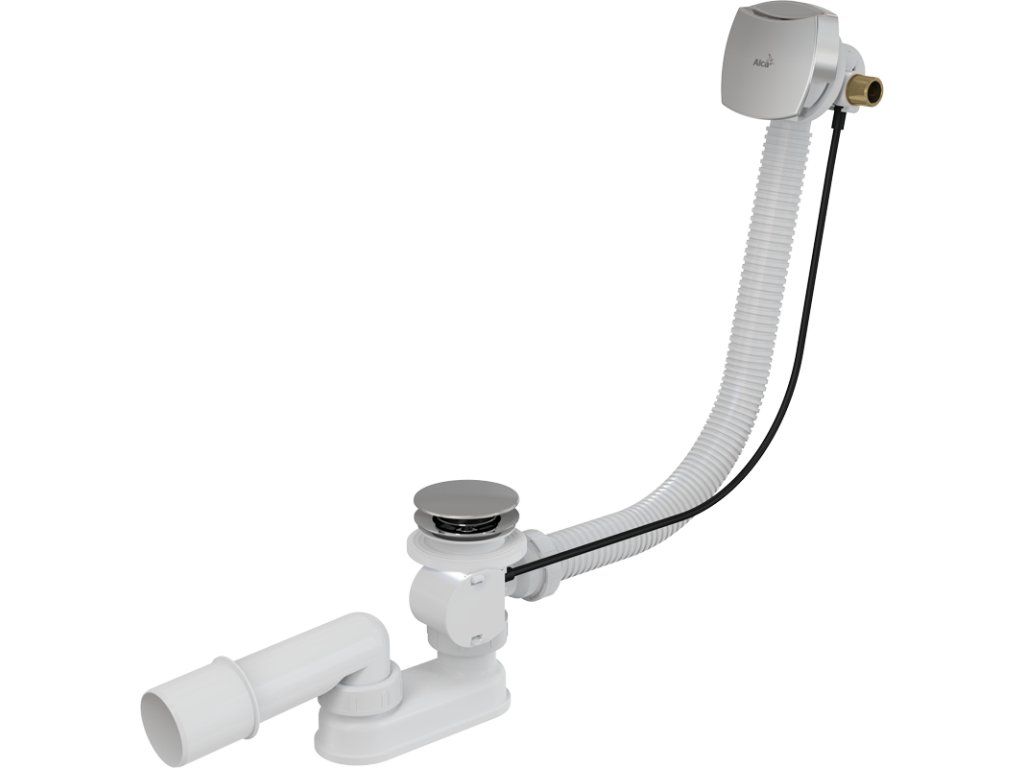 |
Automatic bathtub trap with overflow filling, chrome - the chrome finish matches most modern bathtub faucets, and automatic drain control simplifies everyday use and cleaning alike. Price from 102.08 EUR. |
Price Comparison of the Featured Accessories
When planning a budget for replacing or installing a faucet, it's worth counting not just the faucet itself but also the accessories around it. Below is a comparison of three real items from this article so you can see roughly where they sit in a budget.
As you can see, the hose is a negligible item in the budget, while the reducing valve and the trap represent an investment comparable to a mid-range faucet itself. That doesn't mean they're "expensive" – on the contrary, they're a one-time investment that protects the whole distribution system (the valve) or takes care of everyday comfort (the trap) for years to come.
How to Decide – a Simple Procedure
If you don't know where to start, stick to this order of steps instead of immediately browsing the catalog by design.
This procedure applies equally to a complete bathroom renovation and to a simple replacement of one old faucet for a new one – the only difference is how many steps you've already "solved" from the previous installation.
Installation – What to Watch Out for Even With a DIY Replacement
Replacing a basin or bathtub faucet with the same type (same number of holes, same connection spacing) is usually manageable as a DIY job if you have basic plumbing experience. Key steps:
- Shut off the water supply at the main shut-off or at the angle valves under the basin, not just at the faucet.
- Drain the remaining water from the pipe by opening the old faucet until it stops flowing.
- Remove the old faucet and thoroughly clean the seating area of old seals and any silicone residue.
- Install the new faucet with new connection hoses (never reuse old hoses, even if they look fine).
- When first turning the water on, run it slowly and check all joints for dripping, ideally with a paper towel, which reveals even a minimal leak.
For more complicated cases – changing the position of the supplies, switching from a two-tap to a lever faucet with different spacing, or any intervention in the piping behind the wall – it's worth calling in a plumber. The cost of a botched DIY installation (damaged wall, flooding the neighbor downstairs) far exceeds the labor savings.
Common Selection Mistakes That Are Easy to Avoid
Over the years of selling heating and water technology, the same scenarios keep coming up that lead to complaints or customer dissatisfaction:
- A spout that's too short or too long for the basin – the faucet either doesn't reach the middle of the basin, or splashes outside it at higher flow. Before buying, measure the basin's depth and compare it with the spout length in the technical sheet.
- Ignoring water pressure – a faucet designed for 1–6 bar won't work reliably at a constant pressure below 0.5 bar, typically on higher floors without a booster station. The solution is a booster pump, not another faucet replacement.
- Choosing the cheapest zinc faucet for hard water – the combination of more aggressive water and a less resistant material shortens lifespan from ordinary years to essentially months or low single years.
- Recycling old connection hoses when replacing a faucet – even visually undamaged rubber can be internally brittle and burst under the new pressure surge on first use.
- Forgetting the trap during a complete renovation – buying it separately after the tiling is finished complicates installation and sometimes requires a partial intervention into an already finished surface.
Water Savings and Operating Costs
In an average four-person household, bathroom water use makes up a substantial part of the total water bill, so it's worth paying attention to this aspect of choosing too, not just design and durability. The air-aerated aerator mentioned above can reduce flow without you feeling a weaker stream of water – a difference that really shows up on the annual water bill and on hot water heating too, since less water flowing through means less energy needed to heat it.
The second element is a flow limiter, which some models have built directly into the faucet body or the shower head. It limits the maximum flow to a preset value regardless of how far you open the lever – useful especially in households with children, where the lever is often opened fully without needing that much flow. For shower sets it's worth combining this feature with the thermostatic control mentioned above, since together they offer the highest comfort at the lowest consumption.
The third, often overlooked factor is how quickly the faucet reaches the desired temperature after opening. If the hot water pipe run is long (a distant boiler or heat source from the bathroom), every use first drains several seconds to tens of seconds of cold water from the pipe before hot water arrives – a loss that isn't affected by the type of faucet, but can be addressed with a hot water circulation pump, which is a separate topic beyond the scope of this article.
Warranty and Service – What to Ask When Buying
Most reputable bathroom faucet manufacturers provide a warranty on the faucet body of the standard statutory two years, and with some brands even longer on the cartridge itself, since it's the most heavily stressed part. When buying, it's worth checking two practical things that matter more than the warranty length on paper: the availability of a replacement cartridge as a separate part (if the cartridge manufacturer doesn't normally sell it separately, you'll have to replace the entire faucet if it fails after the warranty), and the availability of replacement aerators in a standard thread, so you can replace them at any time without having to order an original from the manufacturer with a long delivery time.
Summary
Choosing a bathroom faucet can be simplified to four questions: where the faucet belongs (basin, tub, shower), what the water pressure is in the household, how much you want to invest in the body material and surface finish, and whether you've also sorted out the hoses and trap around it. If you answer these four points before you start looking at design, choosing between specific models will just be a matter of taste – functionally the faucet will work reliably for years to come.
Frequently Asked Questions
What's the difference between a lever and a thermostatic faucet?
A lever faucet sets both temperature and flow with a single lever based on the position you choose manually with each use. A thermostatic faucet has a built-in mechanism that maintains the set temperature automatically regardless of pressure fluctuations in the system – you'll appreciate it especially for a shower in a household where a washing machine or other water-using appliance runs at the same time.
Can I install a pressure reducing valve myself?
With basic plumbing skills, yes – the valve is fitted directly into the pipe with a 1/2" thread and a pressure gauge to check the setting. If you're unsure, or if it involves intervening in the main supply behind the wall, we recommend calling a plumber, since an incorrect setting can affect all the faucets and appliances in the house at once.
How long does a quality ceramic cartridge last?
A quality cartridge made of dense ceramics handles hundreds of thousands of opening and closing cycles without leaking, which under normal use corresponds to many years of operation. Cheaper cartridges made of lower-quality ceramics can start to leak after just one or two years, so it's worth checking this parameter in the technical sheet before buying.
Why does a faucet drip over time even though it's new?
The most common cause is limescale buildup in the cartridge or aerator, which prevents the ceramic discs from seating perfectly. The second common cause is pressure that's too high in the system, which puts long-term strain on the seals – in that case a pressure reducing valve set to the recommended 1 to 6 bar range helps.
Is it necessary to replace the trap along with the faucet?
It's not mandatory, as long as the old trap works without odor or leaks, but during a complete faucet replacement it's worth checking the trap and possibly replacing it at the same time – you'll save yourself having to go back into an already finished installation a few months later.
Which faucet material is best for hard water?
With harder water containing more minerals, a brass or stainless steel body performs better than zinc die-cast, since they're more resistant to internal corrosion caused by deposits. Regularly removing limescale from the aerator will extend the lifespan of any material.
Related Topics
Sinks, Bathtubs and Shower Enclosures - How to Choose
Comparison of Bathroom Faucet Brands
How to Install a Bathroom Faucet - Guide
Common Faucet Problems and How to Fix Them
Bathroom Fixture and Faucet Maintenance
Bathroom, Fixtures, Faucets
Have a question on this topic?
Not sure what to decide or dealing with a specific situation at home? Write to us - we're happy to help.