
Frequently Asked Questions About Manifolds
The manifold is one of those heating system components that most homeowners think about exactly twice - when they buy it, and a few years later when something about it stops working the way it should. In between, it sits quietly in a cabinet in a utility room or hallway, distributing heat into the individual circuits of underfloor heating or radiators. That's exactly why so many questions keep coming to us about manifolds - from customers choosing their first manifold for a new build, as well as from those tackling the renovation of an old system. In this article we've collected the most common ones and answer them in a practical way, without unnecessary theory.
What exactly is a manifold and why does a heating system need one
A manifold (sometimes also called a manifold-collector) is a fitting that distributes heating water from a single source - a boiler, heat pump or central supply - into several separate circuits. It typically consists of a pair of pipes stacked one above the other: the top one acts as the flow (delivering heated water from the boiler to the individual circuits), the bottom one as the return (collecting cooled water from the circuits and returning it to the boiler for reheating). This is where the term "collector" for the lower part comes from.
Without a manifold, you'd have to feed every underfloor heating circuit or larger radiator branch separately, directly from the boiler, which is practically unworkable in a house with more than one room - the pipework would cross over itself, hydraulically interfere with itself, and regulating the temperature in individual rooms would be almost impossible. A manifold solves all this in one place: each circuit has its own shut-off valve, a flow meter (in higher-quality models), and the option to connect an electrothermic actuator for automatic control.
Below is a simplified diagram of how water flows through a system with a manifold - from the boiler through the flow, through the individual circuits, and back through the return to the boiler.
In practice we most often see manifolds for 2, 3 or 4 circuits, although larger assemblies for 6, 8 or even 12 circuits also exist for more extensive underfloor heating. In terms of material, two families dominate - stainless steel and brass - we discuss the difference between them in more detail in a separate article; here we'll cover just the essentials.
How many manifold circuits do I actually need
This is probably the most common question we get from customers even before choosing a specific model. Put simply, the number of circuits isn't determined by the number of rooms, but by the actual underfloor heating area, which needs to be divided so that the length of a single pipe loop doesn't exceed the recommended 80 to 100 metres (for commonly used 16 or 17 mm diameter pipe). A longer loop creates too much hydraulic resistance, and the water in it would cool unevenly, which in practice shows up as cold spots on the floor near the edge of the room.
The diagram below illustrates this recommended limit more clearly - up to 80 metres a loop length is safe, the 80 to 100 metre band is already the recommended upper limit, and above 100 metres there's a real risk of uneven water cooling and cold spots on the floor.
A larger room (for example a living room with a kitchen) is therefore often split into two or even three separate circuits, while a small bathroom or hallway can manage with just one. The exact calculation of the number of circuits, pipe spacing and the length of individual loops is part of the underfloor heating design - we recommend having this calculated before buying a manifold, so you don't end up with an unnecessarily large (more expensive) model or, conversely, an undersized one. You'll find a detailed guide with examples in the article How many manifold circuits do I need.
A practical tip from installation experience: if you're torn between two sizes, it's almost always worth choosing a manifold with one more circuit than the current calculation shows. The extra capacity is useful for future layout changes (for example finishing an attic), and the price difference between neighbouring sizes is usually only a few euros, while replacing an already built-in manifold later means intervening in a finished floor and pipework.
Stainless steel or brass manifold
Short answer: stainless steel is more resistant to corrosion and more stable long-term with fluctuating heating water quality, while brass manifolds tend to be somewhat cheaper but more sensitive to unsuitable water chemistry (for example low pH or oxygen ingress in a leaky system). For an ordinary new-build family home with a closed system, either material is suitable, but in practice demand today leans towards stainless steel models precisely because of their longer service life, without a saving that would make brass a clearly better choice. You'll find a detailed comparison of properties, weight and typical prices in the article Stainless steel vs. brass manifold.
How manifolds differ by number of ways and what that means for price
The number of circuits (ways) directly affects the price of a manifold - more circuits mean more branches, flow meters and shut-off valves in a single body. In our shop, the best-selling stainless steel manifolds are these three sizes:
 |
2-way stainless steel manifold for underfloor heating - suitable for a smaller flat, one or two rooms, or as an additional manifold for an existing system. Price from EUR 53.68. |
 |
3-way stainless steel manifold for underfloor heating - the most versatile size, which we recommend for a typical 2+1 flat or a smaller house. Price from EUR 69.39. |
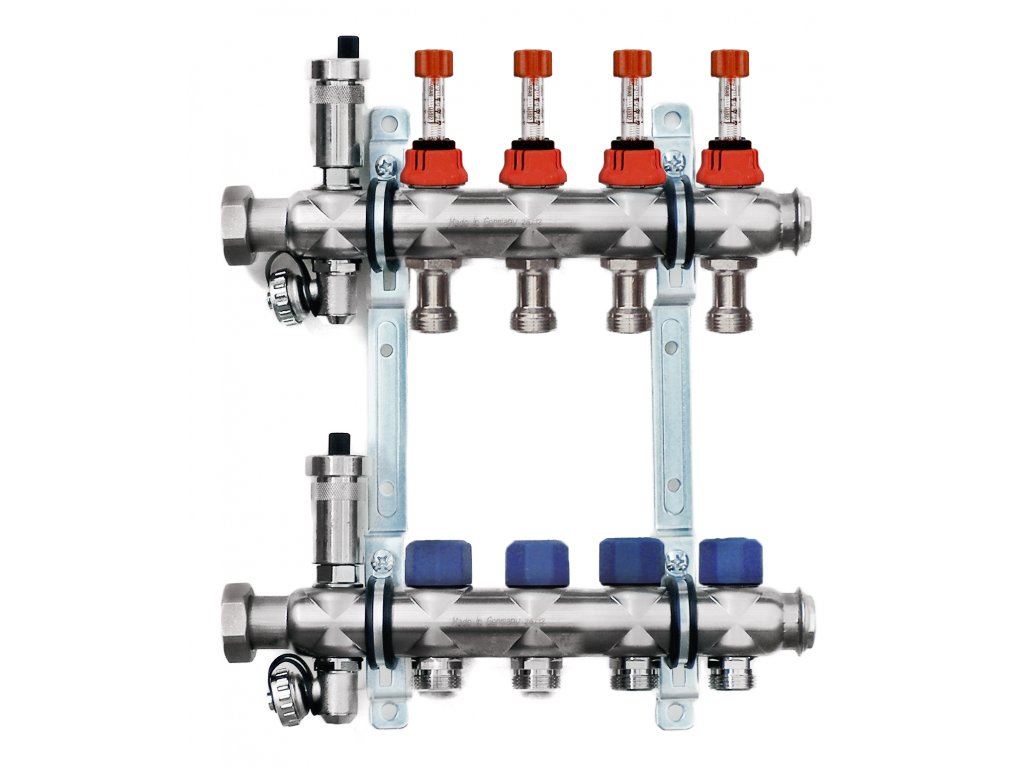 |
4-way stainless steel manifold for underfloor heating - suitable for a larger house or a ground floor with several smaller rooms. Price from EUR 85.32. |
The price difference between the individual sizes is somewhat smaller than many customers expect - going from a 2-way to a 3-way manifold adds about EUR 15.71, and from 3-way to 4-way another approximately EUR 15.93. The chart below shows this more clearly.
If you're not sure which size is right for your case, we recommend starting with a calculation based on the area of individual rooms - a detailed guide is available in the article How to choose a stainless steel manifold.
What electrothermic actuators are for, and whether they must be part of a manifold
An electrothermic actuator is a small drive that fits onto the valve of a single manifold circuit and, based on a signal from a room thermostat, either opens or closes that circuit. Thanks to this, every room can have its own independently controlled temperature - without actuators you'd have to set the temperature manually, directly at the manifold, which is impractical and imprecise.
A manifold also works without electrothermic actuators - in that case the flow to individual circuits is set manually via the regulating valves directly on the manifold body and stays practically unchanged until someone physically readjusts it. This setup is used only rarely today, for example in smaller flats with one shared open space, where individual room-by-room control doesn't make much sense. In an ordinary family home with several rooms with different temperature requirements (a cooler bedroom, a warmer bathroom), electrothermic actuators combined with room thermostats pay off, partly thanks to energy savings - you really only heat where and when it's needed.
Actuators are sold in two voltage variants - 230 V (connected directly to the mains) and 24 V (powered through a safety transformer, typically part of an underfloor heating control system). The choice between them depends on what control system and thermostats you already have or plan to use - 24 V solutions are more common with centralised, multi-zone control, while 230 V actuators are often chosen for simpler or retrofitted systems.
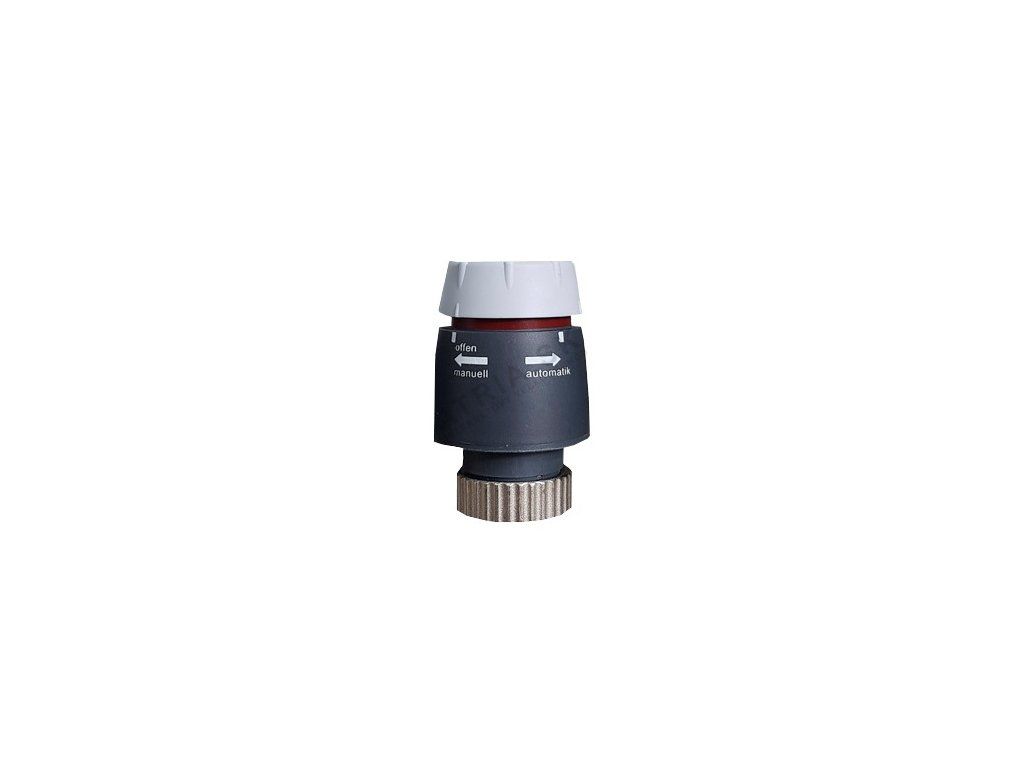 |
Electrothermic actuator 230 V - the most common choice for a simpler installation without a central low-voltage supply. Price from EUR 16.36. |
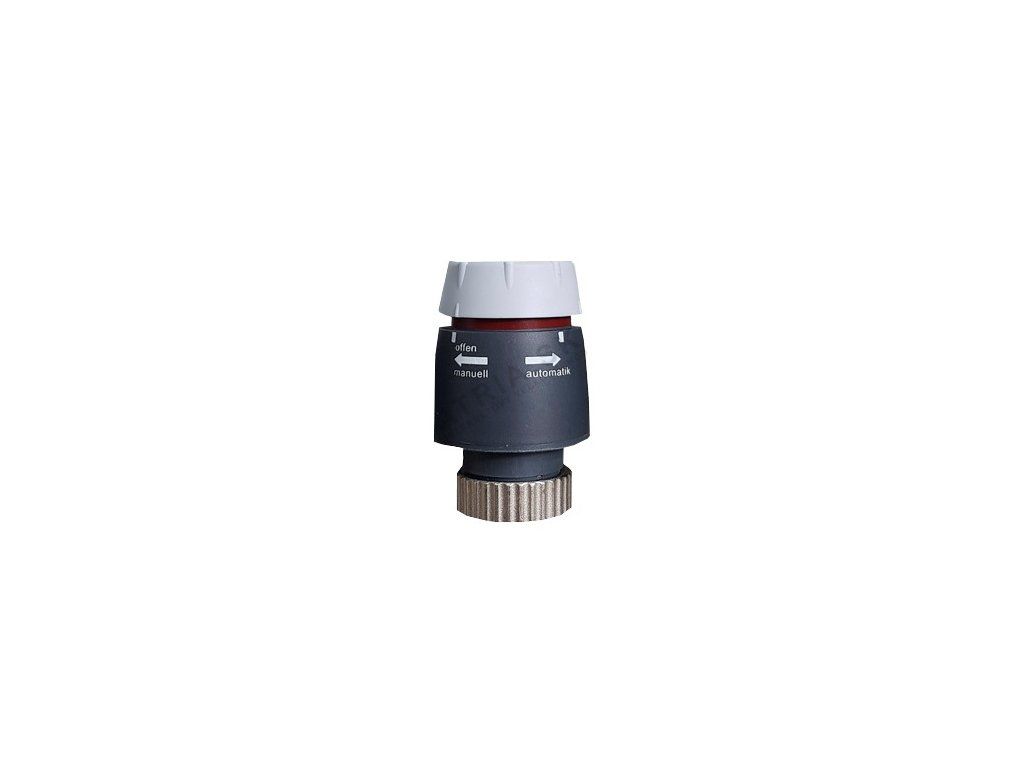 |
Electrothermic actuator 24 V - suitable for central control of several zones through a single low-voltage system. Price from EUR 16.36. |
Interestingly, both actuator versions cost the same with us - EUR 16.36 - so choosing between them is purely a technical matter (which control system you're planning), not a question of price.
How bleeding and setting up a manifold works
Air in an underfloor heating system is one of the most common causes of uneven heating - a circuit where an air pocket builds up stops circulating, and the room below it stays cold even though the valve at the manifold is fully open. Bleeding is therefore not a one-off job done only when the system is first filled, but something worth repeating at the start of every heating season.
The bleeding procedure is simple, but it's important to follow the right order of steps - bleeding all circuits at once usually just moves the air from one circuit to another instead of letting it escape.
In practice this means: first close the regulating valves of all circuits on the manifold. Then open just one circuit, fill it with water, and via the bleed valve (usually on the front of the manifold or directly on the collector) let the air escape until a steady, bubble-free stream of water flows out. Close the valve again, move on to the next circuit and repeat the process. Only once all circuits have been bled do you open them all together and set the flow meters according to the design documentation, or according to how warm each room actually feels after a few days of operation. You'll find a detailed step-by-step guide with photos in the article Bleeding and setting up a manifold.
If the system keeps losing pressure and bleeding only fixes it for a few days, the cause is probably not air trapped during filling, but a leak somewhere in the system or micro-bubbles forming through a chemical reaction in the pipework - in that case it's worth checking the tightness of the joints and possibly fitting an automatic air vent.
Why a cabinet is installed around a manifold and what size I need
A manifold cabinet isn't just a cosmetic extra - it protects the fitting from mechanical damage and dust, while also allowing quick access for servicing or adjustment. Cabinet size is chosen according to the number of circuits (width) and whether the manifold is recessed into the wall or surface-mounted (depth). It's therefore worth thinking about the cabinet at the same time as ordering the manifold, so you don't end up dealing with a size mismatch afterwards. You'll find the exact recommended sizes by number of ways in the article Manifold cabinets - what size.
What accessories still need to be bought for a manifold
The manifold itself is just the base - a complete installation usually also includes a set of connecting fittings for the specific pipe diameter, thermometers/flow meters if not already built in, a bleed valve and drain valve, possibly an automatic air vent, and last but not least electrothermic actuators with the corresponding wiring to the room thermostats. You'll find a complete overview of what's worth having ready before installation in the article Manifold accessories.
How a manifold is installed and connected
Installing a manifold in most cases requires a professional - it involves work on the heating circuit where a mistake (a leaking joint, flow and return connected the wrong way round) only shows up after the system is filled, when the fix is considerably more complicated. The manifold is mounted on brackets inside the cabinet or directly on the wall; it must be level, with enough space for pipework to be connected from below and for future servicing. Electrothermic actuators are added only after the system has first been pressure-tested and checked. You'll find a practical description of the whole installation process, including the recommended order of steps, in the article Installation and connection of a manifold.
What are the most common faults and how to prevent them
Among the recurring problems we see from customers are leaks at the joint between the manifold and the pipework (usually an insufficiently tightened or incorrectly fitted union nut), a regulating valve stuck after a long season without movement, a non-functioning electrothermic actuator (most often due to a broken cable or faulty thermostat, less often the actuator itself), and the air-in-the-system issue already mentioned, causing cold spots on the floor. Most of these faults can be identified with a simple visual check and worked through step by step - you'll find a detailed overview of symptoms and solutions in the article Most common manifold faults.
How to look after a stainless steel manifold so it lasts as long as possible
A stainless steel manifold basically doesn't require any complicated maintenance - its main advantage is precisely that it can withstand ordinary operation for years without attention. Even so, we recommend checking the tightness of the joints, the function of the bleed valve and the movement of the regulating valves of each circuit once a year (ideally before the start of the heating season) - if they haven't been used for a while, it's worth gently turning them so they don't stay "frozen" in one position. It's also good to keep an eye on the quality of the heating water (hardness, presence of impurities), since this actually has a bigger impact on the manifold's long-term lifespan than the material of the body itself. You'll find a complete seasonal maintenance guide in the article Maintenance of a stainless steel manifold.
A real-world example: renovating a family house
A typical case we come across: the owner of an older house is converting radiator heating into a combination of radiators and underfloor heating on the ground floor. Instead of the original single large circuit, the ground floor is split into three separate zones (the living room with kitchen as two circuits due to size, the bathroom and hallway together as a third circuit) - in this kind of case we usually recommended a 3-way stainless steel manifold together with 24 V electrothermic actuators, since the house already had a central zone controller in place. In such a case, the investment in the manifold and actuators was only a fraction of the total cost of the heating renovation, but choosing them correctly determines whether heat in each room ends up even, or whether the owner ends up dealing with cold corners afterwards.
Frequently asked questions
Does a manifold need to have flow meters?
It's not essential, but it makes setting up the system much easier - you can see directly on the manifold how much water is flowing through each circuit, and balance the heating between rooms without guesswork. For a larger number of circuits (3 or more), we clearly recommend flow meters.
Can a radiator and underfloor heating be connected to the same manifold at the same time?
Yes, as long as the system is designed with the different temperatures in mind (radiators typically run with higher water temperature than underfloor heating) - in practice this is handled either with separate manifolds for each type, or with a mixing valve on the underfloor circuit side. Combining them directly on one manifold without adjusting the temperature is not recommended.
How often does a manifold need to be bled?
We recommend checking, and bleeding if necessary, at least once a year, ideally at the start of the heating season. If the air problem keeps recurring more often, it usually signals a leak or another technical issue worth investigating separately.
Is it worth buying a manifold with extra spare circuits?
In most cases, yes - the price difference between neighbouring sizes (for example 3-way and 4-way) is typically only about EUR 15-16, while replacing a manifold that's already built into a wall or cabinet means far more work and cost later.
Is a stainless steel manifold always a better choice than a brass one?
It's not a universal rule, but stainless steel offers better corrosion resistance and more stable long-term performance with fluctuating water quality, which is why it now accounts for most of our sales in this category. Brass remains a sensible choice where budget is the limiting factor and water quality in the system is under control.
Do I need electrothermic actuators on all circuits, or just some of them?
If you want the ability to regulate the temperature in each room independently, you need an actuator on every circuit. If shared control for several rooms at once suits you (for example a shared open-plan space), an actuator on the circuit representing that zone is enough, or it can be left out entirely and the flow set manually - though in practice that's chosen only rarely.
Related topics
How to choose a stainless steel manifold
How many manifold circuits do I need
Stainless steel vs. brass manifold
Installation and connection of a manifold
Manifold accessories
Most common manifold faults
Bleeding and setting up a manifold
Manifold cabinets - what size
Maintenance of a stainless steel manifold
Full range: Stainless steel manifolds
Do you have a question on this topic?
Can't decide, or dealing with a specific situation in your home? Write to us - we're happy to help.