
Most Common Manifold Faults
The manifold is the heart of every heating circuit with multiple branches - underfloor heating, radiators fed from a single source, or a combination of both systems. Even though it's a mechanically simple device (essentially two pipes with branches, flow meters and shut-off valves), in practice the manifold is exactly the place where problems in the whole heating system tend to show up first - uneven heat in rooms, noise in the pipework, dripping water under the insulation cabinet, or a boiler that keeps needing its pressure topped up. In this article we go through the most common faults in stainless steel manifolds, how to recognise them, what the usual cause is, and when it makes sense to reach for a replacement part or go straight for a new manifold.
The article is based on routine service work on manifolds for both underfloor and radiator heating, and we've added specific product recommendations that we actually sell on atria.sk. This isn't a theoretical overview - we try to describe what an installation company or a capable homeowner genuinely deals with in year one, year two, and year five of operation.
Why manifolds develop faults precisely here and not elsewhere
The manifold is the one place in the system where several different components meet at once: a metal body (most often stainless steel or brass), plastic or brass flow meters, rubber or PTFE seals on every thread, electrothermic or thermostatic actuators with their own electronics or wax element, and finally bleed and drain valves. Each of these elements has its own lifespan and its own way of failing. While the pipes in the floor or wall practically never get damaged (unless they were mechanically damaged during installation), the manifold is accessible, operated, adjusted, and has the most threaded joints of any part of the system - and therefore also the most places where something can leak or fail.
The second reason is adjustment. The manifold is where circuits are balanced, where individual rooms are switched on and off, and where the electrical control is connected. Anything with moving parts that's operated from outside (manually or electrically) wears out faster over time than a static pipe full of water.
Overview of the most common faults
Before going through individual faults in depth, let's look at how the causes of service calls on manifolds typically break down, based on the experience of installation companies. The following percentages aren't the result of a nationwide statistical survey, but an estimate based on routine service work handling complaints and maintenance on both underfloor and radiator manifolds: air in a circuit accounts for around 35% of service calls, a faulty or stuck actuator/drive around 25%, a leak at a threaded joint around 20%, uneven flow between circuits around 12%, and the remaining 8% covers other causes (a damaged flow meter, a control unit fault, mechanical damage).
Leaks and dripping from joints
The most visible fault - water appears in the cabinet under the manifold, damp insulation, or a white mineral film left by evaporated water. With stainless steel manifolds, a leak almost always comes down to one of three causes:
1. An under-tightened or poorly sealed threaded joint
Most joints on a manifold (connecting the flow meters, actuators, end caps, or the connection to the boiler pipework) are threaded with a flat or conical seal. Sometimes during installation a joint gets tightened "by feel" without a torque wrench, PTFE tape gets wound in the wrong direction, or the seal is slightly damaged during fitting. This may not be noticeable for the first few months, but with temperature cycling (the system heats up and cools down, materials expand and contract) the joint gradually loosens and starts to "weep" slightly. The fix is simple - drain the circuit, take the joint apart, clean the thread, reseal it (new PTFE tape or hemp fibre with paste, depending on the joint type) and retighten it to the correct torque.
2. A worn or hardened rubber seal
Flat rubber (EPDM) seals in screw joints have a lifespan of several years, but with lower-quality material or higher heating water temperatures (common on radiator circuits, where the temperature is higher than for underfloor heating) they harden and lose their elasticity faster. A hardened seal no longer seats perfectly, and a slight leak appears at the joint, typically only becoming visible after several years of operation. Replacing the seal is a cheap, quick job that a capable homeowner can do themselves - the important thing is to use a seal designed for heating water (heat-resistant), not a general-purpose one from the plumbing range.
3. Micro-cracks from incorrect installation or mechanical stress
The stainless steel manifold body is very durable on its own, but if the manifold is hung or fixed in the cabinet in a way that lets the connected pipes pull on it (for example unsupported pipes "pulling" a joint sideways under their own weight), a microscopic crack can develop over time exactly at that joint. This is a rarer cause, but typical where installation didn't follow recommended support and stress relief for the pipes before connecting them to the manifold.
Air in circuits - the most common "fault" that isn't really a fault
As mentioned above, air accounts for the largest share of service calls - and paradoxically it's the easiest to fix and the least "faulty" case of all. Air gets into the system every time water is topped up, after the system has been shut down, after a component replacement, or simply through the natural release of dissolved air from water as it heats up. Signs of an air-locked circuit:
- bubbling or gurgling audible at the manifold or in the pipework in the floor,
- the circuit is cold or lukewarm despite the actuator being open and the circulation pump running,
- the flow meter on that circuit shows zero or very low flow even though the valve is open,
- the boiler repeatedly reports a pressure drop and a need to top up, without there being a significant leak.
Bleeding is done directly at the manifold - each circuit has its own bleed valve (either automatic or manual with a small key). The procedure is simple: close the other circuits, keep the circulation pump running, slowly open the bleed valve of that circuit and let the air escape until a steady stream of water flows out without bubbles. If the same circuit needs bleeding repeatedly (more often than once every six months), that's already a sign of a micro-leak somewhere in the system, drawing air in - and you need to look for the cause elsewhere, not just keep bleeding it repeatedly.
Damaged or stuck electrothermic and thermostatic actuators
An electrothermic actuator is a small motor with a wax or bimetal insert that opens or closes the flow through a specific circuit based on a signal from the room thermostat. It's the component with the most moving (or thermally expanding) parts on the whole manifold, and is therefore logically also the most common source of faults after air.
Typical symptoms of a faulty actuator
- A stuck pin - the actuator can't return to its original position after a longer shutdown (typically after summer, when it sat in one position for months). The internal pin "sticks", and the circuit stays either permanently open or permanently closed.
- The actuator doesn't warm up - with a 230 V or 24 V electrothermic actuator, within a few minutes of the thermostat calling for heat you should be able to feel that the actuator body is warm (the internal heating element warms the wax). If it stays cold, either it's not getting power (a wiring fault or a relay fault in the control unit), or the heating element itself is faulty.
- The relay clicks but the actuator doesn't respond - the control unit switches the relay correctly (you hear a click), but the circuit doesn't open or close - typically the drive itself is faulty, not the electronics.
The good news is that electrothermic actuators are a standardised, cheap and quickly replaceable part - there's no need to replace the whole manifold or the control unit, just the specific faulty actuator, matched by voltage (230 V or 24 V, depending on the system's control type).
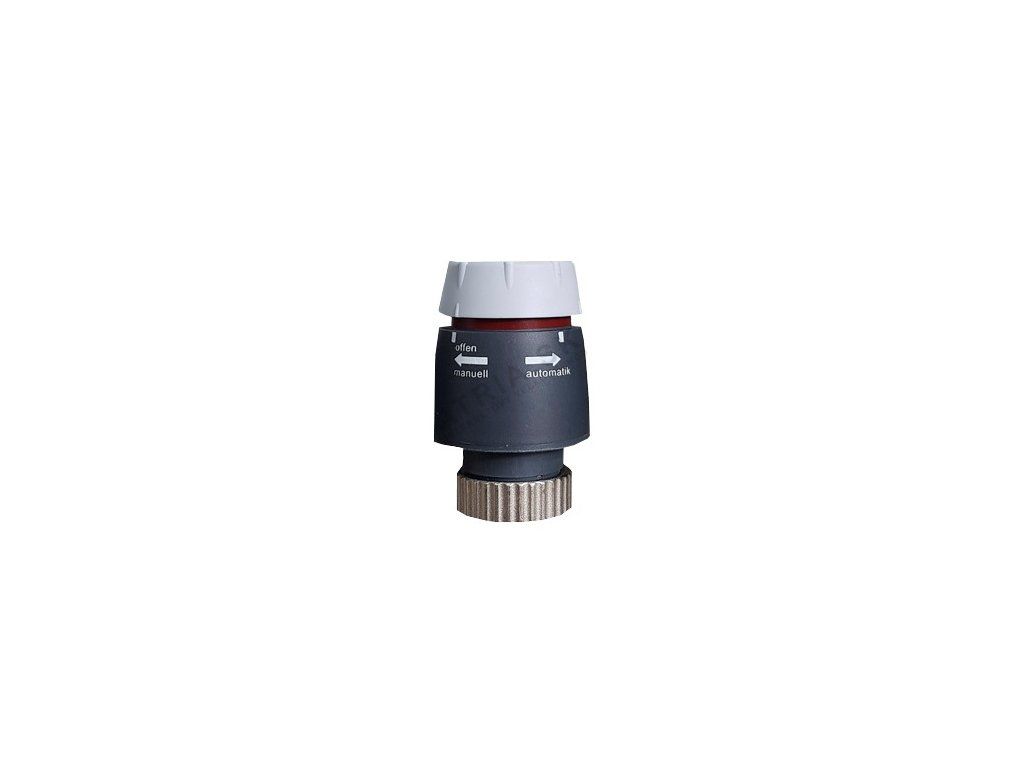 |
Electrothermic actuator 230 V - the most common drive for both underfloor and radiator circuits with standard 230 V control. If the drive on your manifold has stuck or stopped responding, this is a direct replacement without touching the control unit. Price from €16.36. |
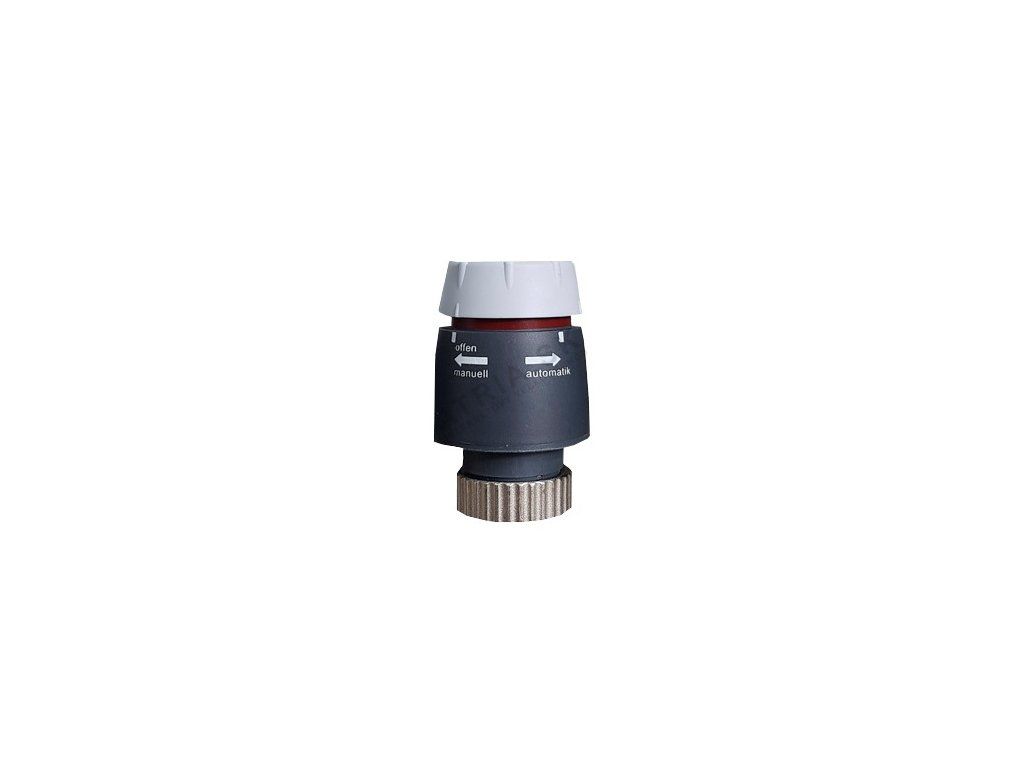 |
Electrothermic actuator 24 V - a variant for low-voltage control (common with newer smart thermostats and systems with a central control unit). Always check the voltage against the label on the original actuator or the control unit before ordering. Price from €16.36. |
Uneven flow between circuits
If one room is consistently colder than the others despite the actuators being equally open, the problem is usually with the flow setting at the manifold, not with the heating element or the underfloor loop itself. Each circuit has a different resistance (different pipe length, different number of bends, different room area), so the flow at the flow meters has to be manually balanced - otherwise the "stronger" circuits (shorter, with less resistance) take most of the water, and the weaker circuits get only what's left.
As an illustration, here's a common real-world example for a four-circuit underfloor heating manifold, before and after balancing: the living room circuit originally at 3.2 l/min, the bedroom circuit at just 0.9 l/min, the bathroom circuit at 1.8 l/min, the children's room circuit at 2.5 l/min - a difference of almost 3.5 times between the strongest and weakest circuit. After balancing at the flow meters (adding restriction to the "stronger" circuits and opening up the "weaker" ones), all four circuits ended up at roughly 2.0 to 2.2 l/min - an even, predictable output in every room.
Setting the flow meters isn't a one-off, "for life" job - after replacing a floor covering, insulating the house, adding an extension, or simply after a long time, it's worth rechecking flows and fine-tuning them if needed, since the heat loss of individual rooms changes too.
Corrosion and deposits in the manifold body
Compared to brass, stainless steel manifolds have significantly higher resistance to corrosion and deposits - this is the main reason they're now used almost exclusively in underfloor systems. Even so, they're not entirely maintenance-free:
- Limescale deposits can form with harder water, and especially in systems where fresh water is topped up often (typically because of repeated leaks elsewhere in the system - another reason not to ignore a leak as "it's only dripping a little"). Deposits build up mainly in the flow meters and can distort the reading.
- Galvanic corrosion can occur where stainless steel directly touches another metal (for example a brass flow meter screwed directly into the stainless body) without proper dielectric separation. This is a slow process that only shows up after years, but it's one reason why it's important to buy complete, matched components from a single manufacturer rather than combining "whatever was on hand".
- Sludge deposits in systems without a filter or dirt separator can reach the flow meters and partially clog them - this shows up as a gradual, steady drop in flow on one or more circuits over months, unlike the sudden drop caused by air.
Faults in the control unit and electrical part
In systems with electrothermic actuators, the manifold assembly includes (or has mounted right next to it) a control unit that gathers signals from room thermostats and switches the individual actuators. Typical faults at this level:
One circuit doesn't respond, the others work fine
This is most often a fault at the level of a single channel on the control unit (a burnt-out relay, a loose terminal) or a fault with the thermostat in that particular room - not a fault with the whole unit. It's easy to check: swap the actuator from the non-working circuit with one from a working circuit. If the fault "travels" with the actuator, the actuator is faulty. If it stays in place, the problem is with the thermostat or the control unit.
The whole system doesn't respond, the boiler isn't saving energy
If no circuit responds, first check the power supply to the control unit (fuse, adapter) before checking individual channels. With wireless thermostats, also check the batteries and signal strength - a common "silent" failure happens after replacing thermostat batteries, when re-pairing with the receiver gets forgotten.
How to prevent faults - a simple maintenance plan
Most of the faults described above can be prevented with regular, undemanding checks. There's no single universal "service plan" prescribed by a manufacturer for every house, but the following rhythm has proven itself in practice as a reasonable compromise between effort and prevention:
This simple routine takes a few dozen minutes a year, but in practice catches the vast majority of potential faults before they cause bigger damage (a flooded floor, boiler electronics damaged by repeated topping-up, mould under a leaking cabinet).
When a replacement part is enough, and when a new manifold pays off
In the vast majority of the cases described above, replacing a specific part - an actuator, a seal, a flow meter - is enough. Completely replacing the whole manifold body only makes sense in a few situations: the body is visibly corroded or cracked, the manifold is undersized for the current number of circuits (for example after an extension added a room and the original 2-way manifold is no longer enough), or it's such an old, worn-out type that replacement parts are no longer available.
When choosing a new manifold, it's worth allowing a small margin - if you need exactly 3 circuits today, a 4-way variant leaves room for future expansion (for example an extension, converting an attic, a separate bathroom circuit) without having to replace the whole body again a few years later.
 |
2-way stainless steel manifold for underfloor heating - a suitable replacement if the original body is damaged and you need exactly 2 circuits with no margin for the future, for example a smaller flat or a standalone extension. Price from €53.68. |
 |
3-way stainless steel manifold for underfloor heating - a common choice when replacing a damaged body in a standard house with three zones (for example living room, bedroom, bathroom) on one floor. Price from €69.39. |
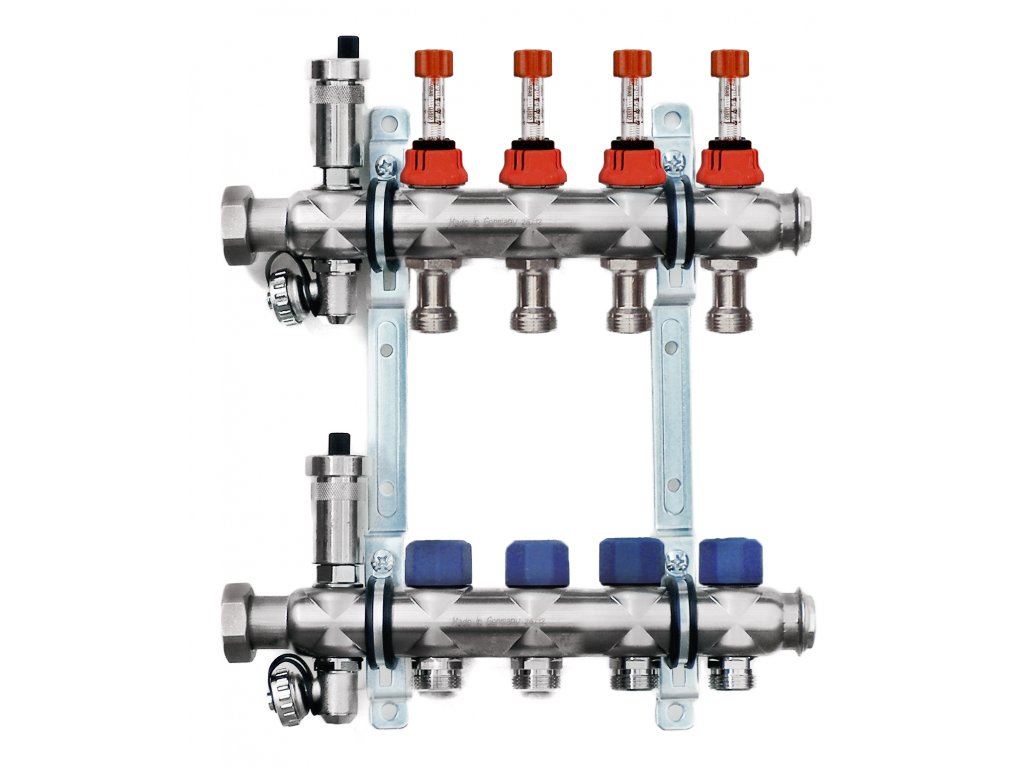 |
4-way stainless steel manifold for underfloor heating - a good choice if you're planning a margin for the future, or dealing with a larger house with four separate zones at once. Price from €85.32. |
If the fault is only on the measurement or flow indication side (typical of older analogue flow meters where the float has "frozen" or the scale has faded), it's also worth looking at simple accessory components that can be bought separately and used to replace just the faulty part without touching the rest of the manifold.
 |
Avansa 2003 - a practical accessory component for the heating system, worth having on hand for routine maintenance and service work around the manifold. Price from €20.05. |
A practical example from a real-world situation
A common situation we come across: a homeowner notices that the children's room is colder than elsewhere, even though the room's thermostat shows that heating should be running. The first step is always the same - check whether the actuator on that circuit is warming up at all. If it's cold, the problem is either on the electrical side (the thermostat isn't sending a signal, the control unit isn't switching) or with the actuator itself. If the actuator is warm and the circuit still isn't heating, the problem is downstream of the actuator - most often air, or a clogged or incorrectly set flow meter.
In the vast majority of such cases (see the percentage breakdown above), it really is air, which gets resolved in a few minutes without needing any replacement part at all. Only when bleeding doesn't help, and the flow meter still shows zero after balancing, is a faulty actuator or a clogged flow meter reasonably suspected, and it's time to replace the specific part.
Frequently asked questions
How often does an underfloor heating manifold need bleeding?
For a normal, tight system, bleeding once at the start of the heating season (typically in autumn) is enough, plus possibly once during winter if you notice bubbling or a colder circuit. If bleeding is needed more often than once every two or three months, that's already a sign of a hidden leak somewhere in the system, not a normal occurrence.
Can an electrothermic actuator be replaced by yourself?
Yes, replacement is simple and doesn't require draining the whole system - just close that circuit directly at the actuator (or briefly reduce pressure), unscrew the original actuator and screw on a new one of the same type and voltage. The electrical side is simply reconnected to the original terminal or connector. If you're unsure about the electrical side (especially with 230 V wiring), it's sensible to bring in an electrician or service technician.
Why does system pressure keep dropping even though I don't see any water dripping anywhere?
A small leak doesn't always show up as visible dripping - water can evaporate right at the joint, or seep into the insulation, which absorbs it for a while without a visible trace. If pressure keeps dropping repeatedly and you're regularly topping up water, we recommend checking all the joints on the manifold with a dry cloth (even ones that look dry at first glance), and possibly the other joints in the system too, not just the manifold itself.
Is a stainless steel manifold really less prone to faults than a brass one?
In terms of corrosion, yes - stainless steel is more resistant to the long-term effect of water and any chemical additives in the system. Faults with actuators, flow meters and seals, however, are the same for both types, since they're the same components screwed onto the body regardless of what metal the body itself is made from.
Can I adjust the flow setting on circuits myself, or does it need a professional?
Basic balancing (using the scale directly on the flow meters) can be managed even by a reasonably capable homeowner with a bit of patience - it's a matter of gradually tightening and loosening until the values on individual circuits come close together. Precise calculated balancing (based on each room's heat loss) is the domain of a designer or experienced installer, especially for more complex systems with more than four or five circuits.
How do I know I only need to replace the flow meter, not the whole manifold?
If the manifold body itself (the stainless steel part) isn't damaged, corroded or cracked, and the problem is clearly localised to just one flow meter (for example the float visibly isn't moving, or the scale is unreadable), replacing just that specific part is enough. Flow meters are standardised and can be replaced without touching the rest of the manifold body.
Related topics
- How to choose a stainless steel manifold
- How many manifold circuits do I need
- Installation and connection of a manifold
- Maintenance of a stainless steel manifold
- Bleeding and setting up a manifold
You'll find the full range in the main category Stainless steel manifolds.
Do you have a question on this topic?
Not sure how to deal with a specific fault on your manifold, or which part needs replacing? Write to us - we're happy to help.