
How Weather-Compensated Control Works
Most households are content with the idea that a thermostat is just a dial on the wall that tells the boiler when to heat and when to stop. With more modern controllers, though, it's quite different — especially with weather-compensated (equithermal) control, which does not just track the temperature in your living room, but above all the temperature outside, and uses it to calculate on its own what temperature it should heat the water in the heating system to. The result is a more stable temperature in the house, fewer fluctuations, and generally more economical boiler operation, since it doesn't needlessly run at full output when the weather doesn't require it.
In this article we'll explain how weather-compensated control works, why it's worth combining it with a room thermostat (so-called cascade control), and at the same time we'll go through the wider context — what the difference is between a wired and a wireless thermostat, between a manual, programmable and WiFi thermostat, between an original controller from the boiler manufacturer and a universal thermostat, how zone control works, and what a thermostat has to do with the ripple-control (HDO) tariff in electric heating. The goal is that after reading you'll be able to judge whether your current controller is using its full potential, or whether it makes sense to consider a change.
If you're planning to buy a new boiler, or just want to modernise the controller for your existing one, the following sections will give you a practical foundation — including specific products you can take a look at right away.
What a room thermostat is and why a heating system needs one
A room thermostat measures the temperature in a room and, according to the set value, switches the heat source — boiler, heat pump or electric heating unit — on or off (or modulates its output). It sounds simple, but the effect is significant: without a thermostat, the boiler would heat continuously at full output regardless of the actual room temperature. This leads to overheating — the flat or house is needlessly warm, windows get opened often because it feels "stuffy", and the boiler consumes more fuel than is actually needed at that moment.
The thermostat thus works as feedback between what the system actually delivers and what the house actually needs. With simpler controllers it's a binary "heat / don't heat" signal; with more modern ones the output of the heat source is smoothly modulated, so the boiler doesn't needlessly run at maximum and then switch on and off in short cycles. Exactly how precisely a thermostat can communicate with the boiler, and what information it passes to it, is one of the main differences between the individual types of thermostats and controllers, which we'll discuss below.
If you're choosing a thermostat for the first time, it's worth first going through the separate guide How to choose a room thermostat, where this topic is covered from a broader perspective — this article, by contrast, focuses mainly on weather-compensated control and its place in the whole system.
The outdoor sensor measures the temperature, the boiler calculates the water temperature from the curve, and the result is a stable temperature in the house.
How weather-compensated control works
Weather-compensated control is a different principle from a classic room thermostat. Instead of controlling heating only according to the measured room temperature, it primarily tracks the outdoor temperature — measured by a separate outdoor sensor, usually placed on the north side of the facade, away from direct sunlight. According to a pre-set so-called compensation curve, the boiler continuously calculates on its own what temperature it should heat the heating water to (the so-called flow temperature to radiators or underfloor heating), so that a stable temperature is maintained in the house regardless of whether it's freezing outside or the weather is milder.
In practice this means the following: when the outdoor temperature drops, the boiler automatically raises the heating water temperature to compensate for the house's greater heat losses. When it gets warmer, the water temperature drops, because the house loses less heat and less hot water in the radiators is enough to maintain comfort. The system thus reacts before the room temperature would even have a chance to change noticeably — it doesn't wait until the room temperature drops or rises and only then intervene, but anticipates in advance what the house will need.
This approach has one important advantage over purely room-based control: it limits so-called overshoots. With control based solely on room temperature, the boiler often first "runs up" the water to too high a temperature before the thermostat registers that the room is already warm enough, and only then reduces or switches off output — meanwhile the room has time to overheat. The compensation curve largely prevents this phenomenon, because the water temperature adjusts continuously and smoothly according to outdoor conditions, not in steps depending on whether the room temperature has just crossed or has not reached the set threshold.
It's important that the compensation curve is set individually for a specific house — it depends on the house's heat losses (insulation, window size, orientation), the type of heating elements used (radiators generally need a higher water temperature than underfloor heating), and the comfort the occupants want to achieve. That is precisely why setting the curve when commissioning the boiler is usually entrusted to a service technician or installation company familiar with the parameters of the specific building — an incorrectly set curve can lead either to insufficient heat in the house during heavy frosts, or conversely to needlessly high consumption in milder weather.
Weather-compensated control and a room thermostat together — cascade control
Weather-compensated control on its own doesn't know what's happening directly in your living room — it doesn't measure room temperature, only outdoor temperature. That's why, in practice, the combination of weather-compensated control with a room thermostat is most often recommended, referred to as cascade control. In this arrangement, the compensation curve determines the basic, "expected" heating water temperature according to the weather, while the room thermostat finely adjusts this value according to what is actually happening in the specific room — for example if the sun is shining into the living room through a large window, or if cooking is currently happening in the kitchen and the room is warming up even without a heating element.
The result of combining both approaches is the most precise, and generally also the most economical, control that an ordinary family house or flat can have — the system reacts to the weather in advance thanks to the compensation curve, and at the same time can fine-tune according to the actual state of the room thanks to the room thermostat. However, not every thermostat supports this cooperation with weather-compensated control — it depends on whether it's an original controller from the boiler manufacturer, which communicates with the boiler over a digital bus, or a simpler universal thermostat. We cover this difference in more detail in a separate section below.
Wired or wireless thermostat?
Before we get to the types of thermostats by features, it's worth resolving a more practical question — how the thermostat should be physically connected to the boiler. You essentially have two options.
A wired (cabled) thermostat connects to the boiler's controller with a two-core wire. It is reliable, doesn't need batteries, and since it communicates via a direct electrical signal, it's not at risk of interference or connection dropout. The disadvantage is that it requires running a cable from where the thermostat is to hang (usually the living room, on an interior wall, away from direct sunlight and draughts) all the way to the boiler. In a new build or a renovation where a pre-prepared route is already planned during the shell construction, this is not a problem. In a flat in a panel building or a house where only a thermostat replacement is being handled afterwards without breaking into walls, it tends to be problematic — which is exactly why a wireless solution is often the simpler choice in such cases.
A wireless thermostat communicates with a receiver located near the boiler via a radio signal, usually on a frequency of 868 MHz. Installation is faster and takes place without breaking into walls — you just need to mount the transmitter (the thermostat itself) in the chosen location and connect the receiver to the boiler. The disadvantage is that the transmitter needs batteries, which occasionally need replacing, and in densely built-up spaces (apartment blocks with many similar devices nearby) the signal can be more sensitive to interference than with a wired connection. In practice this tends to be a marginal issue, but it's good to know about when choosing.
You'll find a more detailed comparison of both solutions in the article Wired vs. wireless thermostat, which also covers specific situations where it's worth reaching for one type or the other.
Manual, programmable or WiFi thermostat — which type to choose
Besides the method of connection, thermostats also differ in how much "intelligence" they offer.
A manual (mechanical) thermostat has only a rotary dial for setting a single target temperature. It is the cheapest option, but it cannot lower the temperature on its own at night or during the day when you're not at home — the temperature has to be changed manually, otherwise the system keeps the same value the whole time.

Avansa TH1
Simple manual (mechanical) room thermostat with a rotary dial — the ideal and cheapest choice where it's enough to maintain a single constant temperature without programming.
Price: €10.61
A programmable (weekly) thermostat lets you set different temperatures for different times of day and days of the week — for example a lower temperature during the night and while the household is at work, and a higher one shortly before returning home. The typical saving compared to a manual setting is noticeable especially from the temperature drop during the night and absence, since the heating system doesn't try to maintain a comfortable temperature even when it isn't needed.

Avansa 2007 TX
Wireless programmable thermostat — transmitter and receiver without the need for cabling, suitable especially for a subsequent thermostat replacement in a flat or house without a pre-prepared cable route.
Price: €56.31
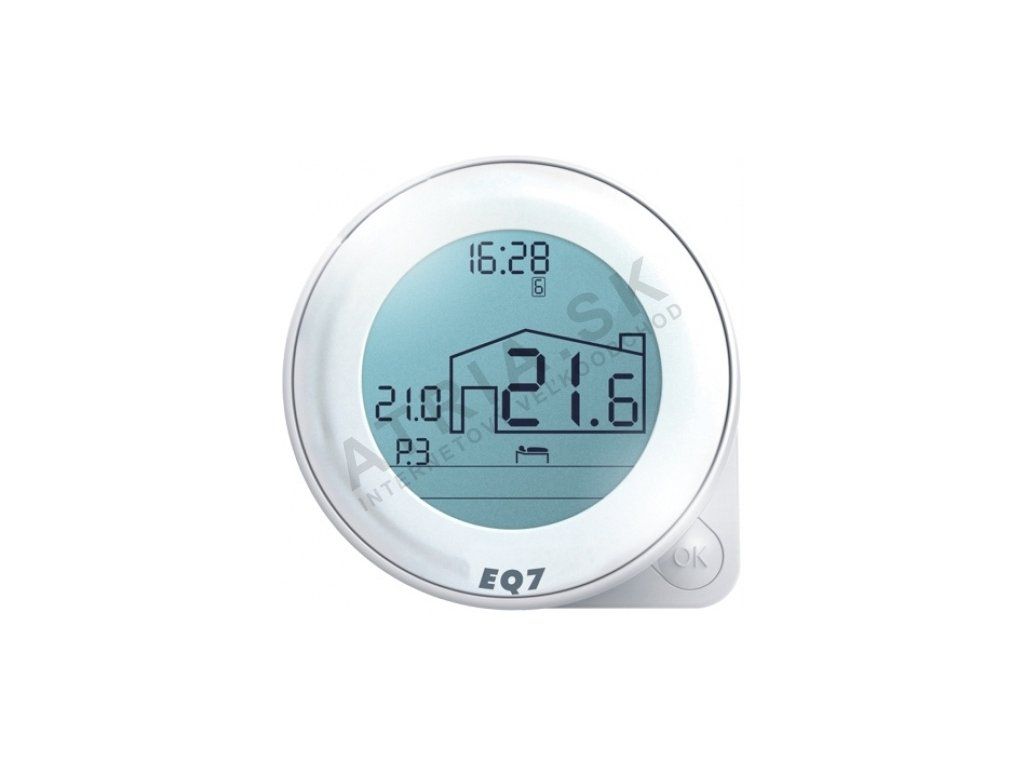
Euroster Q7
Programmable weekly thermostat with a clear display — lets you set a different temperature mode for each day of the week.
Price: €74.29
A WiFi (smart) thermostat adds remote control and monitoring via a mobile app from anywhere on top of the programming — you can change the temperature on your way home, or check that everything's fine at home even while on holiday. You'll find specific WiFi thermostat models, including original solutions from boiler manufacturers, in the next section.
You'll find a detailed comparison of all three levels in the article Manual vs. programmable vs. WiFi thermostat.
The original controller communicates with the boiler over a digital bus, a universal thermostat just opens and closes a circuit.
Original controller from the boiler manufacturer vs. universal thermostat
This choice has a direct effect on how well the thermostat will work together with the weather-compensated control described above, which is why we give it separate attention.
An original controller from the boiler manufacturer (for example Bosch Easycontrol, Protherm MiGo or Vaillant eRELAX) communicates with the boiler over a digital bus — typically eBUS or OpenTherm. Thanks to this it can smoothly modulate the boiler's output exactly according to current need, display error messages directly from the boiler (so in case of a fault you know right away what's wrong, without having to go to the boiler to check the display), and in many cases also directly control the compensation curve through the same interface where you set the room temperature. This is therefore the closest possible integration between thermostat and boiler that can be achieved.
A universal thermostat (for example Avansa, Euroster or Salus) works more simply — it only closes or opens an electrical circuit (contact), which the boiler evaluates as a binary "heat" or "don't heat" signal. A universal thermostat is cheaper and works with practically any boiler regardless of brand, which is its main advantage — you're not tied to a specific manufacturer. An original controller, by contrast, offers smoother output regulation and more features, but only for the specific boiler brand it's designed for.

Bosch Easycontrol CT 200
Original WiFi/smart room controller for Bosch and Junkers boilers, controlled via mobile app, smooth communication with the boiler over a digital bus.
Price: €356.68

Protherm MiGo
Original WiFi controller for Protherm boilers, controlled via mobile app, direct communication with the boiler's control unit.
Price: €222.48
Which approach is more suitable for you depends mainly on whether you plan to change the boiler brand in the future (in that case a universal thermostat pays off more, since you simply reuse it with the new boiler too), and on how much comfort and control precision you expect from the system. You'll find the differences and recommendations discussed in more detail in the article Original boiler controller vs. universal thermostat.
Zone control — different temperature in every room
Weather-compensated control and the room thermostat we've discussed so far mostly control a single shared circuit or a single reference room. If you want different rooms to have different temperatures at the same time, you need zone control.
Thanks to zone control, the living room and bedroom can have different temperatures at the same time.
Zone control divides the house into several independent circuits (zones), each of which has its own thermostat and its own control valve (actuator) on the manifold or directly on the radiator. Thanks to this arrangement, it's possible to have, for example, 22 °C in the living room and 18 °C in the bedroom at the same time, without having to manually adjust radiator valve heads every time the need changes. The system handles it on its own, based on the settings of the individual zone thermostats.
Zone control is commonly combined with underfloor heating, where typically each room has its own loop and its own thermostat controlling an actuator on the manifold. It's precisely with underfloor heating that zone control makes the most sense, since individual rooms often have significantly different temperature requirements (a bathroom usually needs a higher temperature than a bedroom), and without separate control this difference couldn't be achieved.
If you're dealing with a combination of zone control and weather-compensated control, it works on a similar principle to the cascade control described above — the compensation curve sets the basic heating water temperature for the whole system according to the weather, and the individual zone thermostats then regulate the flow into specific circuits according to what a given room needs. You'll find more on the topic in the article Zone heating control.
Ripple control (HDO) and a room thermostat in electric heating
With electric boilers and storage systems, one more factor comes into play — HDO, i.e. ripple control. This is a signal from the electricity distributor that switches between a high and a low (night) tariff.
A thermostat with an HDO input can recognise when the cheaper tariff is active and adjust the system's behaviour accordingly — for example setting a lower comfort-temperature threshold outside HDO (when electricity is more expensive), and a higher one during HDO, when electricity is cheaper and it's worth "heating up" the house with a certain reserve as well. Not every thermostat has an HDO input — if you have or are planning an electric boiler with a dual-tariff rate, it's worth checking this before buying, because adding this feature afterwards can be more complicated than choosing a thermostat that supports it right away.
You can read in more detail about exactly how HDO and a thermostat work together, and what to watch out for when choosing, in the article Ripple control (HDO) and a room thermostat — how they work together.
Real-life examples
A family house with radiators and an older gas boiler. In an older family house with radiator heating and a gas boiler that originally only had a manual thermostat, the system's behaviour changed significantly after switching to a combination of weather-compensated control (an outdoor sensor connected to the boiler) and a room thermostat in the living room. Whereas before, the boiler often "couldn't keep up" during freezing days and rooms further from the boiler room tended to be cooler, after the compensation curve was set by a service technician, the heating water temperature adjusted continuously to outdoor conditions — during a sudden cold snap, the water automatically heated to a higher temperature even before the room thermostat itself would have registered it. The result was a more stable temperature throughout the house, without the occupants having to manually intervene in the settings every time the weather changed.
A flat in a panel building with a subsequent thermostat replacement. In a flat in a panel building, where only the replacement of an old mechanical thermostat with a more modern one was being addressed, but without the option of running a new cable through already-finished walls and floors, the choice fell on a wireless programmable thermostat. The transmitter was mounted on the wall in the living room and the receiver was connected directly to the boiler without any need to break into walls. Thanks to weekly programming, the temperature automatically dropped during the day while the occupants were at work, and rose again shortly before they returned home — without them having to remember anything or manually adjust the temperature morning and evening.
Frequently asked questions about weather-compensated control and thermostats
Do I also need a room thermostat for weather-compensated control, or is an outdoor sensor enough on its own?
Combining the compensation curve with a room thermostat is more precise and more economical than an outdoor sensor alone.
Weather-compensated control also works on its own with just an outdoor sensor, but combining it with a room thermostat (cascade control) gives a more precise and generally also more economical result, since the system takes into account not only the weather outside but also the actual state in the specific room.
Where is the outdoor sensor for weather-compensated control placed?
Usually on the north side of the facade, away from direct sunlight, so it measures the actual outdoor temperature without distortion from solar heating of the facade.
Can a universal thermostat also control the compensation curve?
A universal thermostat mostly only opens or closes a circuit (a "heat/don't heat" signal), so direct control of the compensation curve through the same interface is mainly offered by original controllers from the boiler manufacturer, which communicate over a digital bus such as eBUS or OpenTherm.
Is an original controller from the boiler manufacturer worth it, even though it's more expensive?
It depends on whether you plan to stay with the same boiler brand in the future. An original controller offers smoother output modulation and more features (for example displaying the boiler's error messages), but works only with boilers of the given brand, whereas a universal thermostat is cheaper and portable between different boiler brands.
Is a wireless thermostat as reliable as a wired one?
A wireless thermostat is reliable in normal household use, but since it communicates via a radio signal (usually 868 MHz) and runs on batteries, it can be more sensitive to interference in densely built-up spaces and requires occasional battery replacement, unlike a wired connection, which doesn't need batteries.
Does zone control make sense outside of underfloor heating too?
Yes, zone control can also be used with radiator heating — each radiator or group of radiators can have its own valve head and zone thermostat, although it's most commonly encountered with underfloor heating, where almost every room has its own separate loop.
Do I need an HDO input on the thermostat if I have a gas boiler?
HDO mainly concerns electric boilers and storage systems using a dual-tariff electricity rate. For a common gas boiler, an HDO input on the thermostat is not relevant.
Can the compensation curve be set by myself, or does a technician have to do it?
The curve is set individually according to the specific house's heat losses, the type of heating elements (radiators vs. underfloor heating), and the desired comfort. That's precisely why its initial setting is usually entrusted to a service technician or an installation company familiar with the parameters of the given building — an incorrectly set curve can cause either insufficient heating during heavy frosts or needlessly high consumption in milder weather.
What should I do if my thermostat or weather-compensated control stops working properly?
If the thermostat or weather-compensated control isn't working as it should — for example the boiler doesn't respond to a change in outdoor temperature, or the thermostat loses connection with the receiver — it's worth first checking the basics (batteries in wireless thermostats, placement of the outdoor sensor away from direct sunlight) and contacting service if the problem persists. Common faults and their solutions are described in more detail in the article Thermostat service and common faults.
Related topics
- How to choose a room thermostat
- Wired vs. wireless thermostat
- Manual vs. programmable vs. WiFi thermostat
- Original boiler controller vs. universal thermostat
- Ripple control (HDO) and a room thermostat — how they work together
- Zone heating control
- Installing and wiring a room thermostat
- Thermostat service and common faults
- Frequently asked questions about room thermostats and controllers
Have a question about choosing a room thermostat?
Can't decide, or dealing with a specific situation in your household? Write to us — we're happy to help.