
Original Boiler Controller vs. Universal Thermostat
When choosing a room thermostat for a gas boiler, heat pump or electric heating unit, sooner or later every owner runs into one fundamental question: should you choose the original controller straight from the boiler manufacturer, or will a cheaper universal thermostat that works with almost any heat source be enough? The answer is not the same for everyone — it depends on how precise a control you expect, whether you plan to replace the boiler in the foreseeable future, what your budget is, and whether you need advanced features such as weather-compensated (equithermal) control, zone heating, or switching according to a dual-tariff electricity rate (ripple control/HDO).
In this article we break down the difference between the original controller and a universal thermostat in detail — how they communicate with the boiler, what they can and cannot do, and in which situations it is worth paying extra for a solution straight from the boiler manufacturer. Along the way we also touch on related topics closely connected with choosing a thermostat: wired versus wireless design, the difference between manual, programmable and WiFi thermostats, weather-compensated control, ripple control (HDO), and zone control. The goal is that by the end of the article you'll be able to say which type of control is the right one for your household.
The topic applies equally to family houses with a gas condensing boiler, panel-building flats with their own boiler, and households with a heat pump or an electric boiler. The principle of choosing between an original controller and a universal thermostat is in fact very similar across these heat sources — only the specific name and communication technology changes.
What a room thermostat is and why you need one with a boiler
A room thermostat measures the temperature in a room and, according to the set value, switches the heat source — boiler, heat pump or electric heating unit — on or off, or smoothly modulates its output. Without a thermostat, the boiler would heat continuously at full output regardless of the actual room temperature. The result is an overheated space, needlessly high fuel or electricity consumption, and faster wear on the boiler itself, which keeps running at maximum instead of smoothly adjusting its output.
That is precisely why a thermostat is one of the few heating investments that pays for itself almost immediately — it is not just about comfort (you no longer have to manually increase or decrease heating as the weather outside changes), but above all about real energy savings. If you are not sure which type of thermostat would suit your boiler and household, you'll find a detailed overview of selection criteria in the article How to choose a room thermostat.
The key difference between an original controller and a universal thermostat at a glance.
The basic question that precedes the choice of a specific model is: should you go for a controller straight from your boiler's manufacturer, or will a brand-independent universal thermostat be enough? That is exactly the core of this article.
Original controller from the boiler manufacturer — how it works and what it can do
An original controller from the boiler manufacturer — for example Bosch Easycontrol, Protherm MiGo or Vaillant eRELAX — communicates with the boiler over a digital bus, most often eBUS or OpenTherm. This is two-way communication: the controller does not just send the boiler a simple "heat" or "don't heat" command, but exchanges a much richer set of data with it.
Thanks to this two-way communication, the original controller can smoothly modulate the boiler's output exactly according to the current need — that is, not just switch the burner on and off, but finely regulate its output between minimum and maximum so that the boiler works as efficiently as possible with the fewest possible starts and stops. This shows up both in the boiler's service life and in the smoothness of heating — the room temperature fluctuates less than when the boiler simply "fires up to full gas" and then switches off completely.
Another advantage is that the original controller can display error messages directly from the boiler. If a fault occurs, you don't have to walk over to the boiler to check the display — you'll see the information (and, on smart versions, also a notification in the mobile app) directly on the thermostat or on your phone. On some models, the original controller can also directly control the boiler's weather compensation curve, i.e. link the room temperature with the outdoor air temperature into one intelligent whole (more on this principle below, in the section on weather-compensated control).

Original WiFi/smart room controller for Bosch and Junkers boilers, controlled via mobile app, communicating directly with the boiler's control electronics.
Price: €356.68
An example of such an original controller is the Bosch Easycontrol CT 200 — a WiFi room controller designed specifically for Bosch and Junkers boilers, which, besides smooth output modulation, also offers complete control of the boiler via a mobile app from anywhere. The Protherm MiGo works similarly, an original WiFi controller designed for Protherm boilers.

Original WiFi controller for Protherm boilers, controlled via mobile app, smooth output modulation and display of boiler status/errors.
Price: €222.48
The disadvantage of an original controller is that it works reliably only with a boiler of the given brand (or sometimes only with a specific model line of that brand), and its price is generally higher than a universal thermostat of comparable class. So if you plan to switch to a different boiler brand in a few years, the original controller often cannot be reused after that change.
Universal thermostat — a simpler solution for almost any boiler
A universal thermostat — for example Avansa, Euroster or Salus — works on a substantially simpler principle. Instead of two-way digital communication, it only closes or opens an electrical circuit (a simple voltage-free or voltage contact), which the boiler evaluates as a binary "heat" or "don't heat" signal. The boiler therefore receives no information about by how many degrees the output should be increased or decreased — it only reacts to whether the thermostat's circuit is closed or not.
This simplicity has two key advantages. First, a universal thermostat is noticeably cheaper than an original controller of comparable class. Second, and perhaps even more important, it works with almost any boiler on the market — the brand or age of the boiler doesn't matter, as long as the boiler has an input for a room thermostat (which practically all common boilers have, including older models). This means that if you replace your boiler with a different brand in the future, you generally keep the universal thermostat and simply reconnect it to the new boiler.

Simple manual (mechanical) room thermostat with a rotary dial — the cheapest universal choice, works with most common boilers.
Price: €10.61
An example of the simplest universal solution is the Avansa TH1 — a manual thermostat with a rotary dial, suitable wherever it's enough to maintain a single target temperature without the need for programming by time of day. If you're looking for a universal thermostat with a higher level of comfort, see the section on programmable and WiFi thermostats below — even in the universal category you can now find models with a weekly program and mobile-app control.
The disadvantage of a universal thermostat is precisely the same communication simplicity that gives it broad compatibility — the boiler cannot modulate its output as finely from the precise data of the thermostat as with an original controller with a digital bus, and the thermostat generally does not display the boiler's error messages nor directly control the weather compensation curve (for that it would need a separate input for an outdoor sensor and a boiler that supports this function even with simple contact control).
Price difference between cheap universal thermostats and original boiler-manufacturer controllers.
To keep the differences between an original controller and a universal thermostat clearly at hand in one place, here is a summary of the key differences:
| Criterion | Original controller | Universal thermostat |
|---|---|---|
| Method of communication with the boiler | Digital bus (eBUS, OpenTherm) — two-way | Simple switching contact — one-way "heat/don't heat" |
| Compatibility | Only the given brand (often only a specific model line) | Almost any boiler with a thermostat input |
| Output modulation | Smooth, precise | On/off only (or coarser modulation depending on the boiler's own evaluation) |
| Displaying boiler errors | Yes, directly on the thermostat/in the app | No |
| Control of the weather compensation curve | Often yes, directly from the controller | Only if supported by the boiler itself independently of the thermostat |
| Price | Higher | Lower |
| Usability when replacing the boiler with a different brand | Generally not — a new controller is needed | Yes, it can usually be reconnected |
The table makes it clear that this is a trade-off between precision and comfort on one side, and price and flexibility on the other. The installation of both types is fundamentally similar in principle — it differs mainly in the type of wiring/communication that needs to be connected to the boiler. You'll find a detailed procedure in the article Installing and wiring a room thermostat.
Wired vs. wireless design — applies to both types of thermostats
Regardless of whether you choose an original controller or a universal thermostat, you will also have to choose between a wired (cabled) and a wireless design. A wired thermostat connects to the boiler's controller with a two-core wire — it is reliable and doesn't need batteries, but it requires running a cable from the place where you want the thermostat (usually the living room or hallway) all the way to the boiler. In a new build this is not a problem, since it can be planned in advance, but in the renovation of a flat or house without a pre-prepared cable route, it's a fairly complicated intervention in the walls.
A wireless thermostat communicates with a receiver located near the boiler via a radio signal, usually on a frequency of 868 MHz. Thanks to this, installation is substantially faster and without breaking into walls — you just place the thermostat in a suitable spot in the room and connect the receiver to the boiler. The disadvantage is the need for batteries in the transmitting unit (which need to be replaced occasionally), and in densely built-up spaces, for example a flat in a panel building with many other wireless devices, the signal can be more sensitive to interference.

Wireless programmable thermostat, transmitter and receiver without the need for cabling — fast installation without breaking into walls.
Price: €56.31
An example of a wireless solution is the Avansa 2007 TX — a wireless programmable thermostat with a transmitter and receiver, ideal exactly for situations where the flat or house has no pre-prepared cable route to the thermostat. Interestingly, original controllers from boiler manufacturers are nowadays commonly made in both designs — both the Bosch Easycontrol and the Protherm MiGo exist as wired and as wireless (WiFi) versions, so the choice between a wired and a wireless connection is independent of whether you choose the original or a universal thermostat. You'll find a more detailed comparison of both designs in the article Wired vs. wireless thermostat.
Manual, programmable and WiFi thermostat — where the functional line between them lies
Besides the original/universal and wired/wireless questions, there is a third axis of decision-making — the level of features according to how modern the thermostat is. A manual (mechanical) thermostat has only a rotary dial for setting a single target temperature. It is the cheapest of all types, but it cannot lower the temperature on its own at night or during the day when you're not at home — you have to change the temperature manually every time you want a different mode.
A programmable (weekly) thermostat lets you set different temperatures for different times of day and different days of the week. Typically a lower temperature is set for the night and for times when the household is empty (for example during the working day), and a higher temperature for times when the occupants are home and active. The saving compared to a manual setting is noticeable especially thanks to this automatic drop in temperature during the night and absence — without a programmable thermostat you would have to lower and raise the temperature manually, which in practice hardly anyone does consistently every day.
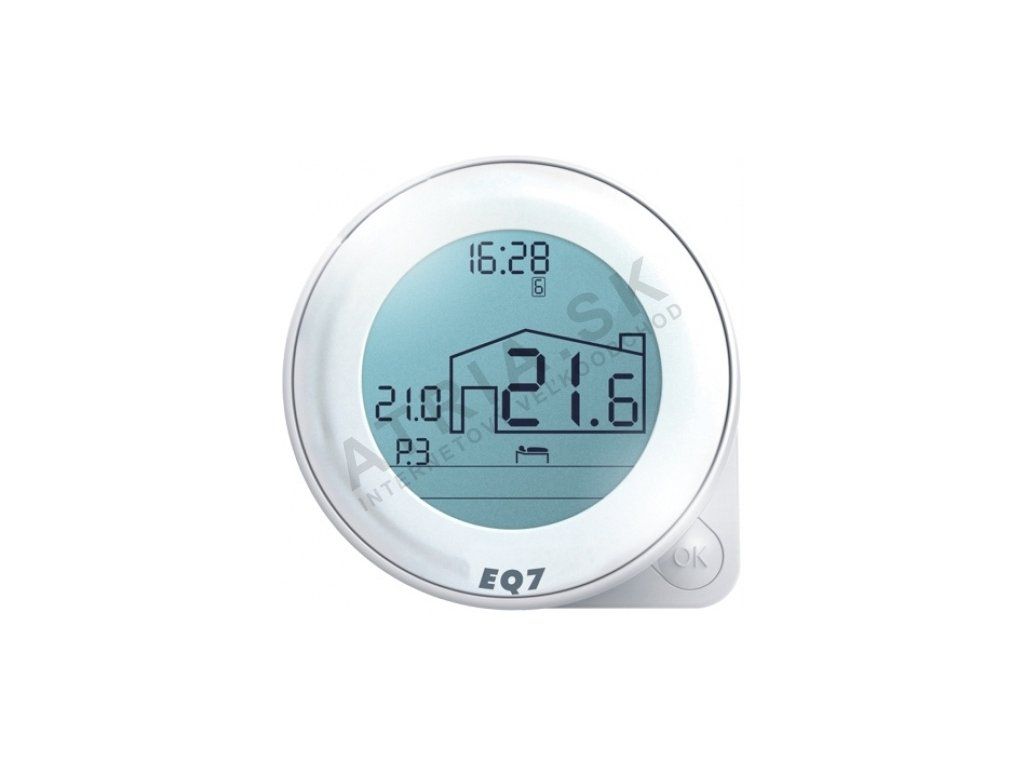
Programmable weekly thermostat with a display — universal, compatible with most common boilers.
Price: €74.29
A good example of a universal programmable thermostat with a display is the Euroster Q7, which lets you set a weekly program without needing to reach for a more expensive original controller. A WiFi (smart) thermostat adds remote control and monitoring of the heating status via a mobile app from anywhere on top of the programming — this level of features is mostly offered by original controllers from boiler manufacturers, such as the mentioned Bosch Easycontrol CT 200 or Protherm MiGo, although universal WiFi thermostats independent of the boiler brand also exist.
If you are still unsure which of these three levels (manual, programmable, WiFi) is sufficient for your household and which is already unnecessary luxury, read the detailed comparison in the article Manual vs. programmable vs. WiFi thermostat.
Weather-compensated (equithermal) control and its relation to choosing a thermostat
Weather-compensated control is a concept that goes a step further than a classic room thermostat. It does not control heating only according to the measured room temperature, but primarily according to the outdoor temperature measured by a separate outdoor sensor. According to a pre-set compensation curve, the boiler itself calculates the temperature to which it should heat the heating water so that the house has a stable temperature regardless of whether it's freezing outside or the weather is milder.
This is exactly where one of the main differences between an original controller and a universal thermostat shows up. An original controller from the boiler manufacturer can often directly control the weather compensation curve, because it communicates with the boiler over a digital bus and can send it precise requests for the heating water temperature. A universal thermostat, which only closes a contact, does not control the weather compensation curve itself — that function has to be handled by the boiler itself (if it has its own input for an outdoor sensor), while the thermostat only supplies the information about the current room temperature.
The most precise and most economical result is a combination of weather-compensated control with a room thermostat, so-called cascade control — the boiler sets the heating water temperature primarily according to the outdoor temperature (weather compensation curve), and the room thermostat serves as a supplementary correction that also takes into account other influences in the room (solar radiation through windows, heat from household appliances, the number of people in the room and so on). If you're interested in this topic in more detail, a separate article covers it: How weather-compensated control works.
Ripple control (HDO) and zone control — specific situations affecting the choice
With electric boilers and storage heating systems, one more factor comes into play — HDO, i.e. ripple control. This is a signal from the electricity distributor that switches between a high and a low (night) tariff. A thermostat with an HDO input can recognise when the cheaper tariff is active and adjust its behaviour accordingly — for example setting a lower comfort threshold outside HDO to save energy, and a higher one during HDO when electricity is cheaper. Not every thermostat, whether original or universal, has an HDO input, so it's important to check this already when choosing, if you have an electric boiler with a dual-tariff rate. You'll find more on this topic in the article Ripple control (HDO) and a room thermostat — how they work together.
The second specific situation is zone control, which divides the house into several independent circuits (zones), each of which has its own thermostat and its own control valve (actuator) on the manifold or radiator. This makes it possible to have, for example, 22 °C in the living room and 18 °C in the bedroom at the same time, without having to manually adjust radiator valve heads every time the need changes. Zone control is commonly combined with underfloor heating, where typically each room has its own loop and its own thermostat controlling an actuator on the manifold.
With zone control, in practice you more often encounter several universal thermostats (one per zone) than a single original controller from the boiler manufacturer, simply because the original controller is typically designed as a single central control for the whole boiler, while zone control needs several independent sensing and switching points. This does not mean that the original controller and zone control are mutually exclusive — in many installations, the original controller works as the boiler's main control element, while zone thermostats alongside it control individual circuits or actuators on the manifold. You'll find a detailed description in the article Zone heating control.
How to decide: original controller or universal thermostat
Let's now summarise the key criteria that should make deciding easier. An original controller from the boiler manufacturer makes sense above all when you plan to stay with the same boiler brand long-term, want to use the maximum precision of output modulation, appreciate the direct display of the boiler's error messages, and it matters to you that the weather compensation curve is controlled by a regulator directly connected to the boiler's electronics. You are willing to pay a higher price for these benefits and accept that, should you ever replace the boiler with a different brand, a new controller will need to be acquired.
A universal thermostat, on the other hand, is a sensible choice when a lower purchase price matters to you, you plan to replace the boiler in the future (possibly with a different brand too) and want to carry the thermostat over with you, or you need several thermostats at once — for example with zone control, where it would be costly to equip every zone with an expensive original controller. A universal thermostat is also the only realistic choice if you have an older boiler for which the manufacturer no longer makes or supplies an original controller.
In practice, both approaches can also be combined — for example an original controller as the main control element of the boiler and cheaper universal thermostats in the other zones of the house. If you're still undecided, or are dealing with a fault in an existing thermostat, also see the article Thermostat service and common faults, or the summary of the most frequent questions in the article Frequently asked questions about room thermostats and controllers.
Real-life examples
Example 1: A family house with a Bosch condensing boiler and plans for long-term living. The owners of a family house heat with a Bosch condensing boiler, for which they originally used only a simple manual thermostat. Since they plan to live in the house long-term and have no intention of replacing the boiler for at least another 10–15 years, they decided to invest in the original Bosch Easycontrol CT 200 WiFi controller. This gave them smooth modulation of the boiler's output (fewer temperature swings in the living room), display of any boiler errors directly in the mobile app without having to go to the boiler in the utility room, and the ability to remotely turn on the heating before arriving home from holiday. Since they will be staying with the same brand of boiler long-term, the higher purchase price of the original controller is spread over a long period of use, and they make full use of the benefit of more precise output control.
Example 2: A flat in a panel building with a boiler replacement planned within a few years.
A universal thermostat survives even a switch to a different boiler brand.
Frequently asked questions
A quick guide to when the original is worth it and when a universal thermostat is enough.
Can I connect any universal thermostat to any boiler?Universal thermostats work with most common boilers that have an input for a room thermostat (switching contact). Before buying, it's a good idea to check whether your boiler has this input — for common gas boilers, electric boilers and heat pumps, it is standard equipment.
Is it worth paying extra for an original controller if I plan to replace the boiler in a few years?
If you know you'll be replacing the boiler in the foreseeable future, and especially if you plan to change brand, an original controller generally does not pay off — after replacing the boiler with a different brand you won't be able to keep using it. In that case it's more sensible to choose a universal thermostat, which you can carry over to the new boiler as well.
Is a wireless thermostat as reliable as a wired one?
A wired thermostat is by principle the most reliable, since it does not depend on batteries or a radio signal. A wireless thermostat is also reliable in an ordinary household, but in densely built-up spaces with many other wireless devices it can be more sensitive to signal interference, and you also need to regularly check and replace the batteries in the transmitting unit.
Do I also need an outdoor sensor for weather-compensated control with a universal thermostat?
A universal thermostat by itself does not control the weather compensation curve, since it only closes a contact. If you want weather-compensated control, it has to be supported by the boiler itself through its own outdoor sensor — the thermostat in that case only supplies the information about the current room temperature alongside the compensation curve controlled by the boiler.
How do I know if my thermostat supports ripple control (HDO)?
Information about HDO input support can be found in the technical specification of the specific thermostat model. If you have an electric boiler with a dual-tariff rate (HDO), it's worth checking this feature before buying, because not every thermostat, whether original or universal, has an HDO input.
Can an original controller be combined with zone control?
Yes. In many installations, the original controller works as the main control element of the boiler, while zone thermostats alongside it control individual circuits or actuators on the manifold, for example in underfloor heating combined with radiators in other rooms.
Do I always have to change the thermostat too when replacing the boiler?
With a universal thermostat this is generally not necessary — you simply connect the thermostat to the new boiler regardless of brand. With an original controller tied to a specific boiler brand, a new controller needs to be acquired if you're changing the boiler to a different brand; if you stay with the same brand, the original controller can keep working.
Is installing a thermostat something I can manage myself, or do I need an electrician or a service technician?
Basic wiring of a wireless thermostat (placing the transmitter and connecting the receiver to the boiler according to the terminal diagram) is something many users manage on their own. With a wired design, where a cable needs to be run and connected directly into the boiler's terminal block, given safety and the manufacturer's warranty it is more advisable to entrust the installation to an experienced electrician or service technician. You'll find a detailed procedure in the article Installing and wiring a room thermostat.
Related topics
- How to choose a room thermostat
- Wired vs. wireless thermostat
- Manual vs. programmable vs. WiFi thermostat
- How weather-compensated control works
- Ripple control (HDO) and a room thermostat — how they work together
- Zone heating control
- Installing and wiring a room thermostat
- Thermostat service and common faults
- Frequently asked questions about room thermostats and controllers
Have a question about choosing a room thermostat?
Can't decide, or dealing with a specific situation in your household? Write to us — we're happy to help.